






Reflecting on 2025: Popular themes from preLights
7 January 2026
As we head into 2026, it seems a good time to reflect on some popular preLights that were posted last year. From the discovery of novel (extra)cellular structures to the adoption of tools reshaping the way we study biological processes up close, these stories together provide a glimpse into the scientific progress made in 2025.
Dynamic role of (extra)cellular microarchitecture
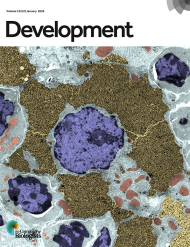
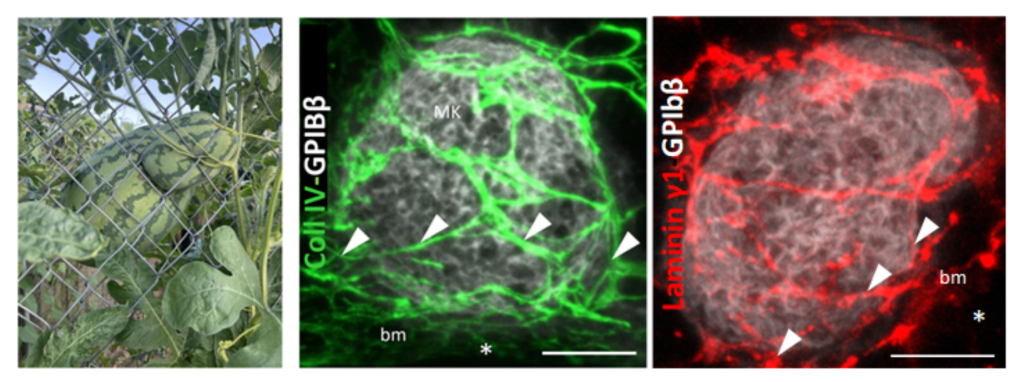
In February ‘25, Simon Cleary highlighted how megakaryocytes build three‑dimensional extracellular matrix cages to anchor themselves in the vascular niche. Simon also reflected on the journey of this preprint through peer review (at eLife) in a later ‘postLight’ that was added in December.
Read the preLight + postLight – “The megakaryocyte: trapped in a cage of its own making”: https://prelights.biologists.com/highlights/megakaryocyte_cages/
Immune responses in disease
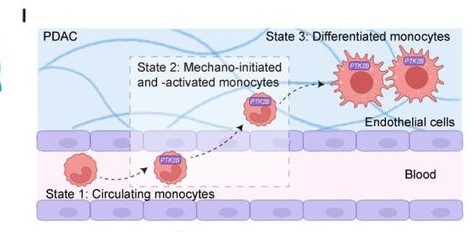
In spring last year, Roberto Amadio highlighted research showing that an immunomechanical checkpoint, PYK2, governs monocyte‑to‑macrophage differentiation in pancreatic cancer, revealing how subtle mechanical cues can shape immune responses in disease.
Check out Roberto’s preLight – “Macrophages sense and adapt. Immuno-mechanics meets cancer research”: https://prelights.biologists.com/highlights/an-immunomechanical-checkpoint-pyk2-governs-monocyte-to-macrophage-differentiation-in-pancreatic-cancer/
Light as a cellular switch
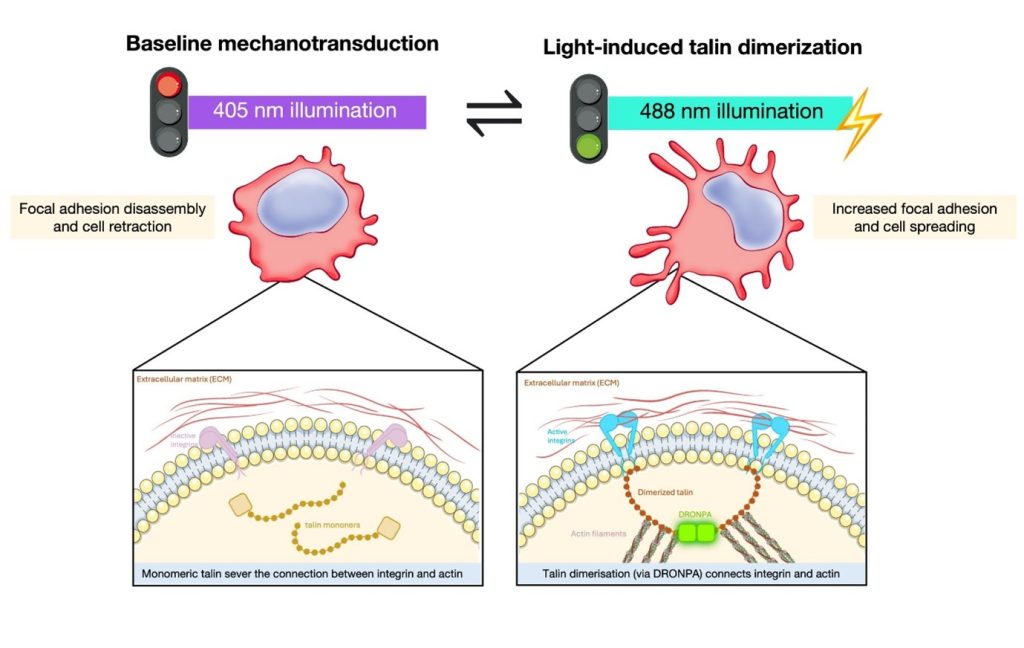
In summer, Barbora Knotkova and Sonhita Chakraborty together highlighted a preprint on the use of optogenetics to regulate mechanotransduction via light‑induced talin homodimerization – a striking example of how light can be used to steer cellular behaviour with great precision.
This preprint was not covered the traditional way (as in, a written preLight), but using a graphical abstract! These were the result of a workshop led by Sonhita (who created the visual below).
Find both graphical abstracts here – “Flip a switch, control cell adhesion”: https://prelights.biologists.com/highlights/optogenetic-control-of-mechanotransduction-based-on-light-induced-homodimerization-of-talin/
Expanding our view on the cytoskeleton
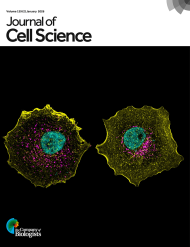
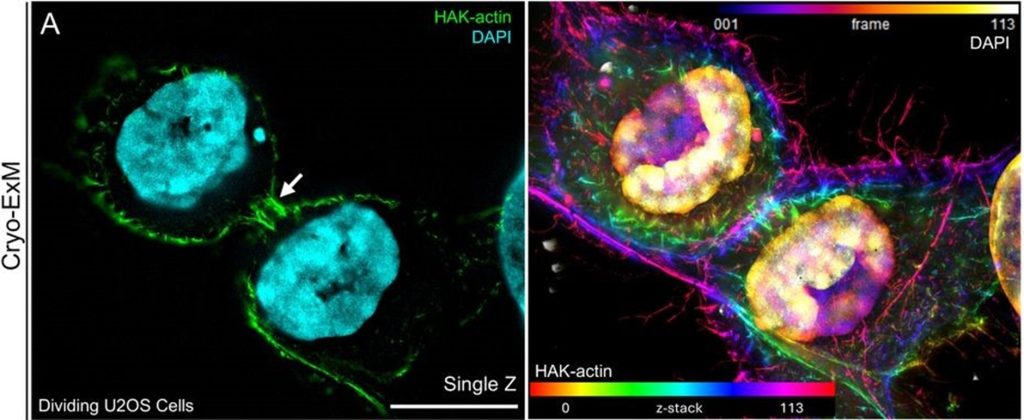
In the final months of the year, Kanishka Parashar spotted a study describing HAK‑actin, a probe compatible with expansion microscopy that enables unprecedented imaging of the actin cytoskeleton. Some beautiful figures were featured as part of this exciting work.
Kanishka’s preLight: https://prelights.biologists.com/highlights/hak-actin-u-exm-compatible-probe-to-image-the-actin-cytoskeleton/
Together, these preLights reflect the diversity and creativity of biological research in 2025 — from fundamental insights into cell biology to ingenious tools that expand the way we can study biological processes. We’re grateful to our preLighter community for their thoughtful highlights and to our readers for engaging with these discoveries. Here’s to another year of inspiring preprinted (and preLighted) science in 2026!