







Epigenome editing of human hematopoietic stem cells enables sustained and reversible thrombosis prevention
Posted on: 6 August 2026
Preprint posted on 29 March 2026
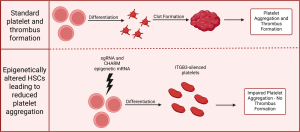
Can we epigenetically alter our way out of stroke risk? This new study suggests it might be possible: a one time RNA edit silences the the clotting protein ITGB3 in stem cells, and that silencing carries through to downstream platelets.
Selected by Beth Chopak
The Headline:
Blood clots cause 1 of every 4 deaths, every day. Risk is managed by daily blood thinning medication, but what if there was a way to genetically edit humans to reduce risk without needing this? Blood clots are caused by aggregations of platelets, which don’t carry their own DNA. This makes them incredibly tricky to genetically manipulate. In this proof-of-concept study, a team at Harvard Medical School cleverly work around this by epigenetically silencing a key aggregation gene in stem cells that precede the platelets; every downstream platelet inherits the change, and aggregation is massively reduced. This therefore has huge therapeutic potential in the prevention of blood clots, which cause approximately 40 million deaths every year.
The Background:
Thrombosis refers to the formation of a blood clot; this is facilitated by platelets, which aggregate to form a clot. This is a double-edged process: whilst this heals any tears and protects against internal blood loss, over-enthusiastic clot formation can result in heart disease and stroke.
Traditional preventative treatment primarily aims to limit platelet aggregation and includes common drugs such as aspirin. This approach requires patients to take medication daily for the rest of their lives, making it prone to human error and low patient compliance. Hence, this therapeutic system is an appealing target for the development of a more permanent solution.
The Genetic Background:
Haematopoietic stem cells (HSCs) reside within bone marrow; these cells differentiate into megakaryocytes, which differentiate into platelets, which then live for about ten days, and circulate round the body. Platelets do not contain their own genome: they instead just carry mRNA. This makes altering their protein content through traditional methods – such as CRISPR – incredibly difficult. One way to try and circumvent this is by altering the genome of the HSC that precedes platelets. HSCs do have classical genomes – so can be edited – and can undergo removal and transplantation. This makes them a tempting target for genetic manipulation.
CRISPR genome editing does, however, have its drawbacks. It physically alters the genome, and is permanent. In a therapeutic context, epigenomic alteration therefore is a more tempting prospect. This primarily involves the methylation of DNA, which makes DNA less accessible to transcription factors, and therefore ultimately reduces the amount of protein that can be transcribed from that DNA. It has been previously shown that methylation can persist through stem cell transplantation, and crucially, unlike CRISPR editing, is reversible through demethylation.
The primary aim of this paper was to try to epigenetically alter HSCs, in order to alter the function of their platelet progeny. The main protein analysed in this study was CD47, which is a protein involved in thrombus formation. As such, it is theorised that reducing the absolute levels of this protein would limit aggregation of platelets, and subsequent clot formation.
Main Findings:
Optimising conditions for epigenetic silencing
Rather than the gene itself, Ye and colleagues targeted the promotor of CD47 using a technique called CHARM – Coupled Histone tail for Autoinhibition Release Methyl-transferase – which essentially methylates DNA to reduce gene expression.
Flow cytometry was used to calculate estimated amounts of CD47 within cells. The authors monitored this over a period of days after editing. This analysis showed consistent and persistent reduction in CD47, and demonstrated that CHARM could be used as an efficient and robust epigenome silencing platform, which persisted through megakaryotic and erythroid differentiation. Additionally, this epigenome silencing of CD47 persisted through multiple cycles of HSC self-renewal, which would be vital in an in vivo context.
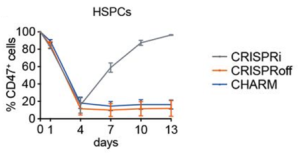
To ensure there were no unintentional off-target effects, whole genome and RNA sequencing were performed. Likely off-target victims were identified, but these were not repressed at the genetic level. Interestingly, the main identified transcriptional difference was in a gene called MYL4, which is the gene directly next to the targeted CD74. This is likely due to chromatin remodelling occurring due to target methylation, but is an interesting side effect none-the-less.
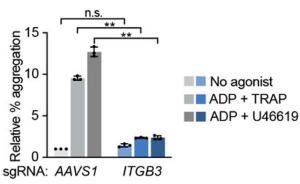
To demonstrate that this reduction in protein level reflected change at a functional level, aggregation was measured in platelets derived from edited HSCs, and was shown to be strikingly deficient in these, compared to controls. The crucial test was, of course, an in vivo model. The team xenotransplanted edited human HSPCs into mouse models, waited for 4 months for the grafted HSPCs to settle, and self-replicate, then harvested the bone marrow to analyse the genetic profile. Due to the murine nature of the model, human megakaryopoiesis was minimal, and therefore it was not possible to measure the in vivo functional effect on platelet production. To account for this, cells from long-term engrafted mice were harvested, and subjected to megakaryotic differentiation. These maintained their genetic suppression.
One part of the appeal of epigenetic modulation, rather than genomic editing, was its reversible nature depending on therapeutic need, and thus represented the next experimental hurdle. The team used demethylation to reverse the effects of CHARM, and neatly demonstrated that protein production could be returned to baseline within 8 days.
Why this preprint matters:
1 in 4 people worldwide die from blood clot-related causes. Preventative measures are therefore key to reducing mortality. In this study, this author team provides proof of concept that demonstrates that CHARM can be used as an effective platform for efficient genetic manipulation that remains stable upon transplantation and differentiation. And that – crucially – that this could be used on a functional level to reduce platelet aggregation. The potential this has for long-term risk reduction is astounding.
On a slightly broader scale, what makes this preprint so interesting is its unusual perspective on thrombosis prevention. Most anti-platelet therapies focus on inhibiting platelet function after platelets have been produced. In contrast, this study asks whether platelet behaviour can be reprogrammed at the level of hematopoietic stem cells, creating a durable and potentially reversible anti-thrombotic effect. Particularly striking is the combination of epigenome editing and platelet biology: these are two fields that are not often discussed together, and raise a fascinating question about how far we can go in engineering blood cell function, and whether future therapies might target disease long before pathological cells are even generated.
Future Questions:
- MYL4 upregulation is noted as an on-target side effect of local chromatin remodelling. Has any functional consequence of this been investigated, in platelets or megakaryocytes?
- The xenotransplantation model couldn’t produce enough human platelets for in vivo functional assessment. Are there alternative animal models being considered that would better support human megakaryopoiesis?
- CHARM efficiency varied between targets, around 90% for ITGB3 but only 60% for ANO6. What determines silencing efficiency, and is there a minimum threshold needed for meaningful clinical effect?
 (No Ratings Yet)