






Extreme cooling enables survival in extreme heat
Posted on: 24 August 2026
Preprint posted on 3 August 2026
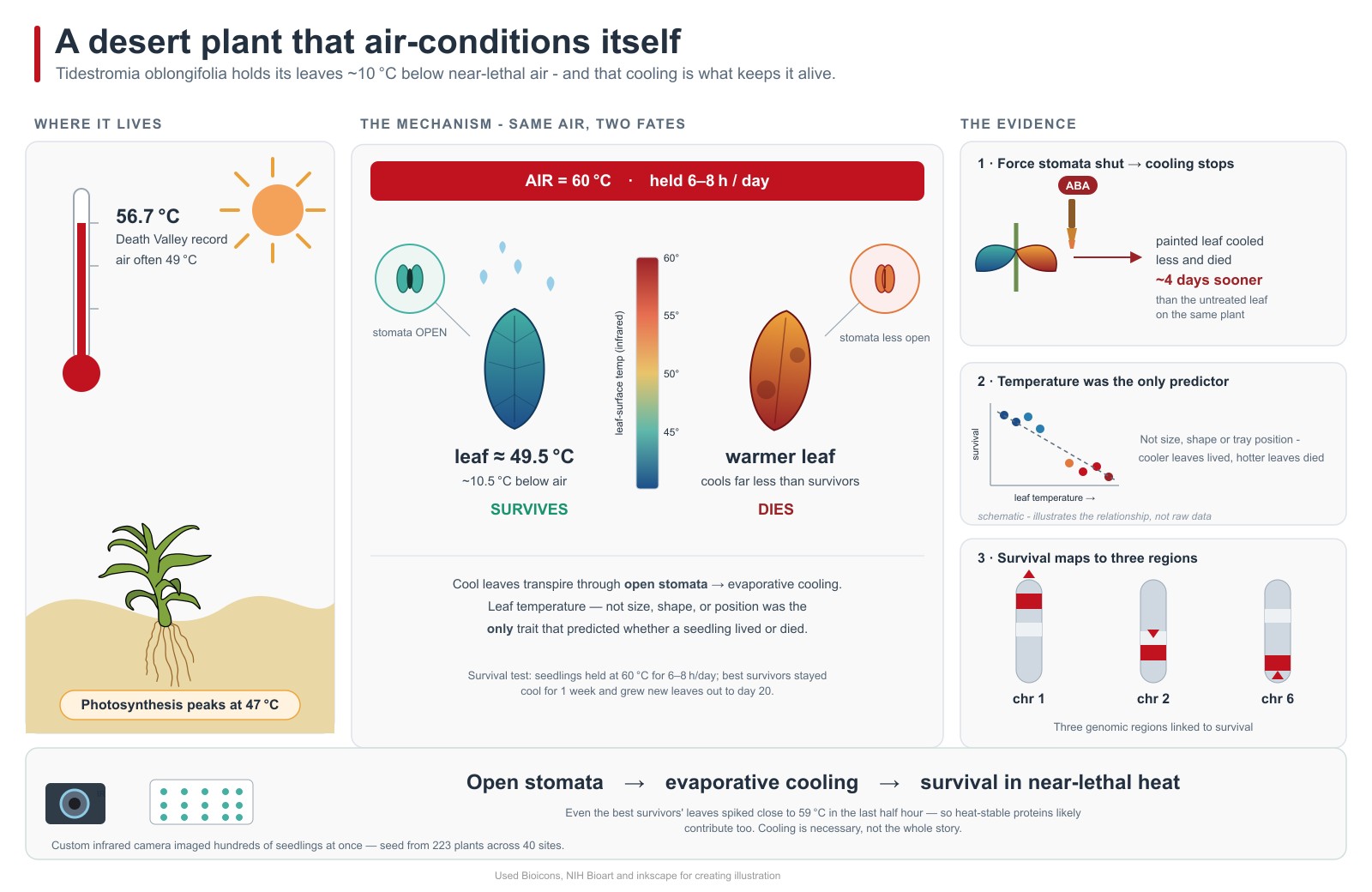
A desert plant that air-conditions itself. Tidestromia oblongifolia survives 60 °C air by cooling its own leaves about 10 °C below it, and this study by Feehan and co-authors shows that self-cooling is what keeps it alive.
Selected by Naveenkumar Muthiah
Categories: plant biology
A desert plant that air-conditions itself
Background
Most life that can take really extreme heat is simple life. The heat survivors are mostly bacteria and archaea that shrug off 100 °C. Eukaryotes reach their limit much lower, around 60 °C, and those that get close are almost all single-celled, mostly algae and fungi, plus one recently described amoeba (Rappaport et al., 2025). A few multicellular species do reach that range, but they need help. Pompeii worms do it at deep-sea vents, and a grass near Yellowstone’s geysers can do it only with a fungus and a virus. Nobody had really tested whether a multicellular plant could get there on its own, without a symbiotic partner.
Tidestromia oblongifolia is a good plant for addressing this question. It grows in Death Valley, where the air often exceeds 49 °C and once reached a world record of 56.7 °C, and it is known for photosynthesizing best at 47 °C (Björkman et al., 1972; Prado et al., 2025). But a simpler question had been skipped. When the air is that hot, does the leaf just heat up with it, or does the plant keep itself cooler than the surrounding air? Feehan and colleagues show that it cools, and that the cooling is what keeps it alive.
What they found
The study is unusual because it works at so many levels for a wild plant. The authors collected seed from 223 plants at 40 sites, checked decades of climate data to confirm that those sites really differ in heat, and then put seedlings through a survival test that holds the air at 60 °C for six to eight hours a day. Some seedlings lasted more than a week. A few stayed healthy and even grew new leaves out to 20 days.
Whether a plant survived depended partly on its genes. The authors scored each plant by how long it lasted, in a way that still counted plants that never died, and then looked for genetic differences behind that. Three loci stood out, on chromosomes 1, 2, and 6. What sits behind these loci is not yet pinned down, though the authors highlight 20 genes there that also respond to heat as their top candidates for follow-up.
The answer to how survivors lived came from watching the leaves. A custom infrared camera setup filmed hundreds of seedlings at once, and the survivors stayed cooler than the plants that died. When the authors tested which trait predicted death, leaf temperature was the only one that mattered, not leaf size, shape, or where the plant sat in the tray. Even on day 8 at 60 °C, the best survivors got about 10.5 °C below the air, though in the last half hour, some leaves still climbed close to 59 °C, right at the edge of what any eukaryote can tolerate.
The gene activity matched the temperatures. Comparing the hottest and coolest leaves at 55.5 °C, genes for photorespiration, which switch on when stomata close, were higher in the hot leaves, while genes that help open stomata were higher in the cool ones. Then the authors tested the cause directly. They painted some leaves with abscisic acid to force the stomata shut, which stopped the cooling, and those leaves died about four days sooner than an untreated leaf on the same plant. So the cooling causes survival; it is not just a side effect.
Why I picked it
I like how much the paper does at once. It goes from wild population genetics to whole-plant physiology to a clean cause-and-effect test, all in a plant that really lives in the heat rather than an easy lab model. It would have been easy to stop at “survivors cool more,” but the abscisic acid experiment shows that the cooling actually matters. I also like that the authors don’t overclaim. Leaves sitting at 59 °C clearly are not surviving solely on cooling, so the plant must have heat-stable proteins as well, and the authors say so. It is a nice reminder that simple leaf physics still explains a lot when paired with modern genetics.
Questions for the authors
• The survivors were still about 10 °C below the air on day 8 and growing new leaves out to 20 days, so how far can this go? I’m curious whether the deep cooling lasts as long as water and humidity allow, and how steady it is from one run to the next.
• Do the three genetic spots look more like stomata control, or more like heat-stable proteins and membranes? I’d like to know if the genes sitting at those spots already point you toward an answer.
• You suggest the survivors are paying a cost that the others can’t. Do you have a sense of what that cost is, maybe water use, or something traded off against growth or seeds, and whether that is what keeps the range of cooling in the population?
• Survival didn’t line up with where the plants were collected, which surprised me. Do the individual cooling genes still track local temperature at all? Is there any sign of them shifting as you get closer to Death Valley?
References:
1. Björkman O, Pearcy RW, Harrison AT, Mooney H. Photosynthetic adaptation to high temperatures: a field study in Death Valley, California. Science. 1972 Feb 18;175(4023):786-9.
2. Prado K, Xue B, Johnson JE, Field S, Stata M, Hawkins CL, Hsia RC, Liu H, Cheng S, Rhee SY. Photosynthetic acclimation is a key contributor to exponential growth of a desert plant in Death Valley summer. Current Biology. 2025 Nov 17;35(22):5502-20.
3. Rappaport HB, Petek-Seoane NA, Tyml T, Mikus F, LaButti K, Ani G, Niblo JK, MacVicar E, Shepherd RM, de la Higuera I, Lord SJ. A geothermal amoeba sets a new upper temperature limit for eukaryotes. bioRxiv. 2025 Nov 24. (preprint)
Sign up to customise the site to your preferences and to receive alerts
Register hereAlso in the plant biology category:
Structure of chlorophyll synthase in complex with the LHC-like protein HliD
Orestis Savva

A drought stress-induced MYB transcription factor regulates pavement cell shape in leaves of European aspen (Populus tremula)
Jeny Jose
Actin Counters Geometry to Guide Plant Cell Division
Jeny Jose

preLists in the plant biology category:
SciELO preprints – From 2025 onwards
SciELO has become a cornerstone of open, multilingual scholarly communication across Latin America. Its preprint server, SciELO preprints, is expanding the global reach of preprinted research from the region (for more information, see our interview with Carolina Tanigushi). This preList brings together biological, English language SciELO preprints to help readers discover emerging work from the Global South. By highlighting these preprints in one place, we aim to support visibility, encourage early feedback, and showcase the vibrant research communities contributing to SciELO’s open science ecosystem.
| List by | Carolina Tanigushi |
‘In preprints’ from Development 2022-2023
A list of the preprints featured in Development's 'In preprints' articles between 2022-2023
| List by | Alex Eve, Katherine Brown |
The Society for Developmental Biology 82nd Annual Meeting
This preList is made up of the preprints discussed during the Society for Developmental Biology 82nd Annual Meeting that took place in Chicago in July 2023.
| List by | Joyce Yu, Katherine Brown |
CSHL 87th Symposium: Stem Cells
Preprints mentioned by speakers at the #CSHLsymp23
| List by | Alex Eve |
SDB 78th Annual Meeting 2019
A curation of the preprints presented at the SDB meeting in Boston, July 26-30 2019. The preList will be updated throughout the duration of the meeting.
| List by | Alex Eve |