






Structure of chlorophyll synthase in complex with the LHC-like protein HliD
Posted on: 4 August 2026 , updated on: 13 August 2026
Preprint posted on 15 May 2026

Categories: biochemistry, plant biology
Summary
Chlorophyll keeps the world breathing – ever wondered how it is made?
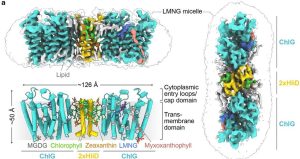
Figure 1. Cryo-em structure of the apo ChlG2HliD2 complex. The apo cryo-EM structure of the ChlG (Chlorophyll a synthase) and HliD (high-light-inducible protein D) complex (top) with the cytoplasmic view on the right. The cartoon representation (bottom) indicates the different binding ligands that were identified. This preprint figure is made available under a CC-BY 4.0 International license.
Background
Chlorophyll a (Chl) absorbs sunlight and allows plants, algae and cyanobacteria to breathe by driving forward the process of photosynthesis. The production of chlorophyll a is a complex multi-step process involving various metal co-factors, substrates and enzymes including Chl synthase (ChlG).
ChlG is an enzyme found in cyanobacteria, which is essential for their survival. It’s an intrinsic membrane protein and has been purified as a complex with two other enzymes: the high-light-inducible proteins (Hlips), HliC and HliD. Hlips are also membrane proteins that can form dimeric structures and likely bind four Chl monomers per dimer.
It was previously shown that under low-stress conditions in the cyanobacterium Synechocystis, the ChlG and Hlip proteins are found to form a hetero-tetrameric complex, comprised of two ChlG monomers that are bound to a HliD dimer forming the complex ChlG-HliD2-ChlG or G-D2-G for short. In this preprint the authors used cryo-EM and molecular simulations to explore the structure of G-D2-G in complex with its substrates.
Key Findings
Structural comparisons of apo and bound complexes
The structure of the Synechocystis G-D2-G complex was solved by the authors using single particle cryo-EM. The solved structure showed two ChlG monomers at either end linked by two HliD monomers situated at the centre of the structure, with each half being almost identical to the other. The active sites of this complex are formed by the transmembrane helices of the two ChlG monomers which are gated by a cap domain.
The authors compared the apo- and substrate-GGPP structures but comparison between the two did not reveal any significant structural differences. Closer inspection of the GGPP binding site helped to identify multiple charged residues found at the cap domain, that form electrostatic interactions with the pyrophosphate (also charged) groups of GGPP, some of which are known to be conserved across enzymes with similar activities. In addition, the hydrophobic tail of GGPP was found to be located deep inside a cavity of ChlG where it interacts with various hydrophobic residues. One difference observed between the apo- and GGPP-bound structures was at the cap domain and suggested that this part of the complex is flexible and provides an entrance for GGPP to enter the active site.
Utilising Alpha Fold to explore binding of chlorophyllide a
The authors were unable to obtain a structure with the other substrate of the enzyme chlorophyllide a (Chlide). Therefore, they utilized AlphaFold 3 to obtain a structure of ChlG bound to Chlide, GGPP and Mg2+ ions. The resulting structure corroborated the cryo-EM results in terms of binding of GGPP and showed how Mg2+ ions could act as intermediaries to support interactions of GGPP with the conserved residues and activate the substrate, but also with potentially unexplored ones. To test the importance of these residues the authors screened point mutations for 16 residues thought to be essential for either catalysis or substrate binding and their effect on chlorophyll production was analysed. The model also placed Chlide in close proximity to GGPP where a chemical reaction could occur.
Molecular dynamics to uncover interactions with binding partners
The solved structure showed that the HliD homodimer forms an X-shape that links the two ChlG monomers, and further pigment-protein interactions from molecules coordinated by the HliD dimer. The authors performed molecular dynamics simulations to show how different molecules bound to the complex form interactions with residues of either HliD or ChlG in some cases interacting with conserved regions.
Importance of the work
The work aims to uncover and understand the mechanism by which Chlorophyll a is produced and looks into the role of each component in this complex process. This work adds to our fundamental understanding of the world around us and how energy is harnessed by organisms for their survival. The work conducted by the authors is exceptional, very detailed and an excellent example of how biochemistry and computational modelling allow us to understand the chemical processes within biological bodies.
doi: https://doi.org/10.1242/prelights.44296
Read preprintSign up to customise the site to your preferences and to receive alerts
Register hereAlso in the biochemistry category:
Fast single molecule localization microscopy in 3D
Kanishka Parashar

Organoids reveal niche-specific mechanotransduction-guided human cortical patterning and cell fate acquisition.
Kanishka Parashar
Neuronal calcium sensors emerge as novel adenylyl cyclase 8 regulators
Jawdat Sandakly

Also in the plant biology category:
Brassinosteroid receptors reveal conserved features of exon-embedded gene regulation
Karima El Mahboubi

A single genetic innovation at the origin of plant terrestrialization
Naveenkumar Muthiah
Extreme cooling enables survival in extreme heat
Naveenkumar Muthiah
preLists in the biochemistry category:
‘In preprints’ from Development 2026
A list of the preprints featured in Development's 'In preprints' articles, as part of the new Preprint Editors initiative
| List by | Clarisse Brunet Avalos et al. |
Keystone Symposium on Stem Cell Models in Embryology 2026
The Keystone Symposium on Stem Cell Models in Embryology, 2026, was organised by Jun Wu (UT Southwestern), Jianping Fu (University of Michigan) and Miki Ebisuya (TU Dresden) and held at Asilomar Conference Grounds in California (US). The meeting discussed recent advances made in establishing stem-cell-based embryo models, what fundamental insights into developmental processes have been gleaned from them, as well as how they are beginning to be applied more widely. This prelist contains preprints by presenters at the talk and poster sessions at the conference, which our Reviews Editor in attendance spotted. Please do reach out to preLights@biologists.com if you notice any that we’ve missed.
| List by | Ingrid Tsang |
September in preprints – Cell biology edition
A group of preLighters, with expertise in different areas of cell biology, have worked together to create this preprint reading list. This month, categories include: (1) Cell organelles and organisation, (2) Cell signalling and mechanosensing, (3) Cell metabolism, (4) Cell cycle and division, (5) Cell migration
| List by | Sristilekha Nath et al. |
July in preprints – the CellBio edition
A group of preLighters, with expertise in different areas of cell biology, have worked together to create this preprint reading lists for researchers with an interest in cell biology. This month, categories include: (1) Cell Signalling and Mechanosensing (2) Cell Cycle and Division (3) Cell Migration and Cytoskeleton (4) Cancer Biology (5) Cell Organelles and Organisation
| List by | Girish Kale et al. |
June in preprints – the CellBio edition
A group of preLighters, with expertise in different areas of cell biology, have worked together to create this preprint reading lists for researchers with an interest in cell biology. This month, categories include: (1) Cell organelles and organisation (2) Cell signaling and mechanosensation (3) Genetics/gene expression (4) Biochemistry (5) Cytoskeleton
| List by | Barbora Knotkova et al. |
May in preprints – the CellBio edition
A group of preLighters, with expertise in different areas of cell biology, have worked together to create this preprint reading lists for researchers with an interest in cell biology. This month, categories include: 1) Biochemistry/metabolism 2) Cancer cell Biology 3) Cell adhesion, migration and cytoskeleton 4) Cell organelles and organisation 5) Cell signalling and 6) Genetics
| List by | Barbora Knotkova et al. |
Keystone Symposium – Metabolic and Nutritional Control of Development and Cell Fate
This preList contains preprints discussed during the Metabolic and Nutritional Control of Development and Cell Fate Keystone Symposia. This conference was organized by Lydia Finley and Ralph J. DeBerardinis and held in the Wylie Center and Tupper Manor at Endicott College, Beverly, MA, United States from May 7th to 9th 2025. This meeting marked the first in-person gathering of leading researchers exploring how metabolism influences development, including processes like cell fate, tissue patterning, and organ function, through nutrient availability and metabolic regulation. By integrating modern metabolic tools with genetic and epidemiological insights across model organisms, this event highlighted key mechanisms and identified open questions to advance the emerging field of developmental metabolism.
| List by | Virginia Savy, Martin Estermann |
April in preprints – the CellBio edition
A group of preLighters, with expertise in different areas of cell biology, have worked together to create this preprint reading lists for researchers with an interest in cell biology. This month, categories include: 1) biochemistry/metabolism 2) cell cycle and division 3) cell organelles and organisation 4) cell signalling and mechanosensing 5) (epi)genetics
| List by | Vibha SINGH et al. |
Biologists @ 100 conference preList
This preList aims to capture all preprints being discussed at the Biologists @100 conference in Liverpool, UK, either as part of the poster sessions or the (flash/short/full-length) talks.
| List by | Reinier Prosee, Jonathan Townson |
February in preprints – the CellBio edition
A group of preLighters, with expertise in different areas of cell biology, have worked together to create this preprint reading lists for researchers with an interest in cell biology. This month, categories include: 1) biochemistry and cell metabolism 2) cell organelles and organisation 3) cell signalling, migration and mechanosensing
| List by | Barbora Knotkova et al. |
Community-driven preList – Immunology
In this community-driven preList, a group of preLighters, with expertise in different areas of immunology have worked together to create this preprint reading list.
| List by | Felipe Del Valle Batalla et al. |
January in preprints – the CellBio edition
A group of preLighters, with expertise in different areas of cell biology, have worked together to create this preprint reading lists for researchers with an interest in cell biology. This month, categories include: 1) biochemistry/metabolism 2) cell migration 3) cell organelles and organisation 4) cell signalling and mechanosensing 5) genetics/gene expression
| List by | Barbora Knotkova et al. |
BSCB-Biochemical Society 2024 Cell Migration meeting
This preList features preprints that were discussed and presented during the BSCB-Biochemical Society 2024 Cell Migration meeting in Birmingham, UK in April 2024. Kindly put together by Sara Morais da Silva, Reviews Editor at Journal of Cell Science.
| List by | Reinier Prosee |
Peer Review in Biomedical Sciences
Communication of scientific knowledge has changed dramatically in recent decades and the public perception of scientific discoveries depends on the peer review process of articles published in scientific journals. Preprints are key vehicles for the dissemination of scientific discoveries, but they are still not properly recognized by the scientific community since peer review is very limited. On the other hand, peer review is very heterogeneous and a fundamental aspect to improve it is to train young scientists on how to think critically and how to evaluate scientific knowledge in a professional way. Thus, this course aims to: i) train students on how to perform peer review of scientific manuscripts in a professional manner; ii) develop students' critical thinking; iii) contribute to the appreciation of preprints as important vehicles for the dissemination of scientific knowledge without restrictions; iv) contribute to the development of students' curricula, as their opinions will be published and indexed on the preLights platform. The evaluations will be based on qualitative analyses of the oral presentations of preprints in the field of biomedical sciences deposited in the bioRxiv server, of the critical reports written by the students, as well as of the participation of the students during the preprints discussions.
| List by | Marcus Oliveira et al. |
CellBio 2022 – An ASCB/EMBO Meeting
This preLists features preprints that were discussed and presented during the CellBio 2022 meeting in Washington, DC in December 2022.
| List by | Nadja Hümpfer et al. |
20th “Genetics Workshops in Hungary”, Szeged (25th, September)
In this annual conference, Hungarian geneticists, biochemists and biotechnologists presented their works. Link: http://group.szbk.u-szeged.hu/minikonf/archive/prg2021.pdf
| List by | Nándor Lipták |
Fibroblasts
The advances in fibroblast biology preList explores the recent discoveries and preprints of the fibroblast world. Get ready to immerse yourself with this list created for fibroblasts aficionados and lovers, and beyond. Here, my goal is to include preprints of fibroblast biology, heterogeneity, fate, extracellular matrix, behavior, topography, single-cell atlases, spatial transcriptomics, and their matrix!
| List by | Osvaldo Contreras |
ASCB EMBO Annual Meeting 2019
A collection of preprints presented at the 2019 ASCB EMBO Meeting in Washington, DC (December 7-11)
| List by | Madhuja Samaddar et al. |
EMBL Seeing is Believing – Imaging the Molecular Processes of Life
Preprints discussed at the 2019 edition of Seeing is Believing, at EMBL Heidelberg from the 9th-12th October 2019
| List by | Dey Lab |
Cellular metabolism
A curated list of preprints related to cellular metabolism at Biorxiv by Pablo Ranea Robles from the Prelights community. Special interest on lipid metabolism, peroxisomes and mitochondria.
| List by | Pablo Ranea Robles |
MitoList
This list of preprints is focused on work expanding our knowledge on mitochondria in any organism, tissue or cell type, from the normal biology to the pathology.
| List by | Sandra Franco Iborra |
Also in the plant biology category:
‘In preprints’ from Development 2026
A list of the preprints featured in Development's 'In preprints' articles, as part of the new Preprint Editors initiative
| List by | Clarisse Brunet Avalos et al. |
Sainsbury Laboratory Symposium 2026
The Sainsbury Laboratory Symposium 2026, Shaping Life: Mechanisms of Morphogenesis, brought together researchers exploring the cellular, genetic and mechanical processes that shape plant form. This preList highlights preprints that were discussed or mentioned at the meeting. If you notice any missing preprints, please contact us at preLights@biologists.com
| List by | Ingrid Tsang |
SciELO preprints – From 2025 onwards
SciELO has become a cornerstone of open, multilingual scholarly communication across Latin America. Its preprint server, SciELO preprints, is expanding the global reach of preprinted research from the region (for more information, see our interview with Carolina Tanigushi). This preList brings together biological, English language SciELO preprints to help readers discover emerging work from the Global South. By highlighting these preprints in one place, we aim to support visibility, encourage early feedback, and showcase the vibrant research communities contributing to SciELO’s open science ecosystem.
| List by | Carolina Tanigushi |
‘In preprints’ from Development 2022-2023
A list of the preprints featured in Development's 'In preprints' articles between 2022-2023
| List by | Alex Eve, Katherine Brown |
The Society for Developmental Biology 82nd Annual Meeting
This preList is made up of the preprints discussed during the Society for Developmental Biology 82nd Annual Meeting that took place in Chicago in July 2023.
| List by | Joyce Yu, Katherine Brown |
CSHL 87th Symposium: Stem Cells
Preprints mentioned by speakers at the #CSHLsymp23
| List by | Alex Eve |
SDB 78th Annual Meeting 2019
A curation of the preprints presented at the SDB meeting in Boston, July 26-30 2019. The preList will be updated throughout the duration of the meeting.
| List by | Alex Eve |