






A single genetic innovation at the origin of plant terrestrialization
Posted on: 29 September 2026
Preprint posted on 17 August 2026
A land-plant-specific p-GPAT family links cuticle formation and arbuscular mycorrhizal symbiosis, suggesting that one biochemical innovation may have helped early plants adapt to life on land.
Selected by Naveenkumar Muthiah
Categories: evolutionary biology, plant biology
Did one gene family help plants colonise land?
Moving from freshwater to land exposed early plants to dehydration, stronger ultraviolet radiation, and nutrient-poor substrates. Two traits associated with overcoming these challenges, the cuticle and arbuscular mycorrhizal (AM) symbiosis, are thought to have been present early in land-plant evolution. The cuticle is a hydrophobic barrier on aerial surfaces that limits water loss and protects against environmental stress. AM fungi extend the plant’s reach for water and mineral nutrients.
Despite their very different functions, both systems involve the movement of lipids out of plant cells. Cutin precursors must be exported to the epidermal surface to build the cuticle, and AM fungi rely on host-derived fatty acids because they have only a limited capacity for de novo fatty-acid synthesis (Wewer et al., 2014; Rich et al., 2021).
A particular class of glycerol-3-phosphate acyltransferases may be the connecting link between the two. In angiosperms, the land-plant-specific phosphatase-domain-containing GPATs (p-GPATs) acylate glycerol-3-phosphate at the sn-2 position and then dephosphorylate the product to give 2-monoacylglycerol (2-MAG). Several Arabidopsis p-GPATs contribute to cutin production, and Medicago truncatula RAM2 is required for normal arbuscule development. p-GPATs also take part in cuticle formation in the moss Physcomitrium patens. What remained unclear was whether the family was already doing both jobs in the earliest land plants. Answering this could reveal whether a single biochemical innovation contributed to multiple adaptations associated with the transition to life on land.
What they found
The authors began by tracing the evolution of p-GPAT across 438 Viridiplantae genomes. The signature pairing of acyltransferase and phosphatase domains was absent from the sampled algal genomes but present across land plants, consistent with a p-GPAT family that arose around the origin of terrestrial plants. Activity assays then showed that bryophyte p-GPATs retain the biochemical activities typical of the family. To test the link genetically, they turned to Marchantia paleacea. The single ram2b and ram2c mutants looked fairly similar to the wild type. The double mutant did not. Its thalli were severely abnormal, stunted, and largely unbranched, with no normal air pores and a strongly reduced cuticle, where cutin monomers were reduced by roughly 60–93%. Expressing MpaRAM2C from either its native promoter or the epidermis-specific SBG promoter rescued the double mutant.
The key experiment came next, when the authors examined AM symbiosis in these complemented plants. The native promoter allows RAM2C to function in both epidermal cells and arbuscule-containing cells, and it restored normally branched arbuscules. Epidermis-restricted expression brought back the cuticle but largely failed to restore arbuscule development. So the same p-GPAT family is required in two distinct cellular contexts, in epidermal cells for cutin formation and in fungus-colonised cells for arbuscule development.
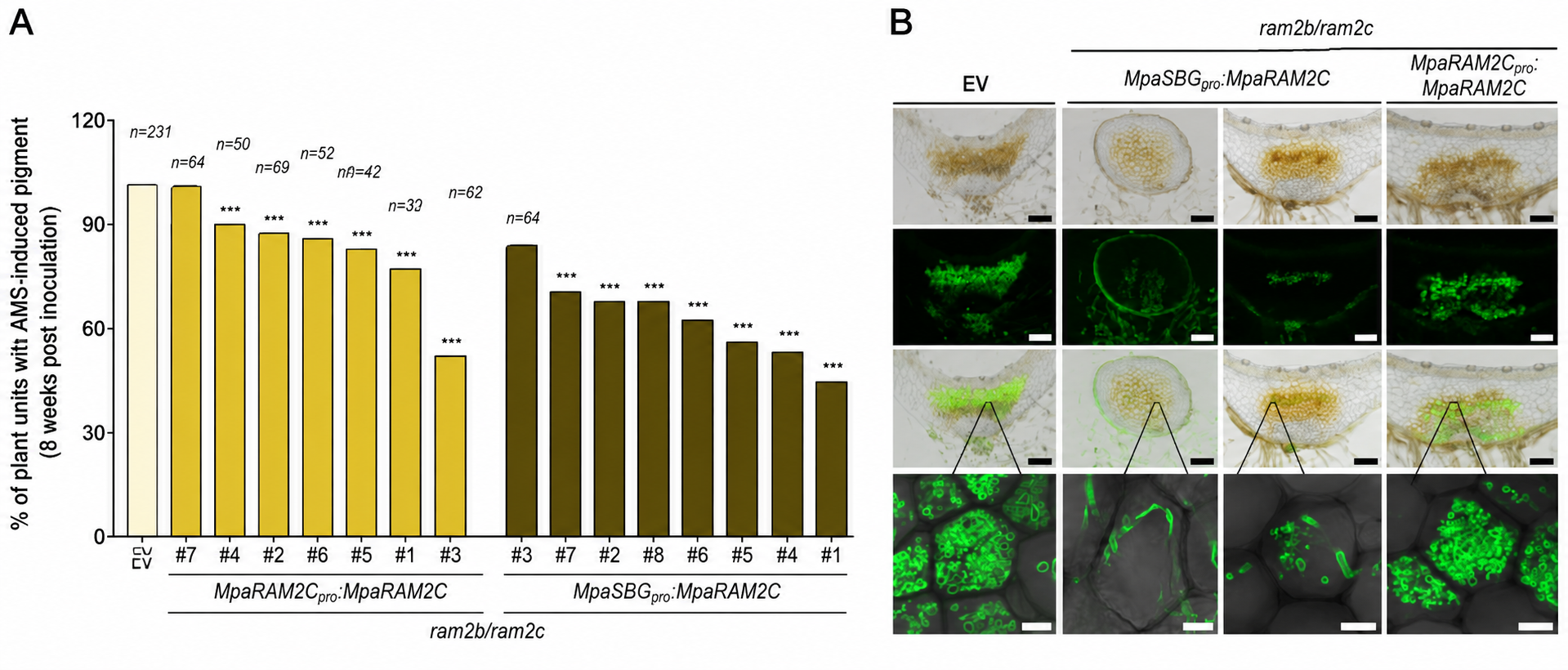
The authors read this as support for the idea that p-GPATs provided plants with a biochemical means to shift lipids from intracellular metabolism to extracellular functions. That innovation, they suggest, may have opened a fairly simple route to two traits that mattered during terrestrialization.
Why I chose this preprint
I picked this work because it connects two aspects of terrestrialization that usually get discussed separately, protection from water loss and cooperation with AM fungi. It also goes beyond merely noting that p-GPATs appear in both pathways. Working with a liverwort, the authors show that a single enzyme family is required across different cell types for two distinct functions.
The promoter-restricted complementation is the most informative part. Restoring p-GPAT activity in the epidermis rescues the cuticle without restoring normal arbuscules, which is evidence that the symbiotic defect is not simply a secondary consequence of a damaged cuticle.
I would still be careful about reading the shared p-GPAT lineage as evidence that the cuticle and AM symbiosis are homologous traits. What the experiments most directly establish is a shared enzymatic requirement operating in two cellular contexts. The evolutionary sequence the authors propose remains a model rather than something directly observed: whether cuticle-associated lipid export came first, whether symbiotic lipid transfer was recruited afterward, and how the two functions came together in the ancestral land plant. That leaves a bigger question, and it’s the one I find most compelling. Did the origin of a new biochemical capability constrain or channel the evolution of several terrestrial adaptations?
Questions for the authors
• MpaRAM2C complements the Medicago truncatula ram2 phenotype, but MpaRAM2B does not, even though both paralogs contribute to cutin-related functions in M. paleacea. Would expressing MpaRAM2B under the MpaRAM2C promoter help distinguish differences in protein activity from differences in spatial or temporal expression?
• Could isotope labelling of host-derived lipids, combined with lipid profiling of Rhizophagus irregularis, show whether 2-MAG itself is transferred to the fungus or is first converted into another lipid species?
References
• Lee, S. B., Yang, S. U., Pandey, G., Kim, M. S., Hyoung, S., Choi, D., … & Suh, M. C. (2020). Occurrence of land‐plant‐specific glycerol‐3‐phosphate acyltransferases is essential for cuticle formation and gametophore development in Physcomitrella patens. New Phytologist, 225(6), 2468-2483.
• Rich, M. K., Vigneron, N., Libourel, C., Keller, J., Xue, L., Hajheidari, M., … & Delaux, P. M. (2021). Lipid exchanges drove the evolution of mutualism during plant terrestrialization. Science, 372(6544), 864-868.
• Wang, E., Schornack, S., Marsh, J. F., Gobbato, E., Schwessinger, B., Eastmond, P., … & Oldroyd, G. E. (2012). A common signaling process that promotes mycorrhizal and oomycete colonization of plants. Current Biology, 22(23), 2242-2246.
• Wewer, V., Brands, M., & Dörmann, P. (2014). Fatty acid synthesis and lipid metabolism in the obligate biotrophic fungus R hizophagus Irregularis during mycorrhization of L otus japonicus. The Plant Journal, 79(3), 398-412.
• Yang, W., Pollard, M., Li-Beisson, Y., Beisson, F., Feig, M., & Ohlrogge, J. (2010). A distinct type of glycerol-3-phosphate acyltransferase with sn-2 preference and phosphatase activity producing 2-monoacylglycerol. Proceedings of the National Academy of Sciences, 107(26), 12040-12045.
Image credit
Reproduced from Mbadinga Zamar et al. (2026), bioRxiv, https://doi.org/10.64898/2026.08.14.744897, under a CC BY 4.0 licence (https://creativecommons.org/licenses/by/4.0/). No changes were made.
doi: https://doi.org/10.1242/prelights.44983
Read preprintSign up to customise the site to your preferences and to receive alerts
Register hereAlso in the evolutionary biology category:
Modes of natural selection on maternal and zygotic gene expression in Drosophila melanogaster embryos
Girish Kale, preLights peer support

Microtubules sustain the fidelity of cellularization in a coenocytic relative of animals
Girish Kale, preLights peer support

Diversity and Spatial Segregation of TRP Channels in Choanoflagellates Provide Insight into the Evolutionary Origin of Animal Sensory Systems
Urvashi Goswami
Also in the plant biology category:
Brassinosteroid receptors reveal conserved features of exon-embedded gene regulation
Karima El Mahboubi

A single genetic innovation at the origin of plant terrestrialization
Naveenkumar Muthiah
Extreme cooling enables survival in extreme heat
Naveenkumar Muthiah
preLists in the evolutionary biology category:
‘In preprints’ from Development 2026
A list of the preprints featured in Development's 'In preprints' articles, as part of the new Preprint Editors initiative
| List by | Clarisse Brunet Avalos et al. |
Santa Cruz Developmental Biology Meeting 2026
This preList brings together a selection of preprints discussed at the Santa Cruz Developmental Biology Meeting 2026, held at UC Santa Cruz with the theme “Biomedicine, Biomechanics, and the Biosphere.” Reflecting the meeting’s broad scientific scope, from development and regeneration to evolution, tissue mechanics, and emerging technologies, this curated collection showcases work that contributed to conversations throughout the meeting.
| List by | Ingrid Tsang |
SciELO preprints – From 2025 onwards
SciELO has become a cornerstone of open, multilingual scholarly communication across Latin America. Its preprint server, SciELO preprints, is expanding the global reach of preprinted research from the region (for more information, see our interview with Carolina Tanigushi). This preList brings together biological, English language SciELO preprints to help readers discover emerging work from the Global South. By highlighting these preprints in one place, we aim to support visibility, encourage early feedback, and showcase the vibrant research communities contributing to SciELO’s open science ecosystem.
| List by | Carolina Tanigushi |
November in preprints – DevBio & Stem cell biology
preLighters with expertise across developmental and stem cell biology have nominated a few developmental and stem cell biology (and related) preprints posted in November they’re excited about and explain in a single paragraph why. Concise preprint highlights, prepared by the preLighter community – a quick way to spot upcoming trends, new methods and fresh ideas.
| List by | Aline Grata et al. |
October in preprints – DevBio & Stem cell biology
Each month, preLighters with expertise across developmental and stem cell biology nominate a few recent developmental and stem cell biology (and related) preprints they’re excited about and explain in a single paragraph why. Short, snappy picks from working scientists — a quick way to spot fresh ideas, bold methods and papers worth reading in full. These preprints can all be found in the October preprint list published on the Node.
| List by | Deevitha Balasubramanian et al. |
October in preprints – Cell biology edition
Different preLighters, with expertise across cell biology, have worked together to create this preprint reading list for researchers with an interest in cell biology. This month, most picks fall under (1) Cell organelles and organisation, followed by (2) Mechanosignaling and mechanotransduction, (3) Cell cycle and division and (4) Cell migration
| List by | Matthew Davies et al. |
Biologists @ 100 conference preList
This preList aims to capture all preprints being discussed at the Biologists @100 conference in Liverpool, UK, either as part of the poster sessions or the (flash/short/full-length) talks.
| List by | Reinier Prosee, Jonathan Townson |
‘In preprints’ from Development 2022-2023
A list of the preprints featured in Development's 'In preprints' articles between 2022-2023
| List by | Alex Eve, Katherine Brown |
preLights peer support – preprints of interest
This is a preprint repository to organise the preprints and preLights covered through the 'preLights peer support' initiative.
| List by | preLights peer support |
EMBO | EMBL Symposium: The organism and its environment
This preList contains preprints discussed during the 'EMBO | EMBL Symposium: The organism and its environment', organised at EMBL Heidelberg, Germany (May 2023).
| List by | Girish Kale |
9th International Symposium on the Biology of Vertebrate Sex Determination
This preList contains preprints discussed during the 9th International Symposium on the Biology of Vertebrate Sex Determination. This conference was held in Kona, Hawaii from April 17th to 21st 2023.
| List by | Martin Estermann |
EMBL Synthetic Morphogenesis: From Gene Circuits to Tissue Architecture (2021)
A list of preprints mentioned at the #EESmorphoG virtual meeting in 2021.
| List by | Alex Eve |
Planar Cell Polarity – PCP
This preList contains preprints about the latest findings on Planar Cell Polarity (PCP) in various model organisms at the molecular, cellular and tissue levels.
| List by | Ana Dorrego-Rivas |
TAGC 2020
Preprints recently presented at the virtual Allied Genetics Conference, April 22-26, 2020. #TAGC20
| List by | Maiko Kitaoka et al. |
ECFG15 – Fungal biology
Preprints presented at 15th European Conference on Fungal Genetics 17-20 February 2020 Rome
| List by | Hiral Shah |
COVID-19 / SARS-CoV-2 preprints
List of important preprints dealing with the ongoing coronavirus outbreak. See http://covidpreprints.com for additional resources and timeline, and https://connect.biorxiv.org/relate/content/181 for full list of bioRxiv and medRxiv preprints on this topic
| List by | Dey Lab, Zhang-He Goh |
1
SDB 78th Annual Meeting 2019
A curation of the preprints presented at the SDB meeting in Boston, July 26-30 2019. The preList will be updated throughout the duration of the meeting.
| List by | Alex Eve |
Pattern formation during development
The aim of this preList is to integrate results about the mechanisms that govern patterning during development, from genes implicated in the processes to theoritical models of pattern formation in nature.
| List by | Alexa Sadier |
Also in the plant biology category:
‘In preprints’ from Development 2026
A list of the preprints featured in Development's 'In preprints' articles, as part of the new Preprint Editors initiative
| List by | Clarisse Brunet Avalos et al. |
Sainsbury Laboratory Symposium 2026
The Sainsbury Laboratory Symposium 2026, Shaping Life: Mechanisms of Morphogenesis, brought together researchers exploring the cellular, genetic and mechanical processes that shape plant form. This preList highlights preprints that were discussed or mentioned at the meeting. If you notice any missing preprints, please contact us at preLights@biologists.com
| List by | Ingrid Tsang |
SciELO preprints – From 2025 onwards
SciELO has become a cornerstone of open, multilingual scholarly communication across Latin America. Its preprint server, SciELO preprints, is expanding the global reach of preprinted research from the region (for more information, see our interview with Carolina Tanigushi). This preList brings together biological, English language SciELO preprints to help readers discover emerging work from the Global South. By highlighting these preprints in one place, we aim to support visibility, encourage early feedback, and showcase the vibrant research communities contributing to SciELO’s open science ecosystem.
| List by | Carolina Tanigushi |
‘In preprints’ from Development 2022-2023
A list of the preprints featured in Development's 'In preprints' articles between 2022-2023
| List by | Alex Eve, Katherine Brown |
The Society for Developmental Biology 82nd Annual Meeting
This preList is made up of the preprints discussed during the Society for Developmental Biology 82nd Annual Meeting that took place in Chicago in July 2023.
| List by | Joyce Yu, Katherine Brown |
CSHL 87th Symposium: Stem Cells
Preprints mentioned by speakers at the #CSHLsymp23
| List by | Alex Eve |
SDB 78th Annual Meeting 2019
A curation of the preprints presented at the SDB meeting in Boston, July 26-30 2019. The preList will be updated throughout the duration of the meeting.
| List by | Alex Eve |