






Brassinosteroid receptors reveal conserved features of exon-embedded gene regulation
Posted on: 15 October 2026
Preprint posted on 21 September 2026
Hide and seek: exonic sequences harbor cis regulatory elements and regulate spatial expression of brassinosteroids receptors.
Selected by Karima El Mahboubi
Categories: genomics, plant biology
Background
In multicellular organisms, precise spatial regulation of gene expression is essential for proper development. Traditionally, this regulation is attributed to cis-regulatory elements located in promoters, intergenic regions, or introns. However, recent studies in diverse eukaryotic systems suggest that coding sequences carry regulatory sequences that influence spatial gene expression (Mouren et al., 2026). This was supported by the prediction of thousands of candidate exonic enhancers (EEs) in the plant model Arabidopsis thaliana (hereafter Arabidopsis).
Consistent with this idea, a previous study suggested that the gene body of BRI1, which encodes a receptor of the phytohormones brassinosteroids, contains regulatory information that contributes to its spatial expression pattern in roots (Blanco-Touriñán et al., 2024). However, the molecular mechanism(s) through which the BRI1 coding region controls spatial gene expression remained unknown (Blanco-Touriñán & Hardtke, 2025). To investigate how BRI1 regulates its own expression, Denia-Mondéjar and colleagues dissected its coding sequence in their latest preprint.
Key findings of the preprint
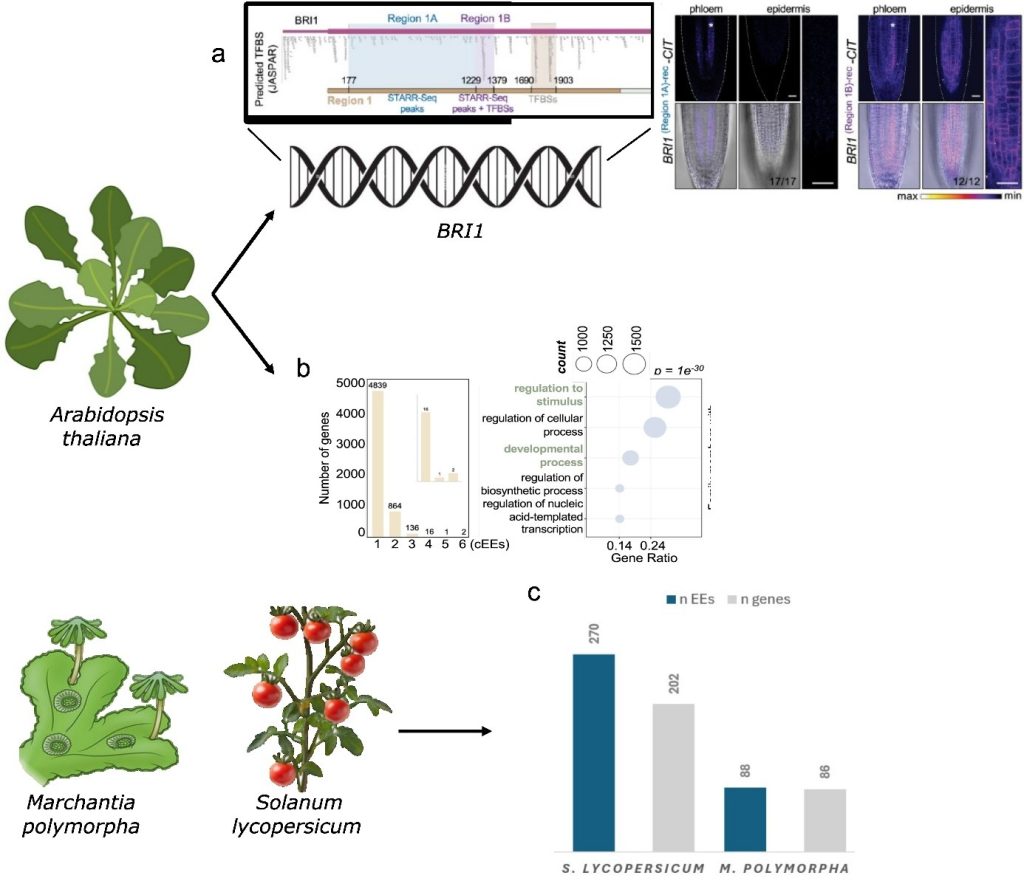
After ruling out alternative transcription start sites and DNA methylation as potential mechanisms, the author team identified an exonic enhancer within the BRI1 coding sequence containing several transcription factor binding sites (Fig. 1). Using different constructs and confocal microscopy, they demonstrated that this exonic enhancer contributes to the spatial expression pattern of BRI1, which is essential for optimal root growth (Fig. 1).
Using available datasets, the authors then investigated the prevalence and genomic distribution of exonic enhancers across the Arabidopsis genome. Remarkably, more than 20% of protein-coding genes carry exonic enhancers, which are preferentially located in the 3′ regions of genes involved in environmental responses and developmental processes. The authors further extended their analysis to other plant species, including tomato and the non-vascular plant Marchantia polymorpha (Fig. 1). Excitingly, they identified exonic enhancers with similar genomic features in both species, suggesting that this regulatory mechanism may be conserved across land plants.
Finally, their analyses suggested that the regulatory effects of exonic enhancers may extend beyond the host gene, potentially influencing neighboring and even distant genes through chromatin interactions.
What I like about the preprint
This preprint reveals an additional layer of transcriptional regulation and provides a new perspective on how we decipher the genome. The findings are exciting and paradigm-shifting as they challenge the conventional view of exons as simple carriers of protein coding information. Also, this work perfectly highlights the importance of considering the genome as a 3D structure.
Future directions
Functional characterisation of exonic enhancers will be essential to determine the extent to which they contribute to different aspects of gene regulation, as the results of this study indicate that their function is not universally restricted to the control of spatial gene expression.
Also, single-cell transcriptomic could reveal whether exonic enhancers not only determine spatial expression patterns but also modulate levels of gene expression within each cell type.
From an evolutionary perspective, future studies with Marchantia could provide valuable insights into how exonic enhancers evolved and contribute to gene regulation across land plants. Expanding these comparisons to a broader range of plant species may provide insight into the evolutionary pressures that shaped the recruitment and distribution of these regulatory elements.
Questions for the authors
Are genes carrying multiple EEs associated with specific biological processes? Have you examined whether their TFBS enrichment is complementary or rather redundant?
If EEs can influence neighboring and distal genes, have you checked whether these genes have been previously described as forming a GRN?
Based on the GO term enrichment, I would expect many genes with EEs to belong to the Arabidopsis accessory or super-accessory genome. Have you considered investigating this?
What is your hypothesis about how this regulatory layer has been recruited and maintained alongside promoters and other cis-regulatory elements? Especially, given that BRI1 EE acts in concert with its promoter.
Have you considered comparing your results with the Monroe et al. datasets to check whether genes containing EEs display higher mutation rates or frequencies? One hypothesis for the presence of regulatory elements within exons would be that it provides better protection from mutations. Interestingly, they showed that genes with higher mutation probabilities are also associated with environmental responses and development.
References
Mouren, J., Torres, M., Van Ouwerkerk, A., Manosalva, I., Gallardo, F., Spicuglia, S., & Ballester, B. (2026). Exonic enhancers are a widespread class of dual-function regulatory elements. Nature Communications, 17(1). https://doi.org/10.1038/s41467-026-71220-6
Blanco-Touriñán, N., Rana, S., Nolan, T. M., Li, K., Vukašinović, N., Hsu, C., Russinova, E., & Hardtke, C. S. (2024). The brassinosteroid receptor gene BRI1 safeguards cell-autonomous brassinosteroid signaling across tissues. Science Advances, 10(39), eadq3352. https://doi.org/10.1126/sciadv.adq3352
Blanco‐Touriñán, N., & Hardtke, C. S. (2025). Specificity of brassinosteroid perception and its integration at signaling crossroads in vascular development. The Plant Journal, 124(3), e70570. https://doi.org/10.1111/tpj.70570
Read preprintSign up to customise the site to your preferences and to receive alerts
Register hereAlso in the genomics category:
Population genomics reveals multi-scale mechanisms sustaining schistosomiasis re-emergence in a near-elimination setting
Hala Taha

Diversity and Spatial Segregation of TRP Channels in Choanoflagellates Provide Insight into the Evolutionary Origin of Animal Sensory Systems
Urvashi Goswami

BAF complexes maintain accessibility at stimulus-responsive chromatin and are required for transcriptional stimulus responses
Dina Kabbara

Also in the plant biology category:
Brassinosteroid receptors reveal conserved features of exon-embedded gene regulation
Karima El Mahboubi

A single genetic innovation at the origin of plant terrestrialization
Naveenkumar Muthiah
Extreme cooling enables survival in extreme heat
Naveenkumar Muthiah
preLists in the genomics category:
‘In preprints’ from Development 2026
A list of the preprints featured in Development's 'In preprints' articles, as part of the new Preprint Editors initiative
| List by | Clarisse Brunet Avalos et al. |
Santa Cruz Developmental Biology Meeting 2026
This preList brings together a selection of preprints discussed at the Santa Cruz Developmental Biology Meeting 2026, held at UC Santa Cruz with the theme “Biomedicine, Biomechanics, and the Biosphere.” Reflecting the meeting’s broad scientific scope, from development and regeneration to evolution, tissue mechanics, and emerging technologies, this curated collection showcases work that contributed to conversations throughout the meeting.
| List by | Ingrid Tsang |
BSDB Spring Meeting: Molecules to Morphogenesis
The British Society for Developmental Biology (BSDB) Spring Meeting Molecules to Morphogenesis was held from 23–26 March 2026 at the University of Warwick (UK). This meeting brought together a vibrant community of researchers to discuss how molecular mechanisms are integrated across scales to drive morphogenesis, spanning diverse model systems and approaches. This preList contains preprints by presenters from the talk and poster sessions at the meeting. Please do get in touch at preLights@biologists.com if you notice any relevant preprints that we may have missed.
| List by | Ingrid Tsang |
Keystone Symposium on Stem Cell Models in Embryology 2026
The Keystone Symposium on Stem Cell Models in Embryology, 2026, was organised by Jun Wu (UT Southwestern), Jianping Fu (University of Michigan) and Miki Ebisuya (TU Dresden) and held at Asilomar Conference Grounds in California (US). The meeting discussed recent advances made in establishing stem-cell-based embryo models, what fundamental insights into developmental processes have been gleaned from them, as well as how they are beginning to be applied more widely. This prelist contains preprints by presenters at the talk and poster sessions at the conference, which our Reviews Editor in attendance spotted. Please do reach out to preLights@biologists.com if you notice any that we’ve missed.
| List by | Ingrid Tsang |
November in preprints – DevBio & Stem cell biology
preLighters with expertise across developmental and stem cell biology have nominated a few developmental and stem cell biology (and related) preprints posted in November they’re excited about and explain in a single paragraph why. Concise preprint highlights, prepared by the preLighter community – a quick way to spot upcoming trends, new methods and fresh ideas.
| List by | Aline Grata et al. |
May in preprints – the CellBio edition
A group of preLighters, with expertise in different areas of cell biology, have worked together to create this preprint reading lists for researchers with an interest in cell biology. This month, categories include: 1) Biochemistry/metabolism 2) Cancer cell Biology 3) Cell adhesion, migration and cytoskeleton 4) Cell organelles and organisation 5) Cell signalling and 6) Genetics
| List by | Barbora Knotkova et al. |
March in preprints – the CellBio edition
A group of preLighters, with expertise in different areas of cell biology, have worked together to create this preprint reading lists for researchers with an interest in cell biology. This month, categories include: 1) cancer biology 2) cell migration 3) cell organelles and organisation 4) cell signalling and mechanosensing 5) genetics and genomics 6) other
| List by | Girish Kale et al. |
Biologists @ 100 conference preList
This preList aims to capture all preprints being discussed at the Biologists @100 conference in Liverpool, UK, either as part of the poster sessions or the (flash/short/full-length) talks.
| List by | Reinier Prosee, Jonathan Townson |
Early 2025 preprints – the genetics & genomics edition
In this community-driven preList, a group of preLighters, with expertise in different areas of genetics and genomics have worked together to create this preprint reading list. Categories include: 1) bioinformatics 2) epigenetics 3) gene regulation 4) genomics 5) transcriptomics
| List by | Chee Kiang Ewe et al. |
End-of-year preprints – the genetics & genomics edition
In this community-driven preList, a group of preLighters, with expertise in different areas of genetics and genomics have worked together to create this preprint reading list. Categories include: 1) genomics 2) bioinformatics 3) gene regulation 4) epigenetics
| List by | Chee Kiang Ewe et al. |
BSCB-Biochemical Society 2024 Cell Migration meeting
This preList features preprints that were discussed and presented during the BSCB-Biochemical Society 2024 Cell Migration meeting in Birmingham, UK in April 2024. Kindly put together by Sara Morais da Silva, Reviews Editor at Journal of Cell Science.
| List by | Reinier Prosee |
9th International Symposium on the Biology of Vertebrate Sex Determination
This preList contains preprints discussed during the 9th International Symposium on the Biology of Vertebrate Sex Determination. This conference was held in Kona, Hawaii from April 17th to 21st 2023.
| List by | Martin Estermann |
Semmelweis Symposium 2022: 40th anniversary of international medical education at Semmelweis University
This preList contains preprints discussed during the 'Semmelweis Symposium 2022' (7-9 November), organised around the 40th anniversary of international medical education at Semmelweis University covering a wide range of topics.
| List by | Nándor Lipták |
20th “Genetics Workshops in Hungary”, Szeged (25th, September)
In this annual conference, Hungarian geneticists, biochemists and biotechnologists presented their works. Link: http://group.szbk.u-szeged.hu/minikonf/archive/prg2021.pdf
| List by | Nándor Lipták |
EMBL Conference: From functional genomics to systems biology
Preprints presented at the virtual EMBL conference "from functional genomics and systems biology", 16-19 November 2020
| List by | Jesus Victorino |
TAGC 2020
Preprints recently presented at the virtual Allied Genetics Conference, April 22-26, 2020. #TAGC20
| List by | Maiko Kitaoka et al. |
Zebrafish immunology
A compilation of cutting-edge research that uses the zebrafish as a model system to elucidate novel immunological mechanisms in health and disease.
| List by | Shikha Nayar |
Also in the plant biology category:
‘In preprints’ from Development 2026
A list of the preprints featured in Development's 'In preprints' articles, as part of the new Preprint Editors initiative
| List by | Clarisse Brunet Avalos et al. |
Sainsbury Laboratory Symposium 2026
The Sainsbury Laboratory Symposium 2026, Shaping Life: Mechanisms of Morphogenesis, brought together researchers exploring the cellular, genetic and mechanical processes that shape plant form. This preList highlights preprints that were discussed or mentioned at the meeting. If you notice any missing preprints, please contact us at preLights@biologists.com
| List by | Ingrid Tsang |
SciELO preprints – From 2025 onwards
SciELO has become a cornerstone of open, multilingual scholarly communication across Latin America. Its preprint server, SciELO preprints, is expanding the global reach of preprinted research from the region (for more information, see our interview with Carolina Tanigushi). This preList brings together biological, English language SciELO preprints to help readers discover emerging work from the Global South. By highlighting these preprints in one place, we aim to support visibility, encourage early feedback, and showcase the vibrant research communities contributing to SciELO’s open science ecosystem.
| List by | Carolina Tanigushi |
‘In preprints’ from Development 2022-2023
A list of the preprints featured in Development's 'In preprints' articles between 2022-2023
| List by | Alex Eve, Katherine Brown |
The Society for Developmental Biology 82nd Annual Meeting
This preList is made up of the preprints discussed during the Society for Developmental Biology 82nd Annual Meeting that took place in Chicago in July 2023.
| List by | Joyce Yu, Katherine Brown |
CSHL 87th Symposium: Stem Cells
Preprints mentioned by speakers at the #CSHLsymp23
| List by | Alex Eve |
SDB 78th Annual Meeting 2019
A curation of the preprints presented at the SDB meeting in Boston, July 26-30 2019. The preList will be updated throughout the duration of the meeting.
| List by | Alex Eve |