






Expanded implementation of Fast & Fair paid peer review reduces time to first decision without reducing review quality in a biology journal
Posted on: 21 September 2026
Preprint posted on 9 September 2026
Fast & Fair peer review: a pilot study demonstrating feasibility of rapid, high-quality peer review in a biology journal
Posted on:
Preprint posted on 19 March 2025

Categories: scientific communication and education
Updated 17 September 2026 with a spotLight by Jonathan Townson and Reinier Prosee
A spotlight about Fast & Fair was also recorded at the Biologists @100 conference and can be viewed here:
Background
Peer review is a fundamental aspect of scientific publishing, providing expert assessment of the quality, rigour and suitability of research for publication. When peer review works well, it can improve the quality of a manuscript and strengthen its claims. However, it can also be slow and frustrating, with long revision times and unrealistic requests. For researchers, whose jobs and future careers can depend on getting papers out in the “publish or perish” academic landscape, these delays can have significant career implications.
The widespread use of preprints has helped address some of these challenges, by enabling research to be shared before formal peer review. This facilitates earlier discussion and dissemination of important results, with preprints shared between colleagues, through social media, and community initiatives such as preLights (such as the one you are reading right now).
Despite the adoption of preprints and Open Science practices, publishing in a scientific journal following peer review remains an important part of the academic process. Publishing in a ‘reputable’ journal still influences how the work, and the authors, are perceived; and many readers still rely on journals to follow developments in their field. Initiatives to improve the peer review process therefore remain of great interest to the academic community. In two preprints from Daniel Gorelick and Alejandra Clark, they examine how their “Fast & Fair” initiative has impacted the peer review process of manuscripts submitted to the journal Biology Open (of which they are respectively the editor in chief and managing editor).
Key findings
The aim of the Fast & Fair initiative is to provide quality reviews to authors within seven working days of submission. To do this, Biology Open established a “pool” of over 400 pre-contracted reviewers. Reviewers must respond rapidly to invitations, and, if they accept, submit their review within four working days (Fig. 1). Reviewers are compensated with a £220 payment if their review is high quality and submitted on time, a key difference between Fast & Fair and other attempts to pay reviewers (Chetty et al., 2014 and Cotton et al., 2025). The large pool of pre-contracted reviewers means suitable expertise is readily available and avoids delays in reviewer recruitment.
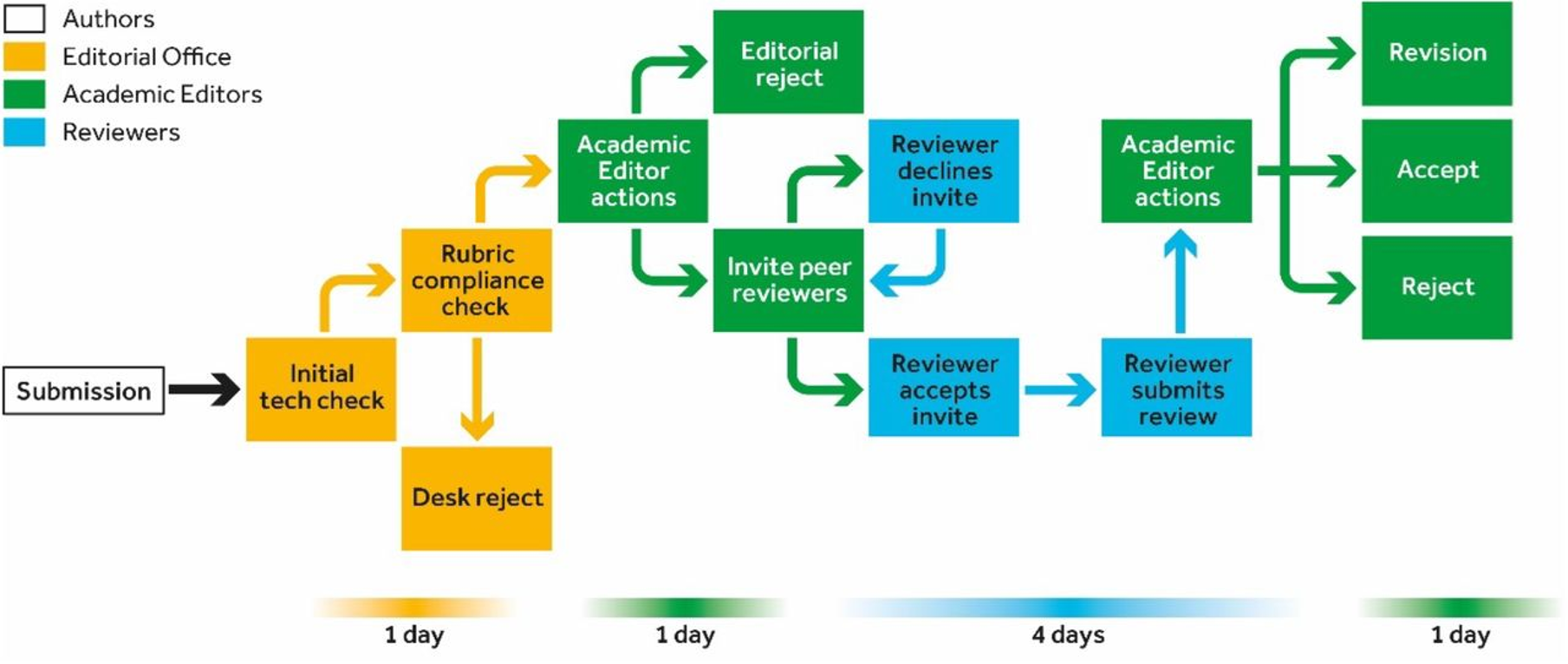
Figure 1: The Fast & Fair workflow from submission to first decision following peer review. Taken from Gorelick and Clark (2025).
The initial trial from July to December 2024 (Gorelick and Clark, 2025) involved two of the ten handling academic editors and compared two payment models for pre-contracted reviewers: retainer and freelancer. Retainer reviewers were required to accept one invitation per month, while freelancers could decline invitations for any reason, provided they did so within one working day. After the trial was successful, Fast & Fair was rolled out across Biology Open (Gorelick and Clark, 2026). By April 2025, all submissions without reviews were handled through Fast & Fair (unless suitable expertise was unavailable in the reviewer pool). Reviewer compensation also switched from the retainer model to a freelance model, with compensation only for completed, high-quality reviews.
Fast & Fair increases the turnaround speed from submission to receiving a review.
The Fast & Fair initiative was designed to reduce time from submission to first decision with reviews. The preprint authors indeed find a much quicker turnaround in manuscripts handled through Fast & Fair than those undergoing conventional peer review (Fig. 2A). The median time for a Fast & Fair response was five working days, compared to 31 for conventional peer review. . Although Fast & Fair was not designed to address time from submission to acceptance, under Fast & Fair, the median time from submission to acceptance was only 48 days, which is approximately half the median time in cell biology journals (Royle, 2026).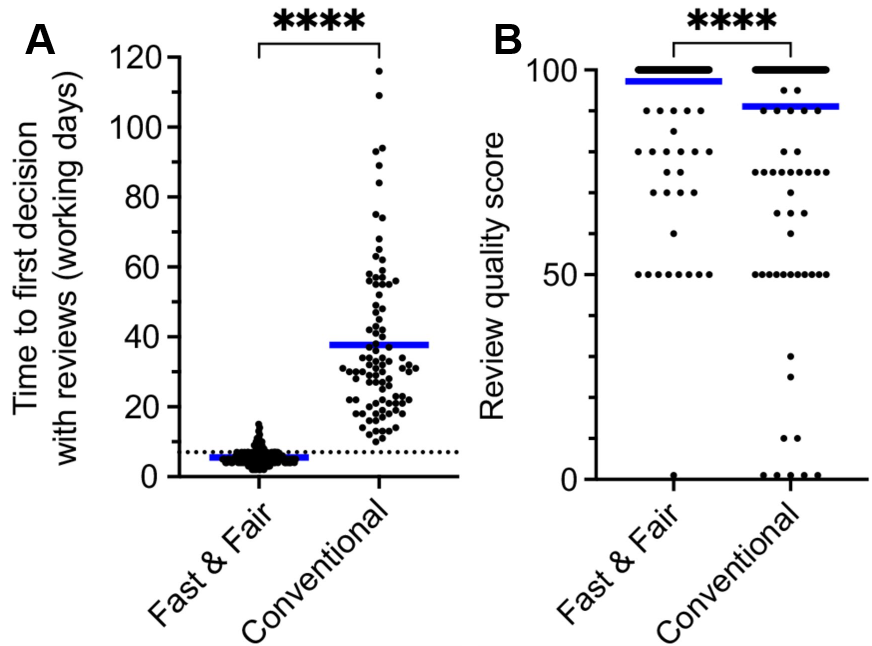
Figure 2: Outcomes from the extended Fast & Fair trial showing (A) faster time to first decision and (B) review quality was not compromised. Adapted from figures 1 and 2 of Gorelick and Clark (2026).
Review quality is not compromised by the Fast & Fair initiative.
Handling editors scored the reviews they received in the Fast & Fair and conventional review processes as 1 – not useful, 50 – partially helpful, and 100 – helpful, for reaching a decision. The Fast & Fair review scores were moderately improved compared to the conventional review process (Fig. 2B), so the time constraint and financial incentives did not diminish the review quality.
One potential contributing factor to maintaining the review quality is Biology Open’s use of a review rubric, based on the work of Matthew Krummel (Krummel et al., 2019). Every review (Fast & Fair or conventional) is expected to answer four sets of questions that cover experimental quality, reproducibility, completeness and scholarship of the submitted manuscript. This does not limit reviewers from making comments outside of the defined questions, but the rubric may help to ensure a more objective and standardised assessment of submitted manuscripts.
My personal experience with Fast & Fair
As part of the recruitment to the reviewer pool, prelighters were offered the opportunity to apply and join, which I successfully did and have been involved in two review processes since. As a postdoc, it has been a great opportunity to be involved in peer review for the first time. The review rubric has helped enormously, and it has been heartening to be paid, both for the money and for the recognition that the handling editor valued my contributions.
On principle, I would like to think I would be more likely to review for a community/non-profit journal than a commercial model one, regardless of the financial compensation. Indeed, one can argue that the non-profit journals are better placed to request free labour, while commercial journals should be the ones paying reviewers.
Colleagues who have submitted their manuscripts to Biology Open have been very impressed by the fast response and objective reviews they got back, as well as the welcome judgment of handling editors who are also academics when making decisions on what revisions are needed for publication.
Discussion
By the measures presented in the preprint Fast & Fair has been a success for Biology Open. It is also arguably a success for the peer reviewers who are compensated for work that would otherwise be given for free, and for early-career researchers who are more likely to receive reviews and complete revisions before moving between positions. These are particularly timely benefits to reflect on during Peer Review Week and National Postdoc Appreciation Week which, each September, celebrate the often-unrecognised contributions of reviewers and postdoctoral researchers to the scientific enterprise.
Looking to the future, it will be interesting to see if the faster turnaround encourages more submissions to Biology Open. The preprint authors note that paying reviewers may require higher article processing charges (APCs) and whether authors would be willing to pay more for faster peer review remains an open question. Another important consideration is scalability. The numbers of published articles discussed in the preprint are relatively modest compared to some journals (e.g. see Royle 2026); whether Fast & Fair could remain affordable and effective at journals publishing thousands of articles per year remains to be seen. Wider adoption by non-profit journals may also be needed before similar models are embraced by for-profit model journals.
The preprint authors also raise the possibility that the Fast & Fair scheme could improve equity in peer review, particularly in light of evidence that articles from female authors, or those from low-income countries, can spend longer in peer review (Alvarez-Ponce et al., 2026). The shorter and defined peer review time of the Fast & Fair scheme could help deal with this, although a lot more data would be needed to prove it. It would also be interesting to learn more about the contribution of Biology Open’s review rubric, which standardises reviewer assessment and may itself promote fairer and more objective decision making.
Further information
If you are interested in joining the reviewer pool, then it is possible to apply following the links and instructions detailed here.
Future directions and questions for the authors
- To what extent do you think the reviewer rubric helped maintain the quality of peer reviews in the Fast & Fair initiative? Is the rubric something other journals could consider implementing to improve the quality of their peer review?
- How does the time taken to reach a first decision at Biology Open compare with other journals (CoB or otherwise)?
- Some of the conventionally reviewed manuscripts had some fast turnaround times, comparable to Fast & Fair, do you have any idea what, if anything, may have driven this?
- Was it necessary to target reviewers with particular areas of interest (within the scope of Biology Open) for recruitment to the reviewer pool?
- Additionally, you highlight the possibility for Fast & Fair to tackle inequity in the peer review process for authors. What steps, if any, did you take to ensure equity within the reviewer pool?
- How did you decide upon £220 as the financial incentive? You mention nonprofit journals with lowe budgets may struggle compared to commercial models, could the Fast & Fair initiative lead to competing financial incentives where more financially constrained journals are unable to compete to recruit reviewers?
- Paying a higher APC for publication may previously have been associated with publishing in a journal with a strong reputation or impact factor. Fast & Fair offers a faster review process. Which motivator do you think would be more likely to incentivise a higher APC?
References
- Alvarez-Ponce, David, Gabrial Batz, and Luis Ramirez Torres. ‘Biomedical and Life Science Articles by Female Researchers Spend Longer under Review’. PLOS Biology 24 (1): e3003574. https://doi.org/10.1371/journal.pbio.3003574.
- Chetty, Raj, Emmanuel Saez, and László Sándor. 2014. ‘What Policies Increase Prosocial Behavior? An Experiment with Referees at the Journal of Public Economics’. Journal of Economic Perspectives 28 (3): 169–88. https://doi.org/10.1257/jep.28.3.169.
- Cotton, Christopher S., Abid Alam, Sophie Tosta, Timothy G. Buchman, and David M. Maslove. 2025. ‘Effect of Monetary Incentives on Peer Review Acceptance and Completion: A Quasi-Randomized Interventional Trial’. Critical Care Medicine 53 (6): e1181–89. https://doi.org/10.1097/CCM.0000000000006637.
- Gorelick, Daniel A., and Alejandra Clark. ‘Fast & Fair Peer Review: A Pilot Study Demonstrating Feasibility of Rapid, High-Quality Peer Review in a Biology Journal’. Preprint, Scientific Communication and Education, 19 March 2025. https://doi.org/10.1101/2025.03.18.644032.
- Gorelick, Daniel A., and Alejandra Clark. 2026. ‘Expanded Implementation of Fast & Fair Paid Peer Review Reduces Time to First Decision without Reducing Review Quality in a Biology Journal’. Preprint, Scientific Communication and Education, June 3. https://doi.org/10.64898/2026.06.02.729548.
- Krummel, Matthew, Catherine Blish, Michael Kuhns, et al. 2019. ‘Universal Principled Review: A Community-Driven Method to Improve Peer Review’. Cell 179 (7): 1441–45. https://doi.org/10.1016/j.cell.2019.11.029.
- Royle, Stephen. 2026. ‘Hold On Hope: Publication Lag Times at Cell Biology Journals’. Quantixed, April 9. https://doi.org/10.59350/j43t1-z0s41.
Sign up to customise the site to your preferences and to receive alerts
Register hereAlso in the scientific communication and education category:
Who chooses open peer review and is it an indicator of article quality? An observational study of PLOS journals
Chee Kiang Ewe

Science should be machine-readable
Theodora Stougiannou

A thirty-year trend of increasing clinical orientation at the National Institutes of Health
AND
Prediction of transformative breakthroughs in biomedical research
Jonathan Townson