






Precision Farming in Aquaculture: Use of a non-invasive, AI-powered real-time automated behavioural monitoring approach to predict gill health and improve welfare in Atlantic salmon (Salmo salar) aquaculture farms
Posted on: 11 September 2024 , updated on: 12 September 2024
Preprint posted on 6 April 2024
Keeping an eye on the prize: Using Artificial Intelligence (AI) behavioural monitoring to improve Atlantic salmon farming welfare
Selected by Jasmine Talevi
Categories: animal behavior and cognition, ecology, physiology
Background:
When we are stressed, we sometimes bite our nails or bounce our legs. In Atlantic Salmon, stress can present itself as changes in feeding or swimming behavior. Shoaling is one example which refers to changes in swimming behavior leading multiple fish to group together. Shoaling, in addition to other changes in feeding and swimming behavior, can occur in response to stress from predators, changes in the environment, or health status.
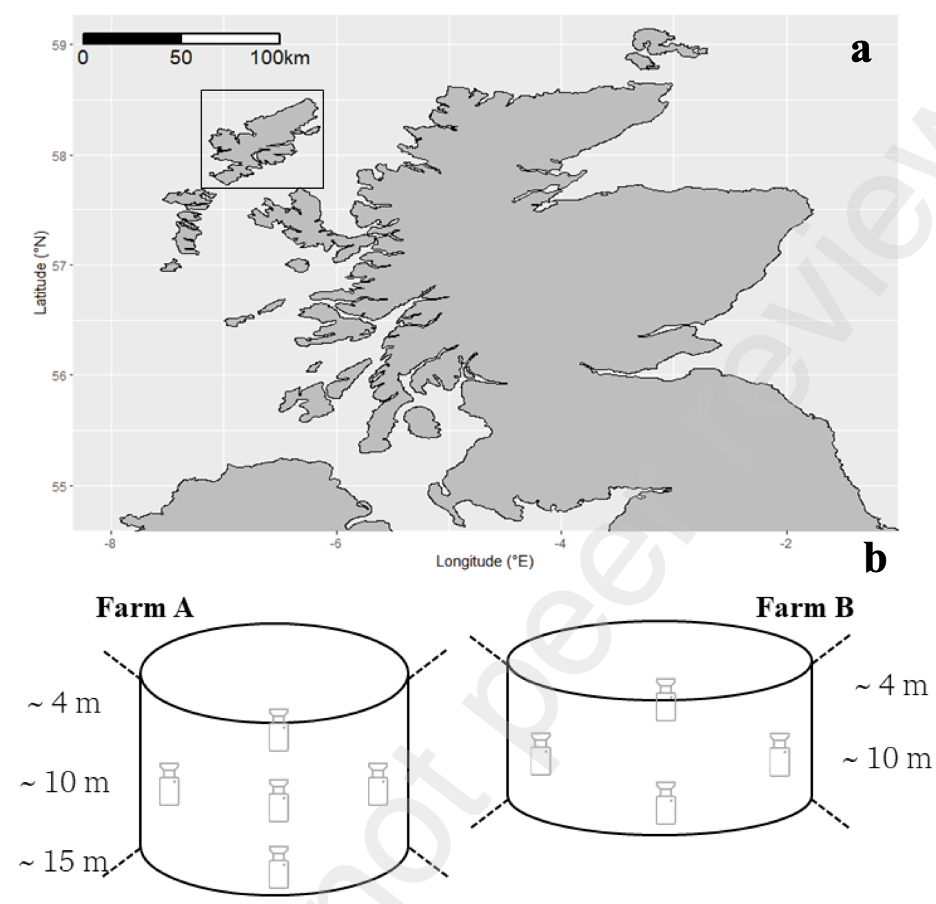
In a recent study, Burke and collaborators have leveraged our current understanding of swimming and feeding behavioral changes to improve Atlantic Salmon farming practices. By installing video cameras in fish net pens (Fig. 1 of the preprint), the researchers could use Artificial Intelligence (AI) machine learning technology to recognize real-time patterns in fish behavior.
Detecting patterns in fish behavior indicative of stress and compromised health could provide farmers with early warning signs of stress, specifically gill disease in the case of this study. Gill disease is a major concern in salmon farming worldwide. Two types of gill disease, Amoebic Gill Disease (AGD) and Proliferative Gill Disease (PGD), are especially common and both of these cause breathing difficulties, hinder growth, and cause mortality. Unfortunately, with increasing sea temperatures, occurrences of AGD and PGD may also increase, highlighting the need for the early detection of fish stress to help prevent disease rather than treat symptoms.
Methods:
As part of this preprinted study, the researchers selected two fish farms (Farm A and Farm B) in Scotland and deployed video camera(s) in 9-10 cages per farm. Several behavioral characteristics were monitored including depth of fish activity (Depth of Max Activity) and proximity of the fish to one another (Activity). Specific Feeding Rate (SFR) were also calculated as ((feed given/fish biomass) X 100). Weekly gill health examinations were carried out where signs of AGD or PGD were scored on a scale of 0 (healthy tissue) – 5 (necrotic tissue) and mortality was monitored throughout the experiment.
Highlighted Key Findings:
1) Proliferative Gill Disease (PGD) was the main driver of increased activity levels
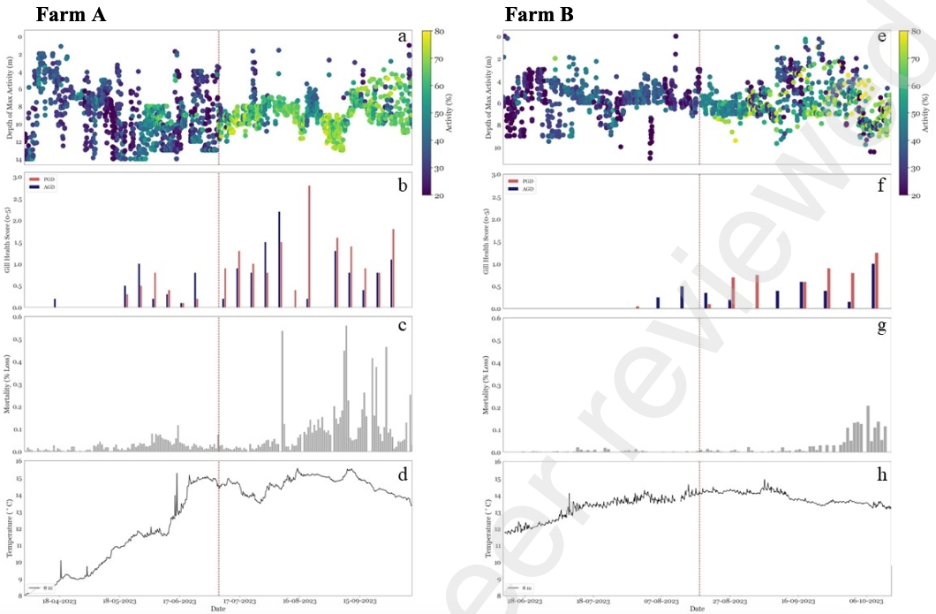
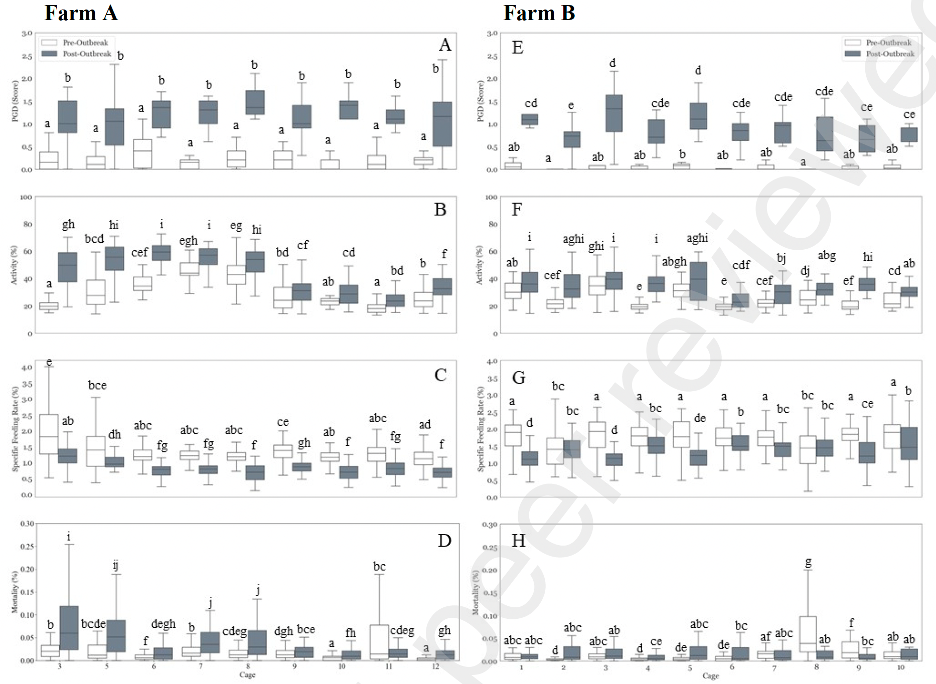
The researchers observed an increase in group fish activity at both farms, which coincided with poorer gill health status, specifically PDG (Fig. 2 of the preprint). On average, there was a 15% increase in activity at Farm A (which experienced poorer gill health), while there was a 7.7% increase at Farm B.
2) Increased fish activity indicates shoaling behavior
Increases in fish activity was concentrated towards the centre of the cage indicating fish shoaling in this area (Fig. 2 of the preprint). This behaviour is often a stress response, commonly triggered by the presence of predatory stimuli or environmental stressors
3) Mortality increased and Specific Feeding Rate (SFR) decreased after the onset of poor gill health
At both farms mortality increased with the onset of poor gill health (Fig. 3 of the preprint). SFR also increased with the onset of poor gill health though more prominently at Farm A where gill health was poorer than Farm B.
4) Group-level assessments are more informative than individual fish assessments
When behavioral changes began to emerge and gill health scores became worse, individual-level assessments of fish did not significantly change. Though individual assessments for signs of illness (changes in eyes, fins, skin) are important, by the time the outward signs of poor health emerge the fish may already be compromised. Thus, group assessments, such as behavioral change, are important for predicting impacts to fish.
Why I Highlight This Preprint:
This preprint presents an innovative solution to a globally relevant issue. The technology tested offers a practical, easily deployable device that farms can readily implement. Additionally, this technique has the potential to enhance salmon welfare, contributing to improved food security.
Questions for the Authors:
- In comparison to individual fish assessments, approximately how much extra time could farmers gain by implementing this group-level behavioural assessment and what does this mean in terms of fish welfare?
- Did the net pen with one strategically placed camera capture enough fish activity to serve as an effective early warning sign? Will farmers need to deploy more than one camera per net pen?
doi: https://doi.org/10.1242/prelights.38340
Read preprintSign up to customise the site to your preferences and to receive alerts
Register hereAlso in the animal behavior and cognition category:
Mice sense Moon and Sun
Jeny Jose

Drift drives phenotypic evolution in a rapid island radiation
Zoha Sadaqat

Behavioral characteristics of an extremely old rhesus macaque in a zoo: Dementia-like symptoms and implications for quality of life of geriatric animals
Stefan Friedrich Wirth

Also in the ecology category:
Modes of natural selection on maternal and zygotic gene expression in Drosophila melanogaster embryos
Girish Kale, preLights peer support

Feeding and reproduction of a tropical coastal copepod across warming and copper gradients
Tina Nguyen

Heatwave winners and losers: cryptic coral holobionts differ in thermal tolerance
Maitri Manjunath
Also in the physiology category:
Inhibition of the gut ceramidase Asah2 decelerates the vertebrate ageing rate
Jeny Jose

Feeding and reproduction of a tropical coastal copepod across warming and copper gradients
Tina Nguyen
Resilience to cardiac aging in Greenland shark Somniosus microcephalus
Theodora Stougiannou

preLists in the animal behavior and cognition category:
Biologists @ 100 conference preList
This preList aims to capture all preprints being discussed at the Biologists @100 conference in Liverpool, UK, either as part of the poster sessions or the (flash/short/full-length) talks.
| List by | Reinier Prosee, Jonathan Townson |
9th International Symposium on the Biology of Vertebrate Sex Determination
This preList contains preprints discussed during the 9th International Symposium on the Biology of Vertebrate Sex Determination. This conference was held in Kona, Hawaii from April 17th to 21st 2023.
| List by | Martin Estermann |
Bats
A list of preprints dealing with the ecology, evolution and behavior of bats
| List by | Baheerathan Murugavel |
FENS 2020
A collection of preprints presented during the virtual meeting of the Federation of European Neuroscience Societies (FENS) in 2020
| List by | Ana Dorrego-Rivas |
Also in the ecology category:
Developmental regulation: molecular and ecological niches
This conference was held at the Station Biologique de Roscoff (France) and brought together researchers exploring how diverse niche environments shape developmental processes across scales. Spanning topics from ecological and metabolic influences to signalling networks, mechanics and gene regulation, the meeting highlighted the interplay between intrinsic and extrinsic factors in controlling cell fate and tissue organisation. This preList gathers preprints discussed by speakers and poster presenters during the meeting. Please do get in touch at preLights@biologists.com if you notice any relevant preprints that we may have missed.
| List by | Ingrid Tsang |
SciELO preprints – From 2025 onwards
SciELO has become a cornerstone of open, multilingual scholarly communication across Latin America. Its preprint server, SciELO preprints, is expanding the global reach of preprinted research from the region (for more information, see our interview with Carolina Tanigushi). This preList brings together biological, English language SciELO preprints to help readers discover emerging work from the Global South. By highlighting these preprints in one place, we aim to support visibility, encourage early feedback, and showcase the vibrant research communities contributing to SciELO’s open science ecosystem.
| List by | Carolina Tanigushi |
November in preprints – DevBio & Stem cell biology
preLighters with expertise across developmental and stem cell biology have nominated a few developmental and stem cell biology (and related) preprints posted in November they’re excited about and explain in a single paragraph why. Concise preprint highlights, prepared by the preLighter community – a quick way to spot upcoming trends, new methods and fresh ideas.
| List by | Aline Grata et al. |
Biologists @ 100 conference preList
This preList aims to capture all preprints being discussed at the Biologists @100 conference in Liverpool, UK, either as part of the poster sessions or the (flash/short/full-length) talks.
| List by | Reinier Prosee, Jonathan Townson |
preLights peer support – preprints of interest
This is a preprint repository to organise the preprints and preLights covered through the 'preLights peer support' initiative.
| List by | preLights peer support |
EMBO | EMBL Symposium: The organism and its environment
This preList contains preprints discussed during the 'EMBO | EMBL Symposium: The organism and its environment', organised at EMBL Heidelberg, Germany (May 2023).
| List by | Girish Kale |
Bats
A list of preprints dealing with the ecology, evolution and behavior of bats
| List by | Baheerathan Murugavel |
Also in the physiology category:
Developmental regulation: molecular and ecological niches
This conference was held at the Station Biologique de Roscoff (France) and brought together researchers exploring how diverse niche environments shape developmental processes across scales. Spanning topics from ecological and metabolic influences to signalling networks, mechanics and gene regulation, the meeting highlighted the interplay between intrinsic and extrinsic factors in controlling cell fate and tissue organisation. This preList gathers preprints discussed by speakers and poster presenters during the meeting. Please do get in touch at preLights@biologists.com if you notice any relevant preprints that we may have missed.
| List by | Ingrid Tsang |
preLighters’ choice – Handpicked DevBio preprints
preLighters with expertise across developmental and stem cell biology have nominated a few developmental biology (and related) preprints they’re excited about and explain in a few paragraph why. Concise preprint highlights, prepared by the preLighter community – a quick way to spot upcoming trends, new methods and fresh ideas.
| List by | Theodora Stougiannou et al. |
Keystone Symposium on Stem Cell Models in Embryology 2026
The Keystone Symposium on Stem Cell Models in Embryology, 2026, was organised by Jun Wu (UT Southwestern), Jianping Fu (University of Michigan) and Miki Ebisuya (TU Dresden) and held at Asilomar Conference Grounds in California (US). The meeting discussed recent advances made in establishing stem-cell-based embryo models, what fundamental insights into developmental processes have been gleaned from them, as well as how they are beginning to be applied more widely. This prelist contains preprints by presenters at the talk and poster sessions at the conference, which our Reviews Editor in attendance spotted. Please do reach out to preLights@biologists.com if you notice any that we’ve missed.
| List by | Ingrid Tsang |
October in preprints – DevBio & Stem cell biology
Each month, preLighters with expertise across developmental and stem cell biology nominate a few recent developmental and stem cell biology (and related) preprints they’re excited about and explain in a single paragraph why. Short, snappy picks from working scientists — a quick way to spot fresh ideas, bold methods and papers worth reading in full. These preprints can all be found in the October preprint list published on the Node.
| List by | Deevitha Balasubramanian et al. |
Biologists @ 100 conference preList
This preList aims to capture all preprints being discussed at the Biologists @100 conference in Liverpool, UK, either as part of the poster sessions or the (flash/short/full-length) talks.
| List by | Reinier Prosee, Jonathan Townson |
Fibroblasts
The advances in fibroblast biology preList explores the recent discoveries and preprints of the fibroblast world. Get ready to immerse yourself with this list created for fibroblasts aficionados and lovers, and beyond. Here, my goal is to include preprints of fibroblast biology, heterogeneity, fate, extracellular matrix, behavior, topography, single-cell atlases, spatial transcriptomics, and their matrix!
| List by | Osvaldo Contreras |
FENS 2020
A collection of preprints presented during the virtual meeting of the Federation of European Neuroscience Societies (FENS) in 2020
| List by | Ana Dorrego-Rivas |
TAGC 2020
Preprints recently presented at the virtual Allied Genetics Conference, April 22-26, 2020. #TAGC20
| List by | Maiko Kitaoka et al. |
Autophagy
Preprints on autophagy and lysosomal degradation and its role in neurodegeneration and disease. Includes molecular mechanisms, upstream signalling and regulation as well as studies on pharmaceutical interventions to upregulate the process.
| List by | Sandra Malmgren Hill |
Cellular metabolism
A curated list of preprints related to cellular metabolism at Biorxiv by Pablo Ranea Robles from the Prelights community. Special interest on lipid metabolism, peroxisomes and mitochondria.
| List by | Pablo Ranea Robles |