






Morphological variations in external genitalia do not explain the interspecific reproductive isolation in Nasonia species complex (Hymenoptera: Pteromalidae)
Posted on: 23 January 2026 , updated on: 26 January 2026
Preprint posted on 1 November 2025
Isolation mechanisms that prevent mating between different species of parasitoid Nasonia wasps remain a mystery
Selected by Stefan Friedrich Wirth
Categories: animal behavior and cognition, evolutionary biology, zoology
Why I highlight this preprint
Prezygotic isolation is an important barrier that ensures species preservation and prevents hybridization with other species. It describes all behavioral and functional morphological characteristics of a species that serve to prevent successful copulation between two species in advance.
A cryptic species complex refers to very closely related, yet distinct species that even experienced specialists can often not readily differentiate from one another. In these species, as for ecample a cryptic group of parasitoid wasps termed Nasonia, speciation events are often relatively recent and species boundaries are more unstable.
I found this preprinted study, which investigates the morphological and behavioral causes of prezygotic isolation observed in four species of genus Nasonia, despite the occurrence of hybridization, interesting from an evolutionary perspective. In insects, specifically, I would expect the morphological compatibility of the reproductive organs to be significant in the context of prezygotic isolation. This preprint points out that this does not appear to be the case for Nasonia species, despite particularly thorough and methodologically complex morphological and statistical analyses. I consider this very noteworthy from both an evolutionary and a behavioral biology point of view.
Background
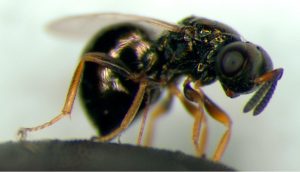
Nasonia (Pteromalidae) is a genus of ectoparasitic small wasps. Four similar-looking species (Fig. 1) are currently known, most of them native to North America: N. vitripennis, N. longicornis, N. giraulti, and N. oneida. The females lay their eggs in the pupae of flesh flies and blowflies after injecting a venom into the pupa. The Nasonia larvae consume the pupa from its outside within the puparium (Fig. 2). This life cycle makes these wasp species a potentially suitable biocontrol agent against so-called pest flies.
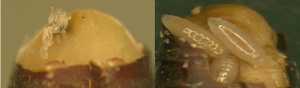
In the past, multidisciplinary studies have been performed looking at the Nasonia complex, for example focused on host-parasite interactions, but also on speciation, e.g. by S. R. Bordenstein et al. (2001), who found indications for a bacterial Wolbachia-induced incompatibility between two species of Nasonia, thus contributing to postmating isolation.
In order to better understand prezygotic isolation in four species of genus Nasonia, Babita Rahul Baisla and colleagues set out to determine whether the male reproductive organs are suitable as distinguishing characteristics and thus may explain prezygotic isolation mechanisms. In addition, they conducted behavioral studies to find further or alternative evidence for prezygotic isolation mechanisms.
Main methods
The authors studied the four species of genus Nasonia under controlled temperature and humidity and reared them repeatedly due to the short life cycle durations of about 14 days. As host they used Sarcophaga dux (Diptera: Sarcophagidae) pupae. For morphological studies they prepared virgin females and males of a defined age of 12 hours, which was important to avoid morphological variation based on aging processes.
The aedeagus length was measured using a specialized Fiji software, while the aedeagus aperture lengthwas determined using scanning electron microscopy. To measure sperm sizes, the authors dissected the seminal vesicles and fixed sperm individuals.
Mating acceptance within the same species and between partners of different species was observed in virgin males and females for a defined duration. Statistical calculations were performed using the Kruskal-Wallis and the pairwise Dunn’s post hoc tests.
Main results
• The morphological structure of the male genital organ was found to be strikingly similar in all four species: two testes with a single lobe structure were located beneath the digestive system. Round accessory glands lay behind the seminal vesicles. The two vas deferens then merged to form the common ejaculatory duct.
• The external components of the male genital system, namely the aedeagus itself as the copulatory organ, was also deceptively similar. They include the ejaculatory duct and three pairs of cuticular sclerites, the digitus, volsellae, and parameres. Also the number of spines on the parameres was not found to be a suitable criterion for distinguishing species, as it can vary even within a single species.
• The aedeagus length of N. vitripennis and N. oneida was statistically the same. The lengths of N. longicornis (longest aedeagus) and N. giraulti (shortest aedeagus) were significantly different. The aedeagus aperture length was statistically similar in N. vitripennis and N. longicornis, but both were significantly different from N. giraulti and N. oneida. Additionally, the aperture showed a variation within species but also between species.
•The teeth-like spines on each digitus or the sclerite on either side of the aedeagus varied only in N. giraulti (3-5 spines). In some specimens, the spine number also varied between the two sclerites. All other species always had 4 spines.
•The length of sperm cells varied in the four species. But N. longicornis had the longest sperm cells, which statistically differed from all other species.
•In behavioral tests in which a male and a female were placed together, the complete mating behaviour happend significantly most often between conspecifics. In interspecific mating pairs, N. longicornis and N. giraulti females accepted statistically more heterospecific males than N. vitripennis and N. oneida females. But the authors found no statistical correlation between female acceptance and the morphological parameters of aegeagal length and aperture length.
Future perspectives
Since the correlation between aedeagus morphology and the inhibition of the mating procedure with interspecific partners remained unclear, the authors suggest chemisensory or acoustic signals as putatively crucial for prezygotic isolation. A theory that will need to be tested in future studies.
In their discussion chapter, the authors discuss possible functions of the spines. Future research may provide more insight into whether the spines play a more significant role in stabilizing prezygotic isolation.
The ultrastructure of the aedeagus and the aedeagal aperture showed variation in the four species. The authors suggest these found parameters to be used in future studies to, for example, determine local variations in populations of different geographic distribution.
Questions to the authors
• How do different species interact in their natural range? Are there ecological limitations that prevent partners of two species from encountering each other frequently enough to experience a mating stimulus?
• S. R. Bordenstein et al. (2001) report postmating islation in Nasonia giraulti and N. longicornis due to cytoplasmic incompatibility caused by Wolbachia bacteria. Do the authors know whether this postmating effect as hybridization barrier also concerns the two other Nasonia species? The study above also found hybrids between N. giraulti and N. longicornis as being completely viable and fertile in the F1 and F2 generations. Is this also true for N. vitripennis and N. oneida? And can fertile hybrids compete equally with purebred competitors in mate selection?
•The authors determined that there is no correlation between the morphology of the male genital tract, the mating success and the female choice. However, the rounded proportions of the male genitals represent novel findings, but appear to be similar in all species. Is this rounded structure of single genital compartments a striking new innovation of the stem species of Nasonia, or are these genital proportions not unusual within the higher-level taxon Pteromalinae? If the former is true, is there any idea what selection pressure might have favored these special Nasonia male genital proportions?
•Is the function of the spines on the external parts of the male genitalia – in species that show no variability in numbers – possibly different in a mechanical context, for example regarding their elasticity conditions, so that different functions during the mating procedure would still be imaginable?
Reference
Bordenstein, S. R., O’Hara, F. P., Werren, J.H. (2001) Wolbachia-induced incompatibility precedes other hybrid incompatibilities in Nasonia. Nature, 409(6821), pp. 707–710. Available at: https://doi.org/10.1038/246170a0.
doi: https://doi.org/10.1242/prelights.42757
Read preprint (No Ratings Yet)
Sign up to customise the site to your preferences and to receive alerts
Register hereAlso in the animal behavior and cognition category:
Cannibalism as a mechanism to offset reproductive costs in three-spined sticklebacks
Tina Nguyen

Trade-offs between surviving and thriving: A careful balance of physiological limitations and reproductive effort under thermal stress
Tshepiso Majelantle

Responses to conflicting binocular stimuli in mouse primary visual cortex
Maitri Manjunath
Also in the evolutionary biology category:
A drought stress-induced MYB transcription factor regulates pavement cell shape in leaves of European aspen (Populus tremula)
Jeny Jose

Morphological variations in external genitalia do not explain the interspecific reproductive isolation in Nasonia species complex (Hymenoptera: Pteromalidae)
Stefan Friedrich Wirth
A high-coverage genome from a 200,000-year-old Denisovan
AND
A global map for introgressed structural variation and selection in humans
Siddharth Singh

Also in the zoology category:
Resilience to cardiac aging in Greenland shark Somniosus microcephalus
Theodora Stougiannou

DNA Specimen Preservation using DESS and DNA Extraction in Museum Collections: A Case Study Report
Daniel Fernando Reyes Enríquez, Marcus Oliveira
Morphological variations in external genitalia do not explain the interspecific reproductive isolation in Nasonia species complex (Hymenoptera: Pteromalidae)
Stefan Friedrich Wirth
preLists in the animal behavior and cognition category:
Biologists @ 100 conference preList
This preList aims to capture all preprints being discussed at the Biologists @100 conference in Liverpool, UK, either as part of the poster sessions or the (flash/short/full-length) talks.
| List by | Reinier Prosee, Jonathan Townson |
9th International Symposium on the Biology of Vertebrate Sex Determination
This preList contains preprints discussed during the 9th International Symposium on the Biology of Vertebrate Sex Determination. This conference was held in Kona, Hawaii from April 17th to 21st 2023.
| List by | Martin Estermann |
Bats
A list of preprints dealing with the ecology, evolution and behavior of bats
| List by | Baheerathan Murugavel |
FENS 2020
A collection of preprints presented during the virtual meeting of the Federation of European Neuroscience Societies (FENS) in 2020
| List by | Ana Dorrego-Rivas |
Also in the evolutionary biology category:
SciELO preprints – From 2025 onwards
SciELO has become a cornerstone of open, multilingual scholarly communication across Latin America. Its preprint server, SciELO preprints, is expanding the global reach of preprinted research from the region (for more information, see our interview with Carolina Tanigushi). This preList brings together biological, English language SciELO preprints to help readers discover emerging work from the Global South. By highlighting these preprints in one place, we aim to support visibility, encourage early feedback, and showcase the vibrant research communities contributing to SciELO’s open science ecosystem.
| List by | Carolina Tanigushi |
November in preprints – DevBio & Stem cell biology
preLighters with expertise across developmental and stem cell biology have nominated a few developmental and stem cell biology (and related) preprints posted in November they’re excited about and explain in a single paragraph why. Concise preprint highlights, prepared by the preLighter community – a quick way to spot upcoming trends, new methods and fresh ideas.
| List by | Aline Grata et al. |
October in preprints – DevBio & Stem cell biology
Each month, preLighters with expertise across developmental and stem cell biology nominate a few recent developmental and stem cell biology (and related) preprints they’re excited about and explain in a single paragraph why. Short, snappy picks from working scientists — a quick way to spot fresh ideas, bold methods and papers worth reading in full. These preprints can all be found in the October preprint list published on the Node.
| List by | Deevitha Balasubramanian et al. |
October in preprints – Cell biology edition
Different preLighters, with expertise across cell biology, have worked together to create this preprint reading list for researchers with an interest in cell biology. This month, most picks fall under (1) Cell organelles and organisation, followed by (2) Mechanosignaling and mechanotransduction, (3) Cell cycle and division and (4) Cell migration
| List by | Matthew Davies et al. |
Biologists @ 100 conference preList
This preList aims to capture all preprints being discussed at the Biologists @100 conference in Liverpool, UK, either as part of the poster sessions or the (flash/short/full-length) talks.
| List by | Reinier Prosee, Jonathan Townson |
‘In preprints’ from Development 2022-2023
A list of the preprints featured in Development's 'In preprints' articles between 2022-2023
| List by | Alex Eve, Katherine Brown |
preLights peer support – preprints of interest
This is a preprint repository to organise the preprints and preLights covered through the 'preLights peer support' initiative.
| List by | preLights peer support |
EMBO | EMBL Symposium: The organism and its environment
This preList contains preprints discussed during the 'EMBO | EMBL Symposium: The organism and its environment', organised at EMBL Heidelberg, Germany (May 2023).
| List by | Girish Kale |
9th International Symposium on the Biology of Vertebrate Sex Determination
This preList contains preprints discussed during the 9th International Symposium on the Biology of Vertebrate Sex Determination. This conference was held in Kona, Hawaii from April 17th to 21st 2023.
| List by | Martin Estermann |
EMBL Synthetic Morphogenesis: From Gene Circuits to Tissue Architecture (2021)
A list of preprints mentioned at the #EESmorphoG virtual meeting in 2021.
| List by | Alex Eve |
Planar Cell Polarity – PCP
This preList contains preprints about the latest findings on Planar Cell Polarity (PCP) in various model organisms at the molecular, cellular and tissue levels.
| List by | Ana Dorrego-Rivas |
TAGC 2020
Preprints recently presented at the virtual Allied Genetics Conference, April 22-26, 2020. #TAGC20
| List by | Maiko Kitaoka et al. |
ECFG15 – Fungal biology
Preprints presented at 15th European Conference on Fungal Genetics 17-20 February 2020 Rome
| List by | Hiral Shah |
COVID-19 / SARS-CoV-2 preprints
List of important preprints dealing with the ongoing coronavirus outbreak. See http://covidpreprints.com for additional resources and timeline, and https://connect.biorxiv.org/relate/content/181 for full list of bioRxiv and medRxiv preprints on this topic
| List by | Dey Lab, Zhang-He Goh |
1
SDB 78th Annual Meeting 2019
A curation of the preprints presented at the SDB meeting in Boston, July 26-30 2019. The preList will be updated throughout the duration of the meeting.
| List by | Alex Eve |
Pattern formation during development
The aim of this preList is to integrate results about the mechanisms that govern patterning during development, from genes implicated in the processes to theoritical models of pattern formation in nature.
| List by | Alexa Sadier |
Also in the zoology category:
SciELO preprints – From 2025 onwards
SciELO has become a cornerstone of open, multilingual scholarly communication across Latin America. Its preprint server, SciELO preprints, is expanding the global reach of preprinted research from the region (for more information, see our interview with Carolina Tanigushi). This preList brings together biological, English language SciELO preprints to help readers discover emerging work from the Global South. By highlighting these preprints in one place, we aim to support visibility, encourage early feedback, and showcase the vibrant research communities contributing to SciELO’s open science ecosystem.
| List by | Carolina Tanigushi |
Biologists @ 100 conference preList
This preList aims to capture all preprints being discussed at the Biologists @100 conference in Liverpool, UK, either as part of the poster sessions or the (flash/short/full-length) talks.
| List by | Reinier Prosee, Jonathan Townson |
Bats
A list of preprints dealing with the ecology, evolution and behavior of bats
| List by | Baheerathan Murugavel |