






Circadian Clock Programming of Anticipatory Antiviral Immunity Gates Enteric Virus Infection Susceptibility
Posted on: 12 June 2026 , updated on: 15 June 2026
Preprint posted on 16 May 2026
Guardians of the Galaxy : A preprint on how the circadian clock tunes the myeloid immune system and primes antiviral sensors to combat viral infections.
Selected by Owen Ang
Categories: immunology, microbiology
Background
Vulnerability to viral infections can vary widely across individuals, and several factors could contribute to these differences. The circadian clock is a powerful biological system that governs the expression of certain genes in an oscillatory rhythmic fashion following the light-dark cycle, ultimately impacting physiological processes, metabolism and disease manifestations (1). Past studies have explored the impact of the circadian clock on respiratory and systemic viral-induced infections. These revealed that circadian rhythms can influence the intensity and duration of post-infection responses (2,3). In contrast, the impact of circadian rhythm on antiviral programs, and how this translates to infection outcome, remains poorly understood.
Using a model of murine coxsackievirus infection, the authors of this preprint sought to determine whether the circadian clock is involved in the local, temporal regulation of host antiviral defense within the gut.
Key Findings
The circadian clock governs the replication and transmission efficiencies of enteric virus
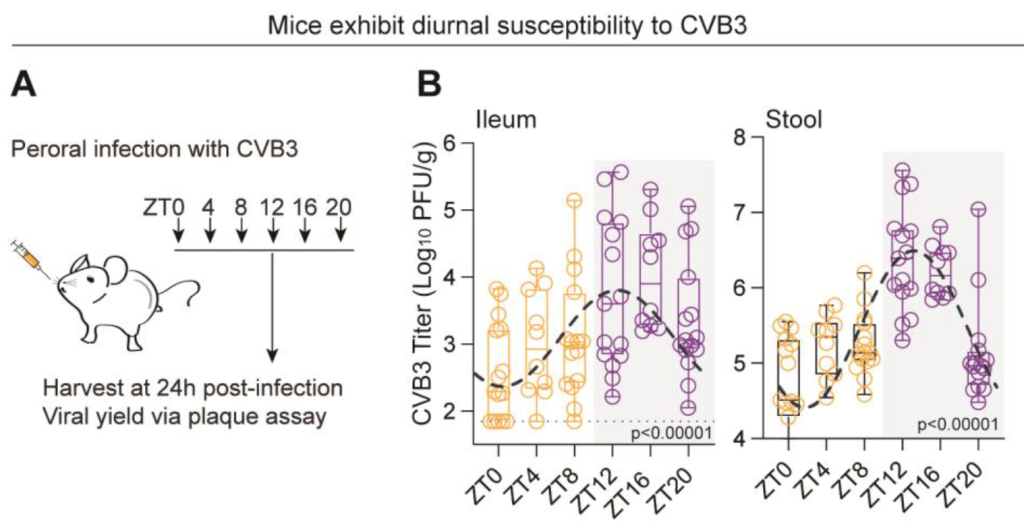
First, the authors established that the circadian clock contributes profoundly to the replication and transmission capacities of enteric viral infection. Using a murine coxsackievirus B3 (CVB3) infection model, the authors observed that mice had significantly higher viral loads especially when infections in the gut occurred during the dark phase of the Zeitgeber Time. The mice were, however, greatly protected if the infections occurred during the early light phase instead (Figure 1A-B). This diurnal oscillation of viral load required an intact circadian clock, as the absence of core circadian transcription factor, CLOCK, completely abolished the phenomenon.
The circadian clock controls the expression of antiviral regulator IRF1
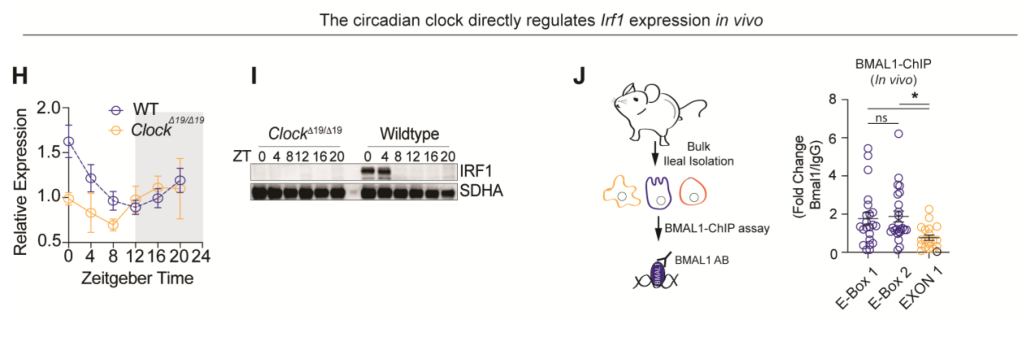
The authors showed for the first time that the circadian clock-regulated Interferon Regulatory Factor 1 (IRF1) was directly responsible for enteric antiviral protection. Since early light phase infection with the CVB3 virus resulted in significant antiviral protection in these mice, the authors investigated if the expression of genes involved in antiviral immunity was altered. Interestingly, IRF1 expression uniquely exhibited a diurnal oscillation, similar to BMAL1, a second vital circadian clock transcription factor.
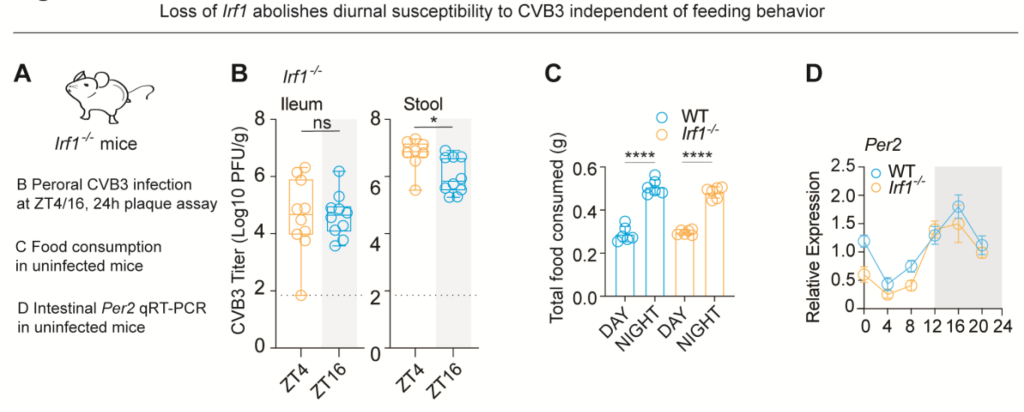
IRF1 is a transcription factor that regulates the expression of host sensors and restriction factors that collectively serve as early antiviral defences (4). The authors elegantly showed through a series of in vitro luciferase reporter and immunoprecipitation assays, that IRF1 expression was directly regulated by CLOCK and BMAL1 (Figure 2H-J), and that high expression of these genes corresponded with antiviral protections conferred during the early light phase. Furthermore, genetic deletion of IRF1 in mice completely abolished temporal variations of CVB3 replication, and reduced expression of antiviral genes without affecting the circadian system (Figure 3A-B).
Enteric antiviral protection is driven by a myeloid cell-intrinsic IRF1 program
The authors also showed that gut myeloid cells were the key mediators of IRF1-driven antiviral immunity against enteric viral infection. The Irf1 gene was more highly expressed within the lamina propria, which is enriched in myeloid cells, and transient deletion of colony-stimulating factor 1 receptor – positive (CSF1r+) myeloid cells greatly reduced Irf1 expression. Furthermore, myeloid cell–specific loss of Irf1 abolished the observed antiviral effect against CVB3 infection, confirming the role of gut myeloid cells in the lamina propria acting as a barrier against CVB3 replication and infection via IRF1.
Why is this preprint important?
This preprint elegantly demonstrates that the timing of infection is a critical determinant of viral pathogenesis, influencing not only host responses following infection but also the effectiveness of antiviral immunity. Notably, the authors are the first to provide evidence, in a mammalian system, for the direct role of the circadian clock in regulating some intrinsic antiviral defense programs. Circadian rhythms shape the host’s susceptibility to early viral infection and replication even before pathogen exposure, positioning the circadian system as a temporal guardian providing antiviral immunity. These results significantly advance our understanding of host–virus interactions and underscore the importance of considering biological time as a key factor in assessing infectious disease susceptibility and outcome.
References
- Bell-Pedersen, V. M. Cassone, D. J. Earnest, S. S. Golden, P. E. Hardin, T. L. Thomas, M. J. Zoran, Circadian rhythms from multiple oscillators: lessons from diverse organisms. Nature Reviews Genetics 6, 544-556 (2005).
- A. Ehlers, W. Xie, E. Agapov, S. Brown, D. Steinberg, R. Tidwell, G. Sajol, R. Schutz, R. Weaver, H. Yu, BMAL1 links the circadian clock to viral airway pathology and asthma phenotypes. Mucosal immunology 11, 97-111 (2018).
- R. S. Edgar, A. Stangherlin, A. D. Nagy, M. P. Nicoll, S. Efstathiou, J. S. O’Neill, A. B. Reddy, Cell autonomous regulation of herpes and influenza virus infection by the circadian clock. Proceedings of the National Academy of Sciences 113, 10085-10090 (2016).
- Zhou, H., Tang, Y.-D., & Zheng, C. (2022). Revisiting IRF1-mediated antiviral innate immunity. Cytokine & Growth Factor Reviews, 64, 1–6. https://doi.org/10.1016/j.cytogfr.2022.01.004
doi: https://doi.org/10.1242/prelights.43942
Read preprintSign up to customise the site to your preferences and to receive alerts
Register hereAlso in the immunology category:
Dysregulated Microglial Synaptic Engulfment in Diffuse Midline Glioma
IRR UoE Journal Club

Inhibition of VP2-mediated entry: a potential antiviral strategy to treat or prevent calicivirus disease
Orestis Savva

EBV reprograms autoreactive anti-CNS B cells as antigen presenting cells in multiple sclerosis
Léa Bastien et al.

Also in the microbiology category:
Population genomics reveals multi-scale mechanisms sustaining schistosomiasis re-emergence in a near-elimination setting
Hala Taha

Circadian Clock Programming of Anticipatory Antiviral Immunity Gates Enteric Virus Infection Susceptibility
Owen Ang
Inhibition of VP2-mediated entry: a potential antiviral strategy to treat or prevent calicivirus disease
Orestis Savva
preLists in the immunology category:
BSDB Spring Meeting: Molecules to Morphogenesis
The British Society for Developmental Biology (BSDB) Spring Meeting Molecules to Morphogenesis was held from 23–26 March 2026 at the University of Warwick (UK). This meeting brought together a vibrant community of researchers to discuss how molecular mechanisms are integrated across scales to drive morphogenesis, spanning diverse model systems and approaches. This preList contains preprints by presenters from the talk and poster sessions at the meeting. Please do get in touch at preLights@biologists.com if you notice any relevant preprints that we may have missed.
| List by | Ingrid Tsang |
SciELO preprints – From 2025 onwards
SciELO has become a cornerstone of open, multilingual scholarly communication across Latin America. Its preprint server, SciELO preprints, is expanding the global reach of preprinted research from the region (for more information, see our interview with Carolina Tanigushi). This preList brings together biological, English language SciELO preprints to help readers discover emerging work from the Global South. By highlighting these preprints in one place, we aim to support visibility, encourage early feedback, and showcase the vibrant research communities contributing to SciELO’s open science ecosystem.
| List by | Carolina Tanigushi |
Community-driven preList – Immunology
In this community-driven preList, a group of preLighters, with expertise in different areas of immunology have worked together to create this preprint reading list.
| List by | Felipe Del Valle Batalla et al. |
Journal of Cell Science meeting ‘Imaging Cell Dynamics’
This preList highlights the preprints discussed at the JCS meeting 'Imaging Cell Dynamics'. The meeting was held from 14 - 17 May 2023 in Lisbon, Portugal and was organised by Erika Holzbaur, Jennifer Lippincott-Schwartz, Rob Parton and Michael Way.
| List by | Helen Zenner |
Fibroblasts
The advances in fibroblast biology preList explores the recent discoveries and preprints of the fibroblast world. Get ready to immerse yourself with this list created for fibroblasts aficionados and lovers, and beyond. Here, my goal is to include preprints of fibroblast biology, heterogeneity, fate, extracellular matrix, behavior, topography, single-cell atlases, spatial transcriptomics, and their matrix!
| List by | Osvaldo Contreras |
Single Cell Biology 2020
A list of preprints mentioned at the Wellcome Genome Campus Single Cell Biology 2020 meeting.
| List by | Alex Eve |
Autophagy
Preprints on autophagy and lysosomal degradation and its role in neurodegeneration and disease. Includes molecular mechanisms, upstream signalling and regulation as well as studies on pharmaceutical interventions to upregulate the process.
| List by | Sandra Malmgren Hill |
Antimicrobials: Discovery, clinical use, and development of resistance
Preprints that describe the discovery of new antimicrobials and any improvements made regarding their clinical use. Includes preprints that detail the factors affecting antimicrobial selection and the development of antimicrobial resistance.
| List by | Zhang-He Goh |
Zebrafish immunology
A compilation of cutting-edge research that uses the zebrafish as a model system to elucidate novel immunological mechanisms in health and disease.
| List by | Shikha Nayar |
Also in the microbiology category:
SciELO preprints – From 2025 onwards
SciELO has become a cornerstone of open, multilingual scholarly communication across Latin America. Its preprint server, SciELO preprints, is expanding the global reach of preprinted research from the region (for more information, see our interview with Carolina Tanigushi). This preList brings together biological, English language SciELO preprints to help readers discover emerging work from the Global South. By highlighting these preprints in one place, we aim to support visibility, encourage early feedback, and showcase the vibrant research communities contributing to SciELO’s open science ecosystem.
| List by | Carolina Tanigushi |
BioMalPar XVI: Biology and Pathology of the Malaria Parasite
[under construction] Preprints presented at the (fully virtual) EMBL BioMalPar XVI, 17-18 May 2020 #emblmalaria
| List by | Dey Lab, Samantha Seah |
1
ECFG15 – Fungal biology
Preprints presented at 15th European Conference on Fungal Genetics 17-20 February 2020 Rome
| List by | Hiral Shah |
EMBL Seeing is Believing – Imaging the Molecular Processes of Life
Preprints discussed at the 2019 edition of Seeing is Believing, at EMBL Heidelberg from the 9th-12th October 2019
| List by | Dey Lab |
Antimicrobials: Discovery, clinical use, and development of resistance
Preprints that describe the discovery of new antimicrobials and any improvements made regarding their clinical use. Includes preprints that detail the factors affecting antimicrobial selection and the development of antimicrobial resistance.
| List by | Zhang-He Goh |