




Gut microbiome changes over the course of multiple sclerosis differentially influence autoimmune neuroinflammation
Posted on: 14 May 2026 , updated on: 18 May 2026
Preprint posted on 24 February 2026
A time‑dependent role of the gut microbiome in Multiple Sclerosis progression
Selected by Carole Djagang, Nour HAROUN, Phalica Georges, uMontreal Neuro preLighters


Categories: genomics, immunology, microbiology, neuroscience
Background
Multiple sclerosis (MS) is a dynamic disease characterized by continuous changes over time. During its early stages, the disease is driven primarily by inflammatory processes that lead to focal demyelinating lesions and episodic neurological symptoms¹,². While genetic factors contribute to MS susceptibility, environmental factors are believed to play a dominant role in its initiation and progression³–⁵. Notably, the gut microbiome has emerged as a critical regulator of immune responses, raising fundamental questions about whether changes in gut bacteria actively drive neurological disease or instead reflect secondary consequences of chronic inflammation ⁶–¹¹.
Although gut microbiome alterations (dysbiosis) have been consistently reported in MS patients, it remains unclear how this relationship evolves over the decades-long course of the disease. Specifically, it is unclear whether microbiome changes are causally linked to disease progression or merely correlate with disease state. Research has shown that MS patients harbor gut microbial communities distinct from those of healthy individuals. In animal models, such differences can directly influence disease severity. However, whether such microbiota-driven immune effects persist throughout the disease or are confined to earlier stages remains an open question.
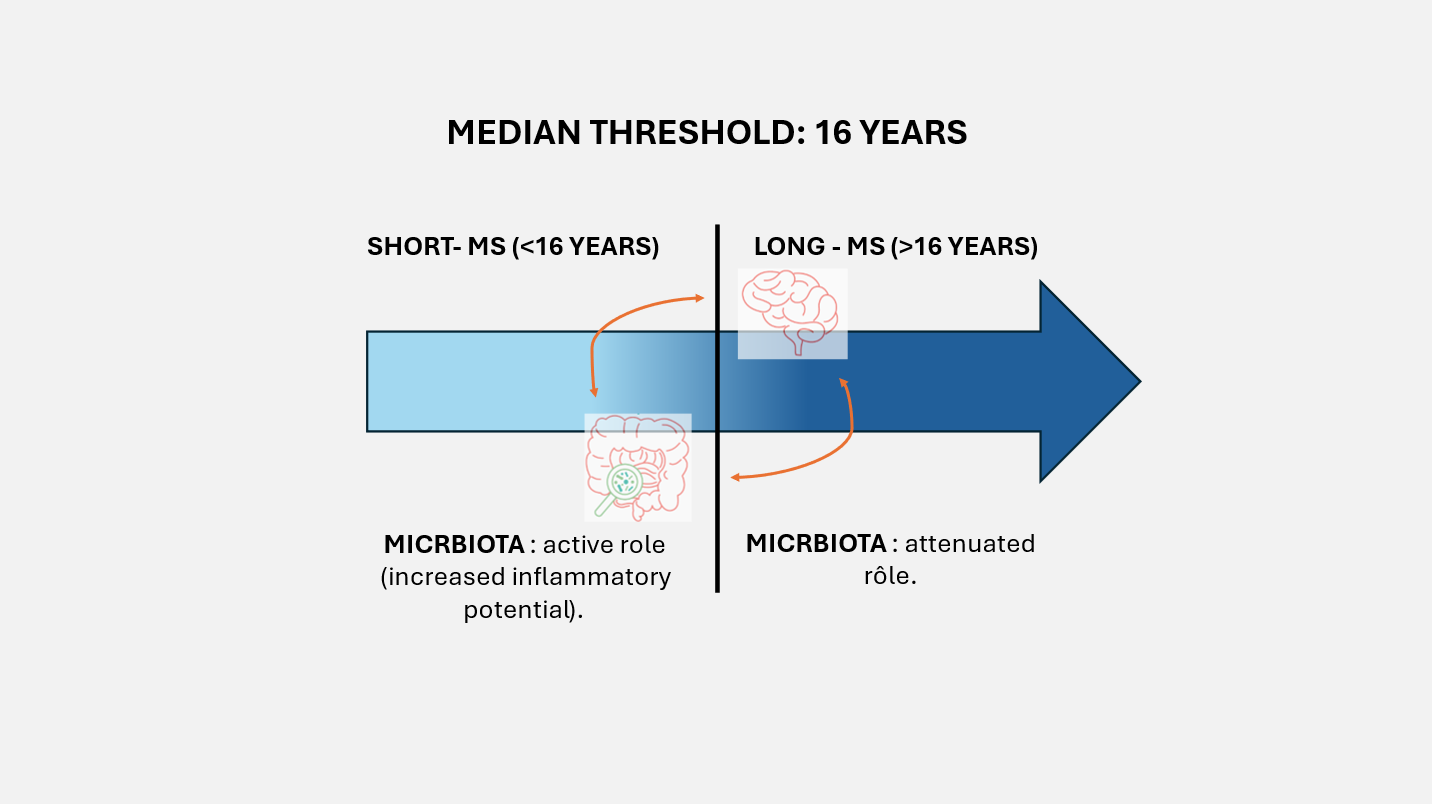
In this context, the present study focuses on a specific cohort of relapsing-remitting MS (RRMS) patients, using a 16-year disease duration threshold to distinguish between “early” and “late” stages. This stratification allows investigation of a potential temporal “window of opportunity” during which modulation of the gut microbiota may exert maximal influence on systemic immune responses and disease trajectory.
Specifically, the study asks whether the gut microbiota’s capacity to shape immune regulation evolves over the course of MS, and whether this evolution parallels the shift from peripheral inflammation to compartmentalized neurodegeneration within the central nervous system. The researchers hypothesize that during early MS (Short-MS), the gut microbiota acts as a key driver of systemic pro-inflammatory responses, whereas this influence diminishes as the disease progresses and pathology becomes increasingly CNS-compartmentalized. Implicitly, this raises the possibility that microbiome-derived signatures could serve as stage-specific biomarkers, potentially informing prognosis or therapeutic timing.
Key Findings
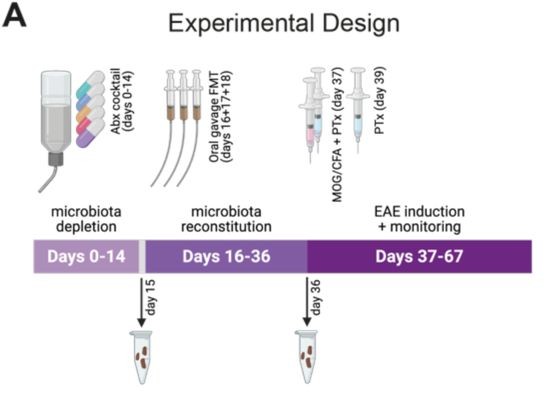
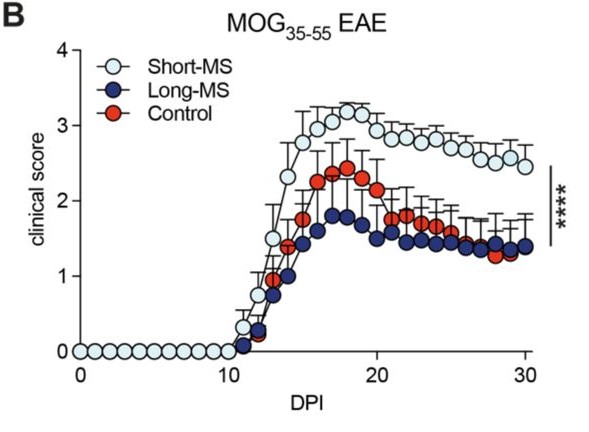
Mice were treated with antibiotics to eliminate their original microbiota and then received three consecutive transplants from human donors to restore it (preprint Fig. 3A). Each faecal sample used for transplantation came from one of three groups (controls, short-MS, and long-MS). After 3 weeks, faecal samples were taken to make sure that the microbiota from human donors was able to implant itself correctly to the gastrointestinal tract of the recipient.
Short-MS microbiota exacerbates disease severity
Mice transplanted with faecal samples demonstrated a similar disease course with a peak followed by a partial recovery period. It was, however, not the case for mice transplanted with short-MS faecal samples, which showed a higher disease burden not followed by a remission phase. (preprint Fig. 3B).
Loss of Treg-mediated regulation correlates with disease severity
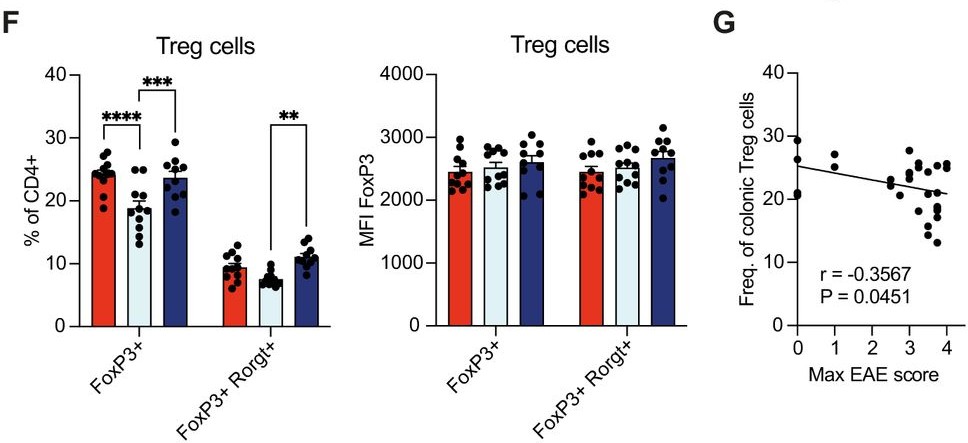
FOXP3 is expressed by Treg. FoxP3+ Rorgt+ pTreg cells are directly related to the microbiota and inflammation. A decrease of FOXP3+ Treg cells and FOXP3+ Rorgt+ PTreg cells was observed in the colon of mice treated with short-MS microbiota (preprint Fig. 4F). The count of FOXP3+ Treg cells was negatively correlated with the maximum clinical score reached during the EAE development used to model neuroinflammation-related damages seen in multiple sclerosis (preprint Fig. 4G).
Short-MS microbiota promotes systemic inflammation
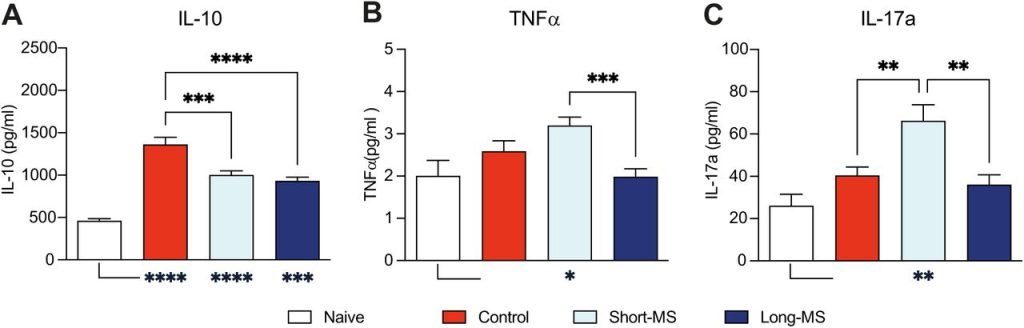
All faecal samples led to an increase in anti-inflammatory cytokine (IL-10) production by Peripheral Blood Mononuclear Cells (PBMCs). However, the control supernatant was a greater IL-10 inducer (preprint Fig. 5A). A higher secretion of pro-inflammatory cytokines (TNF-a and IL-17) was detected in cells stimulated only with the faecal extracts of short-MS patients (preprint Fig. 5B-C). These results show that the microbiota from short-MS patients has a greater capacity of evoking systemic inflammatory responses.
Why we highlight this preprint
This preprint really resonated with us, as it highlights how complex diseases like MS require multidisciplinary approaches. We found it particularly interesting that the gut microbiome evolves with disease stage shifting from a proinflammatory profile early on to a more balanced state later. By focusing on intra-disease variation, it offers a fresh perspective on how these changes shape immune responses and progression.
Our longstanding interest in MS stems from its clinical heterogeneity, unpredictability, and the shifting inflammatory dynamics that make RR form uniquely compelling to explore.
Additionally, this paper parallels our own work using adoptive transfer of activated T cells to induce Parkinsonism-like phenotype in germ-free mice. After encountering difficulties reproducing this model in a new animal facility, we hypothesized that differences in gut microbiota might explain this variability. The findings support our view, showing that immune activation alone is insufficient; microbial composition critically modulates neuroimmune outcomes.
Questions for the authors
1. Would it be possible to include additional control groups, such as mice that were only immunized (MOG), PTx only or those that received microbiota transfer alone, to better isolate and assess the specific influence of the microbiota on the host response?
2. Would it be possible to examine the immune cells composition within the brains of the recipient mice to more precisely identify which cellular subsets had traversed the blood–brain barrier, or to characterize the CNS‑infiltrating immune populations elicited in response to microbiota transfer? Such analyses could provide a deeper mechanistic understanding of how microbiota‑driven immune modulation shapes neuroinflammatory pathways and contributes to neurodegenerative processes
3. It is unclear whether patients discontinued immunomodulatory/suppressive therapy before fecal sampling. If not, how can you rule out that the observed microbiome profiles result from drug effects rather than disease‑related changes, especially if the agent is oral and can directly alter the mice’s response after transplantation?
References
- Pontieri, L., Greene, N., Wandall-Holm, M.F., Geertsen, S.S., Asgari, N., Jensen, H.B., Illes, Z., Schäfer, J., Jensen, R.M., Sejbæk, T., Weglewski, A., Mahler, M.R., Poulsen, M.B., Prakash, S., Stilund, M., Kant, M., Rasmussen, P.V., Svendsen, K.B., Sellebjerg, F., Magyari, M., 2024. Patterns and predictors of multiple sclerosis phenotype transition. Brain Commun. 6, fcae422. doi:10.1093/braincomms/fcae422
- Zanghì, A., Copetti, M., Avolio, C., Paolicelli, D., Romeo, M.A.L., Patti, F., Luca, G.D., Amato, M.P., Galgani, S., Sola, P., Salemi, G., Gallo, P., Granella, F., Romano, S., Zaffaroni, M., Bergamaschi, R., Pozzilli, C., Lus, G., Vianello, M., Trojano, M., D’Amico, E., Danni, M.C., Totaro, R., Lugaresi, A., Cocco, E., Valentino, P., Iaffaldano, P., Inglese, M., Bellantonio, P., Filippi, M., Rovaris, M., Clerici, V.T., Ferraro, D., Lus, G., Maniscalco, G.T., Morra, V.B., Pesci, I., Foschi, M., Aguglia, U., Montepietra, S., Marfia, G.A., 2025. Multiple sclerosis from onset to secondary progression: a 30-year Italian register study. J. Neurol., Neurosurg. Psychiatry 96, 1061–1069. doi:10.1136/jnnp-2025-335958
- Baranzini, S.E., Oksenberg, J.R., 2017. The Genetics of Multiple Sclerosis: From 0 to 200 in 50 Years. Trends Genet. 33, 960–970. doi:10.1016/j.tig.2017.09.004
- Goris, A., Vandebergh, M., McCauley, J.L., Saarela, J., Cotsapas, C., 2022. Genetics of multiple sclerosis: lessons from polygenicity. Lancet Neurol. 21, 830–842. doi:10.1016/s1474-4422(22)00255-1
- Fagnani, C., Neale, M.C., Nisticò, L., Stazi, M.A., Ricigliano, V.A., Buscarinu, M.C., Salvetti, M., Ristori, G., 2014. Twin studies in multiple sclerosis: A meta-estimation of heritability and environmentality. Mult. Scler. J. 21, 1404–1413. doi:10.1177/1352458514564492
- Miyake, S., Kim, S., Suda, W., Oshima, K., Nakamura, M., Matsuoka, T., Chihara, N., Tomita, A., Sato, W., Kim, S.-W., Morita, H., Hattori, M., Yamamura, T., 2015. Dysbiosis in the Gut Microbiota of Patients with Multiple Sclerosis, with a Striking Depletion of Species Belonging to Clostridia XIVa and IV Clusters. PLoS ONE 10, e0137429. doi:10.1371/journal.pone.0137429.s010
- Jangi, S., Gandhi, R., Cox, L.M., Li, N., Glehn, F. von, Yan, R., Patel, B., Mazzola, M.A., Liu, S., Glanz, B.L., Cook, S., Tankou, S., Stuart, F., Melo, K., Nejad, P., Smith, K., uolu, B. uuml m D.T. ccedil, Holden, J., kk, P.K. auml, Chitnis, T., Jager, P.L.D., Quintana, F.J., Gerber, G.K., Bry, L., Weiner, H.L., 2016. Alterations of the human gut microbiome in multiple sclerosis. Nature Communications 7, 1–11. doi:10.1038/ncomms12015
- Tremlett, H., Fadrosh, D.W., Faruqi, A.A., Hart, J., Roalstad, S., Graves, J., Spencer, C.M., Lynch, S.V., Zamvil, S.S., Waubant, E., Centers, U.N. of P.M., 2016. Associations between the gut microbiota and host immune markers in pediatric multiple sclerosis and controls. BMC neurology 16, 182–9. doi:10.1186/s12883-016-0703-3
- Berer, K., Gerdes, L.A., Cekanaviciute, E., Jia, X., Xiao, L., Xia, Z., Liu, C., Klotz, L., Stauffer, U., Baranzini, S.E., Kümpfel, T., Hohlfeld, R., Krishnamoorthy, G., Wekerle, H., 2017. Gut microbiota from multiple sclerosis patients enables spontaneous autoimmune encephalomyelitis in mice. Proceedings of the National Academy of Sciences of the United States of America 114, 10719–10724. doi:10.1073/pnas.1711233114
- Reynders, T., Devolder, L., Valles‐Colomer, M., Remoortel, A.V., Joossens, M., Keyser, J.D., Nagels, G., D’hooghe, M., Raes, J., 2020. Gut microbiome variation is associated to Multiple Sclerosis phenotypic subtypes. Ann. Clin. Transl. Neurol. 7, 406–419. doi:10.1002/acn3.51004
- Horton, M.K., McCauley, K., Fadrosh, D., Fujimura, K., Graves, J., Ness, J., Wheeler, Y., Gorman, M.P., Benson, L.A., Weinstock‐Guttman, B., Waldman, A., Rodriguez, M., Tillema, J., Krupp, L., Belman, A., Mar, S., Rensel, M., Chitnis, T., Casper, T.C., Rose, J., Hart, J., Shao, X., Tremlett, H., Lynch, S.V., Barcellos, L.F., Waubant, E., Centers, the U.S.N. of P.M., 2021. Gut microbiome is associated with multiple sclerosis activity in children. Ann. Clin. Transl. Neurol. 8, 1867–1883. doi:10.1002/acn3.51441
doi: https://doi.org/10.1242/prelights.43545
Read preprintSign up to customise the site to your preferences and to receive alerts
Register hereAlso in the genomics category:
Brassinosteroid receptors reveal conserved features of exon-embedded gene regulation
Karima El Mahboubi

Population genomics reveals multi-scale mechanisms sustaining schistosomiasis re-emergence in a near-elimination setting
Hala Taha

Diversity and Spatial Segregation of TRP Channels in Choanoflagellates Provide Insight into the Evolutionary Origin of Animal Sensory Systems
Urvashi Goswami

Also in the immunology category:
Dysregulated Microglial Synaptic Engulfment in Diffuse Midline Glioma
IRR UoE Journal Club

Circadian Clock Programming of Anticipatory Antiviral Immunity Gates Enteric Virus Infection Susceptibility
Owen Ang

Inhibition of VP2-mediated entry: a potential antiviral strategy to treat or prevent calicivirus disease
Orestis Savva
Also in the microbiology category:
Population genomics reveals multi-scale mechanisms sustaining schistosomiasis re-emergence in a near-elimination setting
Hala Taha
Circadian Clock Programming of Anticipatory Antiviral Immunity Gates Enteric Virus Infection Susceptibility
Owen Ang
Gut microbiome changes over the course of multiple sclerosis differentially influence autoimmune neuroinflammation
Carole Djagang et al.

Also in the neuroscience category:
Centrosome Loss Alters Axonal and Muscle Development
Jeny Jose

Microglia extract neuronal proteolytic organelles via skoupocytosis
Chandrika Rao

Vectorial efference copy and visuomotor transformation through gap junctions
Lochlan Walsh
preLists in the genomics category:
‘In preprints’ from Development 2026
A list of the preprints featured in Development's 'In preprints' articles, as part of the new Preprint Editors initiative
| List by | Clarisse Brunet Avalos et al. |
Santa Cruz Developmental Biology Meeting 2026
This preList brings together a selection of preprints discussed at the Santa Cruz Developmental Biology Meeting 2026, held at UC Santa Cruz with the theme “Biomedicine, Biomechanics, and the Biosphere.” Reflecting the meeting’s broad scientific scope, from development and regeneration to evolution, tissue mechanics, and emerging technologies, this curated collection showcases work that contributed to conversations throughout the meeting.
| List by | Ingrid Tsang |
BSDB Spring Meeting: Molecules to Morphogenesis
The British Society for Developmental Biology (BSDB) Spring Meeting Molecules to Morphogenesis was held from 23–26 March 2026 at the University of Warwick (UK). This meeting brought together a vibrant community of researchers to discuss how molecular mechanisms are integrated across scales to drive morphogenesis, spanning diverse model systems and approaches. This preList contains preprints by presenters from the talk and poster sessions at the meeting. Please do get in touch at preLights@biologists.com if you notice any relevant preprints that we may have missed.
| List by | Ingrid Tsang |
Keystone Symposium on Stem Cell Models in Embryology 2026
The Keystone Symposium on Stem Cell Models in Embryology, 2026, was organised by Jun Wu (UT Southwestern), Jianping Fu (University of Michigan) and Miki Ebisuya (TU Dresden) and held at Asilomar Conference Grounds in California (US). The meeting discussed recent advances made in establishing stem-cell-based embryo models, what fundamental insights into developmental processes have been gleaned from them, as well as how they are beginning to be applied more widely. This prelist contains preprints by presenters at the talk and poster sessions at the conference, which our Reviews Editor in attendance spotted. Please do reach out to preLights@biologists.com if you notice any that we’ve missed.
| List by | Ingrid Tsang |
November in preprints – DevBio & Stem cell biology
preLighters with expertise across developmental and stem cell biology have nominated a few developmental and stem cell biology (and related) preprints posted in November they’re excited about and explain in a single paragraph why. Concise preprint highlights, prepared by the preLighter community – a quick way to spot upcoming trends, new methods and fresh ideas.
| List by | Aline Grata et al. |
May in preprints – the CellBio edition
A group of preLighters, with expertise in different areas of cell biology, have worked together to create this preprint reading lists for researchers with an interest in cell biology. This month, categories include: 1) Biochemistry/metabolism 2) Cancer cell Biology 3) Cell adhesion, migration and cytoskeleton 4) Cell organelles and organisation 5) Cell signalling and 6) Genetics
| List by | Barbora Knotkova et al. |
March in preprints – the CellBio edition
A group of preLighters, with expertise in different areas of cell biology, have worked together to create this preprint reading lists for researchers with an interest in cell biology. This month, categories include: 1) cancer biology 2) cell migration 3) cell organelles and organisation 4) cell signalling and mechanosensing 5) genetics and genomics 6) other
| List by | Girish Kale et al. |
Biologists @ 100 conference preList
This preList aims to capture all preprints being discussed at the Biologists @100 conference in Liverpool, UK, either as part of the poster sessions or the (flash/short/full-length) talks.
| List by | Reinier Prosee, Jonathan Townson |
Early 2025 preprints – the genetics & genomics edition
In this community-driven preList, a group of preLighters, with expertise in different areas of genetics and genomics have worked together to create this preprint reading list. Categories include: 1) bioinformatics 2) epigenetics 3) gene regulation 4) genomics 5) transcriptomics
| List by | Chee Kiang Ewe et al. |
End-of-year preprints – the genetics & genomics edition
In this community-driven preList, a group of preLighters, with expertise in different areas of genetics and genomics have worked together to create this preprint reading list. Categories include: 1) genomics 2) bioinformatics 3) gene regulation 4) epigenetics
| List by | Chee Kiang Ewe et al. |
BSCB-Biochemical Society 2024 Cell Migration meeting
This preList features preprints that were discussed and presented during the BSCB-Biochemical Society 2024 Cell Migration meeting in Birmingham, UK in April 2024. Kindly put together by Sara Morais da Silva, Reviews Editor at Journal of Cell Science.
| List by | Reinier Prosee |
9th International Symposium on the Biology of Vertebrate Sex Determination
This preList contains preprints discussed during the 9th International Symposium on the Biology of Vertebrate Sex Determination. This conference was held in Kona, Hawaii from April 17th to 21st 2023.
| List by | Martin Estermann |
Semmelweis Symposium 2022: 40th anniversary of international medical education at Semmelweis University
This preList contains preprints discussed during the 'Semmelweis Symposium 2022' (7-9 November), organised around the 40th anniversary of international medical education at Semmelweis University covering a wide range of topics.
| List by | Nándor Lipták |
20th “Genetics Workshops in Hungary”, Szeged (25th, September)
In this annual conference, Hungarian geneticists, biochemists and biotechnologists presented their works. Link: http://group.szbk.u-szeged.hu/minikonf/archive/prg2021.pdf
| List by | Nándor Lipták |
EMBL Conference: From functional genomics to systems biology
Preprints presented at the virtual EMBL conference "from functional genomics and systems biology", 16-19 November 2020
| List by | Jesus Victorino |
TAGC 2020
Preprints recently presented at the virtual Allied Genetics Conference, April 22-26, 2020. #TAGC20
| List by | Maiko Kitaoka et al. |
Zebrafish immunology
A compilation of cutting-edge research that uses the zebrafish as a model system to elucidate novel immunological mechanisms in health and disease.
| List by | Shikha Nayar |
Also in the immunology category:
BSDB Spring Meeting: Molecules to Morphogenesis
The British Society for Developmental Biology (BSDB) Spring Meeting Molecules to Morphogenesis was held from 23–26 March 2026 at the University of Warwick (UK). This meeting brought together a vibrant community of researchers to discuss how molecular mechanisms are integrated across scales to drive morphogenesis, spanning diverse model systems and approaches. This preList contains preprints by presenters from the talk and poster sessions at the meeting. Please do get in touch at preLights@biologists.com if you notice any relevant preprints that we may have missed.
| List by | Ingrid Tsang |
SciELO preprints – From 2025 onwards
SciELO has become a cornerstone of open, multilingual scholarly communication across Latin America. Its preprint server, SciELO preprints, is expanding the global reach of preprinted research from the region (for more information, see our interview with Carolina Tanigushi). This preList brings together biological, English language SciELO preprints to help readers discover emerging work from the Global South. By highlighting these preprints in one place, we aim to support visibility, encourage early feedback, and showcase the vibrant research communities contributing to SciELO’s open science ecosystem.
| List by | Carolina Tanigushi |
Community-driven preList – Immunology
In this community-driven preList, a group of preLighters, with expertise in different areas of immunology have worked together to create this preprint reading list.
| List by | Felipe Del Valle Batalla et al. |
Journal of Cell Science meeting ‘Imaging Cell Dynamics’
This preList highlights the preprints discussed at the JCS meeting 'Imaging Cell Dynamics'. The meeting was held from 14 - 17 May 2023 in Lisbon, Portugal and was organised by Erika Holzbaur, Jennifer Lippincott-Schwartz, Rob Parton and Michael Way.
| List by | Helen Zenner |
Fibroblasts
The advances in fibroblast biology preList explores the recent discoveries and preprints of the fibroblast world. Get ready to immerse yourself with this list created for fibroblasts aficionados and lovers, and beyond. Here, my goal is to include preprints of fibroblast biology, heterogeneity, fate, extracellular matrix, behavior, topography, single-cell atlases, spatial transcriptomics, and their matrix!
| List by | Osvaldo Contreras |
Single Cell Biology 2020
A list of preprints mentioned at the Wellcome Genome Campus Single Cell Biology 2020 meeting.
| List by | Alex Eve |
Autophagy
Preprints on autophagy and lysosomal degradation and its role in neurodegeneration and disease. Includes molecular mechanisms, upstream signalling and regulation as well as studies on pharmaceutical interventions to upregulate the process.
| List by | Sandra Malmgren Hill |
Antimicrobials: Discovery, clinical use, and development of resistance
Preprints that describe the discovery of new antimicrobials and any improvements made regarding their clinical use. Includes preprints that detail the factors affecting antimicrobial selection and the development of antimicrobial resistance.
| List by | Zhang-He Goh |
Also in the microbiology category:
SciELO preprints – From 2025 onwards
SciELO has become a cornerstone of open, multilingual scholarly communication across Latin America. Its preprint server, SciELO preprints, is expanding the global reach of preprinted research from the region (for more information, see our interview with Carolina Tanigushi). This preList brings together biological, English language SciELO preprints to help readers discover emerging work from the Global South. By highlighting these preprints in one place, we aim to support visibility, encourage early feedback, and showcase the vibrant research communities contributing to SciELO’s open science ecosystem.
| List by | Carolina Tanigushi |
BioMalPar XVI: Biology and Pathology of the Malaria Parasite
[under construction] Preprints presented at the (fully virtual) EMBL BioMalPar XVI, 17-18 May 2020 #emblmalaria
| List by | Dey Lab, Samantha Seah |
1
ECFG15 – Fungal biology
Preprints presented at 15th European Conference on Fungal Genetics 17-20 February 2020 Rome
| List by | Hiral Shah |
EMBL Seeing is Believing – Imaging the Molecular Processes of Life
Preprints discussed at the 2019 edition of Seeing is Believing, at EMBL Heidelberg from the 9th-12th October 2019
| List by | Dey Lab |
Also in the neuroscience category:
‘In preprints’ from Development 2026
A list of the preprints featured in Development's 'In preprints' articles, as part of the new Preprint Editors initiative
| List by | Clarisse Brunet Avalos et al. |
preLighters’ choice – Handpicked DevBio preprints
preLighters with expertise across developmental and stem cell biology have nominated a few developmental biology (and related) preprints they’re excited about and explain in a few paragraph why. Concise preprint highlights, prepared by the preLighter community – a quick way to spot upcoming trends, new methods and fresh ideas.
| List by | Theodora Stougiannou et al. |
BSDB Spring Meeting: Molecules to Morphogenesis
The British Society for Developmental Biology (BSDB) Spring Meeting Molecules to Morphogenesis was held from 23–26 March 2026 at the University of Warwick (UK). This meeting brought together a vibrant community of researchers to discuss how molecular mechanisms are integrated across scales to drive morphogenesis, spanning diverse model systems and approaches. This preList contains preprints by presenters from the talk and poster sessions at the meeting. Please do get in touch at preLights@biologists.com if you notice any relevant preprints that we may have missed.
| List by | Ingrid Tsang |
Keystone Symposium on Stem Cell Models in Embryology 2026
The Keystone Symposium on Stem Cell Models in Embryology, 2026, was organised by Jun Wu (UT Southwestern), Jianping Fu (University of Michigan) and Miki Ebisuya (TU Dresden) and held at Asilomar Conference Grounds in California (US). The meeting discussed recent advances made in establishing stem-cell-based embryo models, what fundamental insights into developmental processes have been gleaned from them, as well as how they are beginning to be applied more widely. This prelist contains preprints by presenters at the talk and poster sessions at the conference, which our Reviews Editor in attendance spotted. Please do reach out to preLights@biologists.com if you notice any that we’ve missed.
| List by | Ingrid Tsang |
November in preprints – DevBio & Stem cell biology
preLighters with expertise across developmental and stem cell biology have nominated a few developmental and stem cell biology (and related) preprints posted in November they’re excited about and explain in a single paragraph why. Concise preprint highlights, prepared by the preLighter community – a quick way to spot upcoming trends, new methods and fresh ideas.
| List by | Aline Grata et al. |
October in preprints – DevBio & Stem cell biology
Each month, preLighters with expertise across developmental and stem cell biology nominate a few recent developmental and stem cell biology (and related) preprints they’re excited about and explain in a single paragraph why. Short, snappy picks from working scientists — a quick way to spot fresh ideas, bold methods and papers worth reading in full. These preprints can all be found in the October preprint list published on the Node.
| List by | Deevitha Balasubramanian et al. |
October in preprints – Cell biology edition
Different preLighters, with expertise across cell biology, have worked together to create this preprint reading list for researchers with an interest in cell biology. This month, most picks fall under (1) Cell organelles and organisation, followed by (2) Mechanosignaling and mechanotransduction, (3) Cell cycle and division and (4) Cell migration
| List by | Matthew Davies et al. |
July in preprints – the CellBio edition
A group of preLighters, with expertise in different areas of cell biology, have worked together to create this preprint reading lists for researchers with an interest in cell biology. This month, categories include: (1) Cell Signalling and Mechanosensing (2) Cell Cycle and Division (3) Cell Migration and Cytoskeleton (4) Cancer Biology (5) Cell Organelles and Organisation
| List by | Girish Kale et al. |
May in preprints – the CellBio edition
A group of preLighters, with expertise in different areas of cell biology, have worked together to create this preprint reading lists for researchers with an interest in cell biology. This month, categories include: 1) Biochemistry/metabolism 2) Cancer cell Biology 3) Cell adhesion, migration and cytoskeleton 4) Cell organelles and organisation 5) Cell signalling and 6) Genetics
| List by | Barbora Knotkova et al. |
April in preprints – the CellBio edition
A group of preLighters, with expertise in different areas of cell biology, have worked together to create this preprint reading lists for researchers with an interest in cell biology. This month, categories include: 1) biochemistry/metabolism 2) cell cycle and division 3) cell organelles and organisation 4) cell signalling and mechanosensing 5) (epi)genetics
| List by | Vibha SINGH et al. |
Biologists @ 100 conference preList
This preList aims to capture all preprints being discussed at the Biologists @100 conference in Liverpool, UK, either as part of the poster sessions or the (flash/short/full-length) talks.
| List by | Reinier Prosee, Jonathan Townson |
2024 Hypothalamus GRC
This 2024 Hypothalamus GRC (Gordon Research Conference) preList offers an overview of cutting-edge research focused on the hypothalamus, a critical brain region involved in regulating homeostasis, behavior, and neuroendocrine functions. The studies included cover a range of topics, including neural circuits, molecular mechanisms, and the role of the hypothalamus in health and disease. This collection highlights some of the latest advances in understanding hypothalamic function, with potential implications for treating disorders such as obesity, stress, and metabolic diseases.
| List by | Nathalie Krauth |
‘In preprints’ from Development 2022-2023
A list of the preprints featured in Development's 'In preprints' articles between 2022-2023
| List by | Alex Eve, Katherine Brown |
CSHL 87th Symposium: Stem Cells
Preprints mentioned by speakers at the #CSHLsymp23
| List by | Alex Eve |
Journal of Cell Science meeting ‘Imaging Cell Dynamics’
This preList highlights the preprints discussed at the JCS meeting 'Imaging Cell Dynamics'. The meeting was held from 14 - 17 May 2023 in Lisbon, Portugal and was organised by Erika Holzbaur, Jennifer Lippincott-Schwartz, Rob Parton and Michael Way.
| List by | Helen Zenner |
FENS 2020
A collection of preprints presented during the virtual meeting of the Federation of European Neuroscience Societies (FENS) in 2020
| List by | Ana Dorrego-Rivas |
ASCB EMBO Annual Meeting 2019
A collection of preprints presented at the 2019 ASCB EMBO Meeting in Washington, DC (December 7-11)
| List by | Madhuja Samaddar et al. |
SDB 78th Annual Meeting 2019
A curation of the preprints presented at the SDB meeting in Boston, July 26-30 2019. The preList will be updated throughout the duration of the meeting.
| List by | Alex Eve |
Autophagy
Preprints on autophagy and lysosomal degradation and its role in neurodegeneration and disease. Includes molecular mechanisms, upstream signalling and regulation as well as studies on pharmaceutical interventions to upregulate the process.
| List by | Sandra Malmgren Hill |
Young Embryologist Network Conference 2019
Preprints presented at the Young Embryologist Network 2019 conference, 13 May, The Francis Crick Institute, London
| List by | Alex Eve |