






Feeding and reproduction of a tropical coastal copepod across warming and copper gradients
Posted on: 25 May 2026 , updated on: 2 June 2026
Preprint posted on 14 April 2026
Warming makes copper’s effects on copepod feeding and reproduction unpredictable
Selected by Tina Nguyen
Categories: ecology, physiology
Why I highlight this preprint:
While there are many studies on the toxic effects of copper on copepods, this paper caught my attention because it also incorporates increased temperatures and how these variables may in combination impact reproduction and feeding. As there are multiple growing threats to marine life, it is essential to understand how marine populations may change over time and how this may affect ecosystem function.
Background:
Copper pollution in the ocean has been increasing due to expanding aquaculture and shipping in Southeast Asia, which harms the health and survival of marine organisms. Ocean temperatures are also rising, with more frequent and prolonged record highs. Many cold-blooded marine animals already live close to their thermal limit, meaning that warmer waters may push them beyond what they can tolerate. Increased toxin levels can also impact an animal’s sensitivity and ability to deal with warmer waters, emphasizing the importance of studying these stressors together.
Calanoid copepods are a major food source in their ecosystems and have short generation times, with changes in their population size having a large impact on their communities. In this preprint, the authors investigated how these copepods might be affected by combined higher temperature and copper levels to determine how their populations may change over time.
Approach:
The research team raised copepods under different combinations of copper and temperature levels for 7 days. The temperature ranged from 26-35°C, and copper concentrations varied from 0 to 40 µg/L to represent the low and high extremes the copepods may experience (Fig. 1). They measured fecal pellets to approximate energy intake in addition to tracking survival and offspring production.
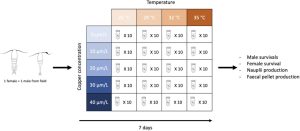
Figure 1: Experimental design used to test the effects of temperature (26, 29, 32, and 35 °C) and copper concentrations (0, 10, 20, 30 and 40 µg L−1) on the tropical copepod Pseudodiaptomus annandalei. This figure was made available under a CC-BY-NC-ND 4.0 International license.
Key findings:
Survival did not change under higher temperatures, but offspring and fecal pellet production decreased
Survival of the copepods did not differ between any of the different temperature and copper combinations, which the authors suspected may be due to the copepods using more energy to tolerate higher temperatures for short periods of time. However, fecal pellets decreased, indicating that warmer waters may increase energetic demand that the copepods cannot meet by feeding alone. Reproduction may have also decreased under the most extreme temperatures, as more energy had to be allocated to survival. Offspring production peaked at 32°C, suggesting that while higher temperatures increase reproduction rates to an extent, extreme conditions can push copepods past their limits and decrease overall production. These findings support the idea that many organisms live near their upper temperature limits and could explain why climate change may reduce their abundance in the future.
Copper alone had little effect on the copepods, but temperature stress and copper combined, as well as an extended experimental duration, showed mixed results
Copepods’ survival, reproduction, and feeding were highly variable under any of the different copper concentrations, but no consistent pattern was found. The authors speculated that this may be due to differences in copepod age, physical health, and reproductive stage. However, adding temperature stress to the mix changed how the copper effects appeared in the copepods. At the optimal temperature of 32°C, there was no difference between any of the copper levels, and all of the copepods seemed to behave the same. When the water was either colder or warmer than their optimal temperature, the responses became inconsistent, with copper seeming to benefit, harm, or have no effect on the copepods. These results indicate that copper concentrations are not the only factor that determines how toxic copper is. The different groups showed no differences for the first 5 days, but diverged in days 6-7, with these changes also being inconsistent. These findings show that both reproduction and feeding are more sensitive to combined copper exposure and temperature stress than survival. They also stress the importance of examining longer-term effects.
Questions for the authors:
- The number of offspring produced was used as a proxy for reproductive health in copepods. Would the offspring of the parents similarly show reduced survival, development, or reproductive success? It would be interesting to see how future generations are impacted by their parents experiencing adverse conditions.
- Since combined high copper and temperature levels had mixed, unpredictable results, how might other environmental variables interact with either copper or temperature and affect the copepods? For example, would UV and copper combined produce different results than UV and temperature?
doi: https://doi.org/10.1242/prelights.43695
Read preprintSign up to customise the site to your preferences and to receive alerts
Register hereAlso in the ecology category:
Modes of natural selection on maternal and zygotic gene expression in Drosophila melanogaster embryos
Girish Kale, preLights peer support

Heatwave winners and losers: cryptic coral holobionts differ in thermal tolerance
Maitri Manjunath

No global collapse of food webs across the Permian–Triassic Mass Extinction
Theodora Stougiannou

Also in the physiology category:
Inhibition of the gut ceramidase Asah2 decelerates the vertebrate ageing rate
Jeny Jose

Feeding and reproduction of a tropical coastal copepod across warming and copper gradients
Tina Nguyen

Resilience to cardiac aging in Greenland shark Somniosus microcephalus
Theodora Stougiannou

preLists in the ecology category:
Developmental regulation: molecular and ecological niches
This conference was held at the Station Biologique de Roscoff (France) and brought together researchers exploring how diverse niche environments shape developmental processes across scales. Spanning topics from ecological and metabolic influences to signalling networks, mechanics and gene regulation, the meeting highlighted the interplay between intrinsic and extrinsic factors in controlling cell fate and tissue organisation. This preList gathers preprints discussed by speakers and poster presenters during the meeting. Please do get in touch at preLights@biologists.com if you notice any relevant preprints that we may have missed.
| List by | Ingrid Tsang |
SciELO preprints – From 2025 onwards
SciELO has become a cornerstone of open, multilingual scholarly communication across Latin America. Its preprint server, SciELO preprints, is expanding the global reach of preprinted research from the region (for more information, see our interview with Carolina Tanigushi). This preList brings together biological, English language SciELO preprints to help readers discover emerging work from the Global South. By highlighting these preprints in one place, we aim to support visibility, encourage early feedback, and showcase the vibrant research communities contributing to SciELO’s open science ecosystem.
| List by | Carolina Tanigushi |
November in preprints – DevBio & Stem cell biology
preLighters with expertise across developmental and stem cell biology have nominated a few developmental and stem cell biology (and related) preprints posted in November they’re excited about and explain in a single paragraph why. Concise preprint highlights, prepared by the preLighter community – a quick way to spot upcoming trends, new methods and fresh ideas.
| List by | Aline Grata et al. |
Biologists @ 100 conference preList
This preList aims to capture all preprints being discussed at the Biologists @100 conference in Liverpool, UK, either as part of the poster sessions or the (flash/short/full-length) talks.
| List by | Reinier Prosee, Jonathan Townson |
preLights peer support – preprints of interest
This is a preprint repository to organise the preprints and preLights covered through the 'preLights peer support' initiative.
| List by | preLights peer support |
EMBO | EMBL Symposium: The organism and its environment
This preList contains preprints discussed during the 'EMBO | EMBL Symposium: The organism and its environment', organised at EMBL Heidelberg, Germany (May 2023).
| List by | Girish Kale |
Bats
A list of preprints dealing with the ecology, evolution and behavior of bats
| List by | Baheerathan Murugavel |
Also in the physiology category:
Developmental regulation: molecular and ecological niches
This conference was held at the Station Biologique de Roscoff (France) and brought together researchers exploring how diverse niche environments shape developmental processes across scales. Spanning topics from ecological and metabolic influences to signalling networks, mechanics and gene regulation, the meeting highlighted the interplay between intrinsic and extrinsic factors in controlling cell fate and tissue organisation. This preList gathers preprints discussed by speakers and poster presenters during the meeting. Please do get in touch at preLights@biologists.com if you notice any relevant preprints that we may have missed.
| List by | Ingrid Tsang |
preLighters’ choice – Handpicked DevBio preprints
preLighters with expertise across developmental and stem cell biology have nominated a few developmental biology (and related) preprints they’re excited about and explain in a few paragraph why. Concise preprint highlights, prepared by the preLighter community – a quick way to spot upcoming trends, new methods and fresh ideas.
| List by | Theodora Stougiannou et al. |
Keystone Symposium on Stem Cell Models in Embryology 2026
The Keystone Symposium on Stem Cell Models in Embryology, 2026, was organised by Jun Wu (UT Southwestern), Jianping Fu (University of Michigan) and Miki Ebisuya (TU Dresden) and held at Asilomar Conference Grounds in California (US). The meeting discussed recent advances made in establishing stem-cell-based embryo models, what fundamental insights into developmental processes have been gleaned from them, as well as how they are beginning to be applied more widely. This prelist contains preprints by presenters at the talk and poster sessions at the conference, which our Reviews Editor in attendance spotted. Please do reach out to preLights@biologists.com if you notice any that we’ve missed.
| List by | Ingrid Tsang |
October in preprints – DevBio & Stem cell biology
Each month, preLighters with expertise across developmental and stem cell biology nominate a few recent developmental and stem cell biology (and related) preprints they’re excited about and explain in a single paragraph why. Short, snappy picks from working scientists — a quick way to spot fresh ideas, bold methods and papers worth reading in full. These preprints can all be found in the October preprint list published on the Node.
| List by | Deevitha Balasubramanian et al. |
Biologists @ 100 conference preList
This preList aims to capture all preprints being discussed at the Biologists @100 conference in Liverpool, UK, either as part of the poster sessions or the (flash/short/full-length) talks.
| List by | Reinier Prosee, Jonathan Townson |
Fibroblasts
The advances in fibroblast biology preList explores the recent discoveries and preprints of the fibroblast world. Get ready to immerse yourself with this list created for fibroblasts aficionados and lovers, and beyond. Here, my goal is to include preprints of fibroblast biology, heterogeneity, fate, extracellular matrix, behavior, topography, single-cell atlases, spatial transcriptomics, and their matrix!
| List by | Osvaldo Contreras |
FENS 2020
A collection of preprints presented during the virtual meeting of the Federation of European Neuroscience Societies (FENS) in 2020
| List by | Ana Dorrego-Rivas |
TAGC 2020
Preprints recently presented at the virtual Allied Genetics Conference, April 22-26, 2020. #TAGC20
| List by | Maiko Kitaoka et al. |
Autophagy
Preprints on autophagy and lysosomal degradation and its role in neurodegeneration and disease. Includes molecular mechanisms, upstream signalling and regulation as well as studies on pharmaceutical interventions to upregulate the process.
| List by | Sandra Malmgren Hill |
Cellular metabolism
A curated list of preprints related to cellular metabolism at Biorxiv by Pablo Ranea Robles from the Prelights community. Special interest on lipid metabolism, peroxisomes and mitochondria.
| List by | Pablo Ranea Robles |