







Heatwave winners and losers: cryptic coral holobionts differ in thermal tolerance
Posted on: 22 May 2026 , updated on: 29 June 2026
Preprint posted on 4 April 2026
Article now published in Proceedings of the Royal Society B: Biological Sciences at http://dx.doi.org/10.1098/rspb.2026.0890

Categories: animal behavior and cognition, ecology, evolutionary biology, zoology
Updated 29 June 2026 with a postLight by Maitri Manjunath
This preprint has now been published in Proceedings of the Royal Society B: Biological Sciences with no major changes to the manuscript. It underwent only minor revisions during peer review. The scientific content, including the hypotheses, experimental design, results, statistical analyses, figures, and overall conclusions, remained essentially unchanged. The principal findings that cryptic coral taxa differ in thermal tolerance and that common garden survival predicts field survival during a marine heatwave were retained without substantive modification.
The changes made prior to publication were primarily editorial. These included copy-editing to improve clarity and readability, conversion of citations to the journal’s numbered reference style, condensation of the methods section, and relocation of detailed methodological descriptions to the electronic supplementary material. Overall, the published version represents a polished and streamlined presentation of the preprint rather than a substantially revised study.
Background:
Marine heatwaves are driving mass coral bleaching. However, individual corals on the same reef can respond to heat very differently – same reef, same heat, different fates.
Importantly, heatwaves do not affect reefs uniformly. Reef flats and lagoons can reach extreme temperatures during low tides, while areas exposed to waves and currents often remain cooler. As a result, neighbouring habitats can experience very different levels of thermal stress during the same event, contributing to variation in coral bleaching and survival. This environmental variation makes it difficult to determine why some corals tolerate heat better than others: is it where corals live, or who they are?
This preprint tackles that question directly. Do some corals survive because they experience less heat, or because they are biologically better built to handle it? The authors studied the Stylophora pistillata species complex during a real marine heatwave at Heron Island Reef, Australia. They combined in situ tracking of tagged coral colonies with a common garden experiment, exposing fragments from different colonies to the same thermal conditions in a lab. By holding the environment constant, they were able to tease apart the effects of heat exposure from underlying biological differences.
Key findings:
-
Survival in the lab matched survival on the reef
The research team ran an 84-day common garden experiment right through the heatwave. They took fragments from different coral colonies and placed them in outdoor tanks with flowing seawater pulled from about 15 meters deep, keeping things as close to real reef conditions as possible. They didn’t crank up the heat artificially. Instead, temperatures rose and fell naturally over the day, just like on the reef. In other words, every coral in the experiment experienced broadly similar conditions and yet, they didn’t respond the same way.
If all corals are exposed to the same temperatures, then differences in survival can’t really be explained by where they came from. Habitat-level differences in heat exposure turned out to matter much less than expected. Instead, survival came down to something deeper, who the coral was biologically. That is where things get really interesting.
What looks like a single coral species (Stylophora pistillata) is actually a mix of hidden lineages, or “cryptic” taxa. They may look identical to the eye, but under heat stress, they behave very differently. One group (Taxon 5) handled the heat surprisingly well. Another (Taxon 4) was extremely sensitive, with most colonies dying off. A third (Taxon 1) sat somewhere in between but many of these corals kept dying even after the worst of the heat had passed. So, even though these corals shared the same reef and even looked the same, their fates during a heatwave were completely different.
One of the most striking things the researchers found was how closely coral survival in the lab tanks matched what happened out on the reef (see Figure below). Coral fragments that survived in the tanks were usually from the same colonies that made it through the heatwave in the wild. But the ones that didn’t? They tended to die in both places. Three months after the heatwave, the researchers were only able to relocate 53 of the original 80 tagged colonies on the reef, and more than half of those relocated colonies were already dead. Several others showed partial mortality, highlighting just how severe the heatwave was.
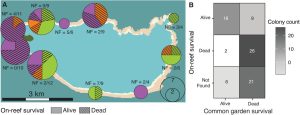
Figure. On-reef survival of tagged Stylophora pistillata colonies after the heatwave.
(A) Survival of colonies across taxa, with colors indicating taxa and striped colonies indicating mortality. NF = colonies not found post-heatwave.
(B) Heatmap comparing colony survival on-reef and in the common garden experiment, showing the number of colonies in each survival category combination. (refer to preprint Figure 3 made available under a CC-BY 4.0 International license).
Some corals bleached quickly and dramatically during the heatwave, turning pale early on, while others showed fewer visible signs of stress. But those early signals didn’t reliably predict what would happen next. Tracking the corals over the full 84-day experiment revealed that some heavily bleached corals survived and recovered, while others that initially looked relatively healthy went on to die later, sometimes after temperatures had already dropped. In fact, one of the most resilient groups bleached the most but still had the highest survival overall.
-
Coral lineages showed survival differences linked to symbiont composition
Corals do not exist in isolation. In fact, they maintain an intimate and functionally essential symbiosis with microscopic photosynthetic algae (their symbionts), and this partnership appears to play a central role in determining thermal tolerance.
Each coral lineage showed a strong and often consistent association with specific symbiont types, suggesting long-term, possibly co-evolved relationships rather than flexible, interchangeable associations. These symbionts are not merely incidental partners; they directly influence energy acquisition and the coral’s physiological capacity to withstand environmental stress, particularly elevated temperatures.
Importantly, these associations aligned closely with observed survival outcomes under heat stress. Corals hosting particular symbiont lineages, such as the C78 type, generally exhibited higher resilience. Notably, even within otherwise heat-sensitive coral groups, the rare surviving colonies frequently retained this more tolerant symbiont, indicating that symbiont identity can significantly modulate, and in some cases override, host-level sensitivity.
There is also evidence suggesting limited but meaningful flexibility in these partnerships. A small number of individuals appeared to shift their symbiont communities under stress, and these cases showed minimal or no bleaching, implying that symbiont restructuring may contribute to short-term stress tolerance in some corals.
This also provides important context for interpreting bleaching responses. While bleaching is often associated with stress-induced breakdown of symbiosis, it does not uniformly predict mortality. Some heavily bleached corals were still able to survive and recover, potentially due to the resilience of their symbionts or their capacity to re-establish more compatible symbiotic associations. In contrast, corals lacking such advantageous partnerships or flexibility showed poorer outcomes.
What I like about the preprint?
This paper shows that during a heatwave, intrinsic biological identity can matter more than microhabitat exposure. Not all “same-looking” corals are ecologically equivalent. That matters because reef surveys often treat morphologically similar colonies as the same unit. This study shows that hidden genetic diversity can determine who survives and who disappears. It also brings forth another important observation that how corals recover after bleaching may matter as much as how much they bleach initially.
Questions to the authors:
- Are there seasonal or transient symbiotic/parasitic organisms associated with these reefs, and could extreme heat events alter their presence, abundance, or migration patterns?
- Do coral reefs trade off reproductive activity to prioritize survival and recovery during extreme climatic events?
Future directions:
This study is an important insight into how coral communities collectively survive environmental stress. It would be exciting to see more work in this area, particularly exploring whether corals can actively reorganize their symbiont communities after stress exposure and whether such changes enhance long-term survival. As a long-term approach, it would be valuable to assess whether corals that survive bleaching continue to maintain normal growth, reproduction, and ecological function over extended periods.
References:
- Humanes, A., Lachs, L., Beauchamp, E. A., Bythell, J. C., Edwards, A. J., Golbuu, Y., Martinez, H. M., Palmowski, P., Treumann, A., Van Der Steeg, E., Van Hooidonk, R., & Guest, J. R. (2022). Within-population variability in coral heat tolerance indicates climate adaptation potential. Proceedings of the Royal Society B: Biological Sciences, 289(1981). doi:10.1098/rspb.2022.0872
- Rodrigues, L. J., & Grottoli, A. G. (2007). Energy reserves and metabolism as indicators of coral recovery from bleaching. Limnology and Oceanography, 52(5), 1874–1882. doi:10.4319/lo.2007.52.5.1874
doi: https://doi.org/10.1242/prelights.43666
Read preprintSign up to customise the site to your preferences and to receive alerts
Register hereAlso in the animal behavior and cognition category:
Mice sense Moon and Sun
Jeny Jose

Drift drives phenotypic evolution in a rapid island radiation
Zoha Sadaqat

Behavioral characteristics of an extremely old rhesus macaque in a zoo: Dementia-like symptoms and implications for quality of life of geriatric animals
Stefan Friedrich Wirth

Also in the ecology category:
Modes of natural selection on maternal and zygotic gene expression in Drosophila melanogaster embryos
Girish Kale, preLights peer support

Feeding and reproduction of a tropical coastal copepod across warming and copper gradients
Tina Nguyen

Heatwave winners and losers: cryptic coral holobionts differ in thermal tolerance
Maitri Manjunath
Also in the evolutionary biology category:
A single genetic innovation at the origin of plant terrestrialization
Naveenkumar Muthiah

Modes of natural selection on maternal and zygotic gene expression in Drosophila melanogaster embryos
Girish Kale, preLights peer support
Microtubules sustain the fidelity of cellularization in a coenocytic relative of animals
Girish Kale, preLights peer support

Also in the zoology category:
Drift drives phenotypic evolution in a rapid island radiation
Zoha Sadaqat
Behavioral characteristics of an extremely old rhesus macaque in a zoo: Dementia-like symptoms and implications for quality of life of geriatric animals
Stefan Friedrich Wirth
Heatwave winners and losers: cryptic coral holobionts differ in thermal tolerance
Maitri Manjunath
preLists in the animal behavior and cognition category:
Biologists @ 100 conference preList
This preList aims to capture all preprints being discussed at the Biologists @100 conference in Liverpool, UK, either as part of the poster sessions or the (flash/short/full-length) talks.
| List by | Reinier Prosee, Jonathan Townson |
9th International Symposium on the Biology of Vertebrate Sex Determination
This preList contains preprints discussed during the 9th International Symposium on the Biology of Vertebrate Sex Determination. This conference was held in Kona, Hawaii from April 17th to 21st 2023.
| List by | Martin Estermann |
Bats
A list of preprints dealing with the ecology, evolution and behavior of bats
| List by | Baheerathan Murugavel |
FENS 2020
A collection of preprints presented during the virtual meeting of the Federation of European Neuroscience Societies (FENS) in 2020
| List by | Ana Dorrego-Rivas |
Also in the ecology category:
Developmental regulation: molecular and ecological niches
This conference was held at the Station Biologique de Roscoff (France) and brought together researchers exploring how diverse niche environments shape developmental processes across scales. Spanning topics from ecological and metabolic influences to signalling networks, mechanics and gene regulation, the meeting highlighted the interplay between intrinsic and extrinsic factors in controlling cell fate and tissue organisation. This preList gathers preprints discussed by speakers and poster presenters during the meeting. Please do get in touch at preLights@biologists.com if you notice any relevant preprints that we may have missed.
| List by | Ingrid Tsang |
SciELO preprints – From 2025 onwards
SciELO has become a cornerstone of open, multilingual scholarly communication across Latin America. Its preprint server, SciELO preprints, is expanding the global reach of preprinted research from the region (for more information, see our interview with Carolina Tanigushi). This preList brings together biological, English language SciELO preprints to help readers discover emerging work from the Global South. By highlighting these preprints in one place, we aim to support visibility, encourage early feedback, and showcase the vibrant research communities contributing to SciELO’s open science ecosystem.
| List by | Carolina Tanigushi |
November in preprints – DevBio & Stem cell biology
preLighters with expertise across developmental and stem cell biology have nominated a few developmental and stem cell biology (and related) preprints posted in November they’re excited about and explain in a single paragraph why. Concise preprint highlights, prepared by the preLighter community – a quick way to spot upcoming trends, new methods and fresh ideas.
| List by | Aline Grata et al. |
Biologists @ 100 conference preList
This preList aims to capture all preprints being discussed at the Biologists @100 conference in Liverpool, UK, either as part of the poster sessions or the (flash/short/full-length) talks.
| List by | Reinier Prosee, Jonathan Townson |
preLights peer support – preprints of interest
This is a preprint repository to organise the preprints and preLights covered through the 'preLights peer support' initiative.
| List by | preLights peer support |
EMBO | EMBL Symposium: The organism and its environment
This preList contains preprints discussed during the 'EMBO | EMBL Symposium: The organism and its environment', organised at EMBL Heidelberg, Germany (May 2023).
| List by | Girish Kale |
Bats
A list of preprints dealing with the ecology, evolution and behavior of bats
| List by | Baheerathan Murugavel |
Also in the evolutionary biology category:
‘In preprints’ from Development 2026
A list of the preprints featured in Development's 'In preprints' articles, as part of the new Preprint Editors initiative
| List by | Clarisse Brunet Avalos et al. |
Santa Cruz Developmental Biology Meeting 2026
This preList brings together a selection of preprints discussed at the Santa Cruz Developmental Biology Meeting 2026, held at UC Santa Cruz with the theme “Biomedicine, Biomechanics, and the Biosphere.” Reflecting the meeting’s broad scientific scope, from development and regeneration to evolution, tissue mechanics, and emerging technologies, this curated collection showcases work that contributed to conversations throughout the meeting.
| List by | Ingrid Tsang |
SciELO preprints – From 2025 onwards
SciELO has become a cornerstone of open, multilingual scholarly communication across Latin America. Its preprint server, SciELO preprints, is expanding the global reach of preprinted research from the region (for more information, see our interview with Carolina Tanigushi). This preList brings together biological, English language SciELO preprints to help readers discover emerging work from the Global South. By highlighting these preprints in one place, we aim to support visibility, encourage early feedback, and showcase the vibrant research communities contributing to SciELO’s open science ecosystem.
| List by | Carolina Tanigushi |
November in preprints – DevBio & Stem cell biology
preLighters with expertise across developmental and stem cell biology have nominated a few developmental and stem cell biology (and related) preprints posted in November they’re excited about and explain in a single paragraph why. Concise preprint highlights, prepared by the preLighter community – a quick way to spot upcoming trends, new methods and fresh ideas.
| List by | Aline Grata et al. |
October in preprints – DevBio & Stem cell biology
Each month, preLighters with expertise across developmental and stem cell biology nominate a few recent developmental and stem cell biology (and related) preprints they’re excited about and explain in a single paragraph why. Short, snappy picks from working scientists — a quick way to spot fresh ideas, bold methods and papers worth reading in full. These preprints can all be found in the October preprint list published on the Node.
| List by | Deevitha Balasubramanian et al. |
October in preprints – Cell biology edition
Different preLighters, with expertise across cell biology, have worked together to create this preprint reading list for researchers with an interest in cell biology. This month, most picks fall under (1) Cell organelles and organisation, followed by (2) Mechanosignaling and mechanotransduction, (3) Cell cycle and division and (4) Cell migration
| List by | Matthew Davies et al. |
Biologists @ 100 conference preList
This preList aims to capture all preprints being discussed at the Biologists @100 conference in Liverpool, UK, either as part of the poster sessions or the (flash/short/full-length) talks.
| List by | Reinier Prosee, Jonathan Townson |
‘In preprints’ from Development 2022-2023
A list of the preprints featured in Development's 'In preprints' articles between 2022-2023
| List by | Alex Eve, Katherine Brown |
preLights peer support – preprints of interest
This is a preprint repository to organise the preprints and preLights covered through the 'preLights peer support' initiative.
| List by | preLights peer support |
EMBO | EMBL Symposium: The organism and its environment
This preList contains preprints discussed during the 'EMBO | EMBL Symposium: The organism and its environment', organised at EMBL Heidelberg, Germany (May 2023).
| List by | Girish Kale |
9th International Symposium on the Biology of Vertebrate Sex Determination
This preList contains preprints discussed during the 9th International Symposium on the Biology of Vertebrate Sex Determination. This conference was held in Kona, Hawaii from April 17th to 21st 2023.
| List by | Martin Estermann |
EMBL Synthetic Morphogenesis: From Gene Circuits to Tissue Architecture (2021)
A list of preprints mentioned at the #EESmorphoG virtual meeting in 2021.
| List by | Alex Eve |
Planar Cell Polarity – PCP
This preList contains preprints about the latest findings on Planar Cell Polarity (PCP) in various model organisms at the molecular, cellular and tissue levels.
| List by | Ana Dorrego-Rivas |
TAGC 2020
Preprints recently presented at the virtual Allied Genetics Conference, April 22-26, 2020. #TAGC20
| List by | Maiko Kitaoka et al. |
ECFG15 – Fungal biology
Preprints presented at 15th European Conference on Fungal Genetics 17-20 February 2020 Rome
| List by | Hiral Shah |
COVID-19 / SARS-CoV-2 preprints
List of important preprints dealing with the ongoing coronavirus outbreak. See http://covidpreprints.com for additional resources and timeline, and https://connect.biorxiv.org/relate/content/181 for full list of bioRxiv and medRxiv preprints on this topic
| List by | Dey Lab, Zhang-He Goh |
1
SDB 78th Annual Meeting 2019
A curation of the preprints presented at the SDB meeting in Boston, July 26-30 2019. The preList will be updated throughout the duration of the meeting.
| List by | Alex Eve |
Pattern formation during development
The aim of this preList is to integrate results about the mechanisms that govern patterning during development, from genes implicated in the processes to theoritical models of pattern formation in nature.
| List by | Alexa Sadier |
Also in the zoology category:
SciELO preprints – From 2025 onwards
SciELO has become a cornerstone of open, multilingual scholarly communication across Latin America. Its preprint server, SciELO preprints, is expanding the global reach of preprinted research from the region (for more information, see our interview with Carolina Tanigushi). This preList brings together biological, English language SciELO preprints to help readers discover emerging work from the Global South. By highlighting these preprints in one place, we aim to support visibility, encourage early feedback, and showcase the vibrant research communities contributing to SciELO’s open science ecosystem.
| List by | Carolina Tanigushi |
Biologists @ 100 conference preList
This preList aims to capture all preprints being discussed at the Biologists @100 conference in Liverpool, UK, either as part of the poster sessions or the (flash/short/full-length) talks.
| List by | Reinier Prosee, Jonathan Townson |
Bats
A list of preprints dealing with the ecology, evolution and behavior of bats
| List by | Baheerathan Murugavel |