










Consciously detecting and recognizing a past visual word after its sensory trace is gone
Posted on: 16 April 2026 , updated on: 20 April 2026
Preprint posted on 25 February 2026

Categories: animal behavior and cognition, neuroscience, zoology
Background:
Conscious perception refers to the subjective experience of sensory information, the ability to know and report what one is perceiving at a given moment. It reflects not just sensory processing but awareness of that information. A broad consensus holds that the initial feedforward sweep of sensory processing – a fast, bottom-up flow of neural activity from sensory receptors (like the retina) through the cortex within ~100–150 ms occurs without awareness. During this stage, the brain extracts basic features such as edges, motion, or sound frequency, but this processing is automatic and not yet accessible to conscious perception.
In practice, it has been difficult to clearly separate consciousness from unconscious perception at these early stages. The study discussed here tests whether a briefly seen (and masked) stimulus can still leave behind a hidden meaning (semantic information, i.e., what the stimulus represents, like the concept of a word or object), even if its visual details fade away. It shows that a later cue, if it is related in meaning, can help bring this information into awareness. This suggests that people can access the meaning of a stimulus even when they are not aware of its sensory details. Building on this idea, the preprint tests a stronger hypothesis: that even when the visual details of a masked stimulus are lost, its meaning (semantic information) can still remain and be brought into awareness by a related cue presented later. In other words, it asks whether people can become aware of what something is without seeing how it looked. This directly challenges the idea that consciousness depends only on ongoing sensory signals, and instead suggests that perception is flexible over time, where earlier unconscious information can later become consciously accessible through broader brain processes.
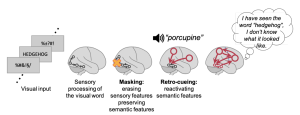
Figure 1. Schematic depicting the preprint’s hypothesis – masking erases a word’s low-level features, but a congruent retro-cue can reactivate its semantic representation, allowing conscious access to meaning without the original sensory details. (refer to Preprint Figure 1, made available under a CC-BY-NC-ND 4.0 International license.)
Key findings:
- Congruent retro-cues improved participant’s identification and sensitivity to detect the presence of the words.
One of the first experiments in this study tested a key question: can awareness of a stimulus be triggered after it has already disappeared? To examine this, participants viewed rapid visual masks in which a word briefly appeared for just 12–48 ms, close to the limit of visibility. Some trials had no word, allowing the researchers to measure detection accurately. Importantly, about 200 ms after the word disappeared, participants heard a retro-cue (a cue presented after the stimulus, often related in meaning) that was either related or unrelated to the word. They then reported the word’s identity, its visual form (upper/lower case), and how clearly they saw it.
For comparison, in other conditions researchers can use pre-cues (cues presented before the stimulus) to guide attention in advance. By using many different word pairs and controlling for guessing, the study ensured that any improvement in performance was due to the cue itself, not simple response strategies.
The results from this experiment revealed a striking dissociation. When the retro-cue was congruent, participants were better at identifying the word and detecting its presence but not at reporting its visual features. This pattern could not be explained by partial awareness of letters or orthographic fragments, as multiple control analyses ruled out these alternatives. Instead, the findings suggest that the cue can reactivate a latent semantic trace, allowing access to meaning
even when the underlying sensory representation has faded. In this way, the experiment provides strong evidence that conscious perception is not fixed at the moment of stimulus presentation, but can emerge later through top-down processes that selectively recover high-level information while leaving low-level details behind.
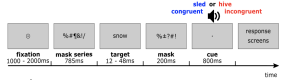
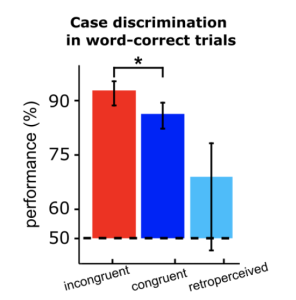
Figure 1: In the trials, participants were presented with one stream of centered stimuli. Response screens asked for word identification, case discrimination and overall visibility rating, in this order. Case discrimination performance was quantified when word identification is correct, with a specific estimate for retro-perceived trials. Error bars represent 95% bootstrapped confidence intervals. (refer to Preprint Figure 2, made available under a CC-BY-NC-ND 4.0 International license.)
- Matching cues shown after a word can reveal its meaning
Building on the previous results, the authors clarify the link between visibility and confidence. Participants rated confidence separately for word identification and case discrimination. Congruent retro-cues improved word identification and confidence for that task, but case discrimination remained unchanged. This reveals a dissociation between high-level and low-level features, that is, participants could access the meaning of the word (semantic information) without recovering its visual details (like uppercase vs lowercase).
- Both pre- and retro-cues improved detection, but only pre-cues improved recognition of visual details.
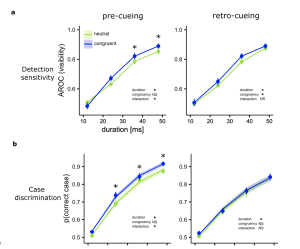
Figure 2: Detection sensitivity (a) and case discrimination performance (b) are shown for pre-cueing (left panels) and retro-cueing (right panels). (refer to Preprint Figure 5, made available under a CC-BY-NC-ND 4.0 International license.)
So far, it is shown that the participants knew what the word was, but not how it looked. This suggests that retro-cues enhance access to meaning without improving sensory representations, and that better detection is not due to misplaced confidence about visual details. This dissociation was further explored by testing whether it is unique to retro-cues or also occurs with pre-cues. Four preregistered experiments compared pre-cues and retro-cues with neutral cues, focusing participants on letter-case and visibility rather than word meaning. Both cue types were found to improve detection sensitivity, but only pre-cues enhanced case discrimination. Retro-cues left low-level visual performance unchanged, confirming that the dissociation between semantic access and sensory details is specific to retro-cueing. Detection improvements with retro-cues were smaller than in earlier experiments, likely due to task differences or reduced interference from incongruent cues.
What I like about the preprint?
The authors have done remarkable work that breaks the perception of seeing is equal to detailed perception. This preprint shows you can consciously extract semantic content without the need for sensory format. I especially liked the section on how the brain can reconstruct awareness thereby challenging the feed forward models. These findings could possibly have implications for hallucinations and predictive coding frameworks.
Questions to the authors:
- How was the length of time that the visual stimulus is presented determined, including the optimal delay between the auditory and visual stimuli?
- What are the effects of pairing a non-associated auditory cue with the visual stimulus?
Future directions:
This preprint addresses and challenges theories of conscious perception that emphasize either local sensory processing or higher-level, global access to information. Future work could investigate whether there is a critical time window after stimulus offset during which retro-cues selectively enhance high-level awareness without restoring low-level details. Although the authors note that the timing of retro-cue effects is flexible, it would be valuable to determine the precise temporal range. Additionally, it remains an open question whether retro-cues preferentially enhance semantic meaning over other cognitive features, such as emotional content or syntactic structure.
References:
- Dehaene, S., Changeux, J. P., & Naccache, L. (2011). The global neuronal workspace model of conscious access: from neuronal architectures to clinical applications. Characterizing consciousness: From cognition to the clinic?, 55-84.
- Koch, C., Massimini, M., Boly, M., & Tononi, G. (2016). Neural correlates of consciousness: progress and problems. Nature reviews neuroscience, 17(5), 307-321.
- Lamme, V. A. Towards a true neural stance on consciousness. Trends in cognitive sciences 10, 494–501 (2006).
- Rosenthal, D. M. 2005 Consciousness and mind. Oxford, UK: Clarendon Press.
- Sergent, C., & Naccache, L. (2012). Imaging neural signatures of consciousness: ‘What’,‘When’,‘Where’ and ‘How’ does it work?. Archives italiennes de biologie, 150(2/3), 91-106.
doi: https://doi.org/10.1242/prelights.43298
Read preprintSign up to customise the site to your preferences and to receive alerts
Register hereAlso in the animal behavior and cognition category:
Mice sense Moon and Sun
Jeny Jose

Drift drives phenotypic evolution in a rapid island radiation
Zoha Sadaqat

Behavioral characteristics of an extremely old rhesus macaque in a zoo: Dementia-like symptoms and implications for quality of life of geriatric animals
Stefan Friedrich Wirth

Also in the neuroscience category:
Microglia extract neuronal proteolytic organelles via skoupocytosis
Chandrika Rao

Vectorial efference copy and visuomotor transformation through gap junctions
Lochlan Walsh
SPOTTER: Automated Tissue-Barcoding Platform for Spatial Proteomics and Phosphoproteomics
TheLangeLab, Felix Kraus

Also in the zoology category:
Drift drives phenotypic evolution in a rapid island radiation
Zoha Sadaqat
Behavioral characteristics of an extremely old rhesus macaque in a zoo: Dementia-like symptoms and implications for quality of life of geriatric animals
Stefan Friedrich Wirth
Heatwave winners and losers: cryptic coral holobionts differ in thermal tolerance
Maitri Manjunath
preLists in the animal behavior and cognition category:
Biologists @ 100 conference preList
This preList aims to capture all preprints being discussed at the Biologists @100 conference in Liverpool, UK, either as part of the poster sessions or the (flash/short/full-length) talks.
| List by | Reinier Prosee, Jonathan Townson |
9th International Symposium on the Biology of Vertebrate Sex Determination
This preList contains preprints discussed during the 9th International Symposium on the Biology of Vertebrate Sex Determination. This conference was held in Kona, Hawaii from April 17th to 21st 2023.
| List by | Martin Estermann |
Bats
A list of preprints dealing with the ecology, evolution and behavior of bats
| List by | Baheerathan Murugavel |
FENS 2020
A collection of preprints presented during the virtual meeting of the Federation of European Neuroscience Societies (FENS) in 2020
| List by | Ana Dorrego-Rivas |
Also in the neuroscience category:
‘In preprints’ from Development 2026
A list of the preprints featured in Development's 'In preprints' articles, as part of the new Preprint Editors initiative
| List by | Clarisse Brunet Avalos et al. |
preLighters’ choice – Handpicked DevBio preprints
preLighters with expertise across developmental and stem cell biology have nominated a few developmental biology (and related) preprints they’re excited about and explain in a few paragraph why. Concise preprint highlights, prepared by the preLighter community – a quick way to spot upcoming trends, new methods and fresh ideas.
| List by | Theodora Stougiannou et al. |
BSDB Spring Meeting: Molecules to Morphogenesis
The British Society for Developmental Biology (BSDB) Spring Meeting Molecules to Morphogenesis was held from 23–26 March 2026 at the University of Warwick (UK). This meeting brought together a vibrant community of researchers to discuss how molecular mechanisms are integrated across scales to drive morphogenesis, spanning diverse model systems and approaches. This preList contains preprints by presenters from the talk and poster sessions at the meeting. Please do get in touch at preLights@biologists.com if you notice any relevant preprints that we may have missed.
| List by | Ingrid Tsang |
Keystone Symposium on Stem Cell Models in Embryology 2026
The Keystone Symposium on Stem Cell Models in Embryology, 2026, was organised by Jun Wu (UT Southwestern), Jianping Fu (University of Michigan) and Miki Ebisuya (TU Dresden) and held at Asilomar Conference Grounds in California (US). The meeting discussed recent advances made in establishing stem-cell-based embryo models, what fundamental insights into developmental processes have been gleaned from them, as well as how they are beginning to be applied more widely. This prelist contains preprints by presenters at the talk and poster sessions at the conference, which our Reviews Editor in attendance spotted. Please do reach out to preLights@biologists.com if you notice any that we’ve missed.
| List by | Ingrid Tsang |
November in preprints – DevBio & Stem cell biology
preLighters with expertise across developmental and stem cell biology have nominated a few developmental and stem cell biology (and related) preprints posted in November they’re excited about and explain in a single paragraph why. Concise preprint highlights, prepared by the preLighter community – a quick way to spot upcoming trends, new methods and fresh ideas.
| List by | Aline Grata et al. |
October in preprints – DevBio & Stem cell biology
Each month, preLighters with expertise across developmental and stem cell biology nominate a few recent developmental and stem cell biology (and related) preprints they’re excited about and explain in a single paragraph why. Short, snappy picks from working scientists — a quick way to spot fresh ideas, bold methods and papers worth reading in full. These preprints can all be found in the October preprint list published on the Node.
| List by | Deevitha Balasubramanian et al. |
October in preprints – Cell biology edition
Different preLighters, with expertise across cell biology, have worked together to create this preprint reading list for researchers with an interest in cell biology. This month, most picks fall under (1) Cell organelles and organisation, followed by (2) Mechanosignaling and mechanotransduction, (3) Cell cycle and division and (4) Cell migration
| List by | Matthew Davies et al. |
July in preprints – the CellBio edition
A group of preLighters, with expertise in different areas of cell biology, have worked together to create this preprint reading lists for researchers with an interest in cell biology. This month, categories include: (1) Cell Signalling and Mechanosensing (2) Cell Cycle and Division (3) Cell Migration and Cytoskeleton (4) Cancer Biology (5) Cell Organelles and Organisation
| List by | Girish Kale et al. |
May in preprints – the CellBio edition
A group of preLighters, with expertise in different areas of cell biology, have worked together to create this preprint reading lists for researchers with an interest in cell biology. This month, categories include: 1) Biochemistry/metabolism 2) Cancer cell Biology 3) Cell adhesion, migration and cytoskeleton 4) Cell organelles and organisation 5) Cell signalling and 6) Genetics
| List by | Barbora Knotkova et al. |
April in preprints – the CellBio edition
A group of preLighters, with expertise in different areas of cell biology, have worked together to create this preprint reading lists for researchers with an interest in cell biology. This month, categories include: 1) biochemistry/metabolism 2) cell cycle and division 3) cell organelles and organisation 4) cell signalling and mechanosensing 5) (epi)genetics
| List by | Vibha SINGH et al. |
Biologists @ 100 conference preList
This preList aims to capture all preprints being discussed at the Biologists @100 conference in Liverpool, UK, either as part of the poster sessions or the (flash/short/full-length) talks.
| List by | Reinier Prosee, Jonathan Townson |
2024 Hypothalamus GRC
This 2024 Hypothalamus GRC (Gordon Research Conference) preList offers an overview of cutting-edge research focused on the hypothalamus, a critical brain region involved in regulating homeostasis, behavior, and neuroendocrine functions. The studies included cover a range of topics, including neural circuits, molecular mechanisms, and the role of the hypothalamus in health and disease. This collection highlights some of the latest advances in understanding hypothalamic function, with potential implications for treating disorders such as obesity, stress, and metabolic diseases.
| List by | Nathalie Krauth |
‘In preprints’ from Development 2022-2023
A list of the preprints featured in Development's 'In preprints' articles between 2022-2023
| List by | Alex Eve, Katherine Brown |
CSHL 87th Symposium: Stem Cells
Preprints mentioned by speakers at the #CSHLsymp23
| List by | Alex Eve |
Journal of Cell Science meeting ‘Imaging Cell Dynamics’
This preList highlights the preprints discussed at the JCS meeting 'Imaging Cell Dynamics'. The meeting was held from 14 - 17 May 2023 in Lisbon, Portugal and was organised by Erika Holzbaur, Jennifer Lippincott-Schwartz, Rob Parton and Michael Way.
| List by | Helen Zenner |
ASCB EMBO Annual Meeting 2019
A collection of preprints presented at the 2019 ASCB EMBO Meeting in Washington, DC (December 7-11)
| List by | Madhuja Samaddar et al. |
SDB 78th Annual Meeting 2019
A curation of the preprints presented at the SDB meeting in Boston, July 26-30 2019. The preList will be updated throughout the duration of the meeting.
| List by | Alex Eve |
Autophagy
Preprints on autophagy and lysosomal degradation and its role in neurodegeneration and disease. Includes molecular mechanisms, upstream signalling and regulation as well as studies on pharmaceutical interventions to upregulate the process.
| List by | Sandra Malmgren Hill |
Young Embryologist Network Conference 2019
Preprints presented at the Young Embryologist Network 2019 conference, 13 May, The Francis Crick Institute, London
| List by | Alex Eve |
Also in the zoology category:
SciELO preprints – From 2025 onwards
SciELO has become a cornerstone of open, multilingual scholarly communication across Latin America. Its preprint server, SciELO preprints, is expanding the global reach of preprinted research from the region (for more information, see our interview with Carolina Tanigushi). This preList brings together biological, English language SciELO preprints to help readers discover emerging work from the Global South. By highlighting these preprints in one place, we aim to support visibility, encourage early feedback, and showcase the vibrant research communities contributing to SciELO’s open science ecosystem.
| List by | Carolina Tanigushi |
Biologists @ 100 conference preList
This preList aims to capture all preprints being discussed at the Biologists @100 conference in Liverpool, UK, either as part of the poster sessions or the (flash/short/full-length) talks.
| List by | Reinier Prosee, Jonathan Townson |
Bats
A list of preprints dealing with the ecology, evolution and behavior of bats
| List by | Baheerathan Murugavel |