







Drift drives phenotypic evolution in a rapid island radiation
Posted on: 13 July 2026 , updated on: 14 July 2026
Preprint posted on 11 June 2026
Do spectacular feather colors always evolve through selection? In island kingfishers, genetic drift may have a bigger role to play!
Selected by Zoha Sadaqat
Categories: animal behavior and cognition, evolutionary biology, zoology
Background
As populations accumulate phenotypic differences over time, they eventually evolve into different species. The phenotypic diversity and lineage diversification are central to understanding how new species arise. Faster species formation is often linked to faster trait evolution.
Sexual signalling traits, such as plumage coloration, are not merely ornamental but can influence mate choice. Thus, it has been used to study the phenomenon of lineage diversification. Several hypotheses have been proposed to explain why rapidly evolving feather colors may accompany the formation of different lineages (Figure 1).
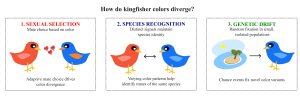
Under sexual selection, certain phenotypes are favoured over others, where birds choose their partners based on color. Species recognition offers a different explanation, where varying color patterns are advantageous in the identification of the mates of the same species. In genetic drift, a color variant is fixed due to sheer sampling luck. Random chance events, such as drift, are known to shape the smaller populations.
In the preprint highlighted here, the authors hypothesised that if sexual selection is the driving force, then color change should occur irrespective of the population size. But if genetic drift is the dominant force, populations with lower genomic diversity and smaller population sizes should exhibit faster rates of color evolution.
The preprint’s main aim was to study the kingfisher birds that diversified across islands, where selection- and genetic drift-predictions could be compared 1. Such diversification of an ancestral species into multiple species, termed as island radiation, provides an ideal setting because an isolated population often experiences reduced gene flow and a smaller population size.
The authors combined the genetic data and feather color measurements of 96 taxa across the Indo-Pacific kingfishers to assess how color evolution correlates with the patterns of species diversification.
Key findings
Diversification and phenotypic evolutionary rates are positively correlated
The authors observed and verified a positive correlation where species exhibiting a higher lineage diversification rate also had a higher rate of plumage color evolution. This relation was consistent across sexes and the two methods for calculating lineage diversification rate. These results also highlighted within-species heterogeneity, challenging the longstanding belief of a species being a monolith.
Tempo of phenotypic diversification increased with decreasing genomic diversity
Next, the authors tested whether patterns of plumage evolution were better predicted by selection or genetic drift. Differences in color between males and females, often allied with sexual selection, showed no association with the rate of color evolution. Similarly, species sharing the same geographical space did not exhibit faster color evolution and were instead weakly associated with lower evolutionary rates.
In contrast, genome-wide heterozygosity emerged as the strongest predictor of color evolution. It was found that lineages with lower genomic diversity displayed a higher rate of chromatic (hue and saturation) and achromatic (brightness) color evolution. Range-limited kingfishers, such as the Pacific, exhibited faster rates of color evolution than the widely distributed taxa, such as the Red-backed or Sacred.
Genetic drift drives rapid phenotypic evolution in an island radiation
The rate of color evolution was best described by genomic diversity: birds with lower genetic diversity demonstrated a high rate of evolution. Adaptive processes were unable to account for these observations and did not emerge as the primary driver of the signalling trait. These results, hence, suggest that random evolutionary mechanisms, such as genetic drift, may be more important as a determinant of plumage coloration.
Conclusion and future directions
Earlier studies have implicated genetic drift in microevolutionary processes such as bat vocalisations 2 , but this study provides rare evidence that drift may drive the evolution of sexual signalling traits in bird radiations. These findings highlight drift as an often-overlooked process shaping the phenotypic diversity in isolated populations.
The authors further suggest that structurally produced colors may be more susceptible to drift, as opposed to biochemically driven colors. Future studies across bird radiations would clarify the different mechanisms of color production and their evolutionary trajectories.
More broadly, these results raise an exciting possibility that genetic drift may play a larger role in phenotypic diversification than previously accounted for. Investigating other radiations and non-avian taxa will determine whether drift-driven divergence is a general principle of speciation or largely restricted to island systems.
What I like about the preprint
For the last few decades, biologists have presumed that most sexual signalling traits have an adaptive advantage. I find this study interesting because it challenges the deeply ingrained assumption that striking phenotypes, such as plumage colouration, arise solely through strong selection.
I also found the preprint authors’ approach to the problem interesting. Most studies analyse species that are already established and measure the color differences. As speciation begins before species exist, the authors here studied populations diverging in real time, rather than looking only at already formed species.
Questions for the authors
- Can drift-generated color divergence become a driver of reproductive isolation?
- Would this pattern persist outside island radiations?
- Is there other signalling traits expected to show a similar role of genetic drift in lineage diversification?
References
- McCullough J, Eliason C, Shultz A, et al. Drift drives phenotypic evolution in a rapid island radiation. bioRxiv. Published online June 11, 2026:2026.06.09.731170. doi:10.64898/2026.06.09.731170
- Pratt HD, Etpison MT. The Birds and Bats of Palau.; 2008. Accessed June 14, 2026. https://library.sprep.org/content/birds-and-bats-palau
doi: https://doi.org/10.1242/prelights.44127
Read preprintSign up to customise the site to your preferences and to receive alerts
Register hereAlso in the animal behavior and cognition category:
Mice sense Moon and Sun
Jeny Jose

Behavioral characteristics of an extremely old rhesus macaque in a zoo: Dementia-like symptoms and implications for quality of life of geriatric animals
Stefan Friedrich Wirth

Heatwave winners and losers: cryptic coral holobionts differ in thermal tolerance
Maitri Manjunath
Also in the evolutionary biology category:
A single genetic innovation at the origin of plant terrestrialization
Naveenkumar Muthiah

Modes of natural selection on maternal and zygotic gene expression in Drosophila melanogaster embryos
Girish Kale, preLights peer support

Microtubules sustain the fidelity of cellularization in a coenocytic relative of animals
Girish Kale, preLights peer support

Also in the zoology category:
Drift drives phenotypic evolution in a rapid island radiation
Zoha Sadaqat

Behavioral characteristics of an extremely old rhesus macaque in a zoo: Dementia-like symptoms and implications for quality of life of geriatric animals
Stefan Friedrich Wirth
Heatwave winners and losers: cryptic coral holobionts differ in thermal tolerance
Maitri Manjunath
preLists in the animal behavior and cognition category:
Biologists @ 100 conference preList
This preList aims to capture all preprints being discussed at the Biologists @100 conference in Liverpool, UK, either as part of the poster sessions or the (flash/short/full-length) talks.
| List by | Reinier Prosee, Jonathan Townson |
9th International Symposium on the Biology of Vertebrate Sex Determination
This preList contains preprints discussed during the 9th International Symposium on the Biology of Vertebrate Sex Determination. This conference was held in Kona, Hawaii from April 17th to 21st 2023.
| List by | Martin Estermann |
Bats
A list of preprints dealing with the ecology, evolution and behavior of bats
| List by | Baheerathan Murugavel |
FENS 2020
A collection of preprints presented during the virtual meeting of the Federation of European Neuroscience Societies (FENS) in 2020
| List by | Ana Dorrego-Rivas |
Also in the evolutionary biology category:
Santa Cruz Developmental Biology Meeting 2026
This preList brings together a selection of preprints discussed at the Santa Cruz Developmental Biology Meeting 2026, held at UC Santa Cruz with the theme “Biomedicine, Biomechanics, and the Biosphere.” Reflecting the meeting’s broad scientific scope, from development and regeneration to evolution, tissue mechanics, and emerging technologies, this curated collection showcases work that contributed to conversations throughout the meeting.
| List by | Ingrid Tsang |
SciELO preprints – From 2025 onwards
SciELO has become a cornerstone of open, multilingual scholarly communication across Latin America. Its preprint server, SciELO preprints, is expanding the global reach of preprinted research from the region (for more information, see our interview with Carolina Tanigushi). This preList brings together biological, English language SciELO preprints to help readers discover emerging work from the Global South. By highlighting these preprints in one place, we aim to support visibility, encourage early feedback, and showcase the vibrant research communities contributing to SciELO’s open science ecosystem.
| List by | Carolina Tanigushi |
November in preprints – DevBio & Stem cell biology
preLighters with expertise across developmental and stem cell biology have nominated a few developmental and stem cell biology (and related) preprints posted in November they’re excited about and explain in a single paragraph why. Concise preprint highlights, prepared by the preLighter community – a quick way to spot upcoming trends, new methods and fresh ideas.
| List by | Aline Grata et al. |
October in preprints – DevBio & Stem cell biology
Each month, preLighters with expertise across developmental and stem cell biology nominate a few recent developmental and stem cell biology (and related) preprints they’re excited about and explain in a single paragraph why. Short, snappy picks from working scientists — a quick way to spot fresh ideas, bold methods and papers worth reading in full. These preprints can all be found in the October preprint list published on the Node.
| List by | Deevitha Balasubramanian et al. |
October in preprints – Cell biology edition
Different preLighters, with expertise across cell biology, have worked together to create this preprint reading list for researchers with an interest in cell biology. This month, most picks fall under (1) Cell organelles and organisation, followed by (2) Mechanosignaling and mechanotransduction, (3) Cell cycle and division and (4) Cell migration
| List by | Matthew Davies et al. |
Biologists @ 100 conference preList
This preList aims to capture all preprints being discussed at the Biologists @100 conference in Liverpool, UK, either as part of the poster sessions or the (flash/short/full-length) talks.
| List by | Reinier Prosee, Jonathan Townson |
‘In preprints’ from Development 2022-2023
A list of the preprints featured in Development's 'In preprints' articles between 2022-2023
| List by | Alex Eve, Katherine Brown |
preLights peer support – preprints of interest
This is a preprint repository to organise the preprints and preLights covered through the 'preLights peer support' initiative.
| List by | preLights peer support |
EMBO | EMBL Symposium: The organism and its environment
This preList contains preprints discussed during the 'EMBO | EMBL Symposium: The organism and its environment', organised at EMBL Heidelberg, Germany (May 2023).
| List by | Girish Kale |
9th International Symposium on the Biology of Vertebrate Sex Determination
This preList contains preprints discussed during the 9th International Symposium on the Biology of Vertebrate Sex Determination. This conference was held in Kona, Hawaii from April 17th to 21st 2023.
| List by | Martin Estermann |
EMBL Synthetic Morphogenesis: From Gene Circuits to Tissue Architecture (2021)
A list of preprints mentioned at the #EESmorphoG virtual meeting in 2021.
| List by | Alex Eve |
Planar Cell Polarity – PCP
This preList contains preprints about the latest findings on Planar Cell Polarity (PCP) in various model organisms at the molecular, cellular and tissue levels.
| List by | Ana Dorrego-Rivas |
TAGC 2020
Preprints recently presented at the virtual Allied Genetics Conference, April 22-26, 2020. #TAGC20
| List by | Maiko Kitaoka et al. |
ECFG15 – Fungal biology
Preprints presented at 15th European Conference on Fungal Genetics 17-20 February 2020 Rome
| List by | Hiral Shah |
COVID-19 / SARS-CoV-2 preprints
List of important preprints dealing with the ongoing coronavirus outbreak. See http://covidpreprints.com for additional resources and timeline, and https://connect.biorxiv.org/relate/content/181 for full list of bioRxiv and medRxiv preprints on this topic
| List by | Dey Lab, Zhang-He Goh |
1
SDB 78th Annual Meeting 2019
A curation of the preprints presented at the SDB meeting in Boston, July 26-30 2019. The preList will be updated throughout the duration of the meeting.
| List by | Alex Eve |
Pattern formation during development
The aim of this preList is to integrate results about the mechanisms that govern patterning during development, from genes implicated in the processes to theoritical models of pattern formation in nature.
| List by | Alexa Sadier |
Also in the zoology category:
SciELO preprints – From 2025 onwards
SciELO has become a cornerstone of open, multilingual scholarly communication across Latin America. Its preprint server, SciELO preprints, is expanding the global reach of preprinted research from the region (for more information, see our interview with Carolina Tanigushi). This preList brings together biological, English language SciELO preprints to help readers discover emerging work from the Global South. By highlighting these preprints in one place, we aim to support visibility, encourage early feedback, and showcase the vibrant research communities contributing to SciELO’s open science ecosystem.
| List by | Carolina Tanigushi |
Biologists @ 100 conference preList
This preList aims to capture all preprints being discussed at the Biologists @100 conference in Liverpool, UK, either as part of the poster sessions or the (flash/short/full-length) talks.
| List by | Reinier Prosee, Jonathan Townson |
Bats
A list of preprints dealing with the ecology, evolution and behavior of bats
| List by | Baheerathan Murugavel |