






Population genomics reveals multi-scale mechanisms sustaining schistosomiasis re-emergence in a near-elimination setting
Posted on: 3 September 2026
Preprint posted on 1 April 2026
Can parasite genomes tell us more than prevalence? A new preprint uses genomic data to reveal localized transmission, cross-village connectivity and persistent parasite diversity despite prolonged control efforts.
Selected by Hala Taha
Categories: genomics, microbiology
Could population genomics become an important tool for guiding schistosomiasis elimination?
#Schistosomiasis #PopulationGenomics #ParasiteGenomics #NTDs #WGS #GenomicSurveillance
One parasite. Many genomes. Infinite stories. Let’s read them.

Figure 1: Cartoon representation of Schistosoma japonicum, hand drawn by Fatima and Hala
BACKGROUND
Schistosomiasis remains an important neglected tropical disease, and achieving elimination can become particularly challenging when transmission persists at low levels.
Although control programmes can dramatically reduce human infection, re-emergence can occur, raising questions about how parasite populations survive and remain connected during periods of intense control.
Population genomics provides a powerful way to investigate these processes by allowing researchers to examine genetic diversity, relatedness, population connectivity and demographic history.
A new preprint uses whole-genome sequencing of 270 Schistosoma japonicum miracidia from 53 hosts across 17 villages to uncover hidden patterns of parasite diversity, relatedness and transmission.
Importantly, the authors highlight that sequencing individual miracidia can provide information about within-host parasite lineage structure, worm burden and transmission heterogeneity without requiring invasive sampling of adult worms.
KEY FINDINGS
270 miracidia from 53 infected individuals across 17 villages in Sichuan, China, were whole-genome sequenced. In doing so, the authors found that:
- parasite populations are broadly connected across villages with weak geographic structure,
- high genetic diversity persists despite prolonged control efforts,
- there is no evidence of a recent decline in effective parasite population size,
- transmission is predominantly local but episodic dispersal connects villages.
BEYOND PREVALENCE: THE GENOMIC LENS
Population genomics helps us see how parasites are related, connected and moving — revealing hidden transmission patterns that prevalence alone cannot see.
One host, multiple parasites — but how closely related are they?
This is where the genomic story becomes particularly interesting.
By examining genome-wide relatedness among individual miracidia, the authors found that closely related parasites were surprisingly common within individual hosts. About 70% of the sampled hosts carried at least one first-degree/full-sibling parasite pair, while 80% carried at least one second-degree pair. These patterns were consistent with clonality and localized transmission, potentially reflecting repeated exposure to cercariae originating from the same infected snail.
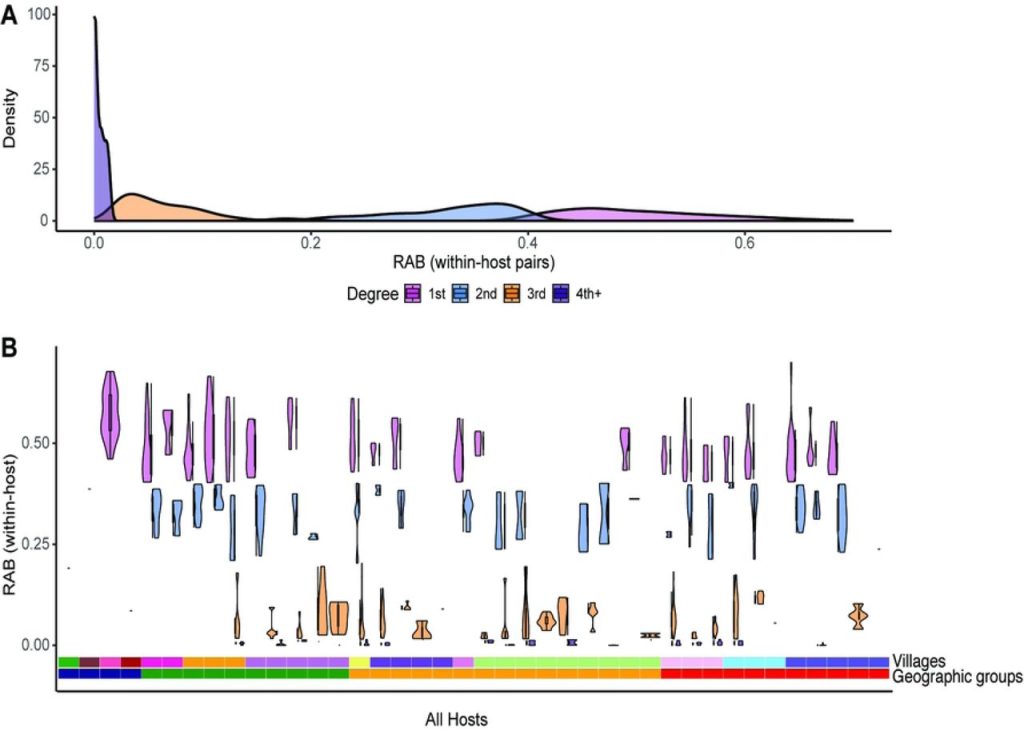
Preprint Figure 3. Within-host genetic relatedness among S. japonicum miracidia. The figure illustrates the clusters of closely related parasites found within individual hosts, providing a genomic view of parasite relatedness and localized transmission. Taken from Guss et al., 2026, made available under a CC-BY 4.0 International license.
But the story doesn’t stop inside one host…
The researchers then looked beyond individual infections to examine relationships among parasite populations across villages. The genomic data revealed dense clusters of related parasites within villages, but also genetic relationships extending between villages. Together, these findings suggest that transmission was largely focal and localized, while occasional parasite dispersal connected different communities into a broader regional transmission network.
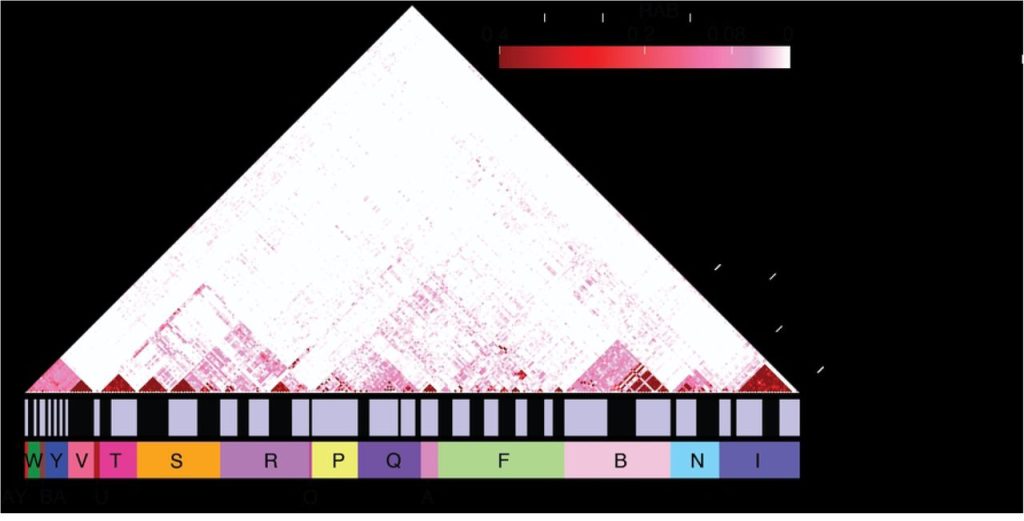
Preprint Figure 4. Genome-wide relatedness reveals connectivity among parasite populations. The relatedness patterns illustrate localized transmission within villages alongside genetic connections extending between parasite populations. Taken from Guss et al., 2026, made available under a CC-BY 4.0 International license.
WHY I CHOSE THIS PREPRINT
- It shows the power of parasite genomics to move beyond “how much infection” to “how is transmission maintained”.
- Individual miracidium WGS reveals who is infecting whom, within hosts, within communities and across landscapes.
- Persistent diversity and connectivity remind us that elimination is more than reducing prevalence.
- Highly relevant to my work on S. haematobium population genomics in Sudan — time to add the parasite’s voice to our surveillance tools!
QUESTIONS FOR THE AUTHORS
- How transferable is this approach to S. haematobium in Africa?
- How many miracidia per site are needed for reliable estimates?
- How can genomic data be integrated with MDA & surveillance?
- How much sampling to distinguish local vs between-village spread?
- Can genomics reveal hidden reservoirs (human, animal, environmental)?
- Could this help monitor praziquantel pressure or reduced efficacy?
- How can this be adapted for resource-limited settings?
Sign up to customise the site to your preferences and to receive alerts
Register hereAlso in the genomics category:
Diversity and Spatial Segregation of TRP Channels in Choanoflagellates Provide Insight into the Evolutionary Origin of Animal Sensory Systems
Urvashi Goswami

BAF complexes maintain accessibility at stimulus-responsive chromatin and are required for transcriptional stimulus responses
Dina Kabbara

Comprehensive Lineage Tracing Maps the Landscape of Cell Fate Decisions in Mouse Embryogenesis
Béryl Laplace-Builhé, Lucie Hermet

Also in the microbiology category:
Population genomics reveals multi-scale mechanisms sustaining schistosomiasis re-emergence in a near-elimination setting
Hala Taha

Circadian Clock Programming of Anticipatory Antiviral Immunity Gates Enteric Virus Infection Susceptibility
Owen Ang

Inhibition of VP2-mediated entry: a potential antiviral strategy to treat or prevent calicivirus disease
Orestis Savva
preLists in the genomics category:
BSDB Spring Meeting: Molecules to Morphogenesis
The British Society for Developmental Biology (BSDB) Spring Meeting Molecules to Morphogenesis was held from 23–26 March 2026 at the University of Warwick (UK). This meeting brought together a vibrant community of researchers to discuss how molecular mechanisms are integrated across scales to drive morphogenesis, spanning diverse model systems and approaches. This preList contains preprints by presenters from the talk and poster sessions at the meeting. Please do get in touch at preLights@biologists.com if you notice any relevant preprints that we may have missed.
| List by | Ingrid Tsang |
Keystone Symposium on Stem Cell Models in Embryology 2026
The Keystone Symposium on Stem Cell Models in Embryology, 2026, was organised by Jun Wu (UT Southwestern), Jianping Fu (University of Michigan) and Miki Ebisuya (TU Dresden) and held at Asilomar Conference Grounds in California (US). The meeting discussed recent advances made in establishing stem-cell-based embryo models, what fundamental insights into developmental processes have been gleaned from them, as well as how they are beginning to be applied more widely. This prelist contains preprints by presenters at the talk and poster sessions at the conference, which our Reviews Editor in attendance spotted. Please do reach out to preLights@biologists.com if you notice any that we’ve missed.
| List by | Ingrid Tsang |
November in preprints – DevBio & Stem cell biology
preLighters with expertise across developmental and stem cell biology have nominated a few developmental and stem cell biology (and related) preprints posted in November they’re excited about and explain in a single paragraph why. Concise preprint highlights, prepared by the preLighter community – a quick way to spot upcoming trends, new methods and fresh ideas.
| List by | Aline Grata et al. |
May in preprints – the CellBio edition
A group of preLighters, with expertise in different areas of cell biology, have worked together to create this preprint reading lists for researchers with an interest in cell biology. This month, categories include: 1) Biochemistry/metabolism 2) Cancer cell Biology 3) Cell adhesion, migration and cytoskeleton 4) Cell organelles and organisation 5) Cell signalling and 6) Genetics
| List by | Barbora Knotkova et al. |
March in preprints – the CellBio edition
A group of preLighters, with expertise in different areas of cell biology, have worked together to create this preprint reading lists for researchers with an interest in cell biology. This month, categories include: 1) cancer biology 2) cell migration 3) cell organelles and organisation 4) cell signalling and mechanosensing 5) genetics and genomics 6) other
| List by | Girish Kale et al. |
Biologists @ 100 conference preList
This preList aims to capture all preprints being discussed at the Biologists @100 conference in Liverpool, UK, either as part of the poster sessions or the (flash/short/full-length) talks.
| List by | Reinier Prosee, Jonathan Townson |
Early 2025 preprints – the genetics & genomics edition
In this community-driven preList, a group of preLighters, with expertise in different areas of genetics and genomics have worked together to create this preprint reading list. Categories include: 1) bioinformatics 2) epigenetics 3) gene regulation 4) genomics 5) transcriptomics
| List by | Chee Kiang Ewe et al. |
End-of-year preprints – the genetics & genomics edition
In this community-driven preList, a group of preLighters, with expertise in different areas of genetics and genomics have worked together to create this preprint reading list. Categories include: 1) genomics 2) bioinformatics 3) gene regulation 4) epigenetics
| List by | Chee Kiang Ewe et al. |
BSCB-Biochemical Society 2024 Cell Migration meeting
This preList features preprints that were discussed and presented during the BSCB-Biochemical Society 2024 Cell Migration meeting in Birmingham, UK in April 2024. Kindly put together by Sara Morais da Silva, Reviews Editor at Journal of Cell Science.
| List by | Reinier Prosee |
9th International Symposium on the Biology of Vertebrate Sex Determination
This preList contains preprints discussed during the 9th International Symposium on the Biology of Vertebrate Sex Determination. This conference was held in Kona, Hawaii from April 17th to 21st 2023.
| List by | Martin Estermann |
Semmelweis Symposium 2022: 40th anniversary of international medical education at Semmelweis University
This preList contains preprints discussed during the 'Semmelweis Symposium 2022' (7-9 November), organised around the 40th anniversary of international medical education at Semmelweis University covering a wide range of topics.
| List by | Nándor Lipták |
20th “Genetics Workshops in Hungary”, Szeged (25th, September)
In this annual conference, Hungarian geneticists, biochemists and biotechnologists presented their works. Link: http://group.szbk.u-szeged.hu/minikonf/archive/prg2021.pdf
| List by | Nándor Lipták |
EMBL Conference: From functional genomics to systems biology
Preprints presented at the virtual EMBL conference "from functional genomics and systems biology", 16-19 November 2020
| List by | Jesus Victorino |
TAGC 2020
Preprints recently presented at the virtual Allied Genetics Conference, April 22-26, 2020. #TAGC20
| List by | Maiko Kitaoka et al. |
Zebrafish immunology
A compilation of cutting-edge research that uses the zebrafish as a model system to elucidate novel immunological mechanisms in health and disease.
| List by | Shikha Nayar |
Also in the microbiology category:
SciELO preprints – From 2025 onwards
SciELO has become a cornerstone of open, multilingual scholarly communication across Latin America. Its preprint server, SciELO preprints, is expanding the global reach of preprinted research from the region (for more information, see our interview with Carolina Tanigushi). This preList brings together biological, English language SciELO preprints to help readers discover emerging work from the Global South. By highlighting these preprints in one place, we aim to support visibility, encourage early feedback, and showcase the vibrant research communities contributing to SciELO’s open science ecosystem.
| List by | Carolina Tanigushi |
BioMalPar XVI: Biology and Pathology of the Malaria Parasite
[under construction] Preprints presented at the (fully virtual) EMBL BioMalPar XVI, 17-18 May 2020 #emblmalaria
| List by | Dey Lab, Samantha Seah |
1
ECFG15 – Fungal biology
Preprints presented at 15th European Conference on Fungal Genetics 17-20 February 2020 Rome
| List by | Hiral Shah |
EMBL Seeing is Believing – Imaging the Molecular Processes of Life
Preprints discussed at the 2019 edition of Seeing is Believing, at EMBL Heidelberg from the 9th-12th October 2019
| List by | Dey Lab |
Antimicrobials: Discovery, clinical use, and development of resistance
Preprints that describe the discovery of new antimicrobials and any improvements made regarding their clinical use. Includes preprints that detail the factors affecting antimicrobial selection and the development of antimicrobial resistance.
| List by | Zhang-He Goh |