







Disrupting a Convergent Acetylation Circuit Collapses Leukemic Identity Across AML Subtypes
Posted on: 7 September 2026
Preprint posted on 14 July 2026
A common epigenetic circuit may unite genetically diverse Acute Myeloid Leukemia. Targeting the SAGA complex dismantles leukemic identity.
Selected by Zoha Sadaqat
Categories: cancer biology
Background
Acute Myeloid Leukaemia (AML) is a genetically heterogeneous blood cancer characterised by recurrent mutations in genes such as FLT3, IDH1/2, or DNMT3A. Despite advances in therapy, outcomes remain poor, particularly in older patients. Current therapeutic regimen includes conventional chemotherapy alongside targeted therapies against IDH or FLT31. This raises an important question: instead of targeting individual mutations, could we instead target a process that every leukaemia cell depends on?
Gene expression is regulated not only by transcription factors but also by chromatin-modifying complexes that determine DNA accessibility. SAGA (Spt-Ada-Gcn5 acetyltransferase) is one such complex. It is a histone acetyltransferase complex that deposits acetyl marks on histones and helps maintain transcription of genes essential for cell identity.
Using large-scale CRISPR-dependency datasets and cell-line-based assays, the authors of this preprint ask whether genetically diverse AML cells converge on a common epigenetic dependency despite their distinct mutations.
Key findings
SAGA is essential in haematological malignancies
The study began by analysing the Cancer Dependency Map (DepMap) comprising genome-wide CRISPR-Cas9 screens across several cancer lines. By identifying protein-complex dependencies unique to haematological malignancies, the SAGA complex was identified as a top candidate in AML. In contrast, the closely related ATAC complex did not show a similar dependency in lymphoid and myeloid lineages. Leukemic cells seem to possess a unique reliance on this transcriptional regulator, SAGA.
KAT2A/B degradation suppresses genetically diverse AML
The authors then targeted the catalytic acetyltransferase subunits of the SAGA complex, KAT2A/B, using GSK983. It produced potent anti-leukemic effects across diverse genetic modifications, including KMT2A rearrangements and NPM1 mutations. The treatment reduced cell proliferation, induced apoptosis and differentiation, impaired colony formation (Figure 1; preprint Figure 2E – I), and depleted the stem-cell-like populations. Importantly, GSK983 remained effective even in model systems carrying mutations associated with therapeutic resistance. This suggested that the dependency on the SAGA complex is common across molecular subtypes.
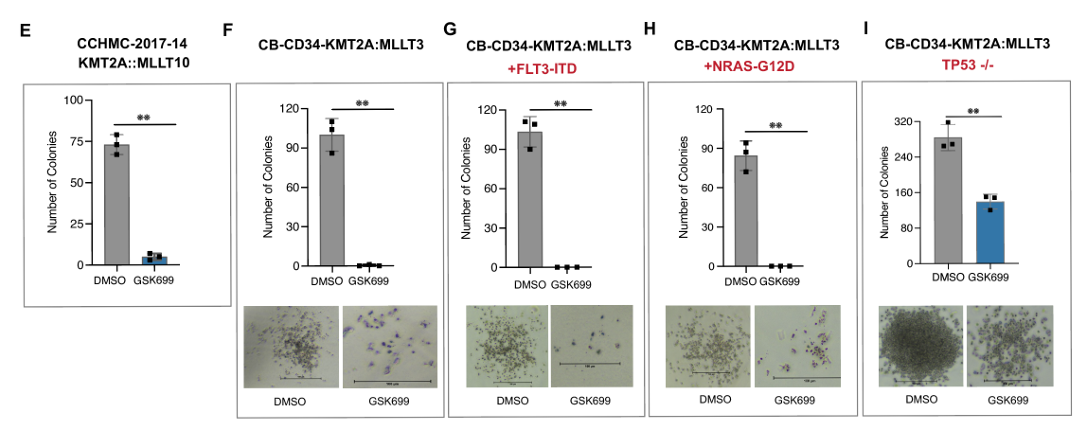
Figure 1 Colony-forming unit (CFU) assay for AML PDX sample (E) and human cord blood-derived CD34 cells transformed with different subtypes of AML mutations (F-I). Preprint Figure 2E-I, made available under a CC-BY-NC-ND 4.0 International License.
SAGA maintains the leukemic identity via a convergent acetylation circuit
KAT2A/B degradation selectively reduced H3K9 acetylation at promoters of key oncogenes, without globally disrupting chromatin acetylation. Beyond reducing histone acetylation, loss of KAT2A/B destabilised ENL- and SEC-associated transcriptional condensates. That led to rapid collapse of the transcriptional program in the leukemic cells. These findings place SAGA at the intersection of chromatin regulation, epigenetic modulation, transcriptional condensates and leukemic cell identity.
Conclusions and future directions
This study proposes a shift in how we view AML biology and leukemic vulnerabilities. Instead of treating each molecular subtype as a distinct entity and an independent form of disease, the authors of the preprint identify a shared epigenetic dependency across genetically diverse AML subtypes. By disrupting a shared acetylation circuit, leukemic identity itself can be destabilised (Figure 2).
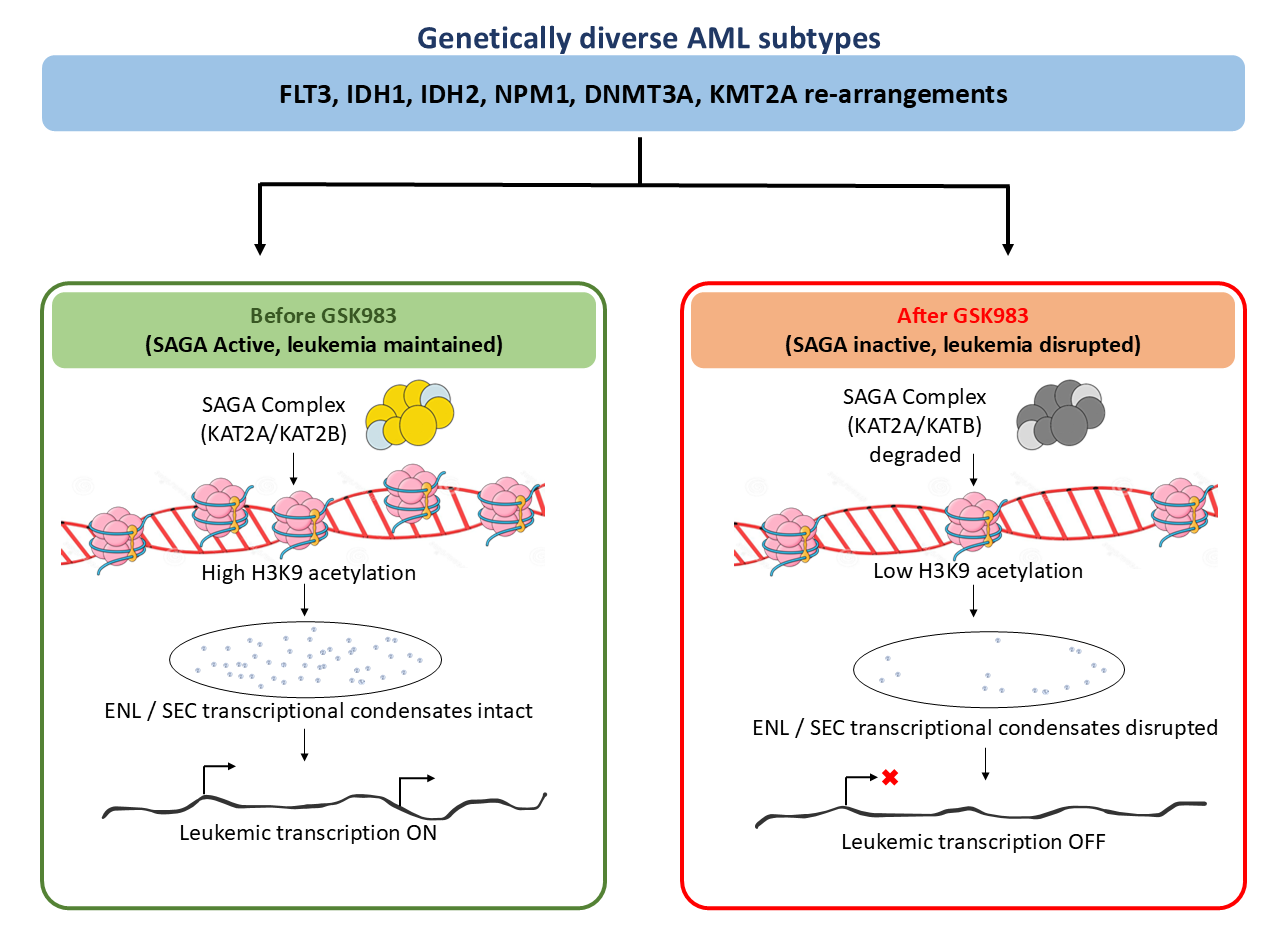
Figure 2 Conceptual overview of SAGA-dependent acetylation circuit maintaining the leukemic identity across genetically diverse AML subtypes. Created by the author using PowerPoint. Icons and symbols obtained from Microsoft PowerPoint. Based on findings reported in the referenced bioRxiv preprint.
GSK983 demonstrates notable preclinical efficacy in the diverse AML cell line models. However, its clinical translation is yet to be established. Future studies will determine whether KAT2A/B degraders can translate these promising preclinical findings into durable clinical responses. Whether combining them with existing targeted therapies or immunotherapies could overcome the disease burden in select patients, particularly older patients, will have to be tested. It will be interesting to see whether such common pathways exist in other genetically heterogeneous cancers such as Acute Lymphoid Leukemia (ALL).
What I like about this preprint
In my doctoral studies, the focus has been on the genetically diverse forms of B-cell Acute Lymphoid Leukemia (B-ALL). I found it intriguing that, though similarly heterogeneous, the authors have not searched for another subtype-specific vulnerability, which has been the norm in leukaemia studies in the recent past. They have instead identified a shared epigenetic vulnerability that appears to be required to unify the diverse forms of AML.
Questions for the authors
- Besides SAGA, several chromatin complexes showed selective dependencies in AML. What made SAGA the most compelling candidate to pursue, and do you think some of them might prove therapeutically valuable as well?
- Do you think that KAT2A/B dependency will extend beyond AML to other malignancies such as B-ALL, which is also equally diverse?
- As transcriptional condensates play a primary role in this mechanism, do you think they could serve as a predictive biomarker for response to KAT2A/B directed therapies?
References
- Jeurkar C, King L, Baek D, Wilde L, Keiffer G, Kasner M. Management of Acute Myeloid Leukemia: A Review. Cancers (Basel) [Internet]. 2026 Feb 1 [cited 2026 Jul 31];18(4):659. Available from: https://pmc.ncbi.nlm.nih.gov/articles/PMC12939490/
doi: https://doi.org/10.1242/prelights.44770
Read preprintSign up to customise the site to your preferences and to receive alerts
Register hereAlso in the cancer biology category:
Fast single molecule localization microscopy in 3D
Kanishka Parashar

Dysregulated Microglial Synaptic Engulfment in Diffuse Midline Glioma
IRR UoE Journal Club

Profilin 1 maintains cell cycle fidelity to prevent unscheduled genome doubling and polyploidy in cancer
Akshata Samel

preLists in the cancer biology category:
‘In preprints’ from Development 2026
A list of the preprints featured in Development's 'In preprints' articles, as part of the new Preprint Editors initiative
| List by | Clarisse Brunet Avalos et al. |
BSDB Spring Meeting: Molecules to Morphogenesis
The British Society for Developmental Biology (BSDB) Spring Meeting Molecules to Morphogenesis was held from 23–26 March 2026 at the University of Warwick (UK). This meeting brought together a vibrant community of researchers to discuss how molecular mechanisms are integrated across scales to drive morphogenesis, spanning diverse model systems and approaches. This preList contains preprints by presenters from the talk and poster sessions at the meeting. Please do get in touch at preLights@biologists.com if you notice any relevant preprints that we may have missed.
| List by | Ingrid Tsang |
October in preprints – Cell biology edition
Different preLighters, with expertise across cell biology, have worked together to create this preprint reading list for researchers with an interest in cell biology. This month, most picks fall under (1) Cell organelles and organisation, followed by (2) Mechanosignaling and mechanotransduction, (3) Cell cycle and division and (4) Cell migration
| List by | Matthew Davies et al. |
September in preprints – Cell biology edition
A group of preLighters, with expertise in different areas of cell biology, have worked together to create this preprint reading list. This month, categories include: (1) Cell organelles and organisation, (2) Cell signalling and mechanosensing, (3) Cell metabolism, (4) Cell cycle and division, (5) Cell migration
| List by | Sristilekha Nath et al. |
July in preprints – the CellBio edition
A group of preLighters, with expertise in different areas of cell biology, have worked together to create this preprint reading lists for researchers with an interest in cell biology. This month, categories include: (1) Cell Signalling and Mechanosensing (2) Cell Cycle and Division (3) Cell Migration and Cytoskeleton (4) Cancer Biology (5) Cell Organelles and Organisation
| List by | Girish Kale et al. |
June in preprints – the CellBio edition
A group of preLighters, with expertise in different areas of cell biology, have worked together to create this preprint reading lists for researchers with an interest in cell biology. This month, categories include: (1) Cell organelles and organisation (2) Cell signaling and mechanosensation (3) Genetics/gene expression (4) Biochemistry (5) Cytoskeleton
| List by | Barbora Knotkova et al. |
May in preprints – the CellBio edition
A group of preLighters, with expertise in different areas of cell biology, have worked together to create this preprint reading lists for researchers with an interest in cell biology. This month, categories include: 1) Biochemistry/metabolism 2) Cancer cell Biology 3) Cell adhesion, migration and cytoskeleton 4) Cell organelles and organisation 5) Cell signalling and 6) Genetics
| List by | Barbora Knotkova et al. |
Keystone Symposium – Metabolic and Nutritional Control of Development and Cell Fate
This preList contains preprints discussed during the Metabolic and Nutritional Control of Development and Cell Fate Keystone Symposia. This conference was organized by Lydia Finley and Ralph J. DeBerardinis and held in the Wylie Center and Tupper Manor at Endicott College, Beverly, MA, United States from May 7th to 9th 2025. This meeting marked the first in-person gathering of leading researchers exploring how metabolism influences development, including processes like cell fate, tissue patterning, and organ function, through nutrient availability and metabolic regulation. By integrating modern metabolic tools with genetic and epidemiological insights across model organisms, this event highlighted key mechanisms and identified open questions to advance the emerging field of developmental metabolism.
| List by | Virginia Savy, Martin Estermann |
April in preprints – the CellBio edition
A group of preLighters, with expertise in different areas of cell biology, have worked together to create this preprint reading lists for researchers with an interest in cell biology. This month, categories include: 1) biochemistry/metabolism 2) cell cycle and division 3) cell organelles and organisation 4) cell signalling and mechanosensing 5) (epi)genetics
| List by | Vibha SINGH et al. |
March in preprints – the CellBio edition
A group of preLighters, with expertise in different areas of cell biology, have worked together to create this preprint reading lists for researchers with an interest in cell biology. This month, categories include: 1) cancer biology 2) cell migration 3) cell organelles and organisation 4) cell signalling and mechanosensing 5) genetics and genomics 6) other
| List by | Girish Kale et al. |
Biologists @ 100 conference preList
This preList aims to capture all preprints being discussed at the Biologists @100 conference in Liverpool, UK, either as part of the poster sessions or the (flash/short/full-length) talks.
| List by | Reinier Prosee, Jonathan Townson |
February in preprints – the CellBio edition
A group of preLighters, with expertise in different areas of cell biology, have worked together to create this preprint reading lists for researchers with an interest in cell biology. This month, categories include: 1) biochemistry and cell metabolism 2) cell organelles and organisation 3) cell signalling, migration and mechanosensing
| List by | Barbora Knotkova et al. |
BSCB-Biochemical Society 2024 Cell Migration meeting
This preList features preprints that were discussed and presented during the BSCB-Biochemical Society 2024 Cell Migration meeting in Birmingham, UK in April 2024. Kindly put together by Sara Morais da Silva, Reviews Editor at Journal of Cell Science.
| List by | Reinier Prosee |
CSHL 87th Symposium: Stem Cells
Preprints mentioned by speakers at the #CSHLsymp23
| List by | Alex Eve |
Journal of Cell Science meeting ‘Imaging Cell Dynamics’
This preList highlights the preprints discussed at the JCS meeting 'Imaging Cell Dynamics'. The meeting was held from 14 - 17 May 2023 in Lisbon, Portugal and was organised by Erika Holzbaur, Jennifer Lippincott-Schwartz, Rob Parton and Michael Way.
| List by | Helen Zenner |
CellBio 2022 – An ASCB/EMBO Meeting
This preLists features preprints that were discussed and presented during the CellBio 2022 meeting in Washington, DC in December 2022.
| List by | Nadja Hümpfer et al. |
Fibroblasts
The advances in fibroblast biology preList explores the recent discoveries and preprints of the fibroblast world. Get ready to immerse yourself with this list created for fibroblasts aficionados and lovers, and beyond. Here, my goal is to include preprints of fibroblast biology, heterogeneity, fate, extracellular matrix, behavior, topography, single-cell atlases, spatial transcriptomics, and their matrix!
| List by | Osvaldo Contreras |
Single Cell Biology 2020
A list of preprints mentioned at the Wellcome Genome Campus Single Cell Biology 2020 meeting.
| List by | Alex Eve |
ASCB EMBO Annual Meeting 2019
A collection of preprints presented at the 2019 ASCB EMBO Meeting in Washington, DC (December 7-11)
| List by | Madhuja Samaddar et al. |
Lung Disease and Regeneration
This preprint list compiles highlights from the field of lung biology.
| List by | Rob Hynds |
Anticancer agents: Discovery and clinical use
Preprints that describe the discovery of anticancer agents and their clinical use. Includes both small molecules and macromolecules like biologics.
| List by | Zhang-He Goh |
Biophysical Society Annual Meeting 2019
Few of the preprints that were discussed in the recent BPS annual meeting at Baltimore, USA
| List by | Joseph Jose Thottacherry |