




Microbial Feast or Famine: dietary carbohydrate composition and gut microbiota metabolic function
Posted on: 11 December 2025 , updated on: 17 December 2025
Preprint posted on 28 October 2025

Categories: clinical trials, genomics, microbiology
Background
There are many facets that contribute to overall human health. A physically small yet important one, is the diverse community of microorganisms living inside our gut, known as the microbiome. Our gut microbial community plays a role not only in digestion but has been linked to health concerns including diabetes, inflammatory diseases, and obesity.
The food that we consume influences our gut microbiome: high fibre diets are more beneficial compared to low fibre diets. Low fibre diets, typically associated with Western countries, are often absorbed almost entirely in the upper gastrointestinal tract (GI), leaving the microorganisms in the lower GI tract without any fuel. When this occurs, the microorganisms begin to consume mucin, which is the mucus lining that protects our GI tract, leading to inflammation and other health issues.
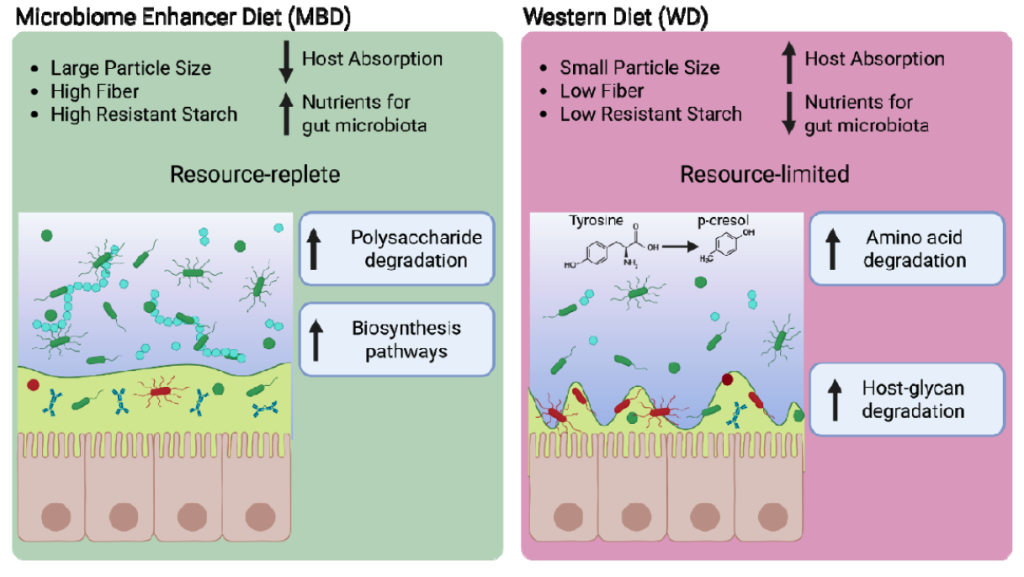
In this preprinted study, Dirks and collaborators conducted clinical trials to compare the functional activities of microbial gut communities when eating a low fibre, Western Diets (WD), compared to a high fibre, Microbiome Enhancer Diet (MBD). Participants were assigned to either the WD or MBD for 22 days straight, then given 14 days to resume their normal diet, followed by another 22 days of eating the opposite diet to the one they were first assigned. Throughout the study, participants were closely monitored and fecal samples were collected to measure differences in microbial composition and function for 11 days during each diet. Metatranscriptomic techniques were used to quantify the active gene expression of the microbial communities.
Key Findings
1) The overall diversity and composition of enzymes expressed by the microbial communities were similar between the WD and MBD.
This suggests functional redundancy of the gut microbiota, meaning many microbes can perform the same tasks. As a result, the gut community stays stable even when the available nutrients change, since its members can adjust their gene expression to keep key metabolic functions going.
2) The MBD microbiota expressed transcripts used for growth and digesting a variety of nutrients, whereas the WD expressed transcripts mostly for amino acid degradation.
This suggests that the microbes in the WD diet lack carbohydrates since amino acids are generally consumed once carbohydrates have been exhausted.
3) Transcripts indicated that MBD microbiota express CAZymes used to break down complex carbohydrates, whereas the WD CAZymes are used to degrade host-derived carbohydrates.
Out of a large group of enzymes important for breaking down and modifying carbohydrates (CAZymes) the difference in expression suggests that MBD delivered a rich source of polysaccharides to the microbiota to consume, while those polysaccharides were much lower in the WD. It can be speculated that, as a result, the WD microbiota turn to alternative, non-dietary carbohydrate sources, such as host tissue.
4) MBD microbiota expressed protein-degrading transcripts with a diversity of functions compared to the WD where enzymes were more focused on protein degradation (Fig. 1).
MBD transcripts are used for building cell walls, synthesizing new proteins, disposing of misfolded proteins. While these activities were still occurring under the WD, microbiota were more focused on protein degradation.
5) MBD microbiota protein degradation produces products important for maintaining the gut barrier, while WD microbiota produce toxin.
MDB produce polyamines (e.g., cadaverine, putrescine, and spermidine) important for the gut barrier while WD microbiota protein degradation produce uremic toxins, biogenic monoamine, and tryamine, which have been linked to gastrointestinal disorder (e.g. irritable bowel syndrome, Crohn’s disease).
Why I highlight this preprint
Although my primary field of study is marine biology, I have a personal interest in human health and wanted to highlight this study because it offers findings that may contribute to improving human well-being. Additionally, dietary modifications represent a relatively accessible intervention that many individuals can adopt to support gut health.
Questions for the authors
1) What were some of the high fibre foods the MBD participants were eating, and would you recommend these foods to support gut microbial health?
2) How quickly can the function and composition of our gut microbiota change after introducing a fibre rich diet similar to the MBD?
doi: https://doi.org/10.1242/prelights.42424
Read preprint (No Ratings Yet)
Sign up to customise the site to your preferences and to receive alerts
Register hereAlso in the clinical trials category:
A thirty-year trend of increasing clinical orientation at the National Institutes of Health
AND
Prediction of transformative breakthroughs in biomedical research
Jonathan Townson

Identifiability-Guided Assessment of Digital Twins in Alzheimer’s Disease Clinical Research and Care
My Nguyen

MCL1 may not mediate chemoresistance
Kanishka Parashar

Also in the genomics category:
Microbial Feast or Famine: dietary carbohydrate composition and gut microbiota metabolic function
Jasmine Talevi

A high-coverage genome from a 200,000-year-old Denisovan
AND
A global map for introgressed structural variation and selection in humans
Siddharth Singh

Human single-cell atlas analysis reveals heterogeneous endothelial signaling
Charis Qi

Also in the microbiology category:
Cryo-EM reveals multiple mechanisms of ribosome inhibition by doxycycline
Leonie Brüne

Microbial Feast or Famine: dietary carbohydrate composition and gut microbiota metabolic function
Jasmine Talevi
Citrobacter rodentium infection activates colonic lamina propria group 2 innate lymphoid cells
André Luiz Amorim Costa, Marcus Oliveira

preLists in the clinical trials category:
Autophagy
Preprints on autophagy and lysosomal degradation and its role in neurodegeneration and disease. Includes molecular mechanisms, upstream signalling and regulation as well as studies on pharmaceutical interventions to upregulate the process.
| List by | Sandra Malmgren Hill |
Antimicrobials: Discovery, clinical use, and development of resistance
Preprints that describe the discovery of new antimicrobials and any improvements made regarding their clinical use. Includes preprints that detail the factors affecting antimicrobial selection and the development of antimicrobial resistance.
| List by | Zhang-He Goh |
Also in the genomics category:
Keystone Symposium on Stem Cell Models in Embryology 2026
The Keystone Symposium on Stem Cell Models in Embryology, 2026, was organised by Jun Wu (UT Southwestern), Jianping Fu (University of Michigan) and Miki Ebisuya (TU Dresden) and held at Asilomar Conference Grounds in California (US). The meeting discussed recent advances made in establishing stem-cell-based embryo models, what fundamental insights into developmental processes have been gleaned from them, as well as how they are beginning to be applied more widely. This prelist contains preprints by presenters at the talk and poster sessions at the conference, which our Reviews Editor in attendance spotted. Please do reach out to preLights@biologists.com if you notice any that we’ve missed.
| List by | Ingrid Tsang |
November in preprints – DevBio & Stem cell biology
preLighters with expertise across developmental and stem cell biology have nominated a few developmental and stem cell biology (and related) preprints posted in November they’re excited about and explain in a single paragraph why. Concise preprint highlights, prepared by the preLighter community – a quick way to spot upcoming trends, new methods and fresh ideas.
| List by | Aline Grata et al. |
May in preprints – the CellBio edition
A group of preLighters, with expertise in different areas of cell biology, have worked together to create this preprint reading lists for researchers with an interest in cell biology. This month, categories include: 1) Biochemistry/metabolism 2) Cancer cell Biology 3) Cell adhesion, migration and cytoskeleton 4) Cell organelles and organisation 5) Cell signalling and 6) Genetics
| List by | Barbora Knotkova et al. |
March in preprints – the CellBio edition
A group of preLighters, with expertise in different areas of cell biology, have worked together to create this preprint reading lists for researchers with an interest in cell biology. This month, categories include: 1) cancer biology 2) cell migration 3) cell organelles and organisation 4) cell signalling and mechanosensing 5) genetics and genomics 6) other
| List by | Girish Kale et al. |
Biologists @ 100 conference preList
This preList aims to capture all preprints being discussed at the Biologists @100 conference in Liverpool, UK, either as part of the poster sessions or the (flash/short/full-length) talks.
| List by | Reinier Prosee, Jonathan Townson |
Early 2025 preprints – the genetics & genomics edition
In this community-driven preList, a group of preLighters, with expertise in different areas of genetics and genomics have worked together to create this preprint reading list. Categories include: 1) bioinformatics 2) epigenetics 3) gene regulation 4) genomics 5) transcriptomics
| List by | Chee Kiang Ewe et al. |
End-of-year preprints – the genetics & genomics edition
In this community-driven preList, a group of preLighters, with expertise in different areas of genetics and genomics have worked together to create this preprint reading list. Categories include: 1) genomics 2) bioinformatics 3) gene regulation 4) epigenetics
| List by | Chee Kiang Ewe et al. |
BSCB-Biochemical Society 2024 Cell Migration meeting
This preList features preprints that were discussed and presented during the BSCB-Biochemical Society 2024 Cell Migration meeting in Birmingham, UK in April 2024. Kindly put together by Sara Morais da Silva, Reviews Editor at Journal of Cell Science.
| List by | Reinier Prosee |
9th International Symposium on the Biology of Vertebrate Sex Determination
This preList contains preprints discussed during the 9th International Symposium on the Biology of Vertebrate Sex Determination. This conference was held in Kona, Hawaii from April 17th to 21st 2023.
| List by | Martin Estermann |
Semmelweis Symposium 2022: 40th anniversary of international medical education at Semmelweis University
This preList contains preprints discussed during the 'Semmelweis Symposium 2022' (7-9 November), organised around the 40th anniversary of international medical education at Semmelweis University covering a wide range of topics.
| List by | Nándor Lipták |
20th “Genetics Workshops in Hungary”, Szeged (25th, September)
In this annual conference, Hungarian geneticists, biochemists and biotechnologists presented their works. Link: http://group.szbk.u-szeged.hu/minikonf/archive/prg2021.pdf
| List by | Nándor Lipták |
EMBL Conference: From functional genomics to systems biology
Preprints presented at the virtual EMBL conference "from functional genomics and systems biology", 16-19 November 2020
| List by | Jesus Victorino |
TAGC 2020
Preprints recently presented at the virtual Allied Genetics Conference, April 22-26, 2020. #TAGC20
| List by | Maiko Kitaoka et al. |
Zebrafish immunology
A compilation of cutting-edge research that uses the zebrafish as a model system to elucidate novel immunological mechanisms in health and disease.
| List by | Shikha Nayar |
Also in the microbiology category:
SciELO preprints – From 2025 onwards
SciELO has become a cornerstone of open, multilingual scholarly communication across Latin America. Its preprint server, SciELO preprints, is expanding the global reach of preprinted research from the region (for more information, see our interview with Carolina Tanigushi). This preList brings together biological, English language SciELO preprints to help readers discover emerging work from the Global South. By highlighting these preprints in one place, we aim to support visibility, encourage early feedback, and showcase the vibrant research communities contributing to SciELO’s open science ecosystem.
| List by | Carolina Tanigushi |
BioMalPar XVI: Biology and Pathology of the Malaria Parasite
[under construction] Preprints presented at the (fully virtual) EMBL BioMalPar XVI, 17-18 May 2020 #emblmalaria
| List by | Dey Lab, Samantha Seah |
1
ECFG15 – Fungal biology
Preprints presented at 15th European Conference on Fungal Genetics 17-20 February 2020 Rome
| List by | Hiral Shah |
EMBL Seeing is Believing – Imaging the Molecular Processes of Life
Preprints discussed at the 2019 edition of Seeing is Believing, at EMBL Heidelberg from the 9th-12th October 2019
| List by | Dey Lab |
Antimicrobials: Discovery, clinical use, and development of resistance
Preprints that describe the discovery of new antimicrobials and any improvements made regarding their clinical use. Includes preprints that detail the factors affecting antimicrobial selection and the development of antimicrobial resistance.
| List by | Zhang-He Goh |