







Nature-Inspired Nanoparticle Adiposomes Enable Targeted Delivery of Hydrophobic Drug for Anti-Cancer Treatment
Posted on: 20 July 2026 , updated on: 21 July 2026
Preprint posted on 7 June 2026

Categories: cancer biology
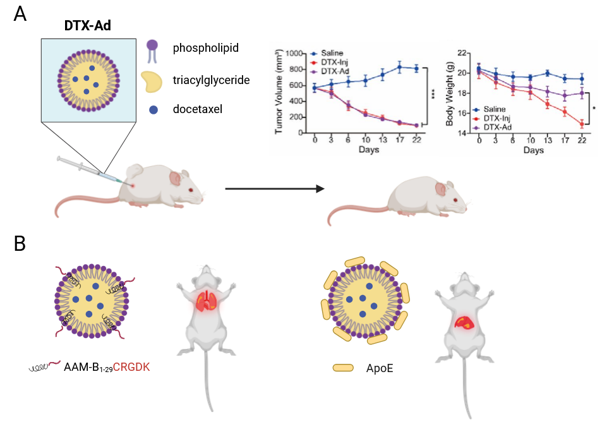
A Structure of docetaxel loaded adiposomes (DTX-Ad) and excerpts of author data showing DTX-Ad treatment outcomes on tumour volume and body weight in the H226 cancer mouse model, compared to docetaxel injection (DTX-Inj) and saline negative control. B Adiposome surface modifications for targeting to the lung (AAM-B1-29CRGDK peptide) and liver (ApoE)
Summary
Inspired by biological mechanisms, the development of adiposomes offers a solution to the challenges faced by hydrophobic drug delivery. Here, the widely used chemotherapeutic agent docetaxel is used to demonstrate the improved safety and efficacy of adiposome delivery compared to conventional platforms in animal models. The results support the potential of this innovation to improve new and existing therapeutic compounds in a variety of disease contexts.
Background
An increasing number of drug targets are being identified inside the cell, opening new avenues for therapeutic development.(1) To reach intracellular targets, compounds must cross the outer lipid bilayer, and to facilitate this many are designed with hydrophobic properties.(2) However, this raises an issue in delivering such compounds to target cells through the hydrophilic environment of the blood. One strategy is to encapsulate drugs in hydrophilic shells with lipid cores called nanoparticles, but poor drug-delivery and immune responses remain barriers to therapeutic implementation.(3–5)
Interestingly, evolution has already solved the problem of transporting hydrophobic molecules through a hydrophilic environment, as this is required by innate biological processes in the human body. It is the endogenous machinery dedicated to this purpose, involving lipoproteins and lipid droplets, which inspired the authors of this preprint in the design of their own nanoparticles called adiposomes.
Whereas other nanoparticles such as liposomes consist of a phospholipid bilayer membrane surrounding an aqueous core, adiposomes have a phospholipid monolayer membrane and a lipid core (Fig. 1A). This design offers advantages over other nanoparticle formulations that are associated with drug leakage and instability, limited loading capacity and inefficient drug delivery.(5) Thus, adiposomes represent a novel platform for the delivery of hydrophobic drugs to intracellular targets, offering increased biocompatibility and pharmacologic properties.
Key findings
Docetaxel-loaded adiposomes’ cytotoxicity was comparable to docetaxel injection in vitro
Docetaxel is an example of a hydrophobic intracellular targeting drug, which is used as first line treatment in a variety of cancers. The authors selected this drug to test the functionality of adiposomes. Initially, the authors evaluate whether docetaxel loaded adiposomes (DTX-Ad) are as effective and work in the same way as clinically used docetaxel injection (DTX-Inj). Quantification of cell death using cytotoxicity assays yielded similar results in cancer cell lines exposed to either treatment, demonstrating comparable efficacy. Using immunofluorescent staining and cell cycle arrest assays, the authors further demonstrated that DTX-Ad induce cytotoxicity through the same mechanism as DTX-Inj: through destabilisation of the cytoskeleton and cell cycle arrest between G2 and M phases.
Antitumour efficacy and safety of docetaxel-loaded adiposomes were demonstrated in multiple in vivo cancer models
The authors then moved on to exploring the effectiveness of DTX-Ad in vivo and showed significant tumour growth suppression in three separate cancer mouse models. The antitumour effects of DTX-Ad were generally comparable to DTX-Inj but the former resulted in less weight loss and minimal-to-no reduction in immune cell counts, unlike the latter. In one model, DTX-Ad performed better than another commercial chemotherapeutic agent, paclitaxel, in terms of tumour inhibition.
Overall, the results support that DTX-Ad effectively inhibits tumour growth in vivo, with less toxicity than DTX-Inj.
Organ specific targeting of docetaxel-loaded adiposomes increased specificity and antitumour effects
Despite these successes, the authors wanted to enhance the antitumour effects of DTX-Ad even further and aimed to do so through organ targeting modifications. Lung-enriched protein binding peptides and ApoE were attached to the outside of DTX-Ad for targeting of the lung and liver, respectively (Fig. 1B). Modified DTX-Ad were shown to selectively accumulate in the target organ in vivo, with lung targeting DTX-Ad delivering 8.7-fold higher, and liver targeting DTX-Ad 16.8-fold higher, concentrations of docetaxel compared to DTX-Inj. Tumour inhibition in cancer mouse models was significantly greater with modified DTX-Ad treatment versus injection, and liver targeting DTX-Ad even achieved total eradication. The enhanced performance did not come at the expense of safety, as modified DTX-Ad did not induce blood cell rupturing, nor a decrease immune cell counts, or otherwise cause noticeable systemic toxicity, unlike DTX-Inj.
Ultimately, these findings support the preprint authors’ achievement in developing a nanoparticle delivery system with improved efficacy and tolerability compared to the most used marketed formulation.
Importance
Therapeutic action is metered by the success of therapeutic delivery, which is especially challenging for hydrophobic small molecule drugs. Docetaxel is just one example where this problem is currently being addressed at the cost of systemic tolerability. Adverse effects have a significant impact on a patient’s quality of life and may result in discontinuation, even when a drug is effective. Adiposomes, through enhanced target specificity and better safety, represent a novel solution to overcoming these limitations on therapeutic potential. This is especially important considering the shifting of the therapeutic landscape toward small molecule drugs, prompted by the increased identification of intracellular drug targets.
Questions for the authors
- How does the loading capacity of adiposomes compare to other nanoparticles; have you investigated the dynamics of loading with multiple drugs?
- Is there much difference between the volume of adiposome formulation and solvent based injection needed for the same dose of docetaxel, as this may confer different storage space requirements?
- How does the production of adiposomes compare with other nanoparticles and delivery platforms in terms of cost and scalability?
- Do you have any plans for evaluating adiposomes in other animal models or patients?
References
- Xie X, Yu T, Li X, Zhang N, Foster LJ, Peng C, et al. Recent advances in targeting the “undruggable” proteins: from drug discovery to clinical trials. Signal Transduction and Targeted Therapy 2023 8:1. 2023;8(1): 335-. https://doi.org/10.1038/s41392-023-01589-z.
- Kalepu S, Nekkanti V. Insoluble drug delivery strategies: review of recent advances and business prospects. Acta Pharmaceutica Sinica B. 2015;5(5): 442–453. https://doi.org/10.1016/J.APSB.2015.07.003.
- Li B, Yuan Z, Hung HC, Ma J, Jain P, Tsao C, et al. Revealing the Immunogenic Risk of Polymers. Angewandte Chemie International Edition. 2018;57(42): 13873–13876. https://doi.org/10.1002/ANIE.201808615.
- Kumar S, Randhawa JK. High melting lipid based approach for drug delivery: solid lipid nanoparticles. Materials science & engineering. C, Materials for biological applications. 2013;33(4): 1842–1852. https://doi.org/10.1016/J.MSEC.2013.01.037.
- Bulbake U, Doppalapudi S, Kommineni N, Khan W. Liposomal Formulations in Clinical Use: An Updated Review. Pharmaceutics 2017, Vol. 9, Page 12. 2017;9(2): 12. https://doi.org/10.3390/PHARMACEUTICS9020012.
- Baker J, Ajani J, Scotté F, Winther D, Martin M, Aapro MS, et al. Docetaxel-related side effects and their management. European journal of oncology nursing : the official journal of European Oncology Nursing Society. 2009;13(1): 49–59. https://doi.org/10.1016/J.EJON.2008.10.003.
- Catimel G, Verweij J, Mattijssen V, Hanauske A, Piccart M, Wanders J, et al. Docetaxel (Taxotere): an active drug for the treatment of patients with advanced squamous cell carcinoma of the head and neck. EORTC Early Clinical Trials Group. Annals of oncology : official journal of the European Society for Medical Oncology. 1994;5(6): 533–537. https://doi.org/10.1093/OXFORDJOURNALS.ANNONC.A058908.
doi: https://doi.org/10.1242/prelights.44199
Read preprintSign up to customise the site to your preferences and to receive alerts
Register hereAlso in the cancer biology category:
Disrupting a Convergent Acetylation Circuit Collapses Leukemic Identity Across AML Subtypes
Zoha Sadaqat

Dysregulated Microglial Synaptic Engulfment in Diffuse Midline Glioma
IRR UoE Journal Club

Profilin 1 maintains cell cycle fidelity to prevent unscheduled genome doubling and polyploidy in cancer
Akshata Samel
preLists in the cancer biology category:
BSDB Spring Meeting: Molecules to Morphogenesis
The British Society for Developmental Biology (BSDB) Spring Meeting Molecules to Morphogenesis was held from 23–26 March 2026 at the University of Warwick (UK). This meeting brought together a vibrant community of researchers to discuss how molecular mechanisms are integrated across scales to drive morphogenesis, spanning diverse model systems and approaches. This preList contains preprints by presenters from the talk and poster sessions at the meeting. Please do get in touch at preLights@biologists.com if you notice any relevant preprints that we may have missed.
| List by | Ingrid Tsang |
October in preprints – Cell biology edition
Different preLighters, with expertise across cell biology, have worked together to create this preprint reading list for researchers with an interest in cell biology. This month, most picks fall under (1) Cell organelles and organisation, followed by (2) Mechanosignaling and mechanotransduction, (3) Cell cycle and division and (4) Cell migration
| List by | Matthew Davies et al. |
September in preprints – Cell biology edition
A group of preLighters, with expertise in different areas of cell biology, have worked together to create this preprint reading list. This month, categories include: (1) Cell organelles and organisation, (2) Cell signalling and mechanosensing, (3) Cell metabolism, (4) Cell cycle and division, (5) Cell migration
| List by | Sristilekha Nath et al. |
July in preprints – the CellBio edition
A group of preLighters, with expertise in different areas of cell biology, have worked together to create this preprint reading lists for researchers with an interest in cell biology. This month, categories include: (1) Cell Signalling and Mechanosensing (2) Cell Cycle and Division (3) Cell Migration and Cytoskeleton (4) Cancer Biology (5) Cell Organelles and Organisation
| List by | Girish Kale et al. |
June in preprints – the CellBio edition
A group of preLighters, with expertise in different areas of cell biology, have worked together to create this preprint reading lists for researchers with an interest in cell biology. This month, categories include: (1) Cell organelles and organisation (2) Cell signaling and mechanosensation (3) Genetics/gene expression (4) Biochemistry (5) Cytoskeleton
| List by | Barbora Knotkova et al. |
May in preprints – the CellBio edition
A group of preLighters, with expertise in different areas of cell biology, have worked together to create this preprint reading lists for researchers with an interest in cell biology. This month, categories include: 1) Biochemistry/metabolism 2) Cancer cell Biology 3) Cell adhesion, migration and cytoskeleton 4) Cell organelles and organisation 5) Cell signalling and 6) Genetics
| List by | Barbora Knotkova et al. |
Keystone Symposium – Metabolic and Nutritional Control of Development and Cell Fate
This preList contains preprints discussed during the Metabolic and Nutritional Control of Development and Cell Fate Keystone Symposia. This conference was organized by Lydia Finley and Ralph J. DeBerardinis and held in the Wylie Center and Tupper Manor at Endicott College, Beverly, MA, United States from May 7th to 9th 2025. This meeting marked the first in-person gathering of leading researchers exploring how metabolism influences development, including processes like cell fate, tissue patterning, and organ function, through nutrient availability and metabolic regulation. By integrating modern metabolic tools with genetic and epidemiological insights across model organisms, this event highlighted key mechanisms and identified open questions to advance the emerging field of developmental metabolism.
| List by | Virginia Savy, Martin Estermann |
April in preprints – the CellBio edition
A group of preLighters, with expertise in different areas of cell biology, have worked together to create this preprint reading lists for researchers with an interest in cell biology. This month, categories include: 1) biochemistry/metabolism 2) cell cycle and division 3) cell organelles and organisation 4) cell signalling and mechanosensing 5) (epi)genetics
| List by | Vibha SINGH et al. |
March in preprints – the CellBio edition
A group of preLighters, with expertise in different areas of cell biology, have worked together to create this preprint reading lists for researchers with an interest in cell biology. This month, categories include: 1) cancer biology 2) cell migration 3) cell organelles and organisation 4) cell signalling and mechanosensing 5) genetics and genomics 6) other
| List by | Girish Kale et al. |
Biologists @ 100 conference preList
This preList aims to capture all preprints being discussed at the Biologists @100 conference in Liverpool, UK, either as part of the poster sessions or the (flash/short/full-length) talks.
| List by | Reinier Prosee, Jonathan Townson |
February in preprints – the CellBio edition
A group of preLighters, with expertise in different areas of cell biology, have worked together to create this preprint reading lists for researchers with an interest in cell biology. This month, categories include: 1) biochemistry and cell metabolism 2) cell organelles and organisation 3) cell signalling, migration and mechanosensing
| List by | Barbora Knotkova et al. |
BSCB-Biochemical Society 2024 Cell Migration meeting
This preList features preprints that were discussed and presented during the BSCB-Biochemical Society 2024 Cell Migration meeting in Birmingham, UK in April 2024. Kindly put together by Sara Morais da Silva, Reviews Editor at Journal of Cell Science.
| List by | Reinier Prosee |
CSHL 87th Symposium: Stem Cells
Preprints mentioned by speakers at the #CSHLsymp23
| List by | Alex Eve |
Journal of Cell Science meeting ‘Imaging Cell Dynamics’
This preList highlights the preprints discussed at the JCS meeting 'Imaging Cell Dynamics'. The meeting was held from 14 - 17 May 2023 in Lisbon, Portugal and was organised by Erika Holzbaur, Jennifer Lippincott-Schwartz, Rob Parton and Michael Way.
| List by | Helen Zenner |
CellBio 2022 – An ASCB/EMBO Meeting
This preLists features preprints that were discussed and presented during the CellBio 2022 meeting in Washington, DC in December 2022.
| List by | Nadja Hümpfer et al. |
Fibroblasts
The advances in fibroblast biology preList explores the recent discoveries and preprints of the fibroblast world. Get ready to immerse yourself with this list created for fibroblasts aficionados and lovers, and beyond. Here, my goal is to include preprints of fibroblast biology, heterogeneity, fate, extracellular matrix, behavior, topography, single-cell atlases, spatial transcriptomics, and their matrix!
| List by | Osvaldo Contreras |
Single Cell Biology 2020
A list of preprints mentioned at the Wellcome Genome Campus Single Cell Biology 2020 meeting.
| List by | Alex Eve |
ASCB EMBO Annual Meeting 2019
A collection of preprints presented at the 2019 ASCB EMBO Meeting in Washington, DC (December 7-11)
| List by | Madhuja Samaddar et al. |
Lung Disease and Regeneration
This preprint list compiles highlights from the field of lung biology.
| List by | Rob Hynds |
Anticancer agents: Discovery and clinical use
Preprints that describe the discovery of anticancer agents and their clinical use. Includes both small molecules and macromolecules like biologics.
| List by | Zhang-He Goh |
Biophysical Society Annual Meeting 2019
Few of the preprints that were discussed in the recent BPS annual meeting at Baltimore, USA
| List by | Joseph Jose Thottacherry |