






Bumblebees flexibly adjust learning and decision strategies to sensory information content in a foraging task
Posted on: 28 May 2025 , updated on: 29 May 2025
Preprint posted on 17 December 2024
Article now published in Science Advances at http://dx.doi.org/10.1126/sciadv.adw9320
so many features…so little time: bumblebees show optimization of cue integration in a memory task.
Selected by T. W. Schwanitz, Cemre Coskun

Categories: animal behavior and cognition, neuroscience
Introduction
What do we actually remember when we recognize another person? What features does our brain prioritize to let it recognize and learn another face quickly? And more broadly, how do we keep track of the many different objects in our lives and know which ones are ours?
There are many challenges to understanding how brains encode multiple features for recognition and how those features might get prioritized in learning. To overcome these experimental challenges, Spaethe and colleagues decided to leverage the bumblebee as their study system. Bumblebees are reasonably docile and easy to handle in the lab, and, importantly, they can be trained to recognize colors, patterns, and shapes and then associate these with a sugar reward. This behavior comes naturally to the bees: they spend much of their adult lives flitting from flower to flower, with some being easier to tell apart than others. Moreover, some blossoms are more generous with their nectar rewards, making recognition of distinct flower types a useful skill for the bumblebee.
Experimental design
Bees were “trained” by allowing them to fly out and perform a foraging trip 30 times. In a training session, a given color and pattern/shape were associated with the sugar reward. Then, the authors tested the bees with a series of 10 trips where the same color remained a good indicator of sugar reward but the pattern/shape that had hitherto been associated with the reward suddenly was not. The bees were trained again for 30 trips with the original combination or reward features. Finally, they were tested on 10 trips where the sugar stations now had only the pattern or shape but no color to mark the reward (Fig. 1).
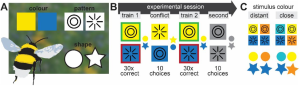
- Bumblebees overwhelmingly give preference to color as a cue for recognizing feeder stations that supply a reward.
- When the colors are easy to discriminate, the bumblebees evidently do not learn the pattern/shape associated with the reward. Instead, they rely on the color as their recognition feature.
- When the colors are difficult to discriminate, e.g., two similar colors like yellow and orange, the bumblebees do also learn to associate the pattern/shape with the reward, possibly to augment their decision making.
Given these results, the authors then made a Bayesian model to help understand and formalize these behavioral results. This model, and the empirical data, suggest that bees switch their decision-making strategy based on how difficult it is to rely solely on their preferred feature. To put this into human terms, if there’s only one person with red hair in a new group of people you encounter, you might quickly be able to distinguish them based solely on that salient feature; however, if there are multiple redheads in a group, then your brain would have to take advantage of other more subtle features for distinguishing them.
Spaethe and colleagues also further analyzed their behavioral data by looking closely at each learning block, and by performing additional experiments investigating how bees handle single versus multiple attributes. There are a few key takeaways from this part of the paper:
- As one would expect, bumblebees more quickly leanred distant color pairs. Colors that were close together, i.e., more difficult to discriminate, took longer to learn.
- Bumblebees shift strategy consistent with cue blocking in associative learning. When one cue is highly predictive (color) and easily associated with the reward, it blocks the learning process for others (pattern/shape).
- The authors also asked if bees learned close color combinations more quickly when they were presented with patterns/shapes. Although the effect is subtle, it does seem that having an additional cue helped them to learn faster (Fig. 4D of the preprint).
The results from these experiments (contained in Fig. 4 of the preprint) suggest that for difficult features, having several cues can improve learning outcomes. The exact mechanisms underlying this effect remain unclear, yet it is a result that makes some intuitive sense: the brain can learn more quickly when it can get more information to help sort out tricky features. Moreover, bumblebees can flexibly switch their learning strategy depending on the reliability of the cue and can make trade-offs between speed and accuracy in learning—an ability that has no doubt been selected for multiple times over the course of nervous system evolution.
What we like about this preprint
doi: https://doi.org/10.1242/prelights.40575
Read preprint (No Ratings Yet)
Sign up to customise the site to your preferences and to receive alerts
Register hereAlso in the animal behavior and cognition category:
Cannibalism as a mechanism to offset reproductive costs in three-spined sticklebacks
Tina Nguyen

Morphological variations in external genitalia do not explain the interspecific reproductive isolation in Nasonia species complex (Hymenoptera: Pteromalidae)
Stefan Friedrich Wirth
Trade-offs between surviving and thriving: A careful balance of physiological limitations and reproductive effort under thermal stress
Tshepiso Majelantle

Also in the neuroscience category:
Human Assembloid Model of Emergent Neurotropic Enteroviruses
Mitchell Sarmie

Small Molecule Agonists of TREM2 Reprogram Microglia and Protect Synapses in Human Alzheimer’s Models
Dina Kabbara

'Preprints by preLighters': Cell loss disrupts mechanical homeostasis to drive retinal pigment epithelium ageing-like phenotype in vitro
Reinier Prosee, Teodora Piskova

preLists in the animal behavior and cognition category:
Biologists @ 100 conference preList
This preList aims to capture all preprints being discussed at the Biologists @100 conference in Liverpool, UK, either as part of the poster sessions or the (flash/short/full-length) talks.
| List by | Reinier Prosee, Jonathan Townson |
9th International Symposium on the Biology of Vertebrate Sex Determination
This preList contains preprints discussed during the 9th International Symposium on the Biology of Vertebrate Sex Determination. This conference was held in Kona, Hawaii from April 17th to 21st 2023.
| List by | Martin Estermann |
Bats
A list of preprints dealing with the ecology, evolution and behavior of bats
| List by | Baheerathan Murugavel |
FENS 2020
A collection of preprints presented during the virtual meeting of the Federation of European Neuroscience Societies (FENS) in 2020
| List by | Ana Dorrego-Rivas |
Also in the neuroscience category:
Keystone Symposium on Stem Cell Models in Embryology 2026
The Keystone Symposium on Stem Cell Models in Embryology, 2026, was organised by Jun Wu (UT Southwestern), Jianping Fu (University of Michigan) and Miki Ebisuya (TU Dresden) and held at Asilomar Conference Grounds in California (US). The meeting discussed recent advances made in establishing stem-cell-based embryo models, what fundamental insights into developmental processes have been gleaned from them, as well as how they are beginning to be applied more widely. This prelist contains preprints by presenters at the talk and poster sessions at the conference, which our Reviews Editor in attendance spotted. Please do reach out to preLights@biologists.com if you notice any that we’ve missed.
| List by | Ingrid Tsang |
November in preprints – DevBio & Stem cell biology
preLighters with expertise across developmental and stem cell biology have nominated a few developmental and stem cell biology (and related) preprints posted in November they’re excited about and explain in a single paragraph why. Concise preprint highlights, prepared by the preLighter community – a quick way to spot upcoming trends, new methods and fresh ideas.
| List by | Aline Grata et al. |
October in preprints – DevBio & Stem cell biology
Each month, preLighters with expertise across developmental and stem cell biology nominate a few recent developmental and stem cell biology (and related) preprints they’re excited about and explain in a single paragraph why. Short, snappy picks from working scientists — a quick way to spot fresh ideas, bold methods and papers worth reading in full. These preprints can all be found in the October preprint list published on the Node.
| List by | Deevitha Balasubramanian et al. |
October in preprints – Cell biology edition
Different preLighters, with expertise across cell biology, have worked together to create this preprint reading list for researchers with an interest in cell biology. This month, most picks fall under (1) Cell organelles and organisation, followed by (2) Mechanosignaling and mechanotransduction, (3) Cell cycle and division and (4) Cell migration
| List by | Matthew Davies et al. |
July in preprints – the CellBio edition
A group of preLighters, with expertise in different areas of cell biology, have worked together to create this preprint reading lists for researchers with an interest in cell biology. This month, categories include: (1) Cell Signalling and Mechanosensing (2) Cell Cycle and Division (3) Cell Migration and Cytoskeleton (4) Cancer Biology (5) Cell Organelles and Organisation
| List by | Girish Kale et al. |
May in preprints – the CellBio edition
A group of preLighters, with expertise in different areas of cell biology, have worked together to create this preprint reading lists for researchers with an interest in cell biology. This month, categories include: 1) Biochemistry/metabolism 2) Cancer cell Biology 3) Cell adhesion, migration and cytoskeleton 4) Cell organelles and organisation 5) Cell signalling and 6) Genetics
| List by | Barbora Knotkova et al. |
April in preprints – the CellBio edition
A group of preLighters, with expertise in different areas of cell biology, have worked together to create this preprint reading lists for researchers with an interest in cell biology. This month, categories include: 1) biochemistry/metabolism 2) cell cycle and division 3) cell organelles and organisation 4) cell signalling and mechanosensing 5) (epi)genetics
| List by | Vibha SINGH et al. |
Biologists @ 100 conference preList
This preList aims to capture all preprints being discussed at the Biologists @100 conference in Liverpool, UK, either as part of the poster sessions or the (flash/short/full-length) talks.
| List by | Reinier Prosee, Jonathan Townson |
2024 Hypothalamus GRC
This 2024 Hypothalamus GRC (Gordon Research Conference) preList offers an overview of cutting-edge research focused on the hypothalamus, a critical brain region involved in regulating homeostasis, behavior, and neuroendocrine functions. The studies included cover a range of topics, including neural circuits, molecular mechanisms, and the role of the hypothalamus in health and disease. This collection highlights some of the latest advances in understanding hypothalamic function, with potential implications for treating disorders such as obesity, stress, and metabolic diseases.
| List by | Nathalie Krauth |
‘In preprints’ from Development 2022-2023
A list of the preprints featured in Development's 'In preprints' articles between 2022-2023
| List by | Alex Eve, Katherine Brown |
CSHL 87th Symposium: Stem Cells
Preprints mentioned by speakers at the #CSHLsymp23
| List by | Alex Eve |
Journal of Cell Science meeting ‘Imaging Cell Dynamics’
This preList highlights the preprints discussed at the JCS meeting 'Imaging Cell Dynamics'. The meeting was held from 14 - 17 May 2023 in Lisbon, Portugal and was organised by Erika Holzbaur, Jennifer Lippincott-Schwartz, Rob Parton and Michael Way.
| List by | Helen Zenner |
ASCB EMBO Annual Meeting 2019
A collection of preprints presented at the 2019 ASCB EMBO Meeting in Washington, DC (December 7-11)
| List by | Madhuja Samaddar et al. |
SDB 78th Annual Meeting 2019
A curation of the preprints presented at the SDB meeting in Boston, July 26-30 2019. The preList will be updated throughout the duration of the meeting.
| List by | Alex Eve |
Autophagy
Preprints on autophagy and lysosomal degradation and its role in neurodegeneration and disease. Includes molecular mechanisms, upstream signalling and regulation as well as studies on pharmaceutical interventions to upregulate the process.
| List by | Sandra Malmgren Hill |
Young Embryologist Network Conference 2019
Preprints presented at the Young Embryologist Network 2019 conference, 13 May, The Francis Crick Institute, London
| List by | Alex Eve |