






Vectorial efference copy and visuomotor transformation through gap junctions
Posted on: 17 September 2026
Preprint posted on 17 August 2026
To see, or not to see: fruit flies selectively suppress visual input via electrical transmission of an efference copy
Selected by Lochlan Walsh
Categories: neuroscience
Background
Movement isn’t solely about getting from point A to B. It affects the sensory input we receive in a continuous, moment-by-moment manner. Consider the movements of your eyes as you read this text: you flick through the words across the screen in a series of rapid ‘saccades’, and yet you still perceive the screen as a stable, coherent image. Rather than viewing the world as a series of incredibly jerky (and nauseating!) images, your brain recognizes and ignores these ‘self-generated’ signals. How?
Signals generated from self-motion can cancel sensory input produced during movement, termed as an ‘efference copy’. They occur across diverse organisms and sensory modalities, including mammalian eye movements, but identifying where they originate, and how the underlying neural circuits implement them, has proven a challenging feat.
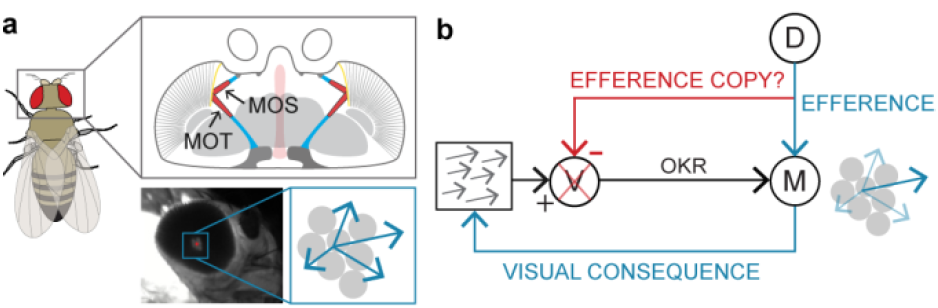
To address this question, Falt and colleagues leveraged recent findings on retinal movements and whole-brain connectomes in the genetic fruit fly model, Drosophila melanogaster. These fruit flies rely strongly on the visual properties of the world, exhibiting spontaneous retinal movements, and the ‘optokinetic reflex’ (OKR). Here, external motion on the retina causes the eyes to follow a moving scene before rapidly resetting gaze with a saccade (see Figure 1 below). Because these saccades also shift the retinal image, visual input must be suppressed to prevent the reflex from responding to self-generated motion, which would cause a reflexive feedback loop.
Experimental Design
Using head-fixed flies, the authors combined high-speed retinal tracking, whole-cell patch-clamp recordings, anatomical staining and genetic manipulations. Experiments were performed in darkness, as well as while flies viewed moving black-and-white gratings, during which the ‘deep pseudopupil’ was tracked to quantify retinal gaze orientation.
They recorded from neurons involved in vision, primarily the ‘horizontal system’ (HS) and ‘vertical system’ (VS) cells, alongside the two retinal motor neurons (RMNs), each innervating a single retinal muscle (musculus orbito-scapalis, MOS; musculus orbito-tentoralis, MOT) (muscles highlighted in Figure 1). Genetic mutants and optogenetic manipulations then provided the causal evidence for their involvement in the visuomotor pathway.
From these data, the authors established two linear models: 1) an oculomotor model predicting retinal shift based on RMN activity. This was later combined with the RMNs’ visual tuning to predict the optokinetic response with great precision, and 2) an electrical wiring model which predicts the electrical information transmission between retinal motor neurons and the upstream visual cells via gap junctions.
Highlighted Results
There are various exciting results that emerged:
- Each retinal muscle is innervated by a single motor neuron, and gaze shift direction can be well predicted by the sum of the activity of the two neurons innervating the muscles.
- Rather than being primarily chemically connected, the authors found that the visual and retinal motor neurons are electrically coupled through gap junctions, providing an incredibly rapid and direct transmission of information between cells.
- A subset of visual neurons (VS1-4 and HS, specifically) are distinctly coupled to each type of retinal motor neuron. Their activity can be linearly summated to predict RMN activity, closely matching the experimental data.
- Conversely, hyperpolarizing the RMNs produced corresponding hyperpolarization in HS cells, demonstrating direct transmission from motor neurons back to upstream sensory neurons.
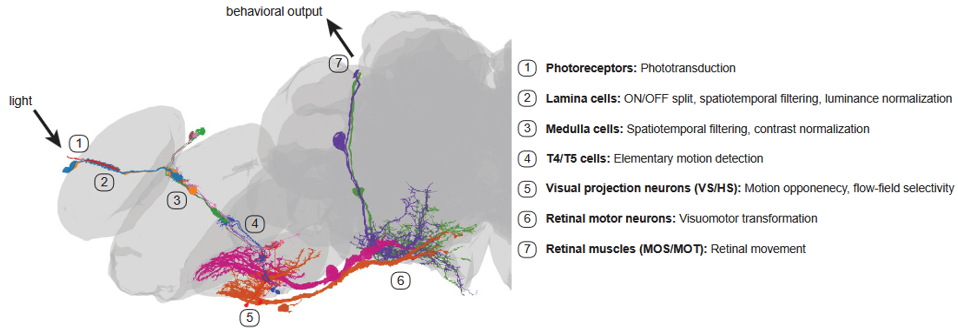
- Activity levels in HS are modulated by the amplitude and direction of retinal shifts. This precedes retinal movement, indicating that the neurons are being ‘predictively’ suppressed before a gaze shift (inhibiting the optokinetic reflex). This convincingly demonstrates a visual efference copy being transmitted along the motor –> sensory pathway (in ED Figure 10: information transmitted from point 6 back to point 5).
Two features appear critical to this rapid response. First, retinal muscles rest in a tonic state, meaning they have a constant, slight contraction at baseline, and via de-/hyperpolarization, can rapidly contract/relax further to adjust the retinal position. Second, direct communication between motor and visual neurons allows motor neurons to rapidly respond to visual input. This also provides what the authors term an “off-switch” for the gaze stability reflex during gaze shifting. Beyond describing this mechanism in remarkable detail, this work provides a base for asking how other animals may uniquely (or not!) implement similar computations.
Most excitingly, the authors seem to provide the final piece of what was a ‘nearly complete visuomotor transformation pathway’: with single-cell resolution, it is possible to map the pathway from light reaching the photoreceptor, to the corresponding behavioural output (albeit with some additional contributing components possibly unknown). ED Figure 10 visualizes this pathway, starting at point 1 with the photoreceptor receiving photons, and ending at point 7, where the retina is actively shifted in response.
What I like about this preprint:
Harnessing the breadth of experimental tools available for Drosophila, the authors elegantly dissect the process of efference copy generation, demonstrating an admirable amount of work to do so. Each experimental step has a clear motivation and rationale, and I particularly liked that the authors started from rather simple predictions and models, before elaborating with additional components (e.g. starting from the oculomotor model derived from individual RMN responses, and then adding visual tuning to make predictions). I also appreciated their use of genetic mutants and optogenetics – rather than simply matching physiology to model predictions, they provide compelling causal evidence for the mechanisms driving the results.
Finally, I think it’s thrilling to see open-source databases of the fruit fly brain (e.g. the connectome) used as a reference for new findings. This preprinted work highlights that even comprehensive, seemingly complete descriptions of the brain can still lack critical detail – here, gap junctions coupling visuo-motor neurons – and that there are still endless exciting discoveries to be made about how animals sense and act in a dynamic world.
Questions for the Authors:
- From a simplicity perspective, I wasn’t expecting that HS cells receive efference copies from two retinal motor neurons, whereas VS cells receive a copy from only one. Is there a functional or computational advantage to this circuitry? Could similar results be expected if the pathways were simply HS –> MOT and VS –> MOS? Could your models be perturbed or rearranged to test how different circuitry or connections influence both the resulting efference copy and retinal movement?
- You mention that efference copies from the retina are likely to influence neck motor neurons, and vice versa. Could the neck and retina ever attempt to stabilize in opposite directions, potentially producing conflicting efference copies, or do gap junctions inherently prevent this?
- How might this translate to a freely-moving fly, whether on a substrate or in the air? Would you expect the same computations and circuitry under much faster and more dynamic sensory input (and more complex motor decisions)?
- You describe a key missing link in a ‘nearly complete sensory-motor transformation’. With this level of resolution now available, and confident predictions about the computations each component performs, what’s next? What might this mean for future Drosophila research on efference copies and active sensing? How might it extend to other animals?
doi: https://doi.org/10.1242/prelights.44871
Read preprintSign up to customise the site to your preferences and to receive alerts
Register hereAlso in the neuroscience category:
Centrosome Loss Alters Axonal and Muscle Development
Jeny Jose

Microglia extract neuronal proteolytic organelles via skoupocytosis
Chandrika Rao

SPOTTER: Automated Tissue-Barcoding Platform for Spatial Proteomics and Phosphoproteomics
TheLangeLab, Felix Kraus

preLists in the neuroscience category:
‘In preprints’ from Development 2026
A list of the preprints featured in Development's 'In preprints' articles, as part of the new Preprint Editors initiative
| List by | Clarisse Brunet Avalos et al. |
preLighters’ choice – Handpicked DevBio preprints
preLighters with expertise across developmental and stem cell biology have nominated a few developmental biology (and related) preprints they’re excited about and explain in a few paragraph why. Concise preprint highlights, prepared by the preLighter community – a quick way to spot upcoming trends, new methods and fresh ideas.
| List by | Theodora Stougiannou et al. |
BSDB Spring Meeting: Molecules to Morphogenesis
The British Society for Developmental Biology (BSDB) Spring Meeting Molecules to Morphogenesis was held from 23–26 March 2026 at the University of Warwick (UK). This meeting brought together a vibrant community of researchers to discuss how molecular mechanisms are integrated across scales to drive morphogenesis, spanning diverse model systems and approaches. This preList contains preprints by presenters from the talk and poster sessions at the meeting. Please do get in touch at preLights@biologists.com if you notice any relevant preprints that we may have missed.
| List by | Ingrid Tsang |
Keystone Symposium on Stem Cell Models in Embryology 2026
The Keystone Symposium on Stem Cell Models in Embryology, 2026, was organised by Jun Wu (UT Southwestern), Jianping Fu (University of Michigan) and Miki Ebisuya (TU Dresden) and held at Asilomar Conference Grounds in California (US). The meeting discussed recent advances made in establishing stem-cell-based embryo models, what fundamental insights into developmental processes have been gleaned from them, as well as how they are beginning to be applied more widely. This prelist contains preprints by presenters at the talk and poster sessions at the conference, which our Reviews Editor in attendance spotted. Please do reach out to preLights@biologists.com if you notice any that we’ve missed.
| List by | Ingrid Tsang |
November in preprints – DevBio & Stem cell biology
preLighters with expertise across developmental and stem cell biology have nominated a few developmental and stem cell biology (and related) preprints posted in November they’re excited about and explain in a single paragraph why. Concise preprint highlights, prepared by the preLighter community – a quick way to spot upcoming trends, new methods and fresh ideas.
| List by | Aline Grata et al. |
October in preprints – DevBio & Stem cell biology
Each month, preLighters with expertise across developmental and stem cell biology nominate a few recent developmental and stem cell biology (and related) preprints they’re excited about and explain in a single paragraph why. Short, snappy picks from working scientists — a quick way to spot fresh ideas, bold methods and papers worth reading in full. These preprints can all be found in the October preprint list published on the Node.
| List by | Deevitha Balasubramanian et al. |
October in preprints – Cell biology edition
Different preLighters, with expertise across cell biology, have worked together to create this preprint reading list for researchers with an interest in cell biology. This month, most picks fall under (1) Cell organelles and organisation, followed by (2) Mechanosignaling and mechanotransduction, (3) Cell cycle and division and (4) Cell migration
| List by | Matthew Davies et al. |
July in preprints – the CellBio edition
A group of preLighters, with expertise in different areas of cell biology, have worked together to create this preprint reading lists for researchers with an interest in cell biology. This month, categories include: (1) Cell Signalling and Mechanosensing (2) Cell Cycle and Division (3) Cell Migration and Cytoskeleton (4) Cancer Biology (5) Cell Organelles and Organisation
| List by | Girish Kale et al. |
May in preprints – the CellBio edition
A group of preLighters, with expertise in different areas of cell biology, have worked together to create this preprint reading lists for researchers with an interest in cell biology. This month, categories include: 1) Biochemistry/metabolism 2) Cancer cell Biology 3) Cell adhesion, migration and cytoskeleton 4) Cell organelles and organisation 5) Cell signalling and 6) Genetics
| List by | Barbora Knotkova et al. |
April in preprints – the CellBio edition
A group of preLighters, with expertise in different areas of cell biology, have worked together to create this preprint reading lists for researchers with an interest in cell biology. This month, categories include: 1) biochemistry/metabolism 2) cell cycle and division 3) cell organelles and organisation 4) cell signalling and mechanosensing 5) (epi)genetics
| List by | Vibha SINGH et al. |
Biologists @ 100 conference preList
This preList aims to capture all preprints being discussed at the Biologists @100 conference in Liverpool, UK, either as part of the poster sessions or the (flash/short/full-length) talks.
| List by | Reinier Prosee, Jonathan Townson |
2024 Hypothalamus GRC
This 2024 Hypothalamus GRC (Gordon Research Conference) preList offers an overview of cutting-edge research focused on the hypothalamus, a critical brain region involved in regulating homeostasis, behavior, and neuroendocrine functions. The studies included cover a range of topics, including neural circuits, molecular mechanisms, and the role of the hypothalamus in health and disease. This collection highlights some of the latest advances in understanding hypothalamic function, with potential implications for treating disorders such as obesity, stress, and metabolic diseases.
| List by | Nathalie Krauth |
‘In preprints’ from Development 2022-2023
A list of the preprints featured in Development's 'In preprints' articles between 2022-2023
| List by | Alex Eve, Katherine Brown |
CSHL 87th Symposium: Stem Cells
Preprints mentioned by speakers at the #CSHLsymp23
| List by | Alex Eve |
Journal of Cell Science meeting ‘Imaging Cell Dynamics’
This preList highlights the preprints discussed at the JCS meeting 'Imaging Cell Dynamics'. The meeting was held from 14 - 17 May 2023 in Lisbon, Portugal and was organised by Erika Holzbaur, Jennifer Lippincott-Schwartz, Rob Parton and Michael Way.
| List by | Helen Zenner |
FENS 2020
A collection of preprints presented during the virtual meeting of the Federation of European Neuroscience Societies (FENS) in 2020
| List by | Ana Dorrego-Rivas |
ASCB EMBO Annual Meeting 2019
A collection of preprints presented at the 2019 ASCB EMBO Meeting in Washington, DC (December 7-11)
| List by | Madhuja Samaddar et al. |
SDB 78th Annual Meeting 2019
A curation of the preprints presented at the SDB meeting in Boston, July 26-30 2019. The preList will be updated throughout the duration of the meeting.
| List by | Alex Eve |
Autophagy
Preprints on autophagy and lysosomal degradation and its role in neurodegeneration and disease. Includes molecular mechanisms, upstream signalling and regulation as well as studies on pharmaceutical interventions to upregulate the process.
| List by | Sandra Malmgren Hill |
Young Embryologist Network Conference 2019
Preprints presented at the Young Embryologist Network 2019 conference, 13 May, The Francis Crick Institute, London
| List by | Alex Eve |