






In vitro pharmacokinetics and pharmacodynamics of the diarylquinoline TBAJ-587 and its metabolites against Mycobacterium tuberculosis
Posted on: 24 November 2025 , updated on: 21 July 2026
Preprint posted on 5 November 2025
Article now published in Frontiers in Microbiology at http://dx.doi.org/10.3389/fmicb.2026.1828998
Battling the TB blues: a pharmacokinetic-pharmacodynamic approach by Aguilar-Ayala and colleagues to characterise the activity of TBAJ-587 and its metabolites
Selected by Zhang-He Goh
Categories: pharmacology and toxicology
Updated 21 July 2026 with a postLight by Zhang-He Goh
There were several changes between the original work and the published version, which was perhaps not surprising given that more than 7 months had passed between both works.
There were no major changes to the figures in the main text. The most notable change I noticed was that the authors have addressed some potential limitations of their work in the summary of the published version. In doing so, the authors have also supported their arguments by comparing them to other more recent studies, including, interestingly, clinical population PK analysis of TBAJ-587 and its main metabolites.
Why I chose to highlight this preprint
Tuberculosis is among the top ten causes of death worldwide and affects millions of people. Given the global disease burden of tuberculosis, translational research to bring drug entities from the bench to the bedside is crucial. Yet, the growth of demand for new antibiotics has far outpaced their discovery.1 Every step that leads to novel antibiotic development—from the initial discovery of candidates to the clinical trials—is needed for the pipeline to succeed.
In my highlight of this preprint by Aguilar-Ayala and colleagues, I hope to recapitulate the key tenets underpinning antibiotic discovery: antibiotics need to be efficacious against the bacteria, but they also need to be safe for humans.
Background of the preprint
The current treatment for tuberculosis involves a drug cocktail (isoniazid, rifampicin, ethambutol, and pyrazinamide), but resistance to this regimen among Mycobacterium tuberculosis (Mtb) is emerging. The need for antibiotics for new drugs against these drug-resistant strains has resulted in the development of bedaquiline, the first of the class of diarylquinolines which specifically inhibit the Mtb ATP synthase. By operating through a distinct mechanism of action and targeting distinct Mtb metabolic pathways, diarylquinolines are especially effective when used in combination with the other treatments. This strategy is also useful for minimising the development of Mtb resistance to these antitubercular agents.
Notwithstanding the efficacy of bedaquiline as a treatment against drug-resistant Mtb strains, it has several side effects. Chief among these is cardiotoxicity arising from bedaquiline’s metabolites. As such, several analogues of bedaquiline have been developed in the past few decades. A promising candidate has surfaced: TBAJ-587, a bedaquiline analogue that has superior pharmacokinetic properties and better efficacy.
To better relate the pharmacokinetics of TBAJ-587 to its efficacy and safety, Aguilar-Ayala and colleagues used a pharmacokinetic-pharmacodynamic (PK-PD) approach in this work to characterise the activity of TBAJ-587 and its metabolites against Mtb H37Rv (Figure 1). The authors characterised the antitubercular activity of TBAJ-587 and its metabolites, then linked this activity to the in vitro exposure of the Mtb to the substrates over time, thus complementing other pharmacokinetic studies involving TBAJ-587.2
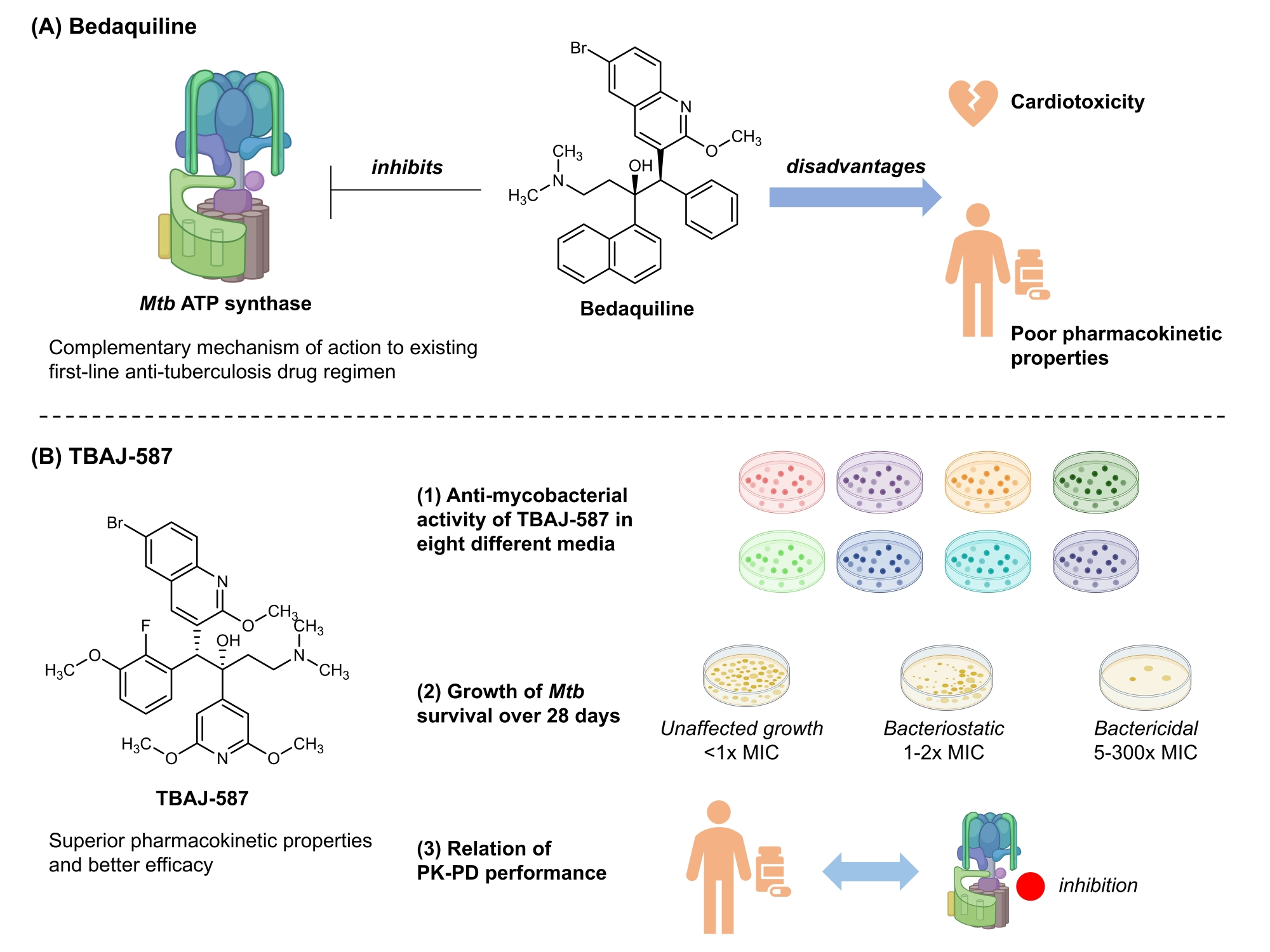
Figure 1. (a) Problems with bedaquiline use. (b) Characterisation of the PK-PD relationship of TBAJ‑587 by Aguilar-Ayala and colleagues.
Key findings of this preprint
To establish a baseline for their studies, Aguilar-Ayala and colleagues first characterised the anti-mycobacterial activity of bedaquiline, TBAJ-587, and its metabolites in eight different media. The minimum inhibitory concentration (MIC) values of bedaquiline exhibited slightly greater variation than the MIC values of TBAJ-587.
The authors then monitored Mtb growth over 28 days when treated with TBAJ‑587 and its main metabolites in standard, fatty acid, and cholesterol media. Under both untreated and treated conditions, Mtb growth was enhanced in cholesterol media compared to fatty acid and standard media. In all media, TBAJ-587 exhibited bacteriostatic activity at 1x MIC and 2x MIC, which means that further Mtb growth was inhibited. At higher concentrations, i.e. from 5x MIC to 300x MIC, TBAJ-587 exhibited bactericidal effects, meaning that Mtb was actively killed. The authors found some antitubercular resistance, with a 4‑fold increase in MIC of the regrowth isolates compared to the wild-type baseline.
Next, the authors measured the pharmacokinetics of TBAJ-587 and its main metabolites. The binding of these substrates to plastic was significant—this is a common challenge in life science research, where unspecific binding of reagents to plastic can complicate attempts to quantify the actual levels of these reagents in solution. These problems became more evident in the authors’ characterisation of the PK-PD relationship of TBAJ-587 and its metabolites, resulting in a marked difference between expected and actual PK-PD performance. This discrepancy led the authors to conclude that the bactericidal effect of TBAJ-587 and M3 (one of the main metabolites of TBAJ-587) was underestimated compared to their in vitro assays, and had already been achieved at exposure levels about 7- to 20-fold times lower than theoretically expected.
Future directions
Future work on this topic will largely involve the further improvement of assays already described in this work to better understand the PK-PD relationship between TBAJ-587 (and its metabolites) and their antitubercular activities. Due to issues involving substrate stability and non-specific adsorption to flask material, the accurate measurement of actual substrate concentrations in media is not always straightforward. Whether these challenges can be resolved technically (i.e. using non-adhesive material) or computationally (i.e. using a careful design of experiments that can predict and compensate for these effects through modelling) remains to be seen.
Furthermore, Aguilar‑Ayala and colleagues also briefly described preliminary work done towards preventing the emergence of resistance against TBAJ-587. Much more extensive research will need to be performed in this regard to identify the exact consequences of the mutations found by the authors in their research. Specifically, how these mutations cause resistance will need to be more clearly defined: do they affect binding of TBAJ-587 to the target, and what are the escape mechanisms through which these mutations cause resistance? The answers to these questions will provide insights into the possibility of exploiting complementary mechanisms of action, thus informing the clinical indications for TBAJ‑587 and minimising the development of Mtb resistance.
Questions for the authors
- Given that non-specific binding of the substrates to the flask material was a challenge, did pre-treating the flask material with the substrates involved help to reduce this issue?
- How do the findings in this study compare to other research performed on: (a) tuberculosis lesions, and (b) in vivo research in animal models? Is TBAJ-587 also more potent in this other research?
- It was found that the M3 metabolite of TBAJ-587 was particularly efficacious—why is this? How do the pharmacophores relate across M3, TBAJ-587, and bedaquiline? What functional groups do the other metabolites lack that are crucial for their activity?
- How is TBAJ-587 eliminated, and how much of the elimination is caused by metabolism (the other route being excretion)? How does the elimination of TBAJ-587 compare to bedaquiline?
Acknowledgements
Images created using Microsoft Powerpoint, ChemDraw, and BioRender.
References
(1) Cardona, S. T.; Rahman, A. S. M. Z.; Novomisky Nechcoff, J. Innovative Perspectives on the Discovery of Small Molecule Antibiotics. Npj Antimicrob. Resist. 2025, 3 (1), 19. https://doi.org/10.1038/s44259-025-00089-0.
(2) Bustion, A. E.; Ernest, J. P.; Kaya, F.; Silva, C.; Sarathy, J.; Blanc, L.; Imperial, M.; Gengenbacher, M.; Xie, M.; Zimmerman, M. D.; Robertson, G. T.; Weiner, D.; Via, L. E.; Barry, C. E.; Savic, R. M.; Dartois, V. The Kinetics of Bedaquiline Diffusion in Tuberculous Cavities Open a Window for the Emergence of Resistance. J. Infect. Dis. 2025, 232 (3), e431–e441. https://doi.org/10.1093/infdis/jiaf303.
doi: https://doi.org/10.1242/prelights.42229
Read preprintSign up to customise the site to your preferences and to receive alerts
Register hereAlso in the pharmacology and toxicology category:
The Endocannabinoid System’s Contribution to Placebo Analgesia
Thomas Nicodemo Arrieta et al.

Small Molecule Agonists of TREM2 Reprogram Microglia and Protect Synapses in Human Alzheimer’s Models
Dina Kabbara

Snake venom metalloproteinases are predominantly responsible for the cytotoxic effects of certain African viper venoms
Daniel Osorno Valencia
preLists in the pharmacology and toxicology category:
SciELO preprints – From 2025 onwards
SciELO has become a cornerstone of open, multilingual scholarly communication across Latin America. Its preprint server, SciELO preprints, is expanding the global reach of preprinted research from the region (for more information, see our interview with Carolina Tanigushi). This preList brings together biological, English language SciELO preprints to help readers discover emerging work from the Global South. By highlighting these preprints in one place, we aim to support visibility, encourage early feedback, and showcase the vibrant research communities contributing to SciELO’s open science ecosystem.
| List by | Carolina Tanigushi |
April in preprints – the CellBio edition
A group of preLighters, with expertise in different areas of cell biology, have worked together to create this preprint reading lists for researchers with an interest in cell biology. This month, categories include: 1) biochemistry/metabolism 2) cell cycle and division 3) cell organelles and organisation 4) cell signalling and mechanosensing 5) (epi)genetics
| List by | Vibha SINGH et al. |
FENS 2020
A collection of preprints presented during the virtual meeting of the Federation of European Neuroscience Societies (FENS) in 2020
| List by | Ana Dorrego-Rivas |
COVID-19 / SARS-CoV-2 preprints
List of important preprints dealing with the ongoing coronavirus outbreak. See http://covidpreprints.com for additional resources and timeline, and https://connect.biorxiv.org/relate/content/181 for full list of bioRxiv and medRxiv preprints on this topic
| List by | Dey Lab, Zhang-He Goh |
1
Drug use in special populations
Any drugs that are being used in special populations: Patients with liver and kidney failure, in paediatrics, in geriatrics, and in pregnant or lactating patients. Includes the discovery of factors that could potentially affect drug use in these special populations.
| List by | Zhang-He Goh |
Toxicology of toxicants, existing therapeutics, and investigational drugs
Preprints that describe the toxicology of environmental pollutants and existing and upcoming drugs. Includes both toxicokinetics and toxicodynamics, as well as technological improvements that will help in the characterisation of this field.
| List by | Zhang-He Goh |
Antimicrobials: Discovery, clinical use, and development of resistance
Preprints that describe the discovery of new antimicrobials and any improvements made regarding their clinical use. Includes preprints that detail the factors affecting antimicrobial selection and the development of antimicrobial resistance.
| List by | Zhang-He Goh |
Anticancer agents: Discovery and clinical use
Preprints that describe the discovery of anticancer agents and their clinical use. Includes both small molecules and macromolecules like biologics.
| List by | Zhang-He Goh |
Advances in Drug Delivery
Advances in formulation technology or targeted delivery methods that describe or develop the distribution of small molecules or large macromolecules to specific parts of the body.
| List by | Zhang-He Goh |