





The role of contextual similarity on brain activity patterns for associated events
Posted on: 24 November 2026
Preprint posted on 24 November 2026

Categories: neuroscience, zoology
Background:
Ever remembered meeting someone but struggled to remember who they were with or when you met them?. Our memories do not always preserve every aspect of an experience equally. Sometimes, we remember what happened but lose the details of where and when it happened. This ability to remember events along with the circumstances in which they occurred is a key feature of episodic memory.
Episodic memories contain more than just the events themselves. They also include contextual information such as when and where an event occurred. Theories of episodic memory suggest that these contextual representations which carry temporal, spatial, and conceptual information (Copara et al., 2014; Diana et al., 2012) can be reinstated when we retrieve an event. Consistent with this view, events sharing both item and contextual information have been shown to have more similar representations in the hippocampus (a brain region important for long-term memory) than events sharing only one of these features (Libby et al., 2019). But how does the brain represent events that share different degrees of contextual overlap? Rather than simply asking whether two events occurred in the same or different contexts, this preprinted study explores how varying degrees of contextual similarity shape neural representations. It shows that the context surrounding an event matters as it helps shape how our brain represents and connects different experiences.
Key findings:
- How context is represented in the brain
To examine neural representations of events with contextual overlap, the authors asked study participants to watch TV show episodes with commercials while measuring their brain activity patterns using functional magnetic resonance (fMRI) imaging. These commercials were presented with either the same TV show and episode (same context), same TV show but different episode (similar context) or different TV show (different context). They focused on two brain regions: the ventromedial prefrontal cortex (vmPFC), which is involved in memory and linking information, and the posterior medial cortex (PMC), which is involved in representing events and their surrounding context.
The vmPFC and PMC showed more similar brain activity patterns when two commercials were associated with the same TV show than when they were associated with different shows. In other words, even though the commercials were different, the brain represented them more similarly when they shared the same show as their context. However, this similarity did not increase when the commercials appeared in the same episode rather than in different episodes of that show suggesting that the vmPFC and PMC are more sensitive to the broader context (the TV show) than to the specific episode.
- Regional differences in contextual representation- How the medial temporal lobe and hippocampus represents context.
The authors also examined how different regions of the medial temporal lobe, a brain area important for memory, represent context. The parahippocampal cortex (PHC) was sensitive to both the broader context (the TV show) and the specific context (the episode). Commercials associated with the same show and episode showed greater similarity in brain activity patterns. The PHC also showed reduced activity when participants viewed different segments from the same commercial, suggesting that it can recognize shared conceptual information.
The perirhinal cortex (PRC), in contrast, showed greater similarity for commercials associated with the same show, but did not distinguish between episodes. This suggests that the PRC is more sensitive to the broader context (TV show) like the vmPFC and PMC.
The hippocampus, a brain region important for memory, showed no overall differences across the context conditions. However, greater similarity in hippocampal activity was linked to better memory for commercials associated with the same TV show and episode. This suggests that the hippocampus may help us remember the specific context in which an event occurred.
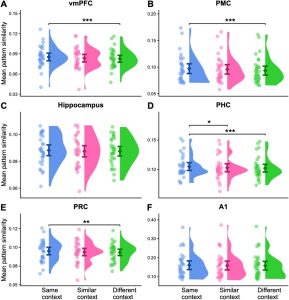
Figure. Raincloud plots show participant-level mean pattern similarity for commercial segments in the three conditions of interest: same context (same show, same episode), similar context (same show, different episode), and different context (different show). The ventromedial prefrontal cortex (vmPFC), posterior medial cortex (PMC), parahippocampal cortex (PHC), and perirhinal cortex (PRC) were sensitive to global context. (refer to preprint Figure 2 made available under a CC-BY-NC-ND 4.0 International license).
What I like about the preprint?
I particularly liked the thoughtfulness of the study design. Rather than treating context as simply present or absent, the authors explored different levels of contextual similarity. This helps us understand why we remember not just what happened, but also where and in what situation it happened. The findings show that the brain can link separate events through their shared context, even when the events themselves are quite different. This gives us a better understanding of how our experiences are organized and connected in memory.
Questions to the authors:
- The hippocampus did not show an overall effect of contextual overlap, but its pattern similarity was related to better source memory in the same context condition. Do you think this reflects a limitation of the experimental task, or does it suggest that hippocampal contextual representations are more closely linked to successful memory formation or retrieval?
- Could differences in ability to remember contextual details explain some of the variability in neural pattern similarity?
Future directions:
Future studies could investigate how long contextual representations persist and whether they change over time or following memory retrieval. It would also be interesting to examine whether similar patterns emerge in more naturalistic experiences, such as everyday conversations and events, where contextual information overlaps and changes continuously.
References:
- Copara, M. S., Hassan, A. S., Kyle, C. T., Libby, L. A., Ranganath, C., & Ekstrom, A. D. (2014). Complementary Roles of Human Hippocampal Subregions during Retrieval of Spatiotemporal Context. The Journal of Neuroscience, 34(20), 6834–6842. doi:10.1523/JNEUROSCI.5341-13.2014
- Diana, R. A., Yonelinas, A. P., & Ranganath, C. (2012). Adaptation to cognitive context and item information in the medial temporal lobes. Neuropsychologia, 50(13), 3062–3069. doi:10.1016/j.neuropsychologia.2012.07.035
- Libby, L. A., Reagh, Z. M., Bouffard, N. R., Ragland, J. D., & Ranganath, C. (2019). The Hippocampus Generalizes across Memories that Share Item and Context Information. Journal of Cognitive Neuroscience, 31(1), 24–35. doi:10.1162/jocn_a_01345
Sign up to customise the site to your preferences and to receive alerts
Register hereAlso in the neuroscience category:
Centrosome Loss Alters Axonal and Muscle Development
Jeny Jose

Microglia extract neuronal proteolytic organelles via skoupocytosis
Chandrika Rao

Vectorial efference copy and visuomotor transformation through gap junctions
Lochlan Walsh

Also in the zoology category:
The role of contextual similarity on brain activity patterns for associated events
Maitri Manjunath
Breaking rules at small scales: ecological and biomechanical diversity in ant terrestrial locomotion
Stefan Friedrich Wirth

Drift drives phenotypic evolution in a rapid island radiation
Zoha Sadaqat

preLists in the neuroscience category:
‘In preprints’ from Development 2026
A list of the preprints featured in Development's 'In preprints' articles, as part of the new Preprint Editors initiative
| List by | Clarisse Brunet Avalos et al. |
preLighters’ choice – Handpicked DevBio preprints
preLighters with expertise across developmental and stem cell biology have nominated a few developmental biology (and related) preprints they’re excited about and explain in a few paragraph why. Concise preprint highlights, prepared by the preLighter community – a quick way to spot upcoming trends, new methods and fresh ideas.
| List by | Theodora Stougiannou et al. |
BSDB Spring Meeting: Molecules to Morphogenesis
The British Society for Developmental Biology (BSDB) Spring Meeting Molecules to Morphogenesis was held from 23–26 March 2026 at the University of Warwick (UK). This meeting brought together a vibrant community of researchers to discuss how molecular mechanisms are integrated across scales to drive morphogenesis, spanning diverse model systems and approaches. This preList contains preprints by presenters from the talk and poster sessions at the meeting. Please do get in touch at preLights@biologists.com if you notice any relevant preprints that we may have missed.
| List by | Ingrid Tsang |
Keystone Symposium on Stem Cell Models in Embryology 2026
The Keystone Symposium on Stem Cell Models in Embryology, 2026, was organised by Jun Wu (UT Southwestern), Jianping Fu (University of Michigan) and Miki Ebisuya (TU Dresden) and held at Asilomar Conference Grounds in California (US). The meeting discussed recent advances made in establishing stem-cell-based embryo models, what fundamental insights into developmental processes have been gleaned from them, as well as how they are beginning to be applied more widely. This prelist contains preprints by presenters at the talk and poster sessions at the conference, which our Reviews Editor in attendance spotted. Please do reach out to preLights@biologists.com if you notice any that we’ve missed.
| List by | Ingrid Tsang |
November in preprints – DevBio & Stem cell biology
preLighters with expertise across developmental and stem cell biology have nominated a few developmental and stem cell biology (and related) preprints posted in November they’re excited about and explain in a single paragraph why. Concise preprint highlights, prepared by the preLighter community – a quick way to spot upcoming trends, new methods and fresh ideas.
| List by | Aline Grata et al. |
October in preprints – DevBio & Stem cell biology
Each month, preLighters with expertise across developmental and stem cell biology nominate a few recent developmental and stem cell biology (and related) preprints they’re excited about and explain in a single paragraph why. Short, snappy picks from working scientists — a quick way to spot fresh ideas, bold methods and papers worth reading in full. These preprints can all be found in the October preprint list published on the Node.
| List by | Deevitha Balasubramanian et al. |
October in preprints – Cell biology edition
Different preLighters, with expertise across cell biology, have worked together to create this preprint reading list for researchers with an interest in cell biology. This month, most picks fall under (1) Cell organelles and organisation, followed by (2) Mechanosignaling and mechanotransduction, (3) Cell cycle and division and (4) Cell migration
| List by | Matthew Davies et al. |
July in preprints – the CellBio edition
A group of preLighters, with expertise in different areas of cell biology, have worked together to create this preprint reading lists for researchers with an interest in cell biology. This month, categories include: (1) Cell Signalling and Mechanosensing (2) Cell Cycle and Division (3) Cell Migration and Cytoskeleton (4) Cancer Biology (5) Cell Organelles and Organisation
| List by | Girish Kale et al. |
May in preprints – the CellBio edition
A group of preLighters, with expertise in different areas of cell biology, have worked together to create this preprint reading lists for researchers with an interest in cell biology. This month, categories include: 1) Biochemistry/metabolism 2) Cancer cell Biology 3) Cell adhesion, migration and cytoskeleton 4) Cell organelles and organisation 5) Cell signalling and 6) Genetics
| List by | Barbora Knotkova et al. |
April in preprints – the CellBio edition
A group of preLighters, with expertise in different areas of cell biology, have worked together to create this preprint reading lists for researchers with an interest in cell biology. This month, categories include: 1) biochemistry/metabolism 2) cell cycle and division 3) cell organelles and organisation 4) cell signalling and mechanosensing 5) (epi)genetics
| List by | Vibha SINGH et al. |
Biologists @ 100 conference preList
This preList aims to capture all preprints being discussed at the Biologists @100 conference in Liverpool, UK, either as part of the poster sessions or the (flash/short/full-length) talks.
| List by | Reinier Prosee, Jonathan Townson |
2024 Hypothalamus GRC
This 2024 Hypothalamus GRC (Gordon Research Conference) preList offers an overview of cutting-edge research focused on the hypothalamus, a critical brain region involved in regulating homeostasis, behavior, and neuroendocrine functions. The studies included cover a range of topics, including neural circuits, molecular mechanisms, and the role of the hypothalamus in health and disease. This collection highlights some of the latest advances in understanding hypothalamic function, with potential implications for treating disorders such as obesity, stress, and metabolic diseases.
| List by | Nathalie Krauth |
‘In preprints’ from Development 2022-2023
A list of the preprints featured in Development's 'In preprints' articles between 2022-2023
| List by | Alex Eve, Katherine Brown |
CSHL 87th Symposium: Stem Cells
Preprints mentioned by speakers at the #CSHLsymp23
| List by | Alex Eve |
Journal of Cell Science meeting ‘Imaging Cell Dynamics’
This preList highlights the preprints discussed at the JCS meeting 'Imaging Cell Dynamics'. The meeting was held from 14 - 17 May 2023 in Lisbon, Portugal and was organised by Erika Holzbaur, Jennifer Lippincott-Schwartz, Rob Parton and Michael Way.
| List by | Helen Zenner |
FENS 2020
A collection of preprints presented during the virtual meeting of the Federation of European Neuroscience Societies (FENS) in 2020
| List by | Ana Dorrego-Rivas |
ASCB EMBO Annual Meeting 2019
A collection of preprints presented at the 2019 ASCB EMBO Meeting in Washington, DC (December 7-11)
| List by | Madhuja Samaddar et al. |
SDB 78th Annual Meeting 2019
A curation of the preprints presented at the SDB meeting in Boston, July 26-30 2019. The preList will be updated throughout the duration of the meeting.
| List by | Alex Eve |
Autophagy
Preprints on autophagy and lysosomal degradation and its role in neurodegeneration and disease. Includes molecular mechanisms, upstream signalling and regulation as well as studies on pharmaceutical interventions to upregulate the process.
| List by | Sandra Malmgren Hill |
Young Embryologist Network Conference 2019
Preprints presented at the Young Embryologist Network 2019 conference, 13 May, The Francis Crick Institute, London
| List by | Alex Eve |
Also in the zoology category:
SciELO preprints – From 2025 onwards
SciELO has become a cornerstone of open, multilingual scholarly communication across Latin America. Its preprint server, SciELO preprints, is expanding the global reach of preprinted research from the region (for more information, see our interview with Carolina Tanigushi). This preList brings together biological, English language SciELO preprints to help readers discover emerging work from the Global South. By highlighting these preprints in one place, we aim to support visibility, encourage early feedback, and showcase the vibrant research communities contributing to SciELO’s open science ecosystem.
| List by | Carolina Tanigushi |
Biologists @ 100 conference preList
This preList aims to capture all preprints being discussed at the Biologists @100 conference in Liverpool, UK, either as part of the poster sessions or the (flash/short/full-length) talks.
| List by | Reinier Prosee, Jonathan Townson |
Bats
A list of preprints dealing with the ecology, evolution and behavior of bats
| List by | Baheerathan Murugavel |