








20 years of African Neuroscience: Waking a sleeping giant
Posted on: 10 July 2020
Preprint posted on 4 June 2020

Categories: neuroscience, scientific communication and education
Background
Understanding the brain in health and disease, remains a key challenge. However, up to now, the majority of brain research is carried out in the Global North, while research from the Global South remains sparse. In their work, Maina et al (1) point out the need for devising new policies to boost Africa’s neuroscience research, and the fact that such policies must be based on accurate data reflecting the heterogeneity of research outputs across the 54 countries in the continent. The authors analysed Africa’s output on neuroscience over the past 21 years, focusing specifically on work performed in Africa and led by African-based researchers- as previous estimates suggested that as much as 80% of published health research with African authors was not led/performed in Africa (2). From this output, they analysed impact metrics, as well as details on funding, collaborations, techniques, and model systems used. They linked this data to indicators of mobility and economy, and compare it to metrics from selected countries in the Global North. This work’s aim is to set the basis to make actionable recommendations to support African research in the future.
Key findings
The main findings of the study by Maina et al are summarized below in key points of the study.
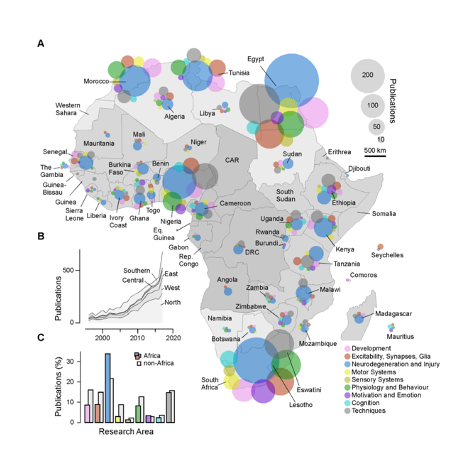
Research landscape: Africa’s neuroscience output since 1997 has been dominated by Egypt, South Africa, Nigeria, Morocco and Tunisia, who account for over 75% of neuroscience papers published in the continent. A further 6-9% is contributed to by Kenya, Ethiopia and Tanzania, while 6-12% is contributed to by Cameroon, Malawi, Algeria, Senegal, Uganda and Ghana. Beyond these countries, over half of the remaining African countries contribute fewer than 10 papers. However, neuroscience publications have exponentially increased across Africa over the last two decades, suggesting greatly a trend of future growth.
Research topics: Main research topics targeted by African labs include neurodegeneration and injury, techniques, excitability, synapses and glia, development and physiology and behavior, while less targeted topics included motivation and emotion, motor systems, cognition, and sensory systems. The authors found that the contribution over time and topics has been consistent.
Relation to economy and governance metrics: The authors related each country’s total number of neuroscience publications to metrics of economy, population, and governance (corruption index). They found a positive correlation between neuroscience output and wealth and resources, and a negative correlation to high corruption index.
Visibility: The authors assessed international visibility and communication outputs of African neuroscience by way of citation numbers and impact factor. Comparison with several non-African countries showed many papers were parallel in visibility, however, they noted high regional variation in these metrics. Moreover, at least a small fraction of papers were considered among neuroscience’s most influential work. They conclude that African neuroscience’s influence on the world’s production of knowledge is significant, and growing.
International collaborations: The authors discuss the barriers faced by African science in terms of engaging in collaborative work with colleagues abroad, whereby for example funding and visa- related processes hinder collaboration. Despite these barriers, African-led neuroscience publications resultant from collaborations tend to be cited more frequently, and in higher impact factor journals. The study evaluated collaborations between researchers in different African countries, as well as beyond the borders of the continent. The authors further found a geographic and cultural pattern, whereby inter-African collaborations seemed to be between West, East and Central African countries with South Africa, while North African labs seemed to seek collaborations within the region or with Europe, North America, and the Middle East. The authors further suggest that the identified networks are linked to underlying factors such as historic, linguistic, economic and cultural ties, and they point out that this relatively poor international connectedness should be considered in future efforts aiming to build a united African research landscape.
Funders of African neuroscience: The authors investigated funders of African neuroscience within the papers, and found that many papers did not declare funding. Of those papers that did declare funding, the majority were supported by international rather than domestic agencies, with some variations across regions, with Southern Africa being the exception. They identify that the availability of local rather than international funding is critical for building a viable research culture. However, 46% of Africa’s top neuroscience papers declared international funding, showing that external money invested into African research has indeed had an important impact. Most of this international funding came from the USA, the UK, France, Switzerland and Germany.
Advanced and basic techniques: Understanding the availability of state-of-the-art tools for research in Africa Is pivotal for developing a strategy to support future research. With this aim, the authors categorized the methods used in the various papers as ‘basic’ (including histology, chromatography and behavior) or ‘advanced’ (including fluorescence microscopy, molecular biology and cell culture work). Except for The Gambia (linked to MRC-funded research), ‘advanced’ methods were rarely used.
Model organisms: There was a near complete absence of small, low-cost and genetically tractable model systems such as fruit flies, zebrafish or C. elegans, as well as genetically modified model systems including cell culture and mice. This leads the authors to conclude that promotion of model systems should be considered as part of strategies aimed at modernizing Africa’s research landscape.
Medicinal plants: The authors evaluated medicinal plant studies given their relevance for drug discovery. They found that research in this field is highly diverse across the continent, with Cameroon, Nigeria and Ghana being countries heavily involved in this aspect of research.
All data is available at https://github.com/BadenLab/AfricanNeuroscience.
What I like about this preprint
I think this is an exciting and very complete study aiming to generate a detailed view of the current landscape of neuroscience research in Africa, with the aim of identifying key areas that need to be addressed to support African research in the years to come. I think the work was integrative, considering multiple key aspects as varied as historical and cultural links between countries, availability of tools, and sources of funding among others. I learned a lot from this work, and I hope it will help indeed to address key issues and promote the presence of African research in the global scientific landscape.
References
- Maina MB, et al 20 years of African Neuroscience: waking a sleeping giant, bioRxiv, 2020.
- Gautier L, Sieleunou I, Kalolo A. Deconstructing the notion of “global health research partnerships” across Northern and African contexts. BMC medical ethics 19, 49-49, 2018
doi: https://doi.org/10.1242/prelights.22725
Read preprint (1 votes)
 Sign up to customise the site to your preferences and to receive alerts
Register hereAlso in the neuroscience category:
Human Assembloid Model of Emergent Neurotropic Enteroviruses
Mitchell Sarmie

Small Molecule Agonists of TREM2 Reprogram Microglia and Protect Synapses in Human Alzheimer’s Models
Dina Kabbara

'Preprints by preLighters': Cell loss disrupts mechanical homeostasis to drive retinal pigment epithelium ageing-like phenotype in vitro
Reinier Prosee, Teodora Piskova

Also in the scientific communication and education category:
A thirty-year trend of increasing clinical orientation at the National Institutes of Health
AND
Prediction of transformative breakthroughs in biomedical research
Jonathan Townson

DNA Specimen Preservation using DESS and DNA Extraction in Museum Collections: A Case Study Report
Daniel Fernando Reyes Enríquez, Marcus Oliveira

Kosmos: An AI Scientist for Autonomous Discovery
Roberto Amadio et al.

preLists in the neuroscience category:
Keystone Symposium on Stem Cell Models in Embryology 2026
The Keystone Symposium on Stem Cell Models in Embryology, 2026, was organised by Jun Wu (UT Southwestern), Jianping Fu (University of Michigan) and Miki Ebisuya (TU Dresden) and held at Asilomar Conference Grounds in California (US). The meeting discussed recent advances made in establishing stem-cell-based embryo models, what fundamental insights into developmental processes have been gleaned from them, as well as how they are beginning to be applied more widely. This prelist contains preprints by presenters at the talk and poster sessions at the conference, which our Reviews Editor in attendance spotted. Please do reach out to preLights@biologists.com if you notice any that we’ve missed.
| List by | Ingrid Tsang |
November in preprints – DevBio & Stem cell biology
preLighters with expertise across developmental and stem cell biology have nominated a few developmental and stem cell biology (and related) preprints posted in November they’re excited about and explain in a single paragraph why. Concise preprint highlights, prepared by the preLighter community – a quick way to spot upcoming trends, new methods and fresh ideas.
| List by | Aline Grata et al. |
October in preprints – DevBio & Stem cell biology
Each month, preLighters with expertise across developmental and stem cell biology nominate a few recent developmental and stem cell biology (and related) preprints they’re excited about and explain in a single paragraph why. Short, snappy picks from working scientists — a quick way to spot fresh ideas, bold methods and papers worth reading in full. These preprints can all be found in the October preprint list published on the Node.
| List by | Deevitha Balasubramanian et al. |
October in preprints – Cell biology edition
Different preLighters, with expertise across cell biology, have worked together to create this preprint reading list for researchers with an interest in cell biology. This month, most picks fall under (1) Cell organelles and organisation, followed by (2) Mechanosignaling and mechanotransduction, (3) Cell cycle and division and (4) Cell migration
| List by | Matthew Davies et al. |
July in preprints – the CellBio edition
A group of preLighters, with expertise in different areas of cell biology, have worked together to create this preprint reading lists for researchers with an interest in cell biology. This month, categories include: (1) Cell Signalling and Mechanosensing (2) Cell Cycle and Division (3) Cell Migration and Cytoskeleton (4) Cancer Biology (5) Cell Organelles and Organisation
| List by | Girish Kale et al. |
May in preprints – the CellBio edition
A group of preLighters, with expertise in different areas of cell biology, have worked together to create this preprint reading lists for researchers with an interest in cell biology. This month, categories include: 1) Biochemistry/metabolism 2) Cancer cell Biology 3) Cell adhesion, migration and cytoskeleton 4) Cell organelles and organisation 5) Cell signalling and 6) Genetics
| List by | Barbora Knotkova et al. |
April in preprints – the CellBio edition
A group of preLighters, with expertise in different areas of cell biology, have worked together to create this preprint reading lists for researchers with an interest in cell biology. This month, categories include: 1) biochemistry/metabolism 2) cell cycle and division 3) cell organelles and organisation 4) cell signalling and mechanosensing 5) (epi)genetics
| List by | Vibha SINGH et al. |
Biologists @ 100 conference preList
This preList aims to capture all preprints being discussed at the Biologists @100 conference in Liverpool, UK, either as part of the poster sessions or the (flash/short/full-length) talks.
| List by | Reinier Prosee, Jonathan Townson |
2024 Hypothalamus GRC
This 2024 Hypothalamus GRC (Gordon Research Conference) preList offers an overview of cutting-edge research focused on the hypothalamus, a critical brain region involved in regulating homeostasis, behavior, and neuroendocrine functions. The studies included cover a range of topics, including neural circuits, molecular mechanisms, and the role of the hypothalamus in health and disease. This collection highlights some of the latest advances in understanding hypothalamic function, with potential implications for treating disorders such as obesity, stress, and metabolic diseases.
| List by | Nathalie Krauth |
‘In preprints’ from Development 2022-2023
A list of the preprints featured in Development's 'In preprints' articles between 2022-2023
| List by | Alex Eve, Katherine Brown |
CSHL 87th Symposium: Stem Cells
Preprints mentioned by speakers at the #CSHLsymp23
| List by | Alex Eve |
Journal of Cell Science meeting ‘Imaging Cell Dynamics’
This preList highlights the preprints discussed at the JCS meeting 'Imaging Cell Dynamics'. The meeting was held from 14 - 17 May 2023 in Lisbon, Portugal and was organised by Erika Holzbaur, Jennifer Lippincott-Schwartz, Rob Parton and Michael Way.
| List by | Helen Zenner |
FENS 2020
A collection of preprints presented during the virtual meeting of the Federation of European Neuroscience Societies (FENS) in 2020
| List by | Ana Dorrego-Rivas |
ASCB EMBO Annual Meeting 2019
A collection of preprints presented at the 2019 ASCB EMBO Meeting in Washington, DC (December 7-11)
| List by | Madhuja Samaddar et al. |
SDB 78th Annual Meeting 2019
A curation of the preprints presented at the SDB meeting in Boston, July 26-30 2019. The preList will be updated throughout the duration of the meeting.
| List by | Alex Eve |
Autophagy
Preprints on autophagy and lysosomal degradation and its role in neurodegeneration and disease. Includes molecular mechanisms, upstream signalling and regulation as well as studies on pharmaceutical interventions to upregulate the process.
| List by | Sandra Malmgren Hill |
Young Embryologist Network Conference 2019
Preprints presented at the Young Embryologist Network 2019 conference, 13 May, The Francis Crick Institute, London
| List by | Alex Eve |