







Pervasive sublethal effects of agrochemicals as contributing factors to insect decline
Posted on: 7 February 2024 , updated on: 9 February 2024
Preprint posted on 14 January 2024

Categories: animal behavior and cognition, ecology, pharmacology and toxicology
Background
The global insect population is declining at a rapid and alarming rate (Wagner et al. 2020). The reduction of their habitats, global warming and the extensive use of pesticides are believed to be the main factors responsible for this general and widespread decline. However, the root, relevance and scope of this problem has rarely been documented systematically. The authors of this preprint use a library of 1024 insecticides and pesticides – at sub-lethal doses on D. melanogaster larvae – in order to gain a systematic understanding of the contribution of these ‘agrochemicals’ to the global decline of insects.
Key findings of this preprint
- Set up of a high throughput screen to monitor the effect of pesticides
Using D. Melanogaster as a model system, the authors focused on the effects of pesticides on larvae. They measured acute (16h) and long term (10 days) lethality as well as behavioural shifts in larvae movements. The concentrations of agrochemical compounds used were 200 uM, 20 uM (both often used for many pesticides) and 2 uM (concentration often detected in the soil). At the lower concentration of 2 uM, only some chemicals caused a high degree of acute toxicity, though long-term toxicity and a behavioural shift were widely detected across the compound library even in non-insecticide pesticides (Fig. 1).
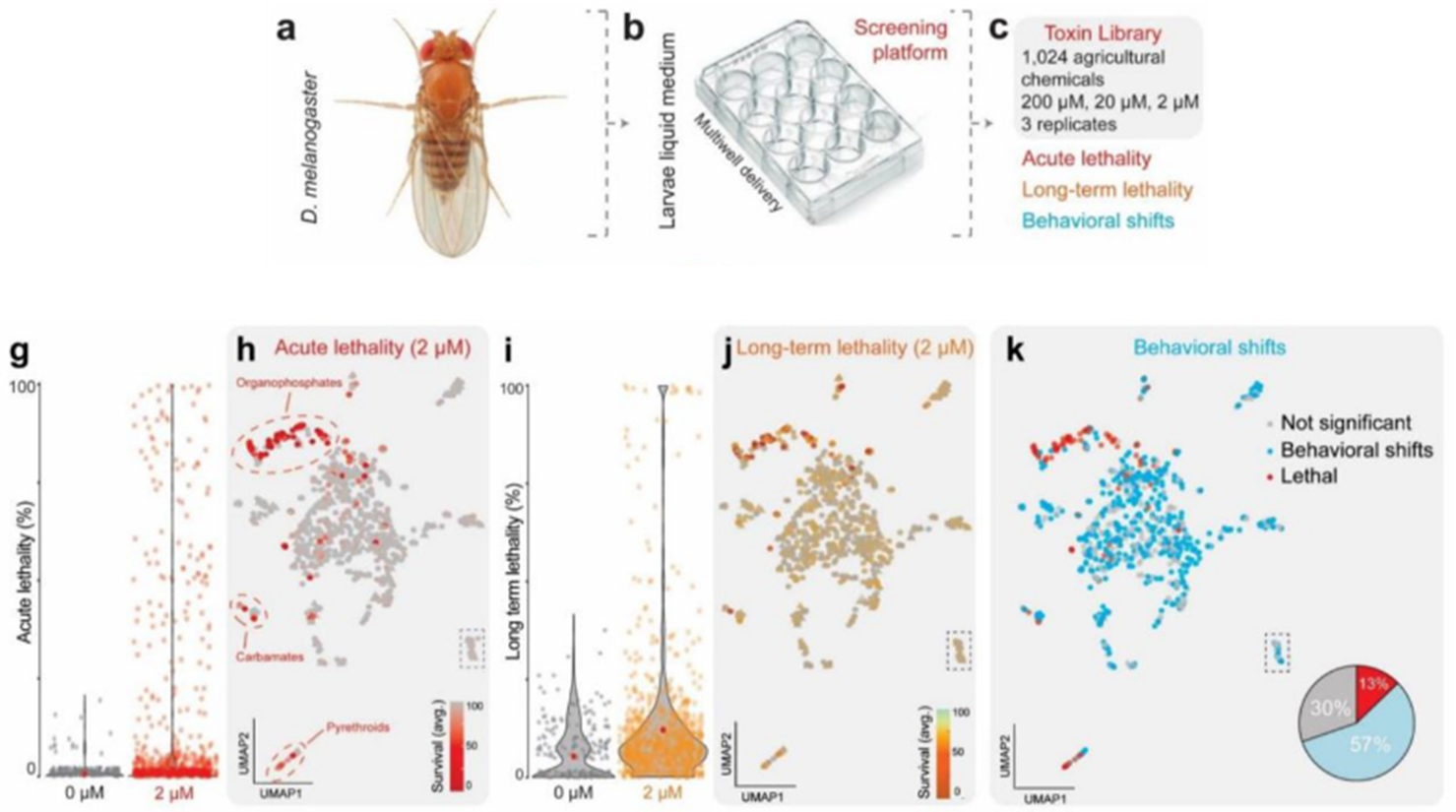
| Figure 1 – a,b,c) Schematic representation of the screening workflow, compounds used and parameters analyzed. g,h,i,j,k) Representation of acute, long term toxicity and a behavioral shift for each agrochemical compound tested. Non gray colored dots represent compound for which a toxic of behavioral effect was observed. |
- Measuring phosphoproteomics changes upon acute exposure of common agrochemical compounds
To quantitatively measure the impact of sub-lethal common agrochemical pesticides, larvae were exposed to 0.2 uM of either Chlorpyrifos, 1,2-dibromoethane, Cyhalothrin, Dodine or Glyphosate. Subsequently, any phosphoproteomic changes were recorded and analysed. Changing the phosphorylation status of proteins is one of the fastest ways in which an organism can adapt to changing environmental conditions. All tested compounds caused behavioural shifts and phosphoproteomic dysregulation in larvae upon acute exposure (Fig. 2). Particularly enriched hits were related to muscular physiology, indicating a potential important stress response axis.
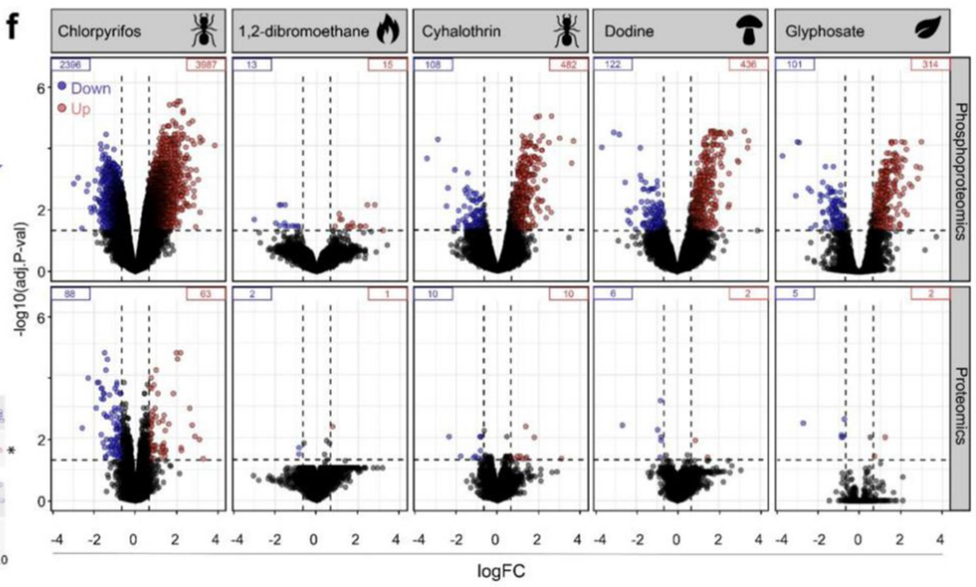
| Figure 2 – Volcano plots show the deregulation of the phosphoproteome (upper panel) and proteome (lower panel) by agrochemical compounds exposure. Red dots indicate upregulation while blue dots downregulation. |
- Increasing the variables of the assay: temperature and compound combinations
The high throughput assay developed by the authors allowed them to study the interaction of pesticides with factors that may also cause insect decline, such as rising global temperatures. As such, they selected a number of compounds and re-tested them at 25°C vs 29°C. Strikingly, an increase of just 4°C strongly impacted the lethality and behavioural effects of many pesticides, indicating that global warming might worsen the effect of agrochemical compounds on insects. Additionally, when the author tested several combinations of chemicals normally present in soil samples, they found some synergistic effects, raising concerns about the safety of agrochemical mixes.
- Validation in other species and natural isolates
To corroborate their findings, the authors also analysed the sensitivity of natural isolates and other insect species to pesticides. Natural isolates showed higher resistance, especially to organophosphates, which might be explained by an adaptive response to chemical exposure. When focusing on other species, in particular the mosquito Anopheles stephensi and the butterfly Vanessa cardui, they also found sub-lethal effects of agrochemicals affecting these species’ behaviour, highlighting the relevance of the findings described in this preprint for different insects.
Why I chose this preprint
Designing conservation plans and gaining a deep understanding of the global effects of pesticides on insect biodiversity and survival is a major challenge of our time. This preprint offers a great resource to interpretate and expand our knowledge on agrochemical compounds and their effects on insects. By having also generated a database, The Agrotoxin Database (https://agrotoxin.embl.de/), this preprint also offers an important resource freely available to the community.
Questions to the authors
- Would it be possible to use the assay you developed to also test the sub-lethal effects of agrochemicals directly on adult insect populations rather than larvae?
- What do you think is the most useful way in which your database could be used?
References
· Wagner, D. L. Insect Declines in the Anthropocene. Annu Rev Entomol 65, 457–480 (2020).
doi: https://doi.org/10.1242/prelights.36431
Read preprintSign up to customise the site to your preferences and to receive alerts
Register hereAlso in the animal behavior and cognition category:
Mice sense Moon and Sun
Jeny Jose

Drift drives phenotypic evolution in a rapid island radiation
Zoha Sadaqat

Behavioral characteristics of an extremely old rhesus macaque in a zoo: Dementia-like symptoms and implications for quality of life of geriatric animals
Stefan Friedrich Wirth

Also in the ecology category:
Modes of natural selection on maternal and zygotic gene expression in Drosophila melanogaster embryos
Girish Kale, preLights peer support

Feeding and reproduction of a tropical coastal copepod across warming and copper gradients
Tina Nguyen

Heatwave winners and losers: cryptic coral holobionts differ in thermal tolerance
Maitri Manjunath
Also in the pharmacology and toxicology category:
The Endocannabinoid System’s Contribution to Placebo Analgesia
Thomas Nicodemo Arrieta et al.
Small Molecule Agonists of TREM2 Reprogram Microglia and Protect Synapses in Human Alzheimer’s Models
Dina Kabbara

Snake venom metalloproteinases are predominantly responsible for the cytotoxic effects of certain African viper venoms
Daniel Osorno Valencia
preLists in the animal behavior and cognition category:
Biologists @ 100 conference preList
This preList aims to capture all preprints being discussed at the Biologists @100 conference in Liverpool, UK, either as part of the poster sessions or the (flash/short/full-length) talks.
| List by | Reinier Prosee, Jonathan Townson |
9th International Symposium on the Biology of Vertebrate Sex Determination
This preList contains preprints discussed during the 9th International Symposium on the Biology of Vertebrate Sex Determination. This conference was held in Kona, Hawaii from April 17th to 21st 2023.
| List by | Martin Estermann |
Bats
A list of preprints dealing with the ecology, evolution and behavior of bats
| List by | Baheerathan Murugavel |
FENS 2020
A collection of preprints presented during the virtual meeting of the Federation of European Neuroscience Societies (FENS) in 2020
| List by | Ana Dorrego-Rivas |
Also in the ecology category:
Developmental regulation: molecular and ecological niches
This conference was held at the Station Biologique de Roscoff (France) and brought together researchers exploring how diverse niche environments shape developmental processes across scales. Spanning topics from ecological and metabolic influences to signalling networks, mechanics and gene regulation, the meeting highlighted the interplay between intrinsic and extrinsic factors in controlling cell fate and tissue organisation. This preList gathers preprints discussed by speakers and poster presenters during the meeting. Please do get in touch at preLights@biologists.com if you notice any relevant preprints that we may have missed.
| List by | Ingrid Tsang |
SciELO preprints – From 2025 onwards
SciELO has become a cornerstone of open, multilingual scholarly communication across Latin America. Its preprint server, SciELO preprints, is expanding the global reach of preprinted research from the region (for more information, see our interview with Carolina Tanigushi). This preList brings together biological, English language SciELO preprints to help readers discover emerging work from the Global South. By highlighting these preprints in one place, we aim to support visibility, encourage early feedback, and showcase the vibrant research communities contributing to SciELO’s open science ecosystem.
| List by | Carolina Tanigushi |
November in preprints – DevBio & Stem cell biology
preLighters with expertise across developmental and stem cell biology have nominated a few developmental and stem cell biology (and related) preprints posted in November they’re excited about and explain in a single paragraph why. Concise preprint highlights, prepared by the preLighter community – a quick way to spot upcoming trends, new methods and fresh ideas.
| List by | Aline Grata et al. |
Biologists @ 100 conference preList
This preList aims to capture all preprints being discussed at the Biologists @100 conference in Liverpool, UK, either as part of the poster sessions or the (flash/short/full-length) talks.
| List by | Reinier Prosee, Jonathan Townson |
preLights peer support – preprints of interest
This is a preprint repository to organise the preprints and preLights covered through the 'preLights peer support' initiative.
| List by | preLights peer support |
EMBO | EMBL Symposium: The organism and its environment
This preList contains preprints discussed during the 'EMBO | EMBL Symposium: The organism and its environment', organised at EMBL Heidelberg, Germany (May 2023).
| List by | Girish Kale |
Bats
A list of preprints dealing with the ecology, evolution and behavior of bats
| List by | Baheerathan Murugavel |
Also in the pharmacology and toxicology category:
SciELO preprints – From 2025 onwards
SciELO has become a cornerstone of open, multilingual scholarly communication across Latin America. Its preprint server, SciELO preprints, is expanding the global reach of preprinted research from the region (for more information, see our interview with Carolina Tanigushi). This preList brings together biological, English language SciELO preprints to help readers discover emerging work from the Global South. By highlighting these preprints in one place, we aim to support visibility, encourage early feedback, and showcase the vibrant research communities contributing to SciELO’s open science ecosystem.
| List by | Carolina Tanigushi |
April in preprints – the CellBio edition
A group of preLighters, with expertise in different areas of cell biology, have worked together to create this preprint reading lists for researchers with an interest in cell biology. This month, categories include: 1) biochemistry/metabolism 2) cell cycle and division 3) cell organelles and organisation 4) cell signalling and mechanosensing 5) (epi)genetics
| List by | Vibha SINGH et al. |
FENS 2020
A collection of preprints presented during the virtual meeting of the Federation of European Neuroscience Societies (FENS) in 2020
| List by | Ana Dorrego-Rivas |
COVID-19 / SARS-CoV-2 preprints
List of important preprints dealing with the ongoing coronavirus outbreak. See http://covidpreprints.com for additional resources and timeline, and https://connect.biorxiv.org/relate/content/181 for full list of bioRxiv and medRxiv preprints on this topic
| List by | Dey Lab, Zhang-He Goh |
1
Drug use in special populations
Any drugs that are being used in special populations: Patients with liver and kidney failure, in paediatrics, in geriatrics, and in pregnant or lactating patients. Includes the discovery of factors that could potentially affect drug use in these special populations.
| List by | Zhang-He Goh |
Toxicology of toxicants, existing therapeutics, and investigational drugs
Preprints that describe the toxicology of environmental pollutants and existing and upcoming drugs. Includes both toxicokinetics and toxicodynamics, as well as technological improvements that will help in the characterisation of this field.
| List by | Zhang-He Goh |
Antimicrobials: Discovery, clinical use, and development of resistance
Preprints that describe the discovery of new antimicrobials and any improvements made regarding their clinical use. Includes preprints that detail the factors affecting antimicrobial selection and the development of antimicrobial resistance.
| List by | Zhang-He Goh |
Anticancer agents: Discovery and clinical use
Preprints that describe the discovery of anticancer agents and their clinical use. Includes both small molecules and macromolecules like biologics.
| List by | Zhang-He Goh |
Advances in Drug Delivery
Advances in formulation technology or targeted delivery methods that describe or develop the distribution of small molecules or large macromolecules to specific parts of the body.
| List by | Zhang-He Goh |