







4,5-dihydroxyhexanoic acid is a robust circulating and urine marker of mitochondrial disease and its severity
Posted on: 1 April 2026 , updated on: 2 April 2026
Preprint posted on 12 February 2026
Shining light on a dark metabolite: 4,5-DHHA as a potential biomarker for mitochondrial disease with respiratory chain dysfunction.
Selected by Hannah Pletcher
Categories: biochemistry
Background:
Mitochondrial diseases are genetic disorders that cause mitochondria to be dysfunctional. They are characterized by defects in the respiratory chain, resulting in a range of different symptoms with a widely variable age of onset. While individual mitochondrial diseases are rare, this group of genetic disorders affects 1 in 5,000 people (Wen et al., 2025). Currently, mitochondrial diseases cannot be cured, with clinical care focusing on managing symptoms. To uncover potential therapeutic targets and monitor disease progression, the authors of this preprint focus on identifying biomarkers for respiratory chain diseases.
In 2021, the group published a biomarker discovery study centering on patients with the most common mutation causing mitochondrial encephalomyopathy with lactic acidosis and stroke-like episodes, abbreviated MELAS. Using metabolomics and proteomics, the researchers identified classic markers of mitochondrial disease and novel metabolite biomarker families, resulting in 19 circulating biomarkers for MELAS, largely related to NADH-reductive stress (Sharma et al., 2021). However, the most significantly changed metabolite in their dataset remained unidentified, or “dark.” In this preprint, Skinner et al. (2026) identified this biomarker as 4,5-dihydroxyhexanoic acid (4,5-DHHA) and discovered that 4,5-DHHA correlates with disease severity across mitochondrial disease patient studies and mouse models.
What I liked/why this new work is important:
Combining mass spectrometry, patient studies, mouse models, and in vitro biochemistry, the authors identified 4,5-DHHA as a potential monitoring biomarker for respiratory chain diseases. In addition to providing a potential avenue for tracking disease progression, the identification of biomarkers can provide pathophysiological insights and new therapeutic strategies. I really appreciate how the authors mined existing datasets to support and increase the breadth of their findings.
Key findings:
Identification of an unknown metabolite biomarker
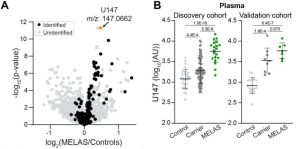
The authors mined their previously published untargeted metabolomics data collected using plasma samples from patients with MELAS (m.3243A>G pathogenic variant) and healthy controls (Sharma et al., 2021). The scientists divided the patients into two groups: patients who had experienced the stroke-like episodes that hallmark the disease were defined as the MELAS group, and patients who have the m.3242A>G mutation but had not experienced stroke-like episodes were defined as the Carrier group. They identified an unknown metabolite that showed the most significant difference between MELAS patients and controls, referring to it as U147 based on its mass-to-charge ratio. U147, detected in both plasma and urine, was increased in the MELAS group and to a lesser degree in the Carrier group. Using small molecule databases and literature searching, the authors created a list of candidate molecules consistent with the mass-to-charge ratio of U147. After comparison against standards and validation with gas chromatography- and liquid chromatography-mass spectrometry, they concluded that U147 was 4,5-DHHA.
4,5-DHHA as a biomarker for mitochondrial disease
The authors correlated 4,5-DHHA levels from their previously published patient cohort with three severity metrics to determine if 4,5-DHHA could be an effective monitoring biomarker for MELAS. They found strong correlations, with 4,5-DHHA outperforming lactate, a classical biomarker for mitochondrial disease, in two out of the three metrics. Further, by mining previously published datasets, the research team discovered that 4,5-DHHA was elevated in patients with mitochondrial myopathies, Leigh Syndrome French Canadian Variant, and septic shock, demonstrating that 4,5-DHHA could be an effective biomarker for various mitochondrial diseases and diseases characterized by respiratory chain dysfunction. They confirmed these results in mouse models of mitochondrial disease, showing that 4,5-DHHA was elevated in liver and brain in the Ndufs4-/- model of Leigh Syndrome and in the brain of the previously published mouse model of thymidine kinase 2 deficiency.
4,5-DHHA biochemistry
The authors then sought to determine the mechanism of 4,5-DHHA synthesis using in vitro biochemistry. They propose a model in which succinic semialdehyde can be converted to 5-keto-4-hydroxyhexanoic acid (KHHA) by the pyruvate dehydrogenase complex, and then KHHA is converted to 4,5-DHHA by an unknown dehydrogenase. In cells, KHHA and 4,5-DHHA generation increased when complex I was inhibited, which matches the increase in 4,5-DHHA observed in patients and mice with respiratory chain dysfunction (as described above).
Future directions & questions for the authors:
- I particularly appreciate the work captured in Fig. 4 to determine the biochemical origin of 4,5-DHHA. Do you have plans to pursue this mechanism? In particular, how would you try to identify the potential unknown dehydrogenase that converts KHHA to 4,5-DHHA?
- While your results support 4,5-DHHA as a monitoring biomarker for respiratory chain diseases, you note that you were unable to correlate 4,5-DHHA levels and specific symptoms, both in the patient cohorts and mouse models. Is this a direction you hope to pursue in the future?
- What are the most important limitations that need to be addressed before 4,5-DHHA is implemented as a monitoring biomarker for mitochondrial diseases in the clinic?
References:
Sharma, R., Reinstadler, B., Engelstad, K., Skinner, O. S., Stackowitz, E., Haller, R. G., Clish, C. B., Pierce, K., Walker, M. A., Fryer, R., Oglesbee, D., Mao, X., Shungu, D. C., Khatri, A., Hirano, M., Vivo, D. C. D., & Mootha, V. K. (2021). Circulating markers of NADH-reductive stress correlate with mitochondrial disease severity. The Journal of Clinical Investigation, 131(2). https://doi.org/10.1172/JCI136055.
Skinner, O. S., Miranda, M., Dong, F., Struhl, T., Walker, M. A., Schleifer, G., Henke, M. T., Clardy, J., Hirano, M., De Vivo, D. C., Schon, E. A., Engelstad, K., Siegmund, S. E., Laprise, C., Des Rosiers, C., Mootha, V. K., & Sharma, R. (2026) 4,5-dihydroxyhexanoic acid is a robust circulating and urine marker of mitochondrial disease and its severity. BioRxiv: The Preprint Server for Biology, 2026.02.10.705117. https://doi.org/10.64898/2026.02.10.705117.
Wen, H., Deng, H., Li, B., Chen, J., Zhu, J., Zhang, X., Yoshida, S., & Zhou, Y. (2025). Mitochondrial diseases: From molecular mechanisms to therapeutic advances. Signal Transduction and Targeted Therapy, 10(1), 9. https://doi.org/10.1038/s41392-024-02044-3.
Read preprint (No Ratings Yet)
Sign up to customise the site to your preferences and to receive alerts
Register hereAlso in the biochemistry category:
Small Molecule Agonists of TREM2 Reprogram Microglia and Protect Synapses in Human Alzheimer’s Models
Dina Kabbara

Active flows drive clustering and sorting of membrane components with differential affinity to dynamic actin cytoskeleton
Teodora Piskova

Snake venom metalloproteinases are predominantly responsible for the cytotoxic effects of certain African viper venoms
Daniel Osorno Valencia
preLists in the biochemistry category:
Keystone Symposium on Stem Cell Models in Embryology 2026
The Keystone Symposium on Stem Cell Models in Embryology, 2026, was organised by Jun Wu (UT Southwestern), Jianping Fu (University of Michigan) and Miki Ebisuya (TU Dresden) and held at Asilomar Conference Grounds in California (US). The meeting discussed recent advances made in establishing stem-cell-based embryo models, what fundamental insights into developmental processes have been gleaned from them, as well as how they are beginning to be applied more widely. This prelist contains preprints by presenters at the talk and poster sessions at the conference, which our Reviews Editor in attendance spotted. Please do reach out to preLights@biologists.com if you notice any that we’ve missed.
| List by | Ingrid Tsang |
September in preprints – Cell biology edition
A group of preLighters, with expertise in different areas of cell biology, have worked together to create this preprint reading list. This month, categories include: (1) Cell organelles and organisation, (2) Cell signalling and mechanosensing, (3) Cell metabolism, (4) Cell cycle and division, (5) Cell migration
| List by | Sristilekha Nath et al. |
July in preprints – the CellBio edition
A group of preLighters, with expertise in different areas of cell biology, have worked together to create this preprint reading lists for researchers with an interest in cell biology. This month, categories include: (1) Cell Signalling and Mechanosensing (2) Cell Cycle and Division (3) Cell Migration and Cytoskeleton (4) Cancer Biology (5) Cell Organelles and Organisation
| List by | Girish Kale et al. |
June in preprints – the CellBio edition
A group of preLighters, with expertise in different areas of cell biology, have worked together to create this preprint reading lists for researchers with an interest in cell biology. This month, categories include: (1) Cell organelles and organisation (2) Cell signaling and mechanosensation (3) Genetics/gene expression (4) Biochemistry (5) Cytoskeleton
| List by | Barbora Knotkova et al. |
May in preprints – the CellBio edition
A group of preLighters, with expertise in different areas of cell biology, have worked together to create this preprint reading lists for researchers with an interest in cell biology. This month, categories include: 1) Biochemistry/metabolism 2) Cancer cell Biology 3) Cell adhesion, migration and cytoskeleton 4) Cell organelles and organisation 5) Cell signalling and 6) Genetics
| List by | Barbora Knotkova et al. |
Keystone Symposium – Metabolic and Nutritional Control of Development and Cell Fate
This preList contains preprints discussed during the Metabolic and Nutritional Control of Development and Cell Fate Keystone Symposia. This conference was organized by Lydia Finley and Ralph J. DeBerardinis and held in the Wylie Center and Tupper Manor at Endicott College, Beverly, MA, United States from May 7th to 9th 2025. This meeting marked the first in-person gathering of leading researchers exploring how metabolism influences development, including processes like cell fate, tissue patterning, and organ function, through nutrient availability and metabolic regulation. By integrating modern metabolic tools with genetic and epidemiological insights across model organisms, this event highlighted key mechanisms and identified open questions to advance the emerging field of developmental metabolism.
| List by | Virginia Savy, Martin Estermann |
April in preprints – the CellBio edition
A group of preLighters, with expertise in different areas of cell biology, have worked together to create this preprint reading lists for researchers with an interest in cell biology. This month, categories include: 1) biochemistry/metabolism 2) cell cycle and division 3) cell organelles and organisation 4) cell signalling and mechanosensing 5) (epi)genetics
| List by | Vibha SINGH et al. |
Biologists @ 100 conference preList
This preList aims to capture all preprints being discussed at the Biologists @100 conference in Liverpool, UK, either as part of the poster sessions or the (flash/short/full-length) talks.
| List by | Reinier Prosee, Jonathan Townson |
February in preprints – the CellBio edition
A group of preLighters, with expertise in different areas of cell biology, have worked together to create this preprint reading lists for researchers with an interest in cell biology. This month, categories include: 1) biochemistry and cell metabolism 2) cell organelles and organisation 3) cell signalling, migration and mechanosensing
| List by | Barbora Knotkova et al. |
Community-driven preList – Immunology
In this community-driven preList, a group of preLighters, with expertise in different areas of immunology have worked together to create this preprint reading list.
| List by | Felipe Del Valle Batalla et al. |
January in preprints – the CellBio edition
A group of preLighters, with expertise in different areas of cell biology, have worked together to create this preprint reading lists for researchers with an interest in cell biology. This month, categories include: 1) biochemistry/metabolism 2) cell migration 3) cell organelles and organisation 4) cell signalling and mechanosensing 5) genetics/gene expression
| List by | Barbora Knotkova et al. |
BSCB-Biochemical Society 2024 Cell Migration meeting
This preList features preprints that were discussed and presented during the BSCB-Biochemical Society 2024 Cell Migration meeting in Birmingham, UK in April 2024. Kindly put together by Sara Morais da Silva, Reviews Editor at Journal of Cell Science.
| List by | Reinier Prosee |
Peer Review in Biomedical Sciences
Communication of scientific knowledge has changed dramatically in recent decades and the public perception of scientific discoveries depends on the peer review process of articles published in scientific journals. Preprints are key vehicles for the dissemination of scientific discoveries, but they are still not properly recognized by the scientific community since peer review is very limited. On the other hand, peer review is very heterogeneous and a fundamental aspect to improve it is to train young scientists on how to think critically and how to evaluate scientific knowledge in a professional way. Thus, this course aims to: i) train students on how to perform peer review of scientific manuscripts in a professional manner; ii) develop students' critical thinking; iii) contribute to the appreciation of preprints as important vehicles for the dissemination of scientific knowledge without restrictions; iv) contribute to the development of students' curricula, as their opinions will be published and indexed on the preLights platform. The evaluations will be based on qualitative analyses of the oral presentations of preprints in the field of biomedical sciences deposited in the bioRxiv server, of the critical reports written by the students, as well as of the participation of the students during the preprints discussions.
| List by | Marcus Oliveira et al. |
CellBio 2022 – An ASCB/EMBO Meeting
This preLists features preprints that were discussed and presented during the CellBio 2022 meeting in Washington, DC in December 2022.
| List by | Nadja Hümpfer et al. |
20th “Genetics Workshops in Hungary”, Szeged (25th, September)
In this annual conference, Hungarian geneticists, biochemists and biotechnologists presented their works. Link: http://group.szbk.u-szeged.hu/minikonf/archive/prg2021.pdf
| List by | Nándor Lipták |
Fibroblasts
The advances in fibroblast biology preList explores the recent discoveries and preprints of the fibroblast world. Get ready to immerse yourself with this list created for fibroblasts aficionados and lovers, and beyond. Here, my goal is to include preprints of fibroblast biology, heterogeneity, fate, extracellular matrix, behavior, topography, single-cell atlases, spatial transcriptomics, and their matrix!
| List by | Osvaldo Contreras |
ASCB EMBO Annual Meeting 2019
A collection of preprints presented at the 2019 ASCB EMBO Meeting in Washington, DC (December 7-11)
| List by | Madhuja Samaddar et al. |
EMBL Seeing is Believing – Imaging the Molecular Processes of Life
Preprints discussed at the 2019 edition of Seeing is Believing, at EMBL Heidelberg from the 9th-12th October 2019
| List by | Dey Lab |
Cellular metabolism
A curated list of preprints related to cellular metabolism at Biorxiv by Pablo Ranea Robles from the Prelights community. Special interest on lipid metabolism, peroxisomes and mitochondria.
| List by | Pablo Ranea Robles |
MitoList
This list of preprints is focused on work expanding our knowledge on mitochondria in any organism, tissue or cell type, from the normal biology to the pathology.
| List by | Sandra Franco Iborra |