







Behavioral characteristics of an extremely old rhesus macaque in a zoo: Dementia-like symptoms and implications for quality of life of geriatric animals
Posted on: 9 June 2026 , updated on: 6 July 2026
Article now published in Zoo Biology at http://dx.doi.org/10.1002/zoo.70074
How dementia symptoms in a Guinness-record-aged female rhesus macaque influenced her overall behaviors
Selected by Stefan Friedrich Wirth
Categories: animal behavior and cognition, neuroscience, pathology, zoology
Updated 6 July 2026 with a postLight by Stefan Friedrich Wirth
The authors Y. Yamanashi et al. (2026) have since published their preprint on dementia-like behavioral traits in a particularly old female rhesus macaque in the journal Zoo Biology. In doing so, the researchers made minor adjustments to their paper; for instance, the “Materials and Methods” section was expanded to include two subheadings, “Subject” and “Data Collection.” These additions represent an improvement, as they allow for a clearer visual and conceptual distinction between methodological approaches that were previously presented as a single block of text, without requiring significant changes to the text itself.
Furthermore, the entire methods section has largely been retained verbatim in the peer-reviewed publication; the same applies to the results section. However, Figures 1–3, which otherwise remain unchanged, have been rearranged: whereas Figures 2 and 3 were visually grouped together in the preprint, Figures 1 and 2 now form a group, while Figure 3 is positioned separately. I was unable to determine whether this change was made for substantive or merely editorial reasons.
Table 2 has been adopted with identical wording but has undergone a layout revision, likely for purely editorial reasons, shifting it from a portrait to a very wide format; in my view, this change actually enhances clarity.
In summary, the authors have optimized their preprint primarily to improve the visual clarity of its diverse and complex methodological approaches, and the resulting complexity in the results and discussion sections.
Introduction
The authors of this preprint investigated dementia-like behavioral abnormalities in an unusually old female rhesus macaque, Macaca mulatta (Papionini; Fig 1).The research was performed using long-length video documentation and corresponding scientific analyses using statistical and qualitative approaches. Only little is known about the overall aging process in rhesus macaques. Studies on pathological behavioral changes due to aging have rarely been conducted in macaques, partly because these animals do not typically live very long lives, either in the wild or in zoos (see for example M. G. Baxter et al., 2023). The female animal studied here, referred to as „ISK“, was so far a notable exception. The individual ISK died in 2021 in the Kyoto Zoo (Japan) at the age of 43 years and 4 months.
![Fig.1) Rhesus macaque, Red Fort, Agra, India. Photo credit: By Yann (own work) [CC BY-SA 4.0-3.0-2.5-2.0-1.0], via Wikimedia Commons.](https://prelights.biologists.com/wp-content/uploads/2026/06/rhesus-macaque-300x200.jpeg)
Previous research on rhesus macaques has found that while associations between tau pathology and neurological symptoms can be observed, these are not characterized by general cognitive decline, but rather, as in the grey mouse lemur, negatively affect object discrimination learning or, as in cynomolgus macaques, lead to Parkinson’s-like symptoms.
In this preprint, the authors used various data sources to assess ISK’s activity budgets, behavioral rhythms, gait, quality of life (QoL) scores and anecdotal episodes, allin relation to senile plaques and phosphorylated tau deposition in her brain.
Main findings
- An autopsy performed after ISK’s death revealed senile plaques and deposits of phosphorylated tau protein in her brain; additionally small amounts of neurofibrillary tangles had accumulated in the hippocampus. While these findings are indicative of Alzheimer-like dementia in humans, their significance in macaques had not previously been established. The behavioral study noted signs of age-related pathology, though these did not reach the severity observed in human Alzheimer’s pathology.
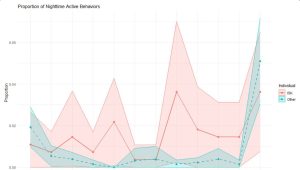
- ISK was active both day and night, albeit with a stronger propensity for diurnal activity; ISK was however more active at night than its conspecifics (Fig. 2).
- ISK interacted with her conspecifics but was last observed grooming a conspecific in January 2021. She did continue to react to other individuals also later on. However, these interactions became progressively less frequent during the final year of her life.
- ISK exhibited progressive changes in her gait, characterized by an altered walking rhythm and a tendency to asymmetrically use of her body.
- ISK spent an increasingly large amount of time in the indoor enclosure. A detailed case observation revealed that when venturing into the outdoor enclosure, ISK displayed pronounced signs of disorientation and diminished obstacle recognition; this led her to first become entangled in dense undergrowth and subsequently fall into a ditch, from which she had to be rescued by a zookeeper. However no direct link could be established between Tau pathology and cognitive decline based on cognitive tests.
- Compared to younger conspecifics, ISK exhibited longer periods of sleep relative to her waking hours.
Why I am highlighting this preprint
Aging research is important not only for better understanding our own age-related frailties and improving the treatment of pathologies in humans, but also for zoo animals – primates in particular. Effective veterinary and husbandry care for all forms of age-related impairments (including cognitive ones) is possible only if we first understand what the aging process actually looks like in these animals. Yet, particularly for primates, there is still limited knowledge on this subject.
Given that the physiological state of the studied rhesus macaque, as revealed by a neuroanatomical autopsy showing tau protein deposits, bears striking similarities to Alzheimer’s disease in humans, and given that the corresponding external symptomatology in primates remains largely unknown, I found it of great interest that the preprint authors investigate in detail which degenerative processes can occur in rhesus macaques.
As vital as aging research in primates is, it can only be conducted if individuals who have reached a noteworthy age are actually available for study. The individual examined here fulfilled this criterion in such an exceptional manner that it even earned an entry in the Guinness Book of World Records.
In my view, the multifaceted methodological approach employed here, which combines anatomical analysis via autopsy with observations of the living animal (utilizing long-term video analysis) and anecdotal individual observations, could serve as a pioneering model for future aging research projects involving also other primate species both in the wild and kept in the zoo.
Questions to the authors
- How might the animal’s condition during her final year of life be distinguished from her former social acceptance within her younger conspecifics? Was ISK’s behavior so markedly abnormal that her conspecifics actively avoided her? Was she ostracized? Or did her social standing merely shift gradually, essentially as a consequence of her own choices to become more withdrawn? And did the reaction of her conspecifics to her decline, at least ostensibly, resemble the kind of empathy we extend to the elderly: a willingness to offer support rooted in the knowledge that they have long rendered faithful service to our society?
- Disorientation, such as that described in the anecdotal account wherein ISK first became entangled and subsequently fell while in the outdoor enclosure, may be attributed to neurodegenerative processes; however, it could also or additionally be a consequence of declining sensory acuity. What was the state of the animal’s vision, hearing or sense of touch? Could these sensory deficits have contributed, at least in part, to the observed behavioral anomalies?
- ISK set a longevity record for rhesus macaques. To what extent can this be explained by her life history? Is this longevity attributable to her upbringing in a zoo environment, and specifically to the improved understanding of optimal housing conditions for primates that has emerged in recent times? In this context, is it reasonable to anticipate that future generations of zoo-housed rhesus macaques will more frequently attain advanced ages, thereby allowing the insights gained from ISK’s case to enhance the care provided to future geriatric rhesus macaques?
- What is known about behavioral and cognitive signs of aging in wild rhesus macaques? Are there at least anecdotal reports regarding this?
Future perspectives
The results of this study may contribute to a better understanding of physiological degenerative signs of aging and their link to behavioral components in macaques and other non-human Old World monkeys. This could also yield evolutionary biological insights regarding the underlying mechanisms of age-related dementia in humans.
This study, as well as future follow-up studies on age-related degeneration in rhesus macaques, should be used to establish more animal-appropriate housing conditions for older animals, for instance, through the provision of navigational aids in outdoor enclosures or even the implementation of an active training program aimed at mitigating cognitive decline. Preventive measures could also be applied, for example, in the form of enhanced environmental enrichment within enclosures to exercise cognitive abilities already in younger animals, with the ultimate goal of preventing age-related impairments from arising in the first place.
Reference
Baxter, M. G., Roberts, M. T., Roberts, J. A., & Rapp, P. R. (2023). Neuropsychology of cognitive aging in rhesus monkeys. Neurobiology of Aging, 130, 40–49. doi:10.1016/j.neurobiolaging.2023.06.011
doi: https://doi.org/10.1242/prelights.43876
Read preprintSign up to customise the site to your preferences and to receive alerts
Register hereAlso in the animal behavior and cognition category:
Also in the neuroscience category:
Vectorial efference copy and visuomotor transformation through gap junctions
Lochlan Walsh

SPOTTER: Automated Tissue-Barcoding Platform for Spatial Proteomics and Phosphoproteomics
TheLangeLab, Felix Kraus

Mice sense Moon and Sun
Jeny Jose

Also in the pathology category:
Dysregulated Microglial Synaptic Engulfment in Diffuse Midline Glioma
IRR UoE Journal Club
Behavioral characteristics of an extremely old rhesus macaque in a zoo: Dementia-like symptoms and implications for quality of life of geriatric animals
Stefan Friedrich Wirth
EBV reprograms autoreactive anti-CNS B cells as antigen presenting cells in multiple sclerosis
Léa Bastien et al.

Also in the zoology category:
Drift drives phenotypic evolution in a rapid island radiation
Zoha Sadaqat

Behavioral characteristics of an extremely old rhesus macaque in a zoo: Dementia-like symptoms and implications for quality of life of geriatric animals
Stefan Friedrich Wirth
Heatwave winners and losers: cryptic coral holobionts differ in thermal tolerance
Maitri Manjunath
preLists in the animal behavior and cognition category:
Biologists @ 100 conference preList
This preList aims to capture all preprints being discussed at the Biologists @100 conference in Liverpool, UK, either as part of the poster sessions or the (flash/short/full-length) talks.
| List by | Reinier Prosee, Jonathan Townson |
9th International Symposium on the Biology of Vertebrate Sex Determination
This preList contains preprints discussed during the 9th International Symposium on the Biology of Vertebrate Sex Determination. This conference was held in Kona, Hawaii from April 17th to 21st 2023.
| List by | Martin Estermann |
Bats
A list of preprints dealing with the ecology, evolution and behavior of bats
| List by | Baheerathan Murugavel |
FENS 2020
A collection of preprints presented during the virtual meeting of the Federation of European Neuroscience Societies (FENS) in 2020
| List by | Ana Dorrego-Rivas |
Also in the neuroscience category:
preLighters’ choice – Handpicked DevBio preprints
preLighters with expertise across developmental and stem cell biology have nominated a few developmental biology (and related) preprints they’re excited about and explain in a few paragraph why. Concise preprint highlights, prepared by the preLighter community – a quick way to spot upcoming trends, new methods and fresh ideas.
| List by | Theodora Stougiannou et al. |
BSDB Spring Meeting: Molecules to Morphogenesis
The British Society for Developmental Biology (BSDB) Spring Meeting Molecules to Morphogenesis was held from 23–26 March 2026 at the University of Warwick (UK). This meeting brought together a vibrant community of researchers to discuss how molecular mechanisms are integrated across scales to drive morphogenesis, spanning diverse model systems and approaches. This preList contains preprints by presenters from the talk and poster sessions at the meeting. Please do get in touch at preLights@biologists.com if you notice any relevant preprints that we may have missed.
| List by | Ingrid Tsang |
Keystone Symposium on Stem Cell Models in Embryology 2026
The Keystone Symposium on Stem Cell Models in Embryology, 2026, was organised by Jun Wu (UT Southwestern), Jianping Fu (University of Michigan) and Miki Ebisuya (TU Dresden) and held at Asilomar Conference Grounds in California (US). The meeting discussed recent advances made in establishing stem-cell-based embryo models, what fundamental insights into developmental processes have been gleaned from them, as well as how they are beginning to be applied more widely. This prelist contains preprints by presenters at the talk and poster sessions at the conference, which our Reviews Editor in attendance spotted. Please do reach out to preLights@biologists.com if you notice any that we’ve missed.
| List by | Ingrid Tsang |
November in preprints – DevBio & Stem cell biology
preLighters with expertise across developmental and stem cell biology have nominated a few developmental and stem cell biology (and related) preprints posted in November they’re excited about and explain in a single paragraph why. Concise preprint highlights, prepared by the preLighter community – a quick way to spot upcoming trends, new methods and fresh ideas.
| List by | Aline Grata et al. |
October in preprints – DevBio & Stem cell biology
Each month, preLighters with expertise across developmental and stem cell biology nominate a few recent developmental and stem cell biology (and related) preprints they’re excited about and explain in a single paragraph why. Short, snappy picks from working scientists — a quick way to spot fresh ideas, bold methods and papers worth reading in full. These preprints can all be found in the October preprint list published on the Node.
| List by | Deevitha Balasubramanian et al. |
October in preprints – Cell biology edition
Different preLighters, with expertise across cell biology, have worked together to create this preprint reading list for researchers with an interest in cell biology. This month, most picks fall under (1) Cell organelles and organisation, followed by (2) Mechanosignaling and mechanotransduction, (3) Cell cycle and division and (4) Cell migration
| List by | Matthew Davies et al. |
July in preprints – the CellBio edition
A group of preLighters, with expertise in different areas of cell biology, have worked together to create this preprint reading lists for researchers with an interest in cell biology. This month, categories include: (1) Cell Signalling and Mechanosensing (2) Cell Cycle and Division (3) Cell Migration and Cytoskeleton (4) Cancer Biology (5) Cell Organelles and Organisation
| List by | Girish Kale et al. |
May in preprints – the CellBio edition
A group of preLighters, with expertise in different areas of cell biology, have worked together to create this preprint reading lists for researchers with an interest in cell biology. This month, categories include: 1) Biochemistry/metabolism 2) Cancer cell Biology 3) Cell adhesion, migration and cytoskeleton 4) Cell organelles and organisation 5) Cell signalling and 6) Genetics
| List by | Barbora Knotkova et al. |
April in preprints – the CellBio edition
A group of preLighters, with expertise in different areas of cell biology, have worked together to create this preprint reading lists for researchers with an interest in cell biology. This month, categories include: 1) biochemistry/metabolism 2) cell cycle and division 3) cell organelles and organisation 4) cell signalling and mechanosensing 5) (epi)genetics
| List by | Vibha SINGH et al. |
Biologists @ 100 conference preList
This preList aims to capture all preprints being discussed at the Biologists @100 conference in Liverpool, UK, either as part of the poster sessions or the (flash/short/full-length) talks.
| List by | Reinier Prosee, Jonathan Townson |
2024 Hypothalamus GRC
This 2024 Hypothalamus GRC (Gordon Research Conference) preList offers an overview of cutting-edge research focused on the hypothalamus, a critical brain region involved in regulating homeostasis, behavior, and neuroendocrine functions. The studies included cover a range of topics, including neural circuits, molecular mechanisms, and the role of the hypothalamus in health and disease. This collection highlights some of the latest advances in understanding hypothalamic function, with potential implications for treating disorders such as obesity, stress, and metabolic diseases.
| List by | Nathalie Krauth |
‘In preprints’ from Development 2022-2023
A list of the preprints featured in Development's 'In preprints' articles between 2022-2023
| List by | Alex Eve, Katherine Brown |
CSHL 87th Symposium: Stem Cells
Preprints mentioned by speakers at the #CSHLsymp23
| List by | Alex Eve |
Journal of Cell Science meeting ‘Imaging Cell Dynamics’
This preList highlights the preprints discussed at the JCS meeting 'Imaging Cell Dynamics'. The meeting was held from 14 - 17 May 2023 in Lisbon, Portugal and was organised by Erika Holzbaur, Jennifer Lippincott-Schwartz, Rob Parton and Michael Way.
| List by | Helen Zenner |
ASCB EMBO Annual Meeting 2019
A collection of preprints presented at the 2019 ASCB EMBO Meeting in Washington, DC (December 7-11)
| List by | Madhuja Samaddar et al. |
SDB 78th Annual Meeting 2019
A curation of the preprints presented at the SDB meeting in Boston, July 26-30 2019. The preList will be updated throughout the duration of the meeting.
| List by | Alex Eve |
Autophagy
Preprints on autophagy and lysosomal degradation and its role in neurodegeneration and disease. Includes molecular mechanisms, upstream signalling and regulation as well as studies on pharmaceutical interventions to upregulate the process.
| List by | Sandra Malmgren Hill |
Young Embryologist Network Conference 2019
Preprints presented at the Young Embryologist Network 2019 conference, 13 May, The Francis Crick Institute, London
| List by | Alex Eve |
Also in the pathology category:
preLighters’ choice – Handpicked DevBio preprints
preLighters with expertise across developmental and stem cell biology have nominated a few developmental biology (and related) preprints they’re excited about and explain in a few paragraph why. Concise preprint highlights, prepared by the preLighter community – a quick way to spot upcoming trends, new methods and fresh ideas.
| List by | Theodora Stougiannou et al. |
October in preprints – DevBio & Stem cell biology
Each month, preLighters with expertise across developmental and stem cell biology nominate a few recent developmental and stem cell biology (and related) preprints they’re excited about and explain in a single paragraph why. Short, snappy picks from working scientists — a quick way to spot fresh ideas, bold methods and papers worth reading in full. These preprints can all be found in the October preprint list published on the Node.
| List by | Deevitha Balasubramanian et al. |
October in preprints – Cell biology edition
Different preLighters, with expertise across cell biology, have worked together to create this preprint reading list for researchers with an interest in cell biology. This month, most picks fall under (1) Cell organelles and organisation, followed by (2) Mechanosignaling and mechanotransduction, (3) Cell cycle and division and (4) Cell migration
| List by | Matthew Davies et al. |
Fibroblasts
The advances in fibroblast biology preList explores the recent discoveries and preprints of the fibroblast world. Get ready to immerse yourself with this list created for fibroblasts aficionados and lovers, and beyond. Here, my goal is to include preprints of fibroblast biology, heterogeneity, fate, extracellular matrix, behavior, topography, single-cell atlases, spatial transcriptomics, and their matrix!
| List by | Osvaldo Contreras |
ECFG15 – Fungal biology
Preprints presented at 15th European Conference on Fungal Genetics 17-20 February 2020 Rome
| List by | Hiral Shah |
COVID-19 / SARS-CoV-2 preprints
List of important preprints dealing with the ongoing coronavirus outbreak. See http://covidpreprints.com for additional resources and timeline, and https://connect.biorxiv.org/relate/content/181 for full list of bioRxiv and medRxiv preprints on this topic
| List by | Dey Lab, Zhang-He Goh |
1
Cellular metabolism
A curated list of preprints related to cellular metabolism at Biorxiv by Pablo Ranea Robles from the Prelights community. Special interest on lipid metabolism, peroxisomes and mitochondria.
| List by | Pablo Ranea Robles |
Also in the zoology category:
SciELO preprints – From 2025 onwards
SciELO has become a cornerstone of open, multilingual scholarly communication across Latin America. Its preprint server, SciELO preprints, is expanding the global reach of preprinted research from the region (for more information, see our interview with Carolina Tanigushi). This preList brings together biological, English language SciELO preprints to help readers discover emerging work from the Global South. By highlighting these preprints in one place, we aim to support visibility, encourage early feedback, and showcase the vibrant research communities contributing to SciELO’s open science ecosystem.
| List by | Carolina Tanigushi |
Biologists @ 100 conference preList
This preList aims to capture all preprints being discussed at the Biologists @100 conference in Liverpool, UK, either as part of the poster sessions or the (flash/short/full-length) talks.
| List by | Reinier Prosee, Jonathan Townson |
Bats
A list of preprints dealing with the ecology, evolution and behavior of bats
| List by | Baheerathan Murugavel |