




TAM receptors control actomyosin dynamics in osteoclasts via RHOA-COFILIN-MYOSIN II signaling
Posted on: 14 October 2025
Preprint posted on 14 April 2024
This preprint investigates the RHOA-ROCK and COFILIN pathways involved in cell migration, amoeboid movement and osteoclast activation and useful to address in breast cancer bone metastasis treatment.
Selected by André Luiz Amorim Costa, Marcus Oliveira

Categories: biochemistry, immunology
Why I highlight this work
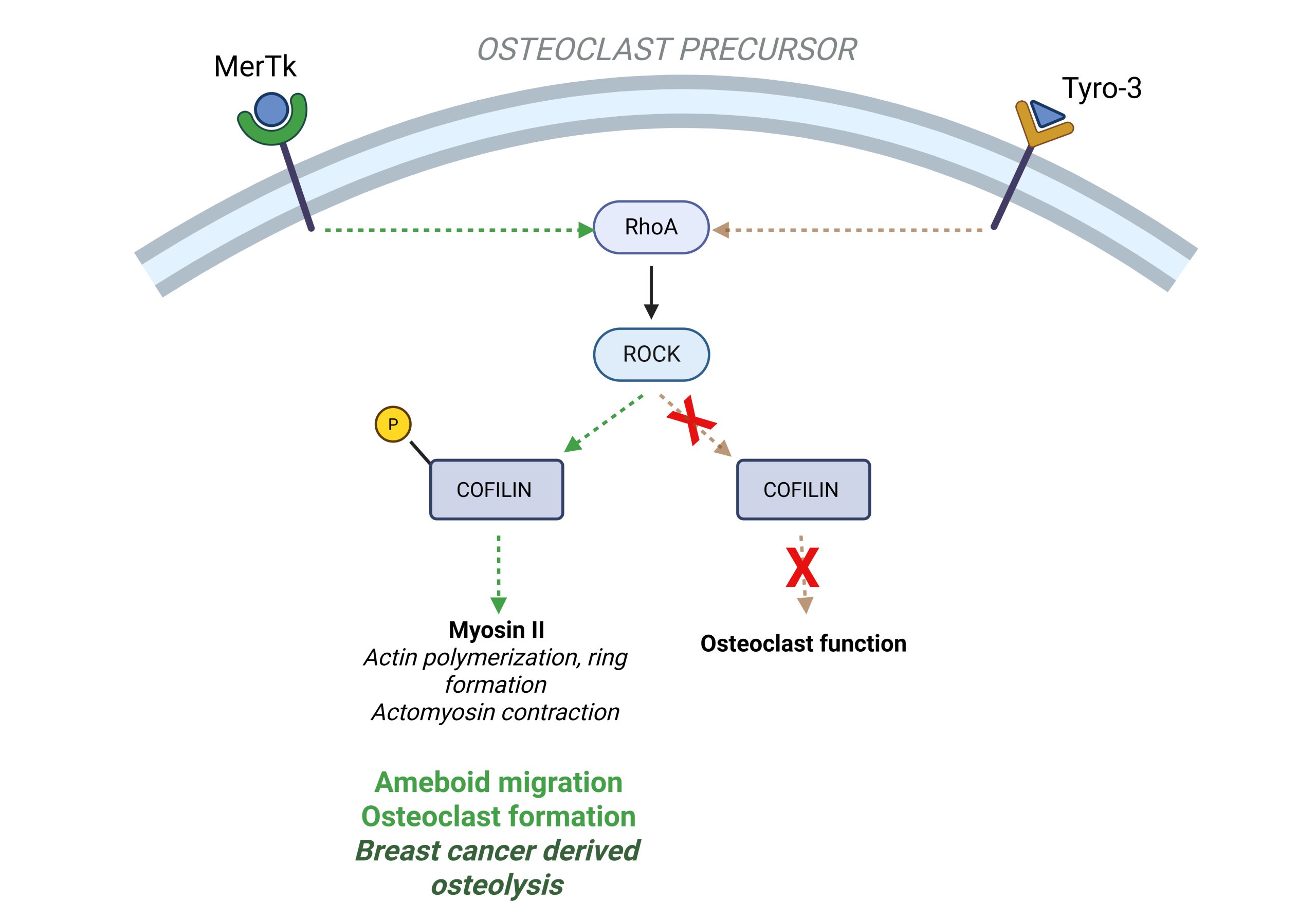
This preprint investigates relevant pathways for cell migration, amoeboid movement, and osteoclast activation that are useful to address in treating bone metastasis in breast cancer. MerTk is a receptor that seems to regulate the conversion to activated osteoclasts and promote bone loss. The pharmacological inhibition of the cellular molecules RHOA-ROCK and COFILIN can be helpful to establish personalized therapies aiming to treat patients with metastases.
The discovery of the pathway by which osteoclasts’ activation can be modulated opens the opportunity for drug repositioning and the application of Cofilin inhibitory approaches to other bone diseases, such as rheumatoid arthritis,osteoporosis,s and periodontitis.
Created in BioRender. Carvalho, N. (2025) https://BioRender.com/n42k7pz
Background
TAM (Tyro-3, Axl, MerTk) receptors belong to the tyrosine kinase family and recognize apoptotic cells bound by soluble ligands, Protein S and Gas6, which induce phagocytosis of the target cells. This process of apoptotic cell engulfment is termed efferocytosis and is important to downregulate the inflammatory response during a tissue repair process. Although TAM receptors perform virtually the same function, their intracellular cascade may be different depending on the physiological context. Nevertheless, they are undoubtedly necessary for the cytoskeleton alterations that precede efferocytosis [1-3]. The role of these receptors in “classic” phagocytes, macrophages and dendritic cells is well known, but their function in specialized tissues is still less explored.
During breast cancer metastasis to the bone, the bone-resident myeloid cells, osteoclasts, perform an exacerbated bone resorption that is detrimental to the tissue structure. The TAM receptors Tyro-3 and MerTk impact the activation of osteoclasts and may be involved in disease progression [4-5]. Some therapies aim to inhibit osteoclast activation or migration, but with several side effects that make their clinical use harder.
This preprint shows how TAM receptors differentially regulate osteoclast migration through RHOA-COFILIN-MYOSIN II signaling, which are molecules involved in cell contraction and actin polymerization.
Key findings:
MerTk deficiency in myeloid cells reduces osteoclastogenesis
Figure 1 of the preprint shows that, by microcomputed tomography (µCT), the authors observed increased bone volume, trabecular number, and thickness. When MerTk was depleted in myeloid cells, they found a reduced number of osteoclasts within the tissue, suggesting the role of this receptor in bone remodeling.
During osteoclastogenesis, TAM receptors are downregulated
The molecule responsible for osteoclast activation, RANKL, also decreased TAM receptors’ expression. The authors measured mRNA from precursor cells activated by RANKL and found negligible levels of Tyro-3, Axl and MerTk gene expression. Furthermore, the precursor cells expressed a higher level of MerTk, whereas the mature osteoclasts had lower levels, showing that MerTk is downregulated during cell activation.
Osteoclast precursors’ amoeboid migration is regulated by MerTk and COFILIN phosphorylation
A shift from an amoeboid to a mesenchymal migration mode, corroborated by increased cell directionality, was seen in the experiments where MerTk was deleted (Figure 3 of the preprint). Since osteoclast migration into bone resorption sites is important for its role in homeostasis, the authors described how cell physiology can be affected by MerTk signaling.
Additionally, the observed increase of rounded cells was correlated with low actin polymerization, which is dependent on COFILIN phosphorylation. Therefore, the lack of MerTk led to COFILIN phosphorylation and decreased migration.
Tyro-3 inhibits RHOA-ROCK pathway to regulate cell migration
The regulator of actin polymerization is the small GTPase RHO, which is inhibited by the canonical TAM ligand, Protein S (Pros1). With or without MerTk expression, Pros1 induced COFILIN phosphorylation, something that did not happen when Tyro-3 was depleted. Interestingly, these results contrast with the existing literature on MerTk.
The Tyro-3 receptor was also activated by Pros1, so the experiment was repeated, and the authors found that RHOA is strongly activated in the absence of Tyro-3, which must be activated by MerTk. In summary, Pros1-mediated activation of MerTk leads to cell migration and polarity, but if Tyro-3 is engaged, this phenotype is reversed by ROCK inhibition.
MerTk or Tyro-3 activation impacts osteolytic bone disease associated with breast cancer bone metastases
In mice lacking MerTk, after injection of a cell lineage of breast cancer, there was increased bone volume, trabecular number, and trabecular thickness compared to MerTk-expressing individuals. This suggests that osteolysis in cancer may be mediated by MerTk. Also, Tyro-3 deletion led to the same phenotype, showing that in vivo, both receptors are important, corroborating the inhibitory function of MERTK as well as TYRO3 in osteoclasts.
Future directions and questions for the authors
Major Questions
Q1: While the data from the in vitro experiments is satisfactory, the observed phenotype in the in vivo steps was ineffective, which can be explained by several factors, such as temperature and stress. It would be great if the authors could address how temperature affects the biology of TAM receptors and actin polymerization, since the literature demonstrates that mice kept at required sub-thermoneutral temperatures (~22°C) suffer from chronic stress [6].
Q2: Given that various anti-Axl medicines are available for cancer and are regarded as the most therapeutically advanced [7], could the authors please clarify why Tyro-3 and MerTk were chosen over Axl in the investigation of cell migration and cancer metastasis?
Given that MerTk exhibits affinity for Gas6, it would be beneficial for the authors to incorporate this ligand into the cell migration analysis too.
Q3: There is no description of the animal facility (diet, humidity, temperature), sample size calculation, or the procedures of breast cancer cell injection. Could this be included in the ‘Materials & Methods’ section?
Q4: Since the C57Bl6/J is a mouse lineage, perhaps the authors can describe which sub-lineage was used to perform the in vivo experiments [8]? Also, the sublineage of mice may explain the differences observed among the in vivo assays.
Q5: The sample effort of Figure 5 was remarkably lower than the other figures, which might introduce bias in the analysis. Therefore, in order to improve statistical reproducibility, the experiments could be repeated with more subjects.
Q6: The in vivo tests are inconclusive about the predominant function of Tyro-3 or MerTk in the phenotype since the differences between controls and knockout mice are statistically insignificant. The temperature of the animal housing can be a stressor that affects the experiment’s resolution [8]. What role do adrenaline and cortisol play in cell migration to bone?
Minor questions
Q1: For the study design, a scheme illustration would be really helpful to the reader.
Q2: On p.15, in the “Statistics and reproducibility” section, given that normal distribution of samples is a necessity for statistical parametric tests, the authors could apply the normal distribution test prior to analysis.
Q3: For Figures 2 and 3: To make these figures self-explanatory, the trajectory plots should include subtitles to identify what the red or black lines mean.
Disclaimer
Artificial intelligence tools (QuillBot) were used to assist in language editing and improve clarity during the revision of this manuscript.
References
[1] Miao, Y. R., Rankin, E. B., & Giaccia, A. J. (2024). Therapeutic targeting of the functionally elusive TAM receptor family. Nature Reviews Drug Discovery, 23(3), 201-217.
[2] Doran, A. C., Yurdagul Jr., A., & Tabas, I. (2020). Efferocytosis in health and disease. Nature Reviews Immunology, 20(4), 254-267.
[3] Boada-Romero, E., Martinez, J., Heckmann, B. L., & Green, D. R. (2020). The clearance of dead cells by efferocytosis. Nature Reviews Molecular Cell Biology, 21(7), 398-414.
[4] Rothlin, C. V., Leighton, J. A., & Ghosh, S. (2014). Tyro3, Axl, and Mertk receptor signaling in inflammatory bowel disease and colitis-associated cancer. Inflammatory bowel diseases, 20(8), 1472-1480.
[5] Song, X., Wei, C., & Li, X. (2022). The signaling pathways associated with breast cancer bone metastasis. Frontiers in Oncology, 12, 855609.
[6] Metze, M. (2016). Thermal neutral zone technology: the doorway to better research results. Lab Animal, 45(7), 274.
[7] Yadav, M., Sharma, A., Patne, K., Tabasum, S., Suryavanshi, J., Rawat, L., … & Sabarwal, A. (2025). AXL signaling in cancer: from molecular insights to targeted therapies. Signal Transduction and Targeted Therapy, 10(1), 37.
[8] Antonio Enriquez, J. (2019). Mind your mouse strain. NATURE METABOLISM, 1(1), 5-7.
doi: https://doi.org/10.1242/prelights.41631
Read preprintSign up to customise the site to your preferences and to receive alerts
Register hereAlso in the biochemistry category:
Fast single molecule localization microscopy in 3D
Kanishka Parashar

Organoids reveal niche-specific mechanotransduction-guided human cortical patterning and cell fate acquisition.
Kanishka Parashar
Structure of chlorophyll synthase in complex with the LHC-like protein HliD
Orestis Savva

Also in the immunology category:
Dysregulated Microglial Synaptic Engulfment in Diffuse Midline Glioma
IRR UoE Journal Club

Circadian Clock Programming of Anticipatory Antiviral Immunity Gates Enteric Virus Infection Susceptibility
Owen Ang

Inhibition of VP2-mediated entry: a potential antiviral strategy to treat or prevent calicivirus disease
Orestis Savva
preLists in the biochemistry category:
‘In preprints’ from Development 2026
A list of the preprints featured in Development's 'In preprints' articles, as part of the new Preprint Editors initiative
| List by | Clarisse Brunet Avalos et al. |
Keystone Symposium on Stem Cell Models in Embryology 2026
The Keystone Symposium on Stem Cell Models in Embryology, 2026, was organised by Jun Wu (UT Southwestern), Jianping Fu (University of Michigan) and Miki Ebisuya (TU Dresden) and held at Asilomar Conference Grounds in California (US). The meeting discussed recent advances made in establishing stem-cell-based embryo models, what fundamental insights into developmental processes have been gleaned from them, as well as how they are beginning to be applied more widely. This prelist contains preprints by presenters at the talk and poster sessions at the conference, which our Reviews Editor in attendance spotted. Please do reach out to preLights@biologists.com if you notice any that we’ve missed.
| List by | Ingrid Tsang |
September in preprints – Cell biology edition
A group of preLighters, with expertise in different areas of cell biology, have worked together to create this preprint reading list. This month, categories include: (1) Cell organelles and organisation, (2) Cell signalling and mechanosensing, (3) Cell metabolism, (4) Cell cycle and division, (5) Cell migration
| List by | Sristilekha Nath et al. |
July in preprints – the CellBio edition
A group of preLighters, with expertise in different areas of cell biology, have worked together to create this preprint reading lists for researchers with an interest in cell biology. This month, categories include: (1) Cell Signalling and Mechanosensing (2) Cell Cycle and Division (3) Cell Migration and Cytoskeleton (4) Cancer Biology (5) Cell Organelles and Organisation
| List by | Girish Kale et al. |
June in preprints – the CellBio edition
A group of preLighters, with expertise in different areas of cell biology, have worked together to create this preprint reading lists for researchers with an interest in cell biology. This month, categories include: (1) Cell organelles and organisation (2) Cell signaling and mechanosensation (3) Genetics/gene expression (4) Biochemistry (5) Cytoskeleton
| List by | Barbora Knotkova et al. |
May in preprints – the CellBio edition
A group of preLighters, with expertise in different areas of cell biology, have worked together to create this preprint reading lists for researchers with an interest in cell biology. This month, categories include: 1) Biochemistry/metabolism 2) Cancer cell Biology 3) Cell adhesion, migration and cytoskeleton 4) Cell organelles and organisation 5) Cell signalling and 6) Genetics
| List by | Barbora Knotkova et al. |
Keystone Symposium – Metabolic and Nutritional Control of Development and Cell Fate
This preList contains preprints discussed during the Metabolic and Nutritional Control of Development and Cell Fate Keystone Symposia. This conference was organized by Lydia Finley and Ralph J. DeBerardinis and held in the Wylie Center and Tupper Manor at Endicott College, Beverly, MA, United States from May 7th to 9th 2025. This meeting marked the first in-person gathering of leading researchers exploring how metabolism influences development, including processes like cell fate, tissue patterning, and organ function, through nutrient availability and metabolic regulation. By integrating modern metabolic tools with genetic and epidemiological insights across model organisms, this event highlighted key mechanisms and identified open questions to advance the emerging field of developmental metabolism.
| List by | Virginia Savy, Martin Estermann |
April in preprints – the CellBio edition
A group of preLighters, with expertise in different areas of cell biology, have worked together to create this preprint reading lists for researchers with an interest in cell biology. This month, categories include: 1) biochemistry/metabolism 2) cell cycle and division 3) cell organelles and organisation 4) cell signalling and mechanosensing 5) (epi)genetics
| List by | Vibha SINGH et al. |
Biologists @ 100 conference preList
This preList aims to capture all preprints being discussed at the Biologists @100 conference in Liverpool, UK, either as part of the poster sessions or the (flash/short/full-length) talks.
| List by | Reinier Prosee, Jonathan Townson |
February in preprints – the CellBio edition
A group of preLighters, with expertise in different areas of cell biology, have worked together to create this preprint reading lists for researchers with an interest in cell biology. This month, categories include: 1) biochemistry and cell metabolism 2) cell organelles and organisation 3) cell signalling, migration and mechanosensing
| List by | Barbora Knotkova et al. |
Community-driven preList – Immunology
In this community-driven preList, a group of preLighters, with expertise in different areas of immunology have worked together to create this preprint reading list.
| List by | Felipe Del Valle Batalla et al. |
January in preprints – the CellBio edition
A group of preLighters, with expertise in different areas of cell biology, have worked together to create this preprint reading lists for researchers with an interest in cell biology. This month, categories include: 1) biochemistry/metabolism 2) cell migration 3) cell organelles and organisation 4) cell signalling and mechanosensing 5) genetics/gene expression
| List by | Barbora Knotkova et al. |
BSCB-Biochemical Society 2024 Cell Migration meeting
This preList features preprints that were discussed and presented during the BSCB-Biochemical Society 2024 Cell Migration meeting in Birmingham, UK in April 2024. Kindly put together by Sara Morais da Silva, Reviews Editor at Journal of Cell Science.
| List by | Reinier Prosee |
Peer Review in Biomedical Sciences
Communication of scientific knowledge has changed dramatically in recent decades and the public perception of scientific discoveries depends on the peer review process of articles published in scientific journals. Preprints are key vehicles for the dissemination of scientific discoveries, but they are still not properly recognized by the scientific community since peer review is very limited. On the other hand, peer review is very heterogeneous and a fundamental aspect to improve it is to train young scientists on how to think critically and how to evaluate scientific knowledge in a professional way. Thus, this course aims to: i) train students on how to perform peer review of scientific manuscripts in a professional manner; ii) develop students' critical thinking; iii) contribute to the appreciation of preprints as important vehicles for the dissemination of scientific knowledge without restrictions; iv) contribute to the development of students' curricula, as their opinions will be published and indexed on the preLights platform. The evaluations will be based on qualitative analyses of the oral presentations of preprints in the field of biomedical sciences deposited in the bioRxiv server, of the critical reports written by the students, as well as of the participation of the students during the preprints discussions.
| List by | Marcus Oliveira et al. |
CellBio 2022 – An ASCB/EMBO Meeting
This preLists features preprints that were discussed and presented during the CellBio 2022 meeting in Washington, DC in December 2022.
| List by | Nadja Hümpfer et al. |
20th “Genetics Workshops in Hungary”, Szeged (25th, September)
In this annual conference, Hungarian geneticists, biochemists and biotechnologists presented their works. Link: http://group.szbk.u-szeged.hu/minikonf/archive/prg2021.pdf
| List by | Nándor Lipták |
Fibroblasts
The advances in fibroblast biology preList explores the recent discoveries and preprints of the fibroblast world. Get ready to immerse yourself with this list created for fibroblasts aficionados and lovers, and beyond. Here, my goal is to include preprints of fibroblast biology, heterogeneity, fate, extracellular matrix, behavior, topography, single-cell atlases, spatial transcriptomics, and their matrix!
| List by | Osvaldo Contreras |
ASCB EMBO Annual Meeting 2019
A collection of preprints presented at the 2019 ASCB EMBO Meeting in Washington, DC (December 7-11)
| List by | Madhuja Samaddar et al. |
EMBL Seeing is Believing – Imaging the Molecular Processes of Life
Preprints discussed at the 2019 edition of Seeing is Believing, at EMBL Heidelberg from the 9th-12th October 2019
| List by | Dey Lab |
Cellular metabolism
A curated list of preprints related to cellular metabolism at Biorxiv by Pablo Ranea Robles from the Prelights community. Special interest on lipid metabolism, peroxisomes and mitochondria.
| List by | Pablo Ranea Robles |
MitoList
This list of preprints is focused on work expanding our knowledge on mitochondria in any organism, tissue or cell type, from the normal biology to the pathology.
| List by | Sandra Franco Iborra |
Also in the immunology category:
BSDB Spring Meeting: Molecules to Morphogenesis
The British Society for Developmental Biology (BSDB) Spring Meeting Molecules to Morphogenesis was held from 23–26 March 2026 at the University of Warwick (UK). This meeting brought together a vibrant community of researchers to discuss how molecular mechanisms are integrated across scales to drive morphogenesis, spanning diverse model systems and approaches. This preList contains preprints by presenters from the talk and poster sessions at the meeting. Please do get in touch at preLights@biologists.com if you notice any relevant preprints that we may have missed.
| List by | Ingrid Tsang |
SciELO preprints – From 2025 onwards
SciELO has become a cornerstone of open, multilingual scholarly communication across Latin America. Its preprint server, SciELO preprints, is expanding the global reach of preprinted research from the region (for more information, see our interview with Carolina Tanigushi). This preList brings together biological, English language SciELO preprints to help readers discover emerging work from the Global South. By highlighting these preprints in one place, we aim to support visibility, encourage early feedback, and showcase the vibrant research communities contributing to SciELO’s open science ecosystem.
| List by | Carolina Tanigushi |
Community-driven preList – Immunology
In this community-driven preList, a group of preLighters, with expertise in different areas of immunology have worked together to create this preprint reading list.
| List by | Felipe Del Valle Batalla et al. |
Journal of Cell Science meeting ‘Imaging Cell Dynamics’
This preList highlights the preprints discussed at the JCS meeting 'Imaging Cell Dynamics'. The meeting was held from 14 - 17 May 2023 in Lisbon, Portugal and was organised by Erika Holzbaur, Jennifer Lippincott-Schwartz, Rob Parton and Michael Way.
| List by | Helen Zenner |
Fibroblasts
The advances in fibroblast biology preList explores the recent discoveries and preprints of the fibroblast world. Get ready to immerse yourself with this list created for fibroblasts aficionados and lovers, and beyond. Here, my goal is to include preprints of fibroblast biology, heterogeneity, fate, extracellular matrix, behavior, topography, single-cell atlases, spatial transcriptomics, and their matrix!
| List by | Osvaldo Contreras |
Single Cell Biology 2020
A list of preprints mentioned at the Wellcome Genome Campus Single Cell Biology 2020 meeting.
| List by | Alex Eve |
Autophagy
Preprints on autophagy and lysosomal degradation and its role in neurodegeneration and disease. Includes molecular mechanisms, upstream signalling and regulation as well as studies on pharmaceutical interventions to upregulate the process.
| List by | Sandra Malmgren Hill |
Antimicrobials: Discovery, clinical use, and development of resistance
Preprints that describe the discovery of new antimicrobials and any improvements made regarding their clinical use. Includes preprints that detail the factors affecting antimicrobial selection and the development of antimicrobial resistance.
| List by | Zhang-He Goh |
Zebrafish immunology
A compilation of cutting-edge research that uses the zebrafish as a model system to elucidate novel immunological mechanisms in health and disease.
| List by | Shikha Nayar |