







A genetically encoded redox bottleneck constrains human developmental rate
Posted on: 29 October 2026
Preprint posted on 13 September 2026
“It’s just my slow metabolism!”, said the human embryo. This new preprint links one missing enzyme to our sluggish embryonic development.
Selected by Alexandra Neaverson
Categories: developmental biology
Background
All animals, big and small, begin their lives the same way: as a fertilised egg, and then an embryo. Yet the amount of time different animals devote to embryonic development varies wildly between different species. The human pregnancy lasts 9 months, and mouse gestation is just 21 days long, yet the blue whale is pregnant for 10-12 months – so this clearly does not correlate with size. The record for the longest gestation goes to the alpine salamander, developing for 2-3 years at low altitudes, or 3-5 years in the cold climates of the Alps!
What governs the rate of embryo development, if it isn’t size or complexity? The alpine salamander gives us a clue: in cold temperatures, the mother’s metabolism drops, leading to a longer gestation. Metabolic rate is a key determinant in the overall pace of development.
Mice have a higher metabolic rate than humans, and their embryos develop much faster – despite needing to build much the same set of body parts (whiskers aside). Somitogenesis is a good example: the rhythmic formation of the segments that will become our vertebrae and skeletal muscle proceeds at double the speed in mice. However, unlike the salamander, this can’t be explained by temperature. Mouse and human cells develop at different rates even when grown in a dish in the same conditions, hinting that metabolic rate must be species-intrinsic.
Why I chose to highlight this preprint
I chose to highlight this preprint because I’m fascinated by this huge amount of variation across the animal kingdom. We know about the metabolic differences, but there is a clear gap in our knowledge, as we don’t know the determining factors for species-specific metabolic rate. Here, the authors use directly comparable stem cell culture systems for both mouse and human. This allowed for causal relationships between the genetics, metabolic rate, and the pace of development to be uncovered.
Metabolism 101
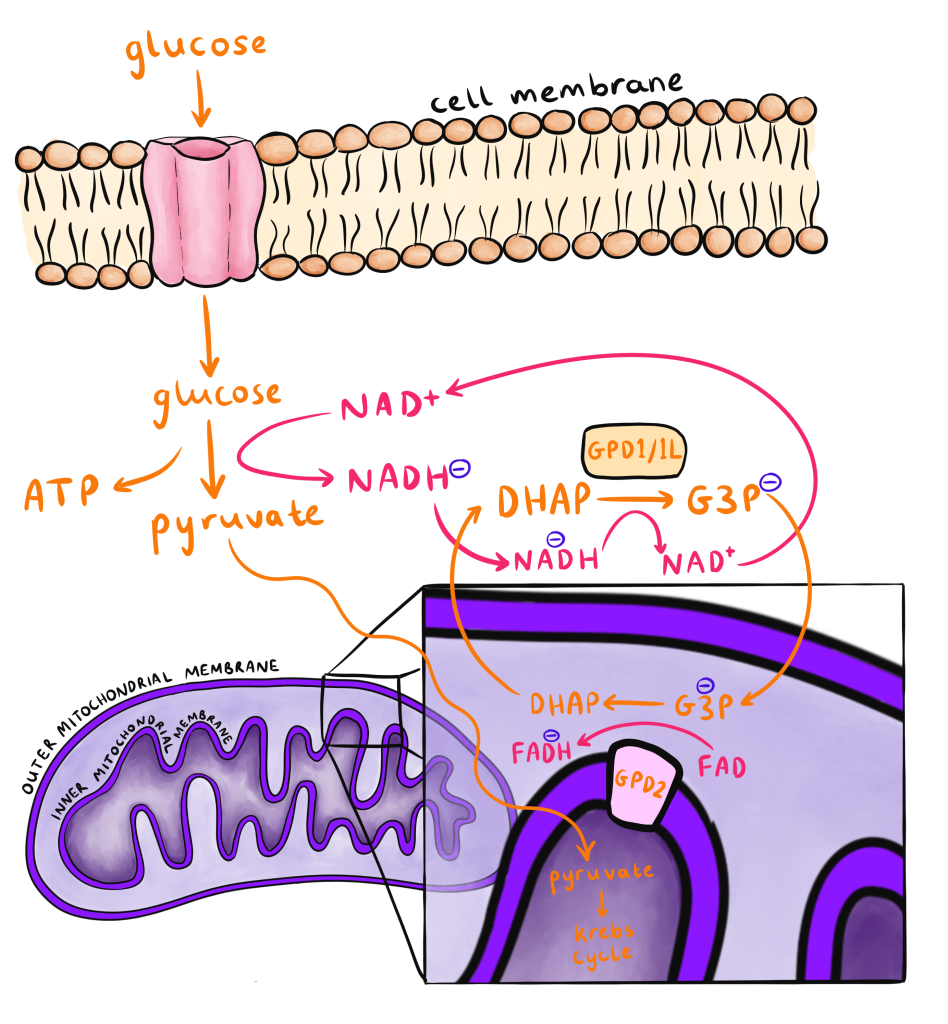
If you’re anything like me, you know that metabolism is central to all biology, but struggle to remember all the different terms and pathways. Here is a reminder of the parts you need to understand for this preprint.
Key findings
Redox metabolism controls developmental rate
The ratio of NAD+ to NADH acts as a gauge of the cell’s metabolic state: high NAD+ is similar to a build-up of empty batteries that are ready to accept electrons, while high NADH indicates a build-up of charged batteries, which causes glycolysis to slow down. Mirroring the results of previous work, the authors of this preprint could demonstrate that this ratio is linked to the speed of somitogenesis.
To do this, they used a stem cell-derived model of human and mouse presomitic mesoderm (PSM) – cells destined to form the somites – expressing a fluorescent Hes7 reporter, a gene that switches on and off cyclically as each new segment forms, driving the speed of the segmentation clock. The mouse clock ticked twice as fast as the human clock. They then expressed a NAD+/NADH sensor called SoNar in the cells, causing them to make a protein that fluoresces differently depending on whether NAD+ or NADH is bound to it. This showed that the mouse PSM had a higher NAD+/NADH ratio than human PSM.
They then took some bacterial genes that can modify redox state and expressed them in human cells, and found that when NAD+ was increased, the clock ticked faster, and the PSM cells induced MSGN1 – the ‘master regulator’ of somite development – earlier, linking the NAD+/NADH ratio directly to developmental tempo.
GPD1L: the missing enzyme
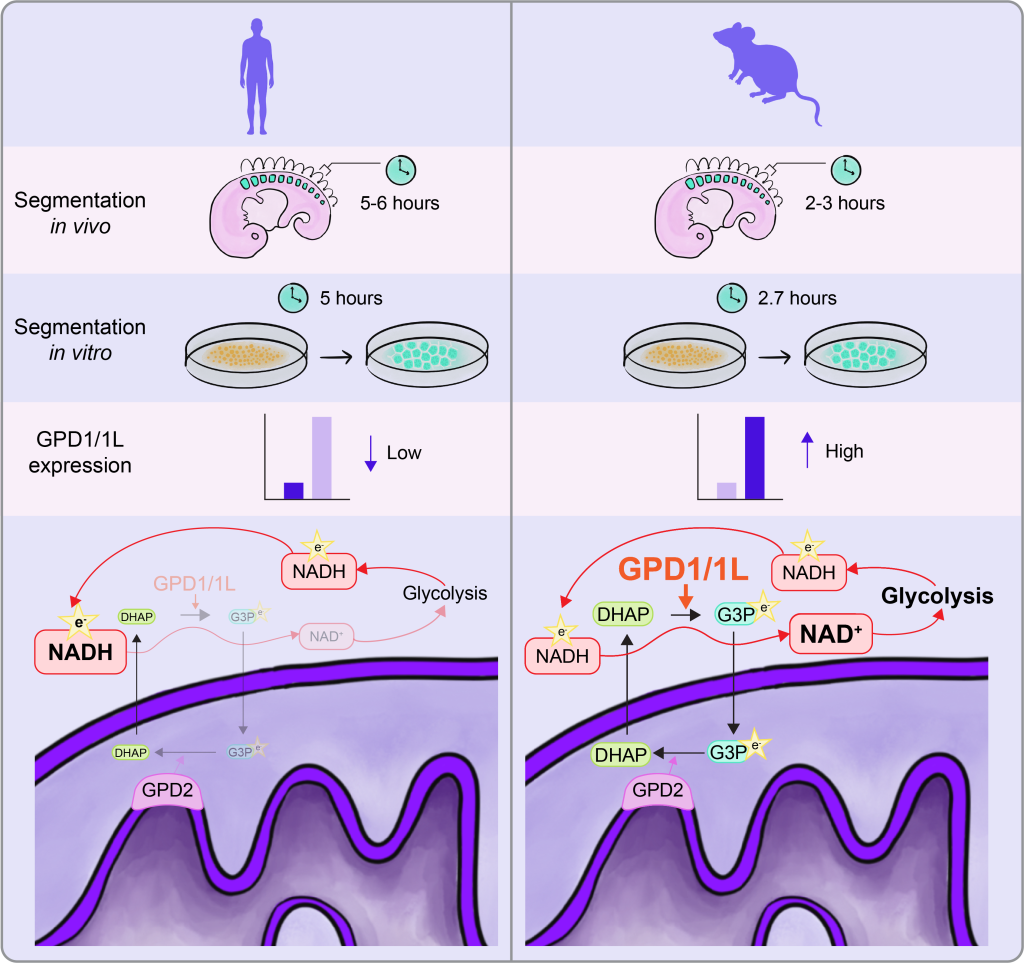
How are these different redox states achieved in mouse and human? As I mentioned earlier, the regeneration of NAD+ from NADH is important for continued glycolysis. The cell has three main ways of achieving this: the G3P shuttle (described in Figure 1), a malate-aspartate (MAS) shuttle, and the LDH reaction, which makes lactate without involving the mitochondria.
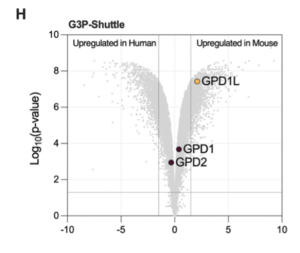
The authors analysed transcriptomic datasets of mouse and human cells. Genes related to the MAS shuttle and the LDH reaction, as well as GPD2 – the enzyme that takes electrons from G3P – were expressed similarly in both mouse and human. The difference came down to GPD1L, which was found at high levels in mouse, but barely expressed in human cells (Figure 1H in the preprint).
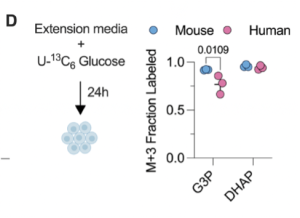
It makes sense, then, that human cells were found to contain less G3P than mouse cells, but the authors still needed to check that this wasn’t a result of differences earlier in glycolysis. They performed two experiments, one with ‘heavy’ carbon and one with ‘heavy’ hydrogen, which labelled the atoms and allowed them to trace the fractions incorporated at each point in the pathway. They found that in human cells, the G3P – but not the DHAP – contained a smaller fraction of both heavy carbon (Figure 2D in the preprint) and heavy hydrogen, indicating the that the conversion step of DHAP to G3P was less efficient, making the G3P shuttle less active in humans than in mice.
Mouse cells burn faster
Embryonic cells, like cancer cells, rely heavily on aerobic glycolysis. Glucose is converted to lactate, allowing for faster ATP production and supplying the building blocks for new cells more quickly, bypassing the mitochondria. But, continued glycolytic flux requires NADH oxidation back to NAD+, and a build-up of NADH can slow this down.
To see whether this was limiting human cells, the authors ran a glycolytic stress test on a ‘Seahorse Extracellular Flux Analyser’. It sounds like something from Back To The Future, but all it does is measure the acidification of the cell culture medium as the cells produce lactate. The mouse cells had a bigger and faster increase in acidification, confirming elevated glycolytic flux. The authors backed this up with transcriptomic data, showing that the mouse PSM expresses higher levels of genes involved in glycolysis.
Speeding up human development
The authors then put what they had learned into practice: could they make human development faster by introducing mouse-like metabolic features?
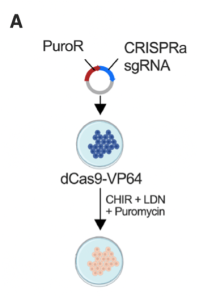
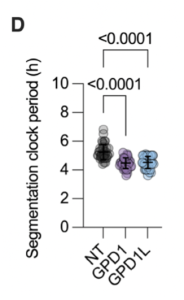
They first used CRISPRa to activate transcription of the human GPD1 or GPD1L genes in human PSM cultures (Figure 3A in the preprint). This led to an increase in G3P shuttle activation, an elevated NAD+/NADH ratio, elevated glycolytic flux, and importantly, faster segmentation clock oscillations – shortening the clock period by 40-50 minutes (Figure 3D in the preprint). This was accompanied by a faster cell cycle; however, it didn’t change the timing of MSGN1 induction.
Finally, the authors asked whether these findings apply to other cell types. When mouse and human stem cells were differentiated into definitive endoderm or neural progenitors using equivalent protocols, the mouse cells consistently expressed SOX17 (endoderm) or PAX6 (neural) earlier than human cells. However, when human cells were made to overexpress GPD1/1L, this led to cells switching on their lineage markers earlier.
Altogether, this preprint gives convincing evidence that GPD1/1L expression, by controlling a critical step of glycolysis, helps set the rate of embryonic development across multiple tissues.
Read preprint
Sign up to customise the site to your preferences and to receive alerts
Register hereAlso in the developmental biology category:
Centrosome Loss Alters Axonal and Muscle Development
Jeny Jose

Fast single molecule localization microscopy in 3D
Kanishka Parashar

'Preprints by preLighters': A novel reaction-diffusion architecture for engineering self-organized patterns in mammalian cells
Reinier Prosee, Benjamin Swedlund

preLists in the developmental biology category:
‘In preprints’ from Development 2026
A list of the preprints featured in Development's 'In preprints' articles, as part of the new Preprint Editors initiative
| List by | Clarisse Brunet Avalos et al. |
Sainsbury Laboratory Symposium 2026
The Sainsbury Laboratory Symposium 2026, Shaping Life: Mechanisms of Morphogenesis, brought together researchers exploring the cellular, genetic and mechanical processes that shape plant form. This preList highlights preprints that were discussed or mentioned at the meeting. If you notice any missing preprints, please contact us at preLights@biologists.com
| List by | Ingrid Tsang |
Santa Cruz Developmental Biology Meeting 2026
This preList brings together a selection of preprints discussed at the Santa Cruz Developmental Biology Meeting 2026, held at UC Santa Cruz with the theme “Biomedicine, Biomechanics, and the Biosphere.” Reflecting the meeting’s broad scientific scope, from development and regeneration to evolution, tissue mechanics, and emerging technologies, this curated collection showcases work that contributed to conversations throughout the meeting.
| List by | Ingrid Tsang |
Developmental regulation: molecular and ecological niches
This conference was held at the Station Biologique de Roscoff (France) and brought together researchers exploring how diverse niche environments shape developmental processes across scales. Spanning topics from ecological and metabolic influences to signalling networks, mechanics and gene regulation, the meeting highlighted the interplay between intrinsic and extrinsic factors in controlling cell fate and tissue organisation. This preList gathers preprints discussed by speakers and poster presenters during the meeting. Please do get in touch at preLights@biologists.com if you notice any relevant preprints that we may have missed.
| List by | Ingrid Tsang |
preLighters’ choice – Handpicked DevBio preprints
preLighters with expertise across developmental and stem cell biology have nominated a few developmental biology (and related) preprints they’re excited about and explain in a few paragraph why. Concise preprint highlights, prepared by the preLighter community – a quick way to spot upcoming trends, new methods and fresh ideas.
| List by | Theodora Stougiannou et al. |
BSDB Spring Meeting: Molecules to Morphogenesis
The British Society for Developmental Biology (BSDB) Spring Meeting Molecules to Morphogenesis was held from 23–26 March 2026 at the University of Warwick (UK). This meeting brought together a vibrant community of researchers to discuss how molecular mechanisms are integrated across scales to drive morphogenesis, spanning diverse model systems and approaches. This preList contains preprints by presenters from the talk and poster sessions at the meeting. Please do get in touch at preLights@biologists.com if you notice any relevant preprints that we may have missed.
| List by | Ingrid Tsang |
Keystone Symposium on Stem Cell Models in Embryology 2026
The Keystone Symposium on Stem Cell Models in Embryology, 2026, was organised by Jun Wu (UT Southwestern), Jianping Fu (University of Michigan) and Miki Ebisuya (TU Dresden) and held at Asilomar Conference Grounds in California (US). The meeting discussed recent advances made in establishing stem-cell-based embryo models, what fundamental insights into developmental processes have been gleaned from them, as well as how they are beginning to be applied more widely. This prelist contains preprints by presenters at the talk and poster sessions at the conference, which our Reviews Editor in attendance spotted. Please do reach out to preLights@biologists.com if you notice any that we’ve missed.
| List by | Ingrid Tsang |
November in preprints – DevBio & Stem cell biology
preLighters with expertise across developmental and stem cell biology have nominated a few developmental and stem cell biology (and related) preprints posted in November they’re excited about and explain in a single paragraph why. Concise preprint highlights, prepared by the preLighter community – a quick way to spot upcoming trends, new methods and fresh ideas.
| List by | Aline Grata et al. |
October in preprints – DevBio & Stem cell biology
Each month, preLighters with expertise across developmental and stem cell biology nominate a few recent developmental and stem cell biology (and related) preprints they’re excited about and explain in a single paragraph why. Short, snappy picks from working scientists — a quick way to spot fresh ideas, bold methods and papers worth reading in full. These preprints can all be found in the October preprint list published on the Node.
| List by | Deevitha Balasubramanian et al. |
October in preprints – Cell biology edition
Different preLighters, with expertise across cell biology, have worked together to create this preprint reading list for researchers with an interest in cell biology. This month, most picks fall under (1) Cell organelles and organisation, followed by (2) Mechanosignaling and mechanotransduction, (3) Cell cycle and division and (4) Cell migration
| List by | Matthew Davies et al. |
June in preprints – the CellBio edition
A group of preLighters, with expertise in different areas of cell biology, have worked together to create this preprint reading lists for researchers with an interest in cell biology. This month, categories include: (1) Cell organelles and organisation (2) Cell signaling and mechanosensation (3) Genetics/gene expression (4) Biochemistry (5) Cytoskeleton
| List by | Barbora Knotkova et al. |
Keystone Symposium – Metabolic and Nutritional Control of Development and Cell Fate
This preList contains preprints discussed during the Metabolic and Nutritional Control of Development and Cell Fate Keystone Symposia. This conference was organized by Lydia Finley and Ralph J. DeBerardinis and held in the Wylie Center and Tupper Manor at Endicott College, Beverly, MA, United States from May 7th to 9th 2025. This meeting marked the first in-person gathering of leading researchers exploring how metabolism influences development, including processes like cell fate, tissue patterning, and organ function, through nutrient availability and metabolic regulation. By integrating modern metabolic tools with genetic and epidemiological insights across model organisms, this event highlighted key mechanisms and identified open questions to advance the emerging field of developmental metabolism.
| List by | Virginia Savy, Martin Estermann |
Biologists @ 100 conference preList
This preList aims to capture all preprints being discussed at the Biologists @100 conference in Liverpool, UK, either as part of the poster sessions or the (flash/short/full-length) talks.
| List by | Reinier Prosee, Jonathan Townson |
BSDB/GenSoc Spring Meeting 2024
A list of preprints highlighted at the British Society for Developmental Biology and Genetics Society joint Spring meeting 2024 at Warwick, UK.
| List by | Joyce Yu, Katherine Brown |
GfE/ DSDB meeting 2024
This preList highlights the preprints discussed at the 2024 joint German and Dutch developmental biology societies meeting that took place in March 2024 in Osnabrück, Germany.
| List by | Joyce Yu |
‘In preprints’ from Development 2022-2023
A list of the preprints featured in Development's 'In preprints' articles between 2022-2023
| List by | Alex Eve, Katherine Brown |
preLights peer support – preprints of interest
This is a preprint repository to organise the preprints and preLights covered through the 'preLights peer support' initiative.
| List by | preLights peer support |
The Society for Developmental Biology 82nd Annual Meeting
This preList is made up of the preprints discussed during the Society for Developmental Biology 82nd Annual Meeting that took place in Chicago in July 2023.
| List by | Joyce Yu, Katherine Brown |
CSHL 87th Symposium: Stem Cells
Preprints mentioned by speakers at the #CSHLsymp23
| List by | Alex Eve |
Journal of Cell Science meeting ‘Imaging Cell Dynamics’
This preList highlights the preprints discussed at the JCS meeting 'Imaging Cell Dynamics'. The meeting was held from 14 - 17 May 2023 in Lisbon, Portugal and was organised by Erika Holzbaur, Jennifer Lippincott-Schwartz, Rob Parton and Michael Way.
| List by | Helen Zenner |
9th International Symposium on the Biology of Vertebrate Sex Determination
This preList contains preprints discussed during the 9th International Symposium on the Biology of Vertebrate Sex Determination. This conference was held in Kona, Hawaii from April 17th to 21st 2023.
| List by | Martin Estermann |
Alumni picks – preLights 5th Birthday
This preList contains preprints that were picked and highlighted by preLights Alumni - an initiative that was set up to mark preLights 5th birthday. More entries will follow throughout February and March 2023.
| List by | Sergio Menchero et al. |
CellBio 2022 – An ASCB/EMBO Meeting
This preLists features preprints that were discussed and presented during the CellBio 2022 meeting in Washington, DC in December 2022.
| List by | Nadja Hümpfer et al. |
2nd Conference of the Visegrád Group Society for Developmental Biology
Preprints from the 2nd Conference of the Visegrád Group Society for Developmental Biology (2-5 September, 2021, Szeged, Hungary)
| List by | Nándor Lipták |
Fibroblasts
The advances in fibroblast biology preList explores the recent discoveries and preprints of the fibroblast world. Get ready to immerse yourself with this list created for fibroblasts aficionados and lovers, and beyond. Here, my goal is to include preprints of fibroblast biology, heterogeneity, fate, extracellular matrix, behavior, topography, single-cell atlases, spatial transcriptomics, and their matrix!
| List by | Osvaldo Contreras |
EMBL Synthetic Morphogenesis: From Gene Circuits to Tissue Architecture (2021)
A list of preprints mentioned at the #EESmorphoG virtual meeting in 2021.
| List by | Alex Eve |
EMBL Conference: From functional genomics to systems biology
Preprints presented at the virtual EMBL conference "from functional genomics and systems biology", 16-19 November 2020
| List by | Jesus Victorino |
Single Cell Biology 2020
A list of preprints mentioned at the Wellcome Genome Campus Single Cell Biology 2020 meeting.
| List by | Alex Eve |
Society for Developmental Biology 79th Annual Meeting
Preprints at SDB 2020
| List by | Irepan Salvador-Martinez, Martin Estermann |
FENS 2020
A collection of preprints presented during the virtual meeting of the Federation of European Neuroscience Societies (FENS) in 2020
| List by | Ana Dorrego-Rivas |
Planar Cell Polarity – PCP
This preList contains preprints about the latest findings on Planar Cell Polarity (PCP) in various model organisms at the molecular, cellular and tissue levels.
| List by | Ana Dorrego-Rivas |
Cell Polarity
Recent research from the field of cell polarity is summarized in this list of preprints. It comprises of studies focusing on various forms of cell polarity ranging from epithelial polarity, planar cell polarity to front-to-rear polarity.
| List by | Yamini Ravichandran |
TAGC 2020
Preprints recently presented at the virtual Allied Genetics Conference, April 22-26, 2020. #TAGC20
| List by | Maiko Kitaoka et al. |
3D Gastruloids
A curated list of preprints related to Gastruloids (in vitro models of early development obtained by 3D aggregation of embryonic cells). Updated until July 2021.
| List by | Paul Gerald L. Sanchez and Stefano Vianello |
ASCB EMBO Annual Meeting 2019
A collection of preprints presented at the 2019 ASCB EMBO Meeting in Washington, DC (December 7-11)
| List by | Madhuja Samaddar et al. |
EDBC Alicante 2019
Preprints presented at the European Developmental Biology Congress (EDBC) in Alicante, October 23-26 2019.
| List by | Sergio Menchero et al. |
EMBL Seeing is Believing – Imaging the Molecular Processes of Life
Preprints discussed at the 2019 edition of Seeing is Believing, at EMBL Heidelberg from the 9th-12th October 2019
| List by | Dey Lab |
SDB 78th Annual Meeting 2019
A curation of the preprints presented at the SDB meeting in Boston, July 26-30 2019. The preList will be updated throughout the duration of the meeting.
| List by | Alex Eve |
Lung Disease and Regeneration
This preprint list compiles highlights from the field of lung biology.
| List by | Rob Hynds |
Young Embryologist Network Conference 2019
Preprints presented at the Young Embryologist Network 2019 conference, 13 May, The Francis Crick Institute, London
| List by | Alex Eve |
Pattern formation during development
The aim of this preList is to integrate results about the mechanisms that govern patterning during development, from genes implicated in the processes to theoritical models of pattern formation in nature.
| List by | Alexa Sadier |
BSCB/BSDB Annual Meeting 2019
Preprints presented at the BSCB/BSDB Annual Meeting 2019
| List by | Dey Lab |
Zebrafish immunology
A compilation of cutting-edge research that uses the zebrafish as a model system to elucidate novel immunological mechanisms in health and disease.
| List by | Shikha Nayar |