







Clonal embeddings allow exploratory analysis of lineage-resolved single-cell data
Posted on: 23 September 2026 , updated on: 24 September 2026
Preprint posted on 5 May 2026
DNA barcoding systems that uniquely label progenitors allow us to trace their fate. This preprint presents a novel method to analyse complex clonal patterns.
Selected by Marine Secchi
Categories: bioinformatics, developmental biology
Background
Lineage tracing – labelling a progenitor cell and following the cells it gives rise to over time – allows us to understand the origin of different cell types. Classical cell fate studies, using dye injection or sparse genetic recombination, are limited in the number of clones tracked simultaneously and in the molecular characterization of the progeny.
Over the past decade, a number of DNA barcoding tools have been developed that address these limitations by allowing thousands of clones to be analyzed at once from one organism (GESTALT, CARLIN/DARLIN, PE Tracer, TREX). Upon barcoding induction, each cell acquires a unique DNA sequence (a ‘barcode’). As the cell divides, that sequence is replicated and inherited by all daughter cells. The barcode can be read out by RNA sequencing alongside the whole transcriptome information of the cell, allowing molecularly-phenotyped cells to be grouped into individual clones. Barcoding tools have been applied to the study of many biological systems including hematopoiesis, the early mammalian embryo and the developing brain.
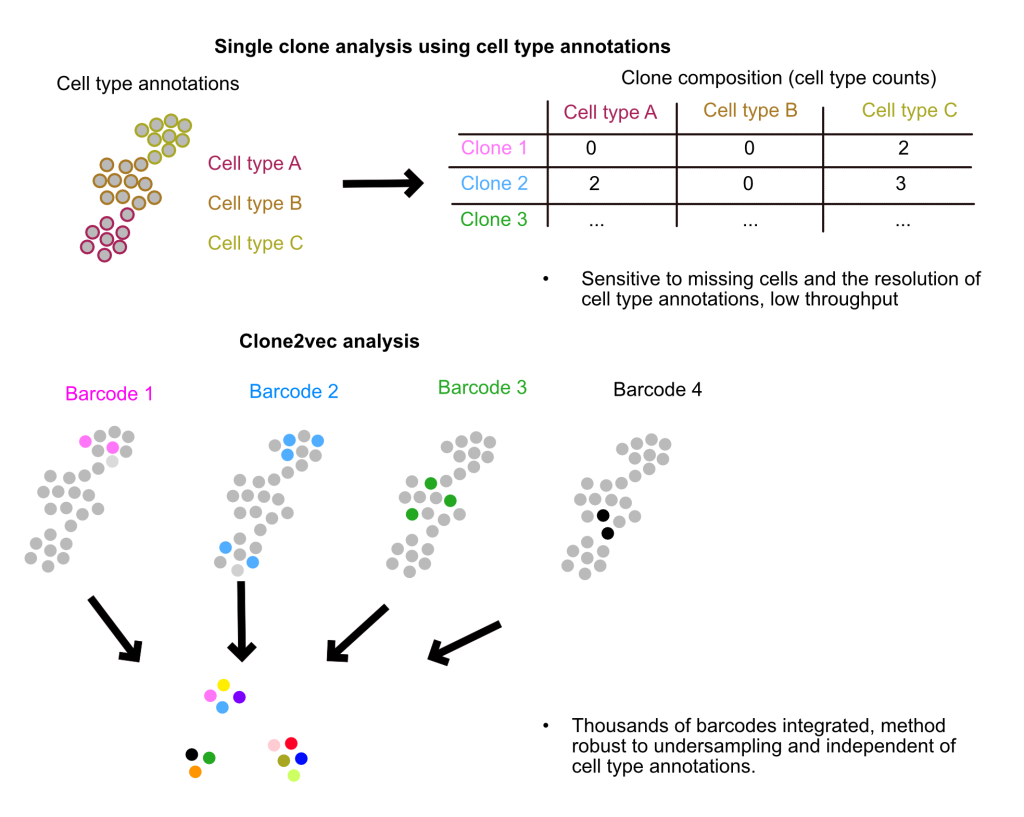
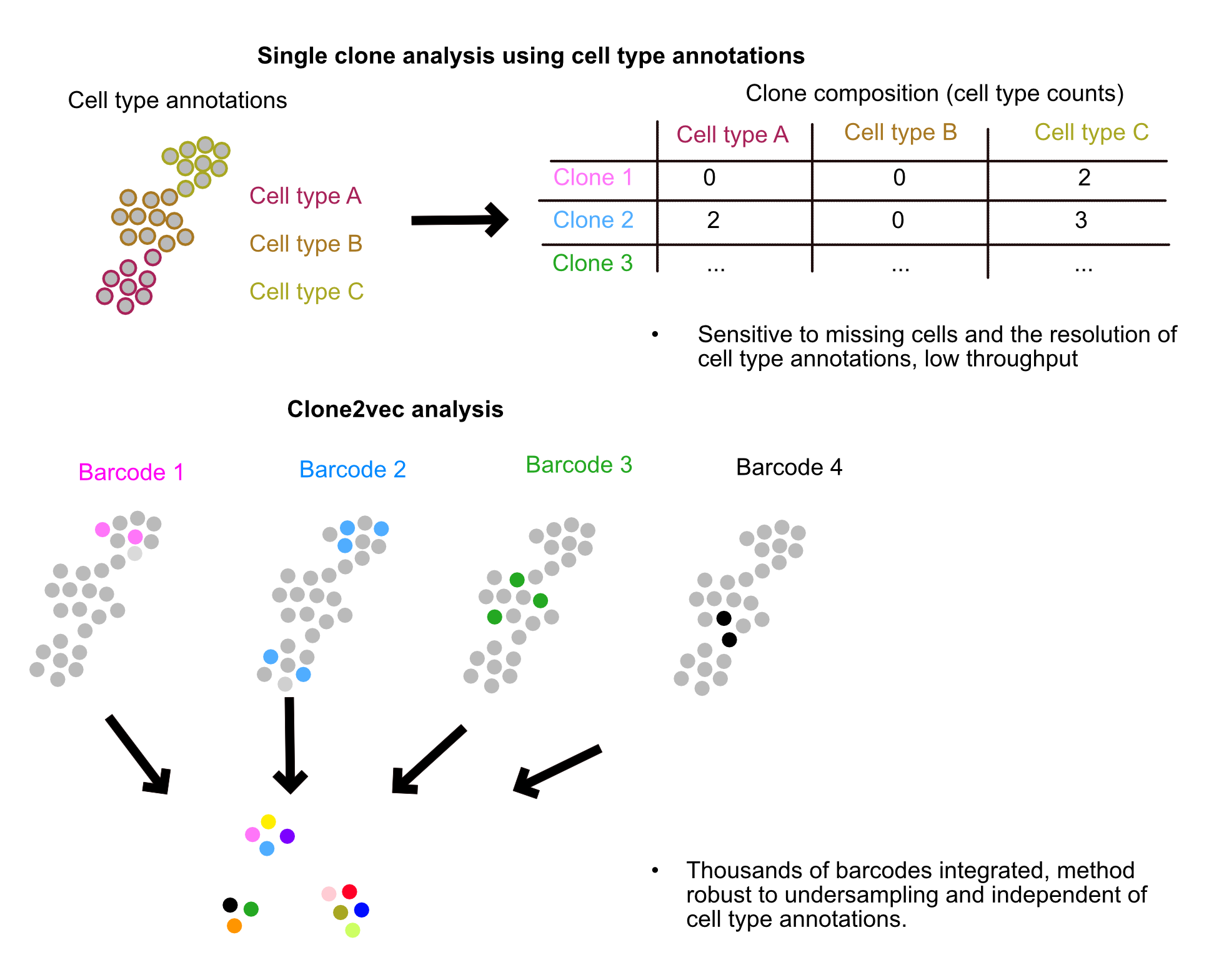
Figure 1. Conceptual summary. Traditional clonal analysis represents a clone by the combination of cell types it gives rise to. Clone2vec instead represents a clone by the combination of its nearest neighboring clones, overcoming key limitations of barcoding data analysis, including undersampling and annotation biases. Created with Affinity Designer.
As illustrated in Figure 1, analysis methods are needed to interpret and group the individual clonal patterns. Furthermore, barcoding experiments typically have two limitations. First, the datasets are undersampled because not all cells in a tissue are sequenced, and a barcode may not be retrieved from every cell. Second, the analysis usually relies on cell annotations as an input, and these can have insufficient resolution. As a result, “manual” clonal analysis or simple clustering algorithms may group clones into distinct patterns inaccurately. The new computational method presented in the preprint highlighted here addresses both limitations and enables the analysis of complex clonal patterns from DNA barcoding data (Figure1).
Study approach
Studying thousands of clones is challenging, so the method described in the preprint grouped clones with similar cellular compositions, thereby facilitating analysis and interpretation of the data. This approach leveraged transcriptomic neighborhoods: for a given barcoded cell, its 15 closest barcoded cells in a low-dimensional embedding (e.g. PCA) were considered its neighbors. This neighborhood information was summarized in a clone-by-clone co-occurrence matrix which captured both the similarities between clones and the cell state proportions within each clone. A neural network was then trained on clone pairs to produce a clonal embedding relating clones to each other that can be clustered using standard algorithms. The architecture was inspired by word2vec which predicts the meaning of a target word, as a vectorized representation, based on the context of surrounding words.
To validate their approach, the authors compared it with several alternatives: cluster-based PCA, cluster-based Poisson GLM-PCA or kNN graphs constructed directly from inter-clone distances (Laplacian Maximum Mean Discrepancy (MMD), Gaussian MMD, Energy distance or Sinkhorn divergence). They used simulated data to test agreement of the clustering of clones from subsampled datasets with the full dataset and showed performance superior to other methods (Figure S4).
Why I highlight this preprint
The new clone2vec method has many useful features. Using the transcriptomic nearest-neighbor identities rather than coarse-grained cell type labels (table Figure 1) as inputs to the first step of the embedding is an advance for the field, because it captures finer transcriptomic differences between cells. Clonal patterns can be challenging to classify when clones differ across multiple cell fates, therefore an unbiased clustering approach is valuable. Combining a neighbor-based description of each clone with the skip-gram neural network also handles sparse data more robustly than previous methods: even when some cells are missing, the transcriptional similarity between the remaining cells of clones X and Y will still place them close together in the embedding. The accompanying package is well documented and user-friendly. Follow-up differential gene expression analysis can then address whether cells of the same terminal fate inherit distinct transcriptional signatures depending on their clonal origin.
Key biological findings
When applied to a central nervous system dataset containing progenitors and mature cells (De Haan and He et al., 2025), the clone2vec method recapitulated the original finding that distinct clonal patterns generate different anatomical structures. Differential gene expression analysis between clonal patterns, averaging expression at the clone level for specific cell types of interest, identified dorso-ventral markers that distinguish two clonal behaviors in both neuronal progenitors and their progeny.
In the small-cell lung cancer dataset by Ireland et al. (2025), the method resolved finer clonal patterns, with one cluster related to an epithelial cell state and another to a neuronal cell state.
Re-analysis of non-small cell lung cancer data (Caushi et al., 2021) revealed fuzzy clonal boundaries amongst CD8 T cells, reflecting continuous transcriptomic variation between subpopulations rather than clones giving rise to discrete cell types. The authors therefore applied archetype analysis to the clonal embedding: extreme patterns were identified, and each clone was represented as a combination of them. The resulting grouping was consistent with distinct histories of antigen exposure and activation, and similar clonal patterns were observed across cancer datasets. To integrate datasets, the authors used average clone expression profiles to build a mutual nearest-neighbors graph and then applied a linear transformation to align the clonal spaces of individual datasets while preserving their structure. Interestingly, anti-PD-1 therapy changed clonal frequencies but not the phenotypic properties of the clones.
Future directions
The clustering step is supervised, whereas recent single-cell RNA sequencing methods select clustering resolution in an unbiased way by testing for statistical significance between candidate clusters (Sant et al., 2025). Incorporating such an approach into the clonal clustering step could be an improvement.
The method makes it possible to look at transcriptional differences between progenitors with different clonal behaviors, but progenitor cells are often no longer present by the time the progeny is sequenced. Protocols that allow repeated sampling of the same clones will therefore need to be developed.
Finally, clonal dynamics result from both cell-intrinsic programming and exposure to the environment. The next frontier will be acquiring spatial information at the same time, so that stronger conclusions can be drawn about the influence of the environment and the factors that regulate clonal dynamics.
Question to the authors
What percentage of subsampling is commonly used in the field?
How does clonal heterogeneity, in terms of both the diversity and number of fate patterns, affect dropout stability? Do you see the same trends when subsampling a biological dataset rather than simulating dropout?
References
de Haan, S. et al. et al. Ectoderm barcoding reveals neural and cochlear compartmentalization. Science 388, 60–68 https://doi.org/10.1126/science.adq9248 (2025)
Ireland, A. S. et al. et al. Basal cell of origin resolves neuroendocrine-tuft lineage plasticity in cancer. Nature 647, 257–267 https://doi.org/10.1038/s41586-025-09503-z (2025).
Caushi, J. X. et al. et al. Transcriptional programs of neoantigen-specific TIL in anti-PD-1-treated lung cancers. Nature 596, 126–132 https://doi.org/10.1038/s41586-021-03752-4 (2021).
Sant, C., Mucke, L. & Corces, M. R. CHOIR improves significance-based detection of cell types and states from single-cell data. Nat. Genet. 57, 1309-1319, doi:10.1038/s41588-025-02148-8 (2025).
doi: https://doi.org/10.1242/prelights.44905
Read preprintSign up to customise the site to your preferences and to receive alerts
Register hereAlso in the bioinformatics category:
AI semantics for biomedical data integration
Theodora Stougiannou

Additive baselines furnish no evidence for epistasis learning by MULTI-evolve
Leonie Brüne
Temporal degradation of PRC2 uncovers specific developmental dependencies
María Mariner-Faulí

Also in the developmental biology category:
'Preprints by preLighters': A novel reaction-diffusion architecture for engineering self-organized patterns in mammalian cells
Reinier Prosee, Benjamin Swedlund

Choreographed morphogenetic events underlie early foregut development in the mouse embryo
Ruoheng Li
Clonal embeddings allow exploratory analysis of lineage-resolved single-cell data
Marine Secchi
preLists in the bioinformatics category:
Keystone Symposium – Metabolic and Nutritional Control of Development and Cell Fate
This preList contains preprints discussed during the Metabolic and Nutritional Control of Development and Cell Fate Keystone Symposia. This conference was organized by Lydia Finley and Ralph J. DeBerardinis and held in the Wylie Center and Tupper Manor at Endicott College, Beverly, MA, United States from May 7th to 9th 2025. This meeting marked the first in-person gathering of leading researchers exploring how metabolism influences development, including processes like cell fate, tissue patterning, and organ function, through nutrient availability and metabolic regulation. By integrating modern metabolic tools with genetic and epidemiological insights across model organisms, this event highlighted key mechanisms and identified open questions to advance the emerging field of developmental metabolism.
| List by | Virginia Savy, Martin Estermann |
‘In preprints’ from Development 2022-2023
A list of the preprints featured in Development's 'In preprints' articles between 2022-2023
| List by | Alex Eve, Katherine Brown |
9th International Symposium on the Biology of Vertebrate Sex Determination
This preList contains preprints discussed during the 9th International Symposium on the Biology of Vertebrate Sex Determination. This conference was held in Kona, Hawaii from April 17th to 21st 2023.
| List by | Martin Estermann |
Alumni picks – preLights 5th Birthday
This preList contains preprints that were picked and highlighted by preLights Alumni - an initiative that was set up to mark preLights 5th birthday. More entries will follow throughout February and March 2023.
| List by | Sergio Menchero et al. |
Fibroblasts
The advances in fibroblast biology preList explores the recent discoveries and preprints of the fibroblast world. Get ready to immerse yourself with this list created for fibroblasts aficionados and lovers, and beyond. Here, my goal is to include preprints of fibroblast biology, heterogeneity, fate, extracellular matrix, behavior, topography, single-cell atlases, spatial transcriptomics, and their matrix!
| List by | Osvaldo Contreras |
Single Cell Biology 2020
A list of preprints mentioned at the Wellcome Genome Campus Single Cell Biology 2020 meeting.
| List by | Alex Eve |
Antimicrobials: Discovery, clinical use, and development of resistance
Preprints that describe the discovery of new antimicrobials and any improvements made regarding their clinical use. Includes preprints that detail the factors affecting antimicrobial selection and the development of antimicrobial resistance.
| List by | Zhang-He Goh |
Also in the developmental biology category:
‘In preprints’ from Development 2026
A list of the preprints featured in Development's 'In preprints' articles, as part of the new Preprint Editors initiative
| List by | Clarisse Brunet Avalos et al. |
Sainsbury Laboratory Symposium 2026
The Sainsbury Laboratory Symposium 2026, Shaping Life: Mechanisms of Morphogenesis, brought together researchers exploring the cellular, genetic and mechanical processes that shape plant form. This preList highlights preprints that were discussed or mentioned at the meeting. If you notice any missing preprints, please contact us at preLights@biologists.com
| List by | Ingrid Tsang |
Santa Cruz Developmental Biology Meeting 2026
This preList brings together a selection of preprints discussed at the Santa Cruz Developmental Biology Meeting 2026, held at UC Santa Cruz with the theme “Biomedicine, Biomechanics, and the Biosphere.” Reflecting the meeting’s broad scientific scope, from development and regeneration to evolution, tissue mechanics, and emerging technologies, this curated collection showcases work that contributed to conversations throughout the meeting.
| List by | Ingrid Tsang |
Developmental regulation: molecular and ecological niches
This conference was held at the Station Biologique de Roscoff (France) and brought together researchers exploring how diverse niche environments shape developmental processes across scales. Spanning topics from ecological and metabolic influences to signalling networks, mechanics and gene regulation, the meeting highlighted the interplay between intrinsic and extrinsic factors in controlling cell fate and tissue organisation. This preList gathers preprints discussed by speakers and poster presenters during the meeting. Please do get in touch at preLights@biologists.com if you notice any relevant preprints that we may have missed.
| List by | Ingrid Tsang |
preLighters’ choice – Handpicked DevBio preprints
preLighters with expertise across developmental and stem cell biology have nominated a few developmental biology (and related) preprints they’re excited about and explain in a few paragraph why. Concise preprint highlights, prepared by the preLighter community – a quick way to spot upcoming trends, new methods and fresh ideas.
| List by | Theodora Stougiannou et al. |
BSDB Spring Meeting: Molecules to Morphogenesis
The British Society for Developmental Biology (BSDB) Spring Meeting Molecules to Morphogenesis was held from 23–26 March 2026 at the University of Warwick (UK). This meeting brought together a vibrant community of researchers to discuss how molecular mechanisms are integrated across scales to drive morphogenesis, spanning diverse model systems and approaches. This preList contains preprints by presenters from the talk and poster sessions at the meeting. Please do get in touch at preLights@biologists.com if you notice any relevant preprints that we may have missed.
| List by | Ingrid Tsang |
Keystone Symposium on Stem Cell Models in Embryology 2026
The Keystone Symposium on Stem Cell Models in Embryology, 2026, was organised by Jun Wu (UT Southwestern), Jianping Fu (University of Michigan) and Miki Ebisuya (TU Dresden) and held at Asilomar Conference Grounds in California (US). The meeting discussed recent advances made in establishing stem-cell-based embryo models, what fundamental insights into developmental processes have been gleaned from them, as well as how they are beginning to be applied more widely. This prelist contains preprints by presenters at the talk and poster sessions at the conference, which our Reviews Editor in attendance spotted. Please do reach out to preLights@biologists.com if you notice any that we’ve missed.
| List by | Ingrid Tsang |
November in preprints – DevBio & Stem cell biology
preLighters with expertise across developmental and stem cell biology have nominated a few developmental and stem cell biology (and related) preprints posted in November they’re excited about and explain in a single paragraph why. Concise preprint highlights, prepared by the preLighter community – a quick way to spot upcoming trends, new methods and fresh ideas.
| List by | Aline Grata et al. |
October in preprints – DevBio & Stem cell biology
Each month, preLighters with expertise across developmental and stem cell biology nominate a few recent developmental and stem cell biology (and related) preprints they’re excited about and explain in a single paragraph why. Short, snappy picks from working scientists — a quick way to spot fresh ideas, bold methods and papers worth reading in full. These preprints can all be found in the October preprint list published on the Node.
| List by | Deevitha Balasubramanian et al. |
October in preprints – Cell biology edition
Different preLighters, with expertise across cell biology, have worked together to create this preprint reading list for researchers with an interest in cell biology. This month, most picks fall under (1) Cell organelles and organisation, followed by (2) Mechanosignaling and mechanotransduction, (3) Cell cycle and division and (4) Cell migration
| List by | Matthew Davies et al. |
June in preprints – the CellBio edition
A group of preLighters, with expertise in different areas of cell biology, have worked together to create this preprint reading lists for researchers with an interest in cell biology. This month, categories include: (1) Cell organelles and organisation (2) Cell signaling and mechanosensation (3) Genetics/gene expression (4) Biochemistry (5) Cytoskeleton
| List by | Barbora Knotkova et al. |
Keystone Symposium – Metabolic and Nutritional Control of Development and Cell Fate
This preList contains preprints discussed during the Metabolic and Nutritional Control of Development and Cell Fate Keystone Symposia. This conference was organized by Lydia Finley and Ralph J. DeBerardinis and held in the Wylie Center and Tupper Manor at Endicott College, Beverly, MA, United States from May 7th to 9th 2025. This meeting marked the first in-person gathering of leading researchers exploring how metabolism influences development, including processes like cell fate, tissue patterning, and organ function, through nutrient availability and metabolic regulation. By integrating modern metabolic tools with genetic and epidemiological insights across model organisms, this event highlighted key mechanisms and identified open questions to advance the emerging field of developmental metabolism.
| List by | Virginia Savy, Martin Estermann |
Biologists @ 100 conference preList
This preList aims to capture all preprints being discussed at the Biologists @100 conference in Liverpool, UK, either as part of the poster sessions or the (flash/short/full-length) talks.
| List by | Reinier Prosee, Jonathan Townson |
BSDB/GenSoc Spring Meeting 2024
A list of preprints highlighted at the British Society for Developmental Biology and Genetics Society joint Spring meeting 2024 at Warwick, UK.
| List by | Joyce Yu, Katherine Brown |
GfE/ DSDB meeting 2024
This preList highlights the preprints discussed at the 2024 joint German and Dutch developmental biology societies meeting that took place in March 2024 in Osnabrück, Germany.
| List by | Joyce Yu |
‘In preprints’ from Development 2022-2023
A list of the preprints featured in Development's 'In preprints' articles between 2022-2023
| List by | Alex Eve, Katherine Brown |
preLights peer support – preprints of interest
This is a preprint repository to organise the preprints and preLights covered through the 'preLights peer support' initiative.
| List by | preLights peer support |
The Society for Developmental Biology 82nd Annual Meeting
This preList is made up of the preprints discussed during the Society for Developmental Biology 82nd Annual Meeting that took place in Chicago in July 2023.
| List by | Joyce Yu, Katherine Brown |
CSHL 87th Symposium: Stem Cells
Preprints mentioned by speakers at the #CSHLsymp23
| List by | Alex Eve |
Journal of Cell Science meeting ‘Imaging Cell Dynamics’
This preList highlights the preprints discussed at the JCS meeting 'Imaging Cell Dynamics'. The meeting was held from 14 - 17 May 2023 in Lisbon, Portugal and was organised by Erika Holzbaur, Jennifer Lippincott-Schwartz, Rob Parton and Michael Way.
| List by | Helen Zenner |
9th International Symposium on the Biology of Vertebrate Sex Determination
This preList contains preprints discussed during the 9th International Symposium on the Biology of Vertebrate Sex Determination. This conference was held in Kona, Hawaii from April 17th to 21st 2023.
| List by | Martin Estermann |
Alumni picks – preLights 5th Birthday
This preList contains preprints that were picked and highlighted by preLights Alumni - an initiative that was set up to mark preLights 5th birthday. More entries will follow throughout February and March 2023.
| List by | Sergio Menchero et al. |
CellBio 2022 – An ASCB/EMBO Meeting
This preLists features preprints that were discussed and presented during the CellBio 2022 meeting in Washington, DC in December 2022.
| List by | Nadja Hümpfer et al. |
2nd Conference of the Visegrád Group Society for Developmental Biology
Preprints from the 2nd Conference of the Visegrád Group Society for Developmental Biology (2-5 September, 2021, Szeged, Hungary)
| List by | Nándor Lipták |
Fibroblasts
The advances in fibroblast biology preList explores the recent discoveries and preprints of the fibroblast world. Get ready to immerse yourself with this list created for fibroblasts aficionados and lovers, and beyond. Here, my goal is to include preprints of fibroblast biology, heterogeneity, fate, extracellular matrix, behavior, topography, single-cell atlases, spatial transcriptomics, and their matrix!
| List by | Osvaldo Contreras |
EMBL Synthetic Morphogenesis: From Gene Circuits to Tissue Architecture (2021)
A list of preprints mentioned at the #EESmorphoG virtual meeting in 2021.
| List by | Alex Eve |
EMBL Conference: From functional genomics to systems biology
Preprints presented at the virtual EMBL conference "from functional genomics and systems biology", 16-19 November 2020
| List by | Jesus Victorino |
Single Cell Biology 2020
A list of preprints mentioned at the Wellcome Genome Campus Single Cell Biology 2020 meeting.
| List by | Alex Eve |
Society for Developmental Biology 79th Annual Meeting
Preprints at SDB 2020
| List by | Irepan Salvador-Martinez, Martin Estermann |
FENS 2020
A collection of preprints presented during the virtual meeting of the Federation of European Neuroscience Societies (FENS) in 2020
| List by | Ana Dorrego-Rivas |
Planar Cell Polarity – PCP
This preList contains preprints about the latest findings on Planar Cell Polarity (PCP) in various model organisms at the molecular, cellular and tissue levels.
| List by | Ana Dorrego-Rivas |
Cell Polarity
Recent research from the field of cell polarity is summarized in this list of preprints. It comprises of studies focusing on various forms of cell polarity ranging from epithelial polarity, planar cell polarity to front-to-rear polarity.
| List by | Yamini Ravichandran |
TAGC 2020
Preprints recently presented at the virtual Allied Genetics Conference, April 22-26, 2020. #TAGC20
| List by | Maiko Kitaoka et al. |
3D Gastruloids
A curated list of preprints related to Gastruloids (in vitro models of early development obtained by 3D aggregation of embryonic cells). Updated until July 2021.
| List by | Paul Gerald L. Sanchez and Stefano Vianello |
ASCB EMBO Annual Meeting 2019
A collection of preprints presented at the 2019 ASCB EMBO Meeting in Washington, DC (December 7-11)
| List by | Madhuja Samaddar et al. |
EDBC Alicante 2019
Preprints presented at the European Developmental Biology Congress (EDBC) in Alicante, October 23-26 2019.
| List by | Sergio Menchero et al. |
EMBL Seeing is Believing – Imaging the Molecular Processes of Life
Preprints discussed at the 2019 edition of Seeing is Believing, at EMBL Heidelberg from the 9th-12th October 2019
| List by | Dey Lab |
SDB 78th Annual Meeting 2019
A curation of the preprints presented at the SDB meeting in Boston, July 26-30 2019. The preList will be updated throughout the duration of the meeting.
| List by | Alex Eve |
Lung Disease and Regeneration
This preprint list compiles highlights from the field of lung biology.
| List by | Rob Hynds |
Young Embryologist Network Conference 2019
Preprints presented at the Young Embryologist Network 2019 conference, 13 May, The Francis Crick Institute, London
| List by | Alex Eve |
Pattern formation during development
The aim of this preList is to integrate results about the mechanisms that govern patterning during development, from genes implicated in the processes to theoritical models of pattern formation in nature.
| List by | Alexa Sadier |
BSCB/BSDB Annual Meeting 2019
Preprints presented at the BSCB/BSDB Annual Meeting 2019
| List by | Dey Lab |
Zebrafish immunology
A compilation of cutting-edge research that uses the zebrafish as a model system to elucidate novel immunological mechanisms in health and disease.
| List by | Shikha Nayar |