






An endodermal subpopulation gives rise to neuromesodermal progenitors in the posterior chick embryo
Posted on: 3 September 2026
Preprint posted on 5 August 2026
Categories: developmental biology
Background
The progressive lineage restriction of cells on their way to becoming part of a functional tissue was considered a core principle in developmental biology. During gastrulation, pluripotent cells decide whether to become ectoderm, mesoderm or endoderm, and from there each germ layer differentiates into progressively more restricted cell types.
However, the discovery of neuromesodermal progenitors (NMPs), residing at the posterior end of the elongating body axis, challenged this idea (1). NMPs are bipotent cells that contribute to both neural and mesodermal tissues. They are usually defined by co-expression of the mesodermal marker TBXT and the neural marker SOX2, but their exact definition – and in some cases, their existence – remains hotly debated. The existence of a truly bipotent mesendoderm cell is also likewise debated, and a consensus is yet to emerge (2,3).
In both cases here, the question is whether bipotent cells are specified during gastrulation. Far less attention has been paid to the capacity of the endoderm to cross germ layer boundaries after its initial specification. The preprint highlighted here provides surprising evidence that endoderm-derived cells contribute to the NMP population and may help drive body axis elongation.
Key findings
Endoderm cells acquire mesenchymal properties
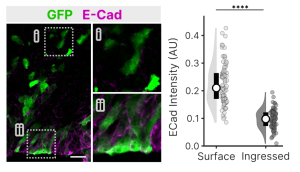
At the ventral surface of Hensen’s node lie progenitors of the definitive endoderm, thought to contribute primarily to the gut and associated organs. During body axis elongation, the node regresses from anterior to posterior, eventually becoming continuous with the tail bud, which then drives further elongation through posterior growth. Using electroporation to selectively tag the ventral surface of the chick embryo with GFP, the authors observed that once node regression is complete, cells of the ventral node migrate dorsally into the mesenchyme, settling into sites outside the gut. They then tested the cells for several hallmarks of EMT, finding that they indeed become mesenchymal as they ingress.
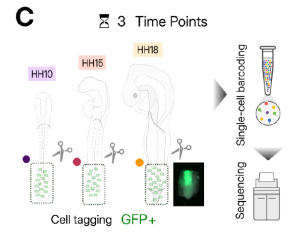
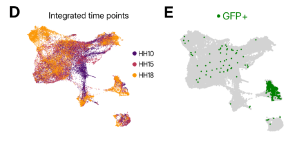
Next, the authors asked whether these cells are truly of endodermal origin. They again tagged the ventral tissue with GFP, but now combined this with single-cell RNA-seq at three stages. At early stages, the ventral node cells were found to express endodermal genes such as SOX17. By stage HH10, 97% of GFP+ cells fell within a distinct endoderm cluster, but had already lost expression of SOX17, suggesting that endodermal identity is lost as cells begin their ingression.
Endoderm to NMP transformation
But what identity do they adopt? At stage HH15, some GFP+ cells were found within clusters identified as NMPs and paraxial mesoderm. Co-staining for SOX2 and TBXT revealed that most of the GFP+ cells in the tailbud expressed both markers, the classic signature of NMPs. Together with their finding that the SOX2 N1 enhancer – another marker used to distinguish NMPs – is active in these cells, the case that ventral node endoderm cells adopt an NMP identity becomes quite convincing.
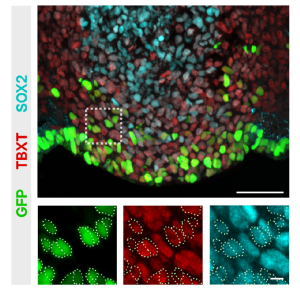
The authors then showed that there are more than just transcriptional similarities. By labelling the ventral node endoderm with GFP and the caudal lateral epiblast – where traditional NMPs derive from – with RFP, they demonstrated that by HH15 these populations converge at the chordoneural hinge – where NMPs are known to reside. At later stages, descendants of both cell populations were found in the somites, as expected for NMPs, as well as a few in the neural tube and notochord. Using a dominant-negative FGFR targeted to the ventral node endoderm, the authors showed that FGF signalling is required for the ingression of these cells, and that blocking it slowed down axial elongation.
Endoderm cells give rise to multipotent progenitors
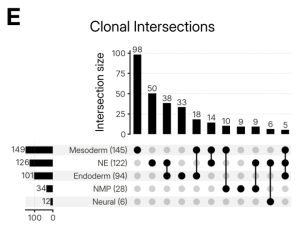
Next, they asked whether individual ventral node endoderm cells are producing descendants that span across germ layers. They used TrackerSeq lineage barcoding to tag individual cells in the posterior endoderm with GFP and a unique, heritable barcode at stage HH10, then sequenced at HH18. Crucially, they identified node endoderm clones with descendants in the mesoderm, endoderm, ectoderm or NMP clusters, with some clones spanning more than one germ layer – providing good evidence that the node endoderm contains both fate-restricted and bipotent progenitors.
Finally, since both node endoderm and traditional NMPs contribute to the somites, the authors asked if they take a similar molecular route to get there. Using computational trajectory inference, they identified putative lineage drivers of somitogenesis unique to either the node endoderm or the NMP trajectory, suggesting they arrive at the same fate through different routes. The node endoderm-specific drivers were active earlier, leading the authors to speculate that this may reflect the erasure of endodermal identity before the transition towards somite fate begins.
Why is this work important?
This work is valuable because it provides more evidence that challenges the preconceived notions of lineage restriction. Differentiation is traditionally seen as a progressive narrowing of potential, with NMPs an exception to the rule, but this study suggests that perhaps germ layers shouldn’t be thought of as lines that can’t be crossed, and that there may be more examples of seemingly lineage-restricted cells crossing germ layer boundaries.
Why did I choose to highlight this preprint?
As a scientist with an interest in the organiser, this paper conjures up many questions and ideas. During my PhD work, I did a lot of organiser ablation experiments, and I was stunned by the embryo’s ability to regulate, and also by the lack of true definition between ‘cell type’ clusters in single-cell datasets at early stages. This preprint builds on this plasticity of cell identities during early development, which could be an important evolutionary adaptation. Having multiple contributions to an essential process like axial elongation could improve its robustness against perturbation; however, this would require the NMP pool to compensate when the endoderm-derived pool is lacking.
Recent work has revealed the existence of a stem cell niche in the posterior part of Hensen’s node that generates notochord, somite and floor plate progenitors as the axis extends (4). The organiser is often described as a position in the embryo, rather than a fixed cell population (5) that can impart resident, self-renewing behaviour onto cells that enter into it – through normal cell movements, or via a graft – allowing them to contribute to axial tissues (4). At later stages, self-renewing, resident axial progenitor cells have also been found in the chordoneural hinge (6,7). Oikonomou et al. don’t describe their cell population as stem cells, probably because their cells ingress and leave, rather than remaining resident, and their single timepoint barcoding cannot show that individual node endoderm cells self-renew while contributing daughters to the axis. However, it would be interesting to see whether the ventral node environment is instructive enough to impose an endodermal identity and a subsequent endoderm-to-NMP transition, mirroring how the node imparts resident behaviour to cells grafted into it.
Questions for the authors:
- What happens to overall axis length when ventral node endoderm ingression is blocked?
- How do the multipotent cells in the node endoderm differ from node stem cells?
- What do you think these results tell us about the node: might it have a broader function in promoting plasticity and/or stemness?
- What proportion of the NMP pool do you think derives from node endoderm cells? Do you think there could be more contributing cells coming from elsewhere?
- Do endoderm-derived NMPs contribute to specific somites, or specific parts of the somite? And do you think that these cells are any different once they have formed the mature somite, compared to those that developed the ‘normal’ way?
Bibliography:
- Tzouanacou E, Wegener A, Wymeersch FJ, Wilson V, Nicolas JF. Redefining the Progression of Lineage Segregations during Mammalian Embryogenesis by Clonal Analysis. Developmental Cell. 2009 Sep 15;17(3):365–76. doi:10.1016/j.devcel.2009.08.002 PubMed PMID: 19758561.
- Probst S, Sagar, Tosic J, Schwan C, Grün D, Arnold SJ. Spatiotemporal sequence of mesoderm and endoderm lineage segregation during mouse gastrulation. Development. 2021 Jan 7;148(1):dev193789. doi:10.1242/dev.193789
- Masamsetti VP, Salehin N, Kim HJ, Santucci N, Weatherstone M, McMahon R, et al. Lineage contribution of the mesendoderm progenitors in the gastrulating mouse embryo. Developmental Cell. 2025 Jul 21;60(14):1991-2006.e9. doi:10.1016/j.devcel.2025.02.015 PubMed PMID: 40132585.
- Solovieva T, Lu HC, Moverley A, Plachta N, Stern CD. The embryonic node behaves as an instructive stem cell niche for axial elongation. Proceedings of the National Academy of Sciences. 2022 Feb;119(5):e2108935119. doi:10.1073/pnas.2108935119
- Joubin K, Stern CD. Molecular Interactions Continuously Define the Organizer during the Cell Movements of Gastrulation. Cell. 1999 Sep 3;98(5):559–71. doi:10.1016/S0092-8674(00)80044-6 PubMed PMID: 10490096.
- McGrew MJ, Sherman A, Lillico SG, Ellard FM, Radcliffe PA, Gilhooley HJ, et al. Localised axial progenitor cell populations in the avian tail bud are not committed to a posterior Hox identity. Development. 2008 Jul 1;135(13):2289–99. doi:10.1242/dev.022020
- Solovieva T, Wilson V, Stern CD. A niche for axial stem cells – A cellular perspective in amniotes. Developmental Biology. 2022 Oct 1;490:13–21. doi:10.1016/j.ydbio.2022.06.015
doi: https://doi.org/10.1242/prelights.44730
Read preprintSign up to customise the site to your preferences and to receive alerts
Register hereAlso in the developmental biology category:
Fast single molecule localization microscopy in 3D
Kanishka Parashar

'Preprints by preLighters': A novel reaction-diffusion architecture for engineering self-organized patterns in mammalian cells
Reinier Prosee, Benjamin Swedlund

Choreographed morphogenetic events underlie early foregut development in the mouse embryo
Ruoheng Li

preLists in the developmental biology category:
‘In preprints’ from Development 2026
A list of the preprints featured in Development's 'In preprints' articles, as part of the new Preprint Editors initiative
| List by | Clarisse Brunet Avalos et al. |
Sainsbury Laboratory Symposium 2026
The Sainsbury Laboratory Symposium 2026, Shaping Life: Mechanisms of Morphogenesis, brought together researchers exploring the cellular, genetic and mechanical processes that shape plant form. This preList highlights preprints that were discussed or mentioned at the meeting. If you notice any missing preprints, please contact us at preLights@biologists.com
| List by | Ingrid Tsang |
Santa Cruz Developmental Biology Meeting 2026
This preList brings together a selection of preprints discussed at the Santa Cruz Developmental Biology Meeting 2026, held at UC Santa Cruz with the theme “Biomedicine, Biomechanics, and the Biosphere.” Reflecting the meeting’s broad scientific scope, from development and regeneration to evolution, tissue mechanics, and emerging technologies, this curated collection showcases work that contributed to conversations throughout the meeting.
| List by | Ingrid Tsang |
Developmental regulation: molecular and ecological niches
This conference was held at the Station Biologique de Roscoff (France) and brought together researchers exploring how diverse niche environments shape developmental processes across scales. Spanning topics from ecological and metabolic influences to signalling networks, mechanics and gene regulation, the meeting highlighted the interplay between intrinsic and extrinsic factors in controlling cell fate and tissue organisation. This preList gathers preprints discussed by speakers and poster presenters during the meeting. Please do get in touch at preLights@biologists.com if you notice any relevant preprints that we may have missed.
| List by | Ingrid Tsang |
preLighters’ choice – Handpicked DevBio preprints
preLighters with expertise across developmental and stem cell biology have nominated a few developmental biology (and related) preprints they’re excited about and explain in a few paragraph why. Concise preprint highlights, prepared by the preLighter community – a quick way to spot upcoming trends, new methods and fresh ideas.
| List by | Theodora Stougiannou et al. |
BSDB Spring Meeting: Molecules to Morphogenesis
The British Society for Developmental Biology (BSDB) Spring Meeting Molecules to Morphogenesis was held from 23–26 March 2026 at the University of Warwick (UK). This meeting brought together a vibrant community of researchers to discuss how molecular mechanisms are integrated across scales to drive morphogenesis, spanning diverse model systems and approaches. This preList contains preprints by presenters from the talk and poster sessions at the meeting. Please do get in touch at preLights@biologists.com if you notice any relevant preprints that we may have missed.
| List by | Ingrid Tsang |
Keystone Symposium on Stem Cell Models in Embryology 2026
The Keystone Symposium on Stem Cell Models in Embryology, 2026, was organised by Jun Wu (UT Southwestern), Jianping Fu (University of Michigan) and Miki Ebisuya (TU Dresden) and held at Asilomar Conference Grounds in California (US). The meeting discussed recent advances made in establishing stem-cell-based embryo models, what fundamental insights into developmental processes have been gleaned from them, as well as how they are beginning to be applied more widely. This prelist contains preprints by presenters at the talk and poster sessions at the conference, which our Reviews Editor in attendance spotted. Please do reach out to preLights@biologists.com if you notice any that we’ve missed.
| List by | Ingrid Tsang |
November in preprints – DevBio & Stem cell biology
preLighters with expertise across developmental and stem cell biology have nominated a few developmental and stem cell biology (and related) preprints posted in November they’re excited about and explain in a single paragraph why. Concise preprint highlights, prepared by the preLighter community – a quick way to spot upcoming trends, new methods and fresh ideas.
| List by | Aline Grata et al. |
October in preprints – DevBio & Stem cell biology
Each month, preLighters with expertise across developmental and stem cell biology nominate a few recent developmental and stem cell biology (and related) preprints they’re excited about and explain in a single paragraph why. Short, snappy picks from working scientists — a quick way to spot fresh ideas, bold methods and papers worth reading in full. These preprints can all be found in the October preprint list published on the Node.
| List by | Deevitha Balasubramanian et al. |
October in preprints – Cell biology edition
Different preLighters, with expertise across cell biology, have worked together to create this preprint reading list for researchers with an interest in cell biology. This month, most picks fall under (1) Cell organelles and organisation, followed by (2) Mechanosignaling and mechanotransduction, (3) Cell cycle and division and (4) Cell migration
| List by | Matthew Davies et al. |
June in preprints – the CellBio edition
A group of preLighters, with expertise in different areas of cell biology, have worked together to create this preprint reading lists for researchers with an interest in cell biology. This month, categories include: (1) Cell organelles and organisation (2) Cell signaling and mechanosensation (3) Genetics/gene expression (4) Biochemistry (5) Cytoskeleton
| List by | Barbora Knotkova et al. |
Keystone Symposium – Metabolic and Nutritional Control of Development and Cell Fate
This preList contains preprints discussed during the Metabolic and Nutritional Control of Development and Cell Fate Keystone Symposia. This conference was organized by Lydia Finley and Ralph J. DeBerardinis and held in the Wylie Center and Tupper Manor at Endicott College, Beverly, MA, United States from May 7th to 9th 2025. This meeting marked the first in-person gathering of leading researchers exploring how metabolism influences development, including processes like cell fate, tissue patterning, and organ function, through nutrient availability and metabolic regulation. By integrating modern metabolic tools with genetic and epidemiological insights across model organisms, this event highlighted key mechanisms and identified open questions to advance the emerging field of developmental metabolism.
| List by | Virginia Savy, Martin Estermann |
Biologists @ 100 conference preList
This preList aims to capture all preprints being discussed at the Biologists @100 conference in Liverpool, UK, either as part of the poster sessions or the (flash/short/full-length) talks.
| List by | Reinier Prosee, Jonathan Townson |
BSDB/GenSoc Spring Meeting 2024
A list of preprints highlighted at the British Society for Developmental Biology and Genetics Society joint Spring meeting 2024 at Warwick, UK.
| List by | Joyce Yu, Katherine Brown |
GfE/ DSDB meeting 2024
This preList highlights the preprints discussed at the 2024 joint German and Dutch developmental biology societies meeting that took place in March 2024 in Osnabrück, Germany.
| List by | Joyce Yu |
‘In preprints’ from Development 2022-2023
A list of the preprints featured in Development's 'In preprints' articles between 2022-2023
| List by | Alex Eve, Katherine Brown |
preLights peer support – preprints of interest
This is a preprint repository to organise the preprints and preLights covered through the 'preLights peer support' initiative.
| List by | preLights peer support |
The Society for Developmental Biology 82nd Annual Meeting
This preList is made up of the preprints discussed during the Society for Developmental Biology 82nd Annual Meeting that took place in Chicago in July 2023.
| List by | Joyce Yu, Katherine Brown |
CSHL 87th Symposium: Stem Cells
Preprints mentioned by speakers at the #CSHLsymp23
| List by | Alex Eve |
Journal of Cell Science meeting ‘Imaging Cell Dynamics’
This preList highlights the preprints discussed at the JCS meeting 'Imaging Cell Dynamics'. The meeting was held from 14 - 17 May 2023 in Lisbon, Portugal and was organised by Erika Holzbaur, Jennifer Lippincott-Schwartz, Rob Parton and Michael Way.
| List by | Helen Zenner |
9th International Symposium on the Biology of Vertebrate Sex Determination
This preList contains preprints discussed during the 9th International Symposium on the Biology of Vertebrate Sex Determination. This conference was held in Kona, Hawaii from April 17th to 21st 2023.
| List by | Martin Estermann |
Alumni picks – preLights 5th Birthday
This preList contains preprints that were picked and highlighted by preLights Alumni - an initiative that was set up to mark preLights 5th birthday. More entries will follow throughout February and March 2023.
| List by | Sergio Menchero et al. |
CellBio 2022 – An ASCB/EMBO Meeting
This preLists features preprints that were discussed and presented during the CellBio 2022 meeting in Washington, DC in December 2022.
| List by | Nadja Hümpfer et al. |
2nd Conference of the Visegrád Group Society for Developmental Biology
Preprints from the 2nd Conference of the Visegrád Group Society for Developmental Biology (2-5 September, 2021, Szeged, Hungary)
| List by | Nándor Lipták |
Fibroblasts
The advances in fibroblast biology preList explores the recent discoveries and preprints of the fibroblast world. Get ready to immerse yourself with this list created for fibroblasts aficionados and lovers, and beyond. Here, my goal is to include preprints of fibroblast biology, heterogeneity, fate, extracellular matrix, behavior, topography, single-cell atlases, spatial transcriptomics, and their matrix!
| List by | Osvaldo Contreras |
EMBL Synthetic Morphogenesis: From Gene Circuits to Tissue Architecture (2021)
A list of preprints mentioned at the #EESmorphoG virtual meeting in 2021.
| List by | Alex Eve |
EMBL Conference: From functional genomics to systems biology
Preprints presented at the virtual EMBL conference "from functional genomics and systems biology", 16-19 November 2020
| List by | Jesus Victorino |
Single Cell Biology 2020
A list of preprints mentioned at the Wellcome Genome Campus Single Cell Biology 2020 meeting.
| List by | Alex Eve |
Society for Developmental Biology 79th Annual Meeting
Preprints at SDB 2020
| List by | Irepan Salvador-Martinez, Martin Estermann |
FENS 2020
A collection of preprints presented during the virtual meeting of the Federation of European Neuroscience Societies (FENS) in 2020
| List by | Ana Dorrego-Rivas |
Planar Cell Polarity – PCP
This preList contains preprints about the latest findings on Planar Cell Polarity (PCP) in various model organisms at the molecular, cellular and tissue levels.
| List by | Ana Dorrego-Rivas |
Cell Polarity
Recent research from the field of cell polarity is summarized in this list of preprints. It comprises of studies focusing on various forms of cell polarity ranging from epithelial polarity, planar cell polarity to front-to-rear polarity.
| List by | Yamini Ravichandran |
TAGC 2020
Preprints recently presented at the virtual Allied Genetics Conference, April 22-26, 2020. #TAGC20
| List by | Maiko Kitaoka et al. |
3D Gastruloids
A curated list of preprints related to Gastruloids (in vitro models of early development obtained by 3D aggregation of embryonic cells). Updated until July 2021.
| List by | Paul Gerald L. Sanchez and Stefano Vianello |
ASCB EMBO Annual Meeting 2019
A collection of preprints presented at the 2019 ASCB EMBO Meeting in Washington, DC (December 7-11)
| List by | Madhuja Samaddar et al. |
EDBC Alicante 2019
Preprints presented at the European Developmental Biology Congress (EDBC) in Alicante, October 23-26 2019.
| List by | Sergio Menchero et al. |
EMBL Seeing is Believing – Imaging the Molecular Processes of Life
Preprints discussed at the 2019 edition of Seeing is Believing, at EMBL Heidelberg from the 9th-12th October 2019
| List by | Dey Lab |
SDB 78th Annual Meeting 2019
A curation of the preprints presented at the SDB meeting in Boston, July 26-30 2019. The preList will be updated throughout the duration of the meeting.
| List by | Alex Eve |
Lung Disease and Regeneration
This preprint list compiles highlights from the field of lung biology.
| List by | Rob Hynds |
Young Embryologist Network Conference 2019
Preprints presented at the Young Embryologist Network 2019 conference, 13 May, The Francis Crick Institute, London
| List by | Alex Eve |
Pattern formation during development
The aim of this preList is to integrate results about the mechanisms that govern patterning during development, from genes implicated in the processes to theoritical models of pattern formation in nature.
| List by | Alexa Sadier |
BSCB/BSDB Annual Meeting 2019
Preprints presented at the BSCB/BSDB Annual Meeting 2019
| List by | Dey Lab |
Zebrafish immunology
A compilation of cutting-edge research that uses the zebrafish as a model system to elucidate novel immunological mechanisms in health and disease.
| List by | Shikha Nayar |