






Minimal essential requirements for neural tube self-organisation
Posted on: 27 July 2026
Preprint posted on 8 June 2026
How cells read the room - coordinated symmetry breaking and proportional cell fate allocation in neural organoids
Selected by Benjamin Swedlund
Categories: developmental biology
Background
Turing wrote of embryonic development: “Most of an organism, most of the time, is developing from one pattern into another, rather than from homogeneity into a pattern” (Turing, 1952). However, this is not the case for many in vitro stem cell-derived systems, which have the uncanny ability to spontaneously break symmetry from homogeneous populations and generate precise spatial patterns of cell types (Ishihara and Tanaka, 2018). Such self-organization may enable biological systems to develop autonomously through intercellular interactions and to dynamically self-correct until a desired outcome is achieved (Ramos et al., 2024).
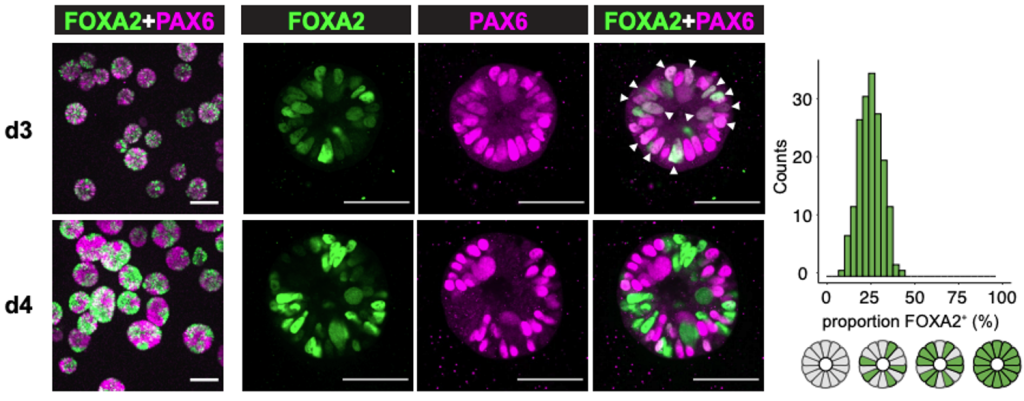
Neural tube organoids are remarkable in this sense: upon addition of a single inductive cue (retinoic acid), a single cell can proliferate and spontaneously break symmetry into two separate patterned populations, the floorplate precursors (FP) and early neural progenitors (eNP) (Meinhardt et al., 2014). The proportions of these two fates is remarkably conserved between different organoids, with FP cells composing around 25% of each organoid (Figure 1). This suggests that the proportional representation of the different cell types is somehow encoded in the system. In this preprint, the authors shed light on the underlying mechanisms of this symmetry breaking event and the subsequent establishment of robust cell type proportions.
Key findings
- Symmetry breaking occurs through a transient progenitor state co-expressing two antagonistic master regulators of the two cell fates
Through a combination of timecourse scRNA-seq and flow cytometry, the authors identified a cell state that sits at the “head” of the bifurcating fate trajectory and can also be identified in the developing mouse neural tube in vivo. This state is characterised by co-expression of Foxa2 and Pax6, markers usually associated with FP and eNP fates respectively. The authors validate the mutual antagonising effect of these two transcription factors for pushing the cells towards one or the other fate.
- Cell type proportions are dynamically allocated through population sensing
The authors observed that the cell fate choices of these “head” cells evolved over time: initially, they mostly contributed towards FPs, then they shifted towards eNPs. This suggests that cell fate allocation may be influenced by some kind of feedback, allowing the system to evolve towards a specific encoded cell type proportion.
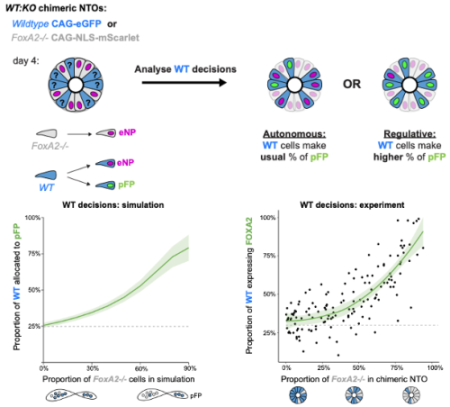
To test this idea, the authors generated chimeric organoids by mixing WT cells with Foxa2 knockout cells, which are incapable of generating FP cells (Figure 2). If the cell fate choice was purely genetically encoded as a probabilistic outcome, the WT cells would always produce the same proportion of cell fate outcomes regardless of the genetic composition of the organoid. Instead, WT cells compensated for increasing numbers of Foxa2 knockout cells by proportionally producing more Foxa2-positive FPs, demonstrating that there is population-level sensing. The authors termed this process ‘regulative feedback’.
- Identifying the signals regulating symmetry breaking and cell type proportion allocation
Interestingly, the final proportion of FPs and eNPs was largely insensitive to both the concentration and duration of the initial signalling cue, retinoic acid. This strengthens the notion that symmetry breaking and proportional cell fate allocation are intrinsically regulated. Consistently, inducing transient co-expression of Foxa2 and Pax6 was sufficient to bypass this inductive cue and initiate the self-organization program.
The authors propose BMP signalling as an important player in the regulative feedback, as shown by the increased proportions of FPs upon BMP inhibition. They suggest that emerging FPs activate BMP signalling, which biases the specification of “head” cells towards eNPs; thus, as FPs accumulate, they increasingly favour the other fate, creating a self-regulating mechanism that stabilises cell type proportions across organoids.
Why I chose this preprint
Symmetry breaking and self-organisation of specific cell type proportions are fascinating properties of developmental systems. To me, it is incredible that a single cell in a dish, given the right cue, can initiate such programs and give rise to reproducible patterns of cell types. What I found compelling in this preprint is the back-and-forth between modeling and experimental data – particularily how time-course experiments informed the dynamical model, and how genetic perturbations served to challenge it.
Their model, which they term ‘regulative feedback’, has the advantage of being dynamic and self-regulating, enabling self-organisation of reproducible cell type proportions in vitro, which is particularly important for organoid models to reach their full potential in disease modelling and drug screening. Previous studies had identified other factors able to break symmetry in organoids, such as mechanical sensing and stochastic signalling heterogeneity (Gjorevski et al., 2022; McNamara et al., 2024). The extent to which regulative feedback is implicated in other developmental systems remains to be explored.
Questions for the authors
- Would a regulative feedback mechanism be dosage-sensitive to BMP activation? If this is the case, is this surprising, given the robustness of the resulting cell type proportions?
- Do you think regulative feedback plays a role not only in initially allocating cell type proportions but also dynamically maintaining them despite cell proliferation?
- Could there be a spatial component to regulative feedback, potentially linked to your previous observations of BMP-mediated cell competition and cell sorting (Krammer et al., 2024)?
- If self-organizing regulative feedback also operates in vivo, how could it be coordinated with external positional cues to ensure consistent ventral positioning of the floorplate across the neural tube?
References
Gjorevski, N., Nikolaev, M., Brown, T.E., Mitrofanova, O., Brandenberg, N., DelRio, F.W., Yavitt, F.M., Liberali, P., Anseth, K.S., Lutolf, M.P., 2022. Tissue geometry drives deterministic organoid patterning. Science 375, eaaw9021.
Ishihara, K., Tanaka, E.M., 2018. Spontaneous symmetry breaking and pattern formation of organoids. Current Opinion in Systems Biology, Development and differentiation 11, 123–128.
Krammer, T., Stuart, H.T., Gromberg, E., Ishihara, K., Cislo, D., Melchionda, M., Perez, F.B., Wang, J., Costantini, E., Lehr, S., Arbanas, L., Hörmann, A., Neumüller, R.A., Elvassore, N., Siggia, E., Briscoe, J., Kicheva, A., Tanaka, E.M., 2024. Mouse neural tube organoids self-organize floorplate through BMP-mediated cluster competition. Developmental Cell 59, 1940-1953.e10.
McNamara, H.M., Solley, S.C., Adamson, B., Chan, M.M., Toettcher, J.E., 2024. Recording morphogen signals reveals mechanisms underlying gastruloid symmetry breaking. Nat Cell Biol 26, 1832–1844.
Meinhardt, A., Eberle, D., Tazaki, A., Ranga, A., Niesche, M., Wilsch-Bräuninger, M., Stec, A., Schackert, G., Lutolf, M., Tanaka, E.M., 2014. 3D reconstitution of the patterned neural tube from embryonic stem cells. Stem Cell Reports 3, 987–999.
Ramos, R., Swedlund, B., Ganesan, A.K., Morsut, L., Maini, P.K., Monuki, E.S., Lander, A.D., Chuong, C.-M., Plikus, M.V., 2024. Parsing patterns: Emerging roles of tissue self-organization in health and disease. Cell 187, 3165–3186.
Turing, A.M., 1952. The chemical basis of morphogenesis. Philosophical Transactions of the Royal Society of London. Series B, Biological Sciences 237, 37–72.
doi: https://doi.org/10.1242/prelights.44226
Read preprintSign up to customise the site to your preferences and to receive alerts
Register hereAlso in the developmental biology category:
Centrosome Loss Alters Axonal and Muscle Development
Jeny Jose

Fast single molecule localization microscopy in 3D
Kanishka Parashar

'Preprints by preLighters': A novel reaction-diffusion architecture for engineering self-organized patterns in mammalian cells
Reinier Prosee, Benjamin Swedlund

preLists in the developmental biology category:
‘In preprints’ from Development 2026
A list of the preprints featured in Development's 'In preprints' articles, as part of the new Preprint Editors initiative
| List by | Clarisse Brunet Avalos et al. |
Sainsbury Laboratory Symposium 2026
The Sainsbury Laboratory Symposium 2026, Shaping Life: Mechanisms of Morphogenesis, brought together researchers exploring the cellular, genetic and mechanical processes that shape plant form. This preList highlights preprints that were discussed or mentioned at the meeting. If you notice any missing preprints, please contact us at preLights@biologists.com
| List by | Ingrid Tsang |
Santa Cruz Developmental Biology Meeting 2026
This preList brings together a selection of preprints discussed at the Santa Cruz Developmental Biology Meeting 2026, held at UC Santa Cruz with the theme “Biomedicine, Biomechanics, and the Biosphere.” Reflecting the meeting’s broad scientific scope, from development and regeneration to evolution, tissue mechanics, and emerging technologies, this curated collection showcases work that contributed to conversations throughout the meeting.
| List by | Ingrid Tsang |
Developmental regulation: molecular and ecological niches
This conference was held at the Station Biologique de Roscoff (France) and brought together researchers exploring how diverse niche environments shape developmental processes across scales. Spanning topics from ecological and metabolic influences to signalling networks, mechanics and gene regulation, the meeting highlighted the interplay between intrinsic and extrinsic factors in controlling cell fate and tissue organisation. This preList gathers preprints discussed by speakers and poster presenters during the meeting. Please do get in touch at preLights@biologists.com if you notice any relevant preprints that we may have missed.
| List by | Ingrid Tsang |
preLighters’ choice – Handpicked DevBio preprints
preLighters with expertise across developmental and stem cell biology have nominated a few developmental biology (and related) preprints they’re excited about and explain in a few paragraph why. Concise preprint highlights, prepared by the preLighter community – a quick way to spot upcoming trends, new methods and fresh ideas.
| List by | Theodora Stougiannou et al. |
BSDB Spring Meeting: Molecules to Morphogenesis
The British Society for Developmental Biology (BSDB) Spring Meeting Molecules to Morphogenesis was held from 23–26 March 2026 at the University of Warwick (UK). This meeting brought together a vibrant community of researchers to discuss how molecular mechanisms are integrated across scales to drive morphogenesis, spanning diverse model systems and approaches. This preList contains preprints by presenters from the talk and poster sessions at the meeting. Please do get in touch at preLights@biologists.com if you notice any relevant preprints that we may have missed.
| List by | Ingrid Tsang |
Keystone Symposium on Stem Cell Models in Embryology 2026
The Keystone Symposium on Stem Cell Models in Embryology, 2026, was organised by Jun Wu (UT Southwestern), Jianping Fu (University of Michigan) and Miki Ebisuya (TU Dresden) and held at Asilomar Conference Grounds in California (US). The meeting discussed recent advances made in establishing stem-cell-based embryo models, what fundamental insights into developmental processes have been gleaned from them, as well as how they are beginning to be applied more widely. This prelist contains preprints by presenters at the talk and poster sessions at the conference, which our Reviews Editor in attendance spotted. Please do reach out to preLights@biologists.com if you notice any that we’ve missed.
| List by | Ingrid Tsang |
November in preprints – DevBio & Stem cell biology
preLighters with expertise across developmental and stem cell biology have nominated a few developmental and stem cell biology (and related) preprints posted in November they’re excited about and explain in a single paragraph why. Concise preprint highlights, prepared by the preLighter community – a quick way to spot upcoming trends, new methods and fresh ideas.
| List by | Aline Grata et al. |
October in preprints – DevBio & Stem cell biology
Each month, preLighters with expertise across developmental and stem cell biology nominate a few recent developmental and stem cell biology (and related) preprints they’re excited about and explain in a single paragraph why. Short, snappy picks from working scientists — a quick way to spot fresh ideas, bold methods and papers worth reading in full. These preprints can all be found in the October preprint list published on the Node.
| List by | Deevitha Balasubramanian et al. |
October in preprints – Cell biology edition
Different preLighters, with expertise across cell biology, have worked together to create this preprint reading list for researchers with an interest in cell biology. This month, most picks fall under (1) Cell organelles and organisation, followed by (2) Mechanosignaling and mechanotransduction, (3) Cell cycle and division and (4) Cell migration
| List by | Matthew Davies et al. |
June in preprints – the CellBio edition
A group of preLighters, with expertise in different areas of cell biology, have worked together to create this preprint reading lists for researchers with an interest in cell biology. This month, categories include: (1) Cell organelles and organisation (2) Cell signaling and mechanosensation (3) Genetics/gene expression (4) Biochemistry (5) Cytoskeleton
| List by | Barbora Knotkova et al. |
Keystone Symposium – Metabolic and Nutritional Control of Development and Cell Fate
This preList contains preprints discussed during the Metabolic and Nutritional Control of Development and Cell Fate Keystone Symposia. This conference was organized by Lydia Finley and Ralph J. DeBerardinis and held in the Wylie Center and Tupper Manor at Endicott College, Beverly, MA, United States from May 7th to 9th 2025. This meeting marked the first in-person gathering of leading researchers exploring how metabolism influences development, including processes like cell fate, tissue patterning, and organ function, through nutrient availability and metabolic regulation. By integrating modern metabolic tools with genetic and epidemiological insights across model organisms, this event highlighted key mechanisms and identified open questions to advance the emerging field of developmental metabolism.
| List by | Virginia Savy, Martin Estermann |
Biologists @ 100 conference preList
This preList aims to capture all preprints being discussed at the Biologists @100 conference in Liverpool, UK, either as part of the poster sessions or the (flash/short/full-length) talks.
| List by | Reinier Prosee, Jonathan Townson |
BSDB/GenSoc Spring Meeting 2024
A list of preprints highlighted at the British Society for Developmental Biology and Genetics Society joint Spring meeting 2024 at Warwick, UK.
| List by | Joyce Yu, Katherine Brown |
GfE/ DSDB meeting 2024
This preList highlights the preprints discussed at the 2024 joint German and Dutch developmental biology societies meeting that took place in March 2024 in Osnabrück, Germany.
| List by | Joyce Yu |
‘In preprints’ from Development 2022-2023
A list of the preprints featured in Development's 'In preprints' articles between 2022-2023
| List by | Alex Eve, Katherine Brown |
preLights peer support – preprints of interest
This is a preprint repository to organise the preprints and preLights covered through the 'preLights peer support' initiative.
| List by | preLights peer support |
The Society for Developmental Biology 82nd Annual Meeting
This preList is made up of the preprints discussed during the Society for Developmental Biology 82nd Annual Meeting that took place in Chicago in July 2023.
| List by | Joyce Yu, Katherine Brown |
CSHL 87th Symposium: Stem Cells
Preprints mentioned by speakers at the #CSHLsymp23
| List by | Alex Eve |
Journal of Cell Science meeting ‘Imaging Cell Dynamics’
This preList highlights the preprints discussed at the JCS meeting 'Imaging Cell Dynamics'. The meeting was held from 14 - 17 May 2023 in Lisbon, Portugal and was organised by Erika Holzbaur, Jennifer Lippincott-Schwartz, Rob Parton and Michael Way.
| List by | Helen Zenner |
9th International Symposium on the Biology of Vertebrate Sex Determination
This preList contains preprints discussed during the 9th International Symposium on the Biology of Vertebrate Sex Determination. This conference was held in Kona, Hawaii from April 17th to 21st 2023.
| List by | Martin Estermann |
Alumni picks – preLights 5th Birthday
This preList contains preprints that were picked and highlighted by preLights Alumni - an initiative that was set up to mark preLights 5th birthday. More entries will follow throughout February and March 2023.
| List by | Sergio Menchero et al. |
CellBio 2022 – An ASCB/EMBO Meeting
This preLists features preprints that were discussed and presented during the CellBio 2022 meeting in Washington, DC in December 2022.
| List by | Nadja Hümpfer et al. |
2nd Conference of the Visegrád Group Society for Developmental Biology
Preprints from the 2nd Conference of the Visegrád Group Society for Developmental Biology (2-5 September, 2021, Szeged, Hungary)
| List by | Nándor Lipták |
Fibroblasts
The advances in fibroblast biology preList explores the recent discoveries and preprints of the fibroblast world. Get ready to immerse yourself with this list created for fibroblasts aficionados and lovers, and beyond. Here, my goal is to include preprints of fibroblast biology, heterogeneity, fate, extracellular matrix, behavior, topography, single-cell atlases, spatial transcriptomics, and their matrix!
| List by | Osvaldo Contreras |
EMBL Synthetic Morphogenesis: From Gene Circuits to Tissue Architecture (2021)
A list of preprints mentioned at the #EESmorphoG virtual meeting in 2021.
| List by | Alex Eve |
EMBL Conference: From functional genomics to systems biology
Preprints presented at the virtual EMBL conference "from functional genomics and systems biology", 16-19 November 2020
| List by | Jesus Victorino |
Single Cell Biology 2020
A list of preprints mentioned at the Wellcome Genome Campus Single Cell Biology 2020 meeting.
| List by | Alex Eve |
Society for Developmental Biology 79th Annual Meeting
Preprints at SDB 2020
| List by | Irepan Salvador-Martinez, Martin Estermann |
FENS 2020
A collection of preprints presented during the virtual meeting of the Federation of European Neuroscience Societies (FENS) in 2020
| List by | Ana Dorrego-Rivas |
Planar Cell Polarity – PCP
This preList contains preprints about the latest findings on Planar Cell Polarity (PCP) in various model organisms at the molecular, cellular and tissue levels.
| List by | Ana Dorrego-Rivas |
Cell Polarity
Recent research from the field of cell polarity is summarized in this list of preprints. It comprises of studies focusing on various forms of cell polarity ranging from epithelial polarity, planar cell polarity to front-to-rear polarity.
| List by | Yamini Ravichandran |
TAGC 2020
Preprints recently presented at the virtual Allied Genetics Conference, April 22-26, 2020. #TAGC20
| List by | Maiko Kitaoka et al. |
3D Gastruloids
A curated list of preprints related to Gastruloids (in vitro models of early development obtained by 3D aggregation of embryonic cells). Updated until July 2021.
| List by | Paul Gerald L. Sanchez and Stefano Vianello |
ASCB EMBO Annual Meeting 2019
A collection of preprints presented at the 2019 ASCB EMBO Meeting in Washington, DC (December 7-11)
| List by | Madhuja Samaddar et al. |
EDBC Alicante 2019
Preprints presented at the European Developmental Biology Congress (EDBC) in Alicante, October 23-26 2019.
| List by | Sergio Menchero et al. |
EMBL Seeing is Believing – Imaging the Molecular Processes of Life
Preprints discussed at the 2019 edition of Seeing is Believing, at EMBL Heidelberg from the 9th-12th October 2019
| List by | Dey Lab |
SDB 78th Annual Meeting 2019
A curation of the preprints presented at the SDB meeting in Boston, July 26-30 2019. The preList will be updated throughout the duration of the meeting.
| List by | Alex Eve |
Lung Disease and Regeneration
This preprint list compiles highlights from the field of lung biology.
| List by | Rob Hynds |
Young Embryologist Network Conference 2019
Preprints presented at the Young Embryologist Network 2019 conference, 13 May, The Francis Crick Institute, London
| List by | Alex Eve |
Pattern formation during development
The aim of this preList is to integrate results about the mechanisms that govern patterning during development, from genes implicated in the processes to theoritical models of pattern formation in nature.
| List by | Alexa Sadier |
BSCB/BSDB Annual Meeting 2019
Preprints presented at the BSCB/BSDB Annual Meeting 2019
| List by | Dey Lab |
Zebrafish immunology
A compilation of cutting-edge research that uses the zebrafish as a model system to elucidate novel immunological mechanisms in health and disease.
| List by | Shikha Nayar |