







Evolutionary landscapes of zygotic genome activation across animals
Posted on: 26 May 2026
Preprint posted on 17 April 2026
61 species, 13 phyla, one simple geometric rule that appears to set when every embryo starts speaking through its own genome.
Selected by Panagiotis Giannios
Categories: developmental biology, evolutionary biology
Why I highlight this work
Zygotic genome activation (ZGA) is one of the earliest fate-defining events in animal development: the moment when an embryo stops running on maternal supplies and starts using its own genome. Once the embryonic genome is on, gastrulation, patterning and organogenesis can begin, making ZGA the upstream gate of the entire developmental program. However, most of what we know about it comes from a handful of model organisms, and the timing in those species differs so much (one cleavage in mouse, fourteen in Drosophila) that it has been hard to tell which features generalise.
What I liked about this preprint is that it reframes ZGA from a species-specific puzzle into a problem in evolutionary developmental logic. Instead of asking how ZGA works in species X, the authors ask what every animal embryo has to solve at the start of development, and whether there is a common rule underneath. Their answer is unusually clean.
Background
After fertilisation, embryos are governed by maternally deposited mRNAs and proteins. At some point, different in every species, the embryo takes over. Classical work on zebrafish, Xenopus and Drosophila proposed that this happens when the nuclear-to-cytoplasmic (N/C) ratio passes a threshold, titrating out a maternal repressor (reviewed in Kojima, Hoppe & Giraldez, Nat Rev Genet 2025). Whether this idea also holds for mammals, nematodes, cnidarians or ctenophores has remained an open question.
Key findings
The authors built a transcriptomic atlas of early embryogenesis across 61 species spanning 13 phyla, and inferred ZGA timing using three complementary signals: a transcriptome-wide PCA shift, the appearance of strongly upregulated genes, and an increase in intron/exon read ratios as a proxy for nascent transcription. ZGA timing varied from 1 to 14 cell cycles, with strong phylogenetic signal (Pagel’s λ = 0.99). The headline result is that a simple proxy for the egg N/C ratio: log10(genome size / egg volume), predicts the cell cycle of ZGA onset with adjusted R² = 0.75. The authors propose a predictive equation, and the relationship is robust to every dataset split tested. Even when Arabidopsis and maize are added, the same line still fits.
The other surprise is at the gene level. ZGA genes share consistent properties across animals. They are short, intron-poor, phylogenetically young, and enriched for chromatin and RNA-processing functions, still their identities are almost entirely lineage-specific. Of all the orthogroups examined, only one is consistently activated at ZGA across every animal group: the FET family (FUS, EWSR1, TAF15), RNA-binding proteins involved in co-transcriptional RNA processing. Taken together: a deeply conserved physical timer drives a strikingly flexible molecular program. The same problem is being solved over and over with a different gene toolset.

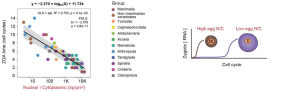
Geometry sets the schedule: a stoichiometric principle for ZGA timing – A conserved quantitative logic for the start of embryonic transcription: (Left) Across animal species, the timing of zygotic genome activation correlates strongly with an egg nuclear-to-cytoplasmic proxy, defined as genome size divided by egg volume. Species with relatively more nuclear material per unit cytoplasm activate their genome earlier, while species with lower initial values activate later. (Right) The schematic illustrates how successive cleavage cycles progressively increase nuclear DNA content relative to a fixed volume of cytoplasm until a physical threshold for large-scale zygotic transcription is reached. Together, these panels support the idea that embryos with vastly different developmental programmes may nevertheless use a shared stoichiometric principle to time the transition from maternal control to zygotic autonomy.
Figure credit: Adapted from Campo-Bes, Mantica et al. (2026), Evolutionary landscapes of zygotic genome activation across animals, bioRxiv, CC BY 4.0. Selected panels (g,j) from Figure 3 were cropped and combined for clarity.
What this could mean
For me, the most interesting implication is that ZGA looks less like a conserved gene program and more like a regulatory window opened on schedule by physical accounting; a window that newly evolved, lineage-specific genes can colonise. That helps explain something that has been puzzling for a long time: how can a process so universal involve genes that overlap so little between species? If the timing is set by geometry, the cast of characters is free to change.
References
Kojima ML, Hoppe C, Giraldez AJ. The maternal-to-zygotic transition: reprogramming of the cytoplasm and nucleus. Nat Rev Genet. 2025 Apr;26(4):245-267. doi: 10.1038/s41576-024-00792-0. Epub 2024 Nov 25. PMID: 39587307; PMCID: PMC11928286.
Israel Campo-Bes, Federica Mantica, Jon Permanyer, Cristina Rodríguez-Marin, Kero Guynes, Tòt Senar-Serra, Gonzalo Quiroga-Artigas, Yan Liang, Allan M. Carrillo-Baltodano, Josefa Cruz, Rossella Annunziata, Sandra Chevalier, Marta Iglesias, Fumiaki Sugahara, Yi-Jyun Luo, Anna Schoenauer, Jorge Corbacho, Periklis Paganos, Filomena Caccavale, Rosa Maria Sepe, Luis P. Iñiguez, Mette Handberg-Thorsager, Christina Zakas, Ralf J. Sommer, Maria Ina Arnone, Alistair P. McGregor, Juan R. Martínez-Morales, Noriyuki Satoh, Hector Escriva, Stéphanie Bertrand, Arnau Sebé-Pedrós, Enrico D’Aniello, Juan Pascual-Anaya, Evelyn Houliston, Xavier Franch-Marro, David Martín, Ildiko M.L. Somorjai, Isabel Almudi, José M Martín-Durán, Yi-Hsien Su, Alejandro Burga, Salvatore D’Aniello, Manuel Irimia. Evolutionary landscapes of zygotic genome activation across animals.
bioRxiv 2026.04.16.718233; doi: https://doi.org/10.64898/2026.04.16.718233
Questions for the authors:
- The N/C-ratio proxy beautifully explains ZGA timing across animals, but the molecular mechanism reading this physical timer remains an open question. Given your findings, do you suspect a conserved class of factors (such as histones) is being titrated across all species, or is it more likely that convergent evolution has led different lineages to use entirely different molecular effectors to read the same physical principle?
- The FET family being the orthogroup consistently activated at ZGA across all examined clades is a striking result. Do you view these RNA-binding proteins as a minimal, ancestral “ZGA toolkit“? Furthermore, what specific mechanistic role do you hypothesize they play during this massive transcriptional awakening?
- Your proxy metric relies on total egg volume, which in yolk-rich embryos is likely to overestimate the actual transcriptionally active cytoplasm. Do you have a sense of how much of the residual variance in your model (the remaining 25%) might be absorbed if we could accurately measure and substitute an “active cytoplasm” estimate for those specific clades?
doi: https://doi.org/10.1242/prelights.43490
Read preprintSign up to customise the site to your preferences and to receive alerts
Register hereAlso in the developmental biology category:
E-cadherin clustering as a regulator of morphogenesis
Girish Kale, preLights peer support

Programmable pathway profiles reveal signaling principles of TGF-β superfamily receptors
Benjamin Swedlund, Charli Lu

Reciprocal mechanochemical feedback couples neural crest migration and neurulation
Béryl Laplace-Builhé

Also in the evolutionary biology category:
Modes of natural selection on maternal and zygotic gene expression in Drosophila melanogaster embryos
Girish Kale, preLights peer support

Microtubules sustain the fidelity of cellularization in a coenocytic relative of animals
Girish Kale, preLights peer support
Diversity and Spatial Segregation of TRP Channels in Choanoflagellates Provide Insight into the Evolutionary Origin of Animal Sensory Systems
Urvashi Goswami
preLists in the developmental biology category:
Santa Cruz Developmental Biology Meeting 2026
This preList brings together a selection of preprints discussed at the Santa Cruz Developmental Biology Meeting 2026, held at UC Santa Cruz with the theme “Biomedicine, Biomechanics, and the Biosphere.” Reflecting the meeting’s broad scientific scope, from development and regeneration to evolution, tissue mechanics, and emerging technologies, this curated collection showcases work that contributed to conversations throughout the meeting.
| List by | Ingrid Tsang |
Developmental regulation: molecular and ecological niches
This conference was held at the Station Biologique de Roscoff (France) and brought together researchers exploring how diverse niche environments shape developmental processes across scales. Spanning topics from ecological and metabolic influences to signalling networks, mechanics and gene regulation, the meeting highlighted the interplay between intrinsic and extrinsic factors in controlling cell fate and tissue organisation. This preList gathers preprints discussed by speakers and poster presenters during the meeting. Please do get in touch at preLights@biologists.com if you notice any relevant preprints that we may have missed.
| List by | Ingrid Tsang |
preLighters’ choice – Handpicked DevBio preprints
preLighters with expertise across developmental and stem cell biology have nominated a few developmental biology (and related) preprints they’re excited about and explain in a few paragraph why. Concise preprint highlights, prepared by the preLighter community – a quick way to spot upcoming trends, new methods and fresh ideas.
| List by | Theodora Stougiannou et al. |
BSDB Spring Meeting: Molecules to Morphogenesis
The British Society for Developmental Biology (BSDB) Spring Meeting Molecules to Morphogenesis was held from 23–26 March 2026 at the University of Warwick (UK). This meeting brought together a vibrant community of researchers to discuss how molecular mechanisms are integrated across scales to drive morphogenesis, spanning diverse model systems and approaches. This preList contains preprints by presenters from the talk and poster sessions at the meeting. Please do get in touch at preLights@biologists.com if you notice any relevant preprints that we may have missed.
| List by | Ingrid Tsang |
Keystone Symposium on Stem Cell Models in Embryology 2026
The Keystone Symposium on Stem Cell Models in Embryology, 2026, was organised by Jun Wu (UT Southwestern), Jianping Fu (University of Michigan) and Miki Ebisuya (TU Dresden) and held at Asilomar Conference Grounds in California (US). The meeting discussed recent advances made in establishing stem-cell-based embryo models, what fundamental insights into developmental processes have been gleaned from them, as well as how they are beginning to be applied more widely. This prelist contains preprints by presenters at the talk and poster sessions at the conference, which our Reviews Editor in attendance spotted. Please do reach out to preLights@biologists.com if you notice any that we’ve missed.
| List by | Ingrid Tsang |
November in preprints – DevBio & Stem cell biology
preLighters with expertise across developmental and stem cell biology have nominated a few developmental and stem cell biology (and related) preprints posted in November they’re excited about and explain in a single paragraph why. Concise preprint highlights, prepared by the preLighter community – a quick way to spot upcoming trends, new methods and fresh ideas.
| List by | Aline Grata et al. |
October in preprints – DevBio & Stem cell biology
Each month, preLighters with expertise across developmental and stem cell biology nominate a few recent developmental and stem cell biology (and related) preprints they’re excited about and explain in a single paragraph why. Short, snappy picks from working scientists — a quick way to spot fresh ideas, bold methods and papers worth reading in full. These preprints can all be found in the October preprint list published on the Node.
| List by | Deevitha Balasubramanian et al. |
October in preprints – Cell biology edition
Different preLighters, with expertise across cell biology, have worked together to create this preprint reading list for researchers with an interest in cell biology. This month, most picks fall under (1) Cell organelles and organisation, followed by (2) Mechanosignaling and mechanotransduction, (3) Cell cycle and division and (4) Cell migration
| List by | Matthew Davies et al. |
June in preprints – the CellBio edition
A group of preLighters, with expertise in different areas of cell biology, have worked together to create this preprint reading lists for researchers with an interest in cell biology. This month, categories include: (1) Cell organelles and organisation (2) Cell signaling and mechanosensation (3) Genetics/gene expression (4) Biochemistry (5) Cytoskeleton
| List by | Barbora Knotkova et al. |
Keystone Symposium – Metabolic and Nutritional Control of Development and Cell Fate
This preList contains preprints discussed during the Metabolic and Nutritional Control of Development and Cell Fate Keystone Symposia. This conference was organized by Lydia Finley and Ralph J. DeBerardinis and held in the Wylie Center and Tupper Manor at Endicott College, Beverly, MA, United States from May 7th to 9th 2025. This meeting marked the first in-person gathering of leading researchers exploring how metabolism influences development, including processes like cell fate, tissue patterning, and organ function, through nutrient availability and metabolic regulation. By integrating modern metabolic tools with genetic and epidemiological insights across model organisms, this event highlighted key mechanisms and identified open questions to advance the emerging field of developmental metabolism.
| List by | Virginia Savy, Martin Estermann |
Biologists @ 100 conference preList
This preList aims to capture all preprints being discussed at the Biologists @100 conference in Liverpool, UK, either as part of the poster sessions or the (flash/short/full-length) talks.
| List by | Reinier Prosee, Jonathan Townson |
BSDB/GenSoc Spring Meeting 2024
A list of preprints highlighted at the British Society for Developmental Biology and Genetics Society joint Spring meeting 2024 at Warwick, UK.
| List by | Joyce Yu, Katherine Brown |
GfE/ DSDB meeting 2024
This preList highlights the preprints discussed at the 2024 joint German and Dutch developmental biology societies meeting that took place in March 2024 in Osnabrück, Germany.
| List by | Joyce Yu |
‘In preprints’ from Development 2022-2023
A list of the preprints featured in Development's 'In preprints' articles between 2022-2023
| List by | Alex Eve, Katherine Brown |
preLights peer support – preprints of interest
This is a preprint repository to organise the preprints and preLights covered through the 'preLights peer support' initiative.
| List by | preLights peer support |
The Society for Developmental Biology 82nd Annual Meeting
This preList is made up of the preprints discussed during the Society for Developmental Biology 82nd Annual Meeting that took place in Chicago in July 2023.
| List by | Joyce Yu, Katherine Brown |
CSHL 87th Symposium: Stem Cells
Preprints mentioned by speakers at the #CSHLsymp23
| List by | Alex Eve |
Journal of Cell Science meeting ‘Imaging Cell Dynamics’
This preList highlights the preprints discussed at the JCS meeting 'Imaging Cell Dynamics'. The meeting was held from 14 - 17 May 2023 in Lisbon, Portugal and was organised by Erika Holzbaur, Jennifer Lippincott-Schwartz, Rob Parton and Michael Way.
| List by | Helen Zenner |
9th International Symposium on the Biology of Vertebrate Sex Determination
This preList contains preprints discussed during the 9th International Symposium on the Biology of Vertebrate Sex Determination. This conference was held in Kona, Hawaii from April 17th to 21st 2023.
| List by | Martin Estermann |
Alumni picks – preLights 5th Birthday
This preList contains preprints that were picked and highlighted by preLights Alumni - an initiative that was set up to mark preLights 5th birthday. More entries will follow throughout February and March 2023.
| List by | Sergio Menchero et al. |
CellBio 2022 – An ASCB/EMBO Meeting
This preLists features preprints that were discussed and presented during the CellBio 2022 meeting in Washington, DC in December 2022.
| List by | Nadja Hümpfer et al. |
2nd Conference of the Visegrád Group Society for Developmental Biology
Preprints from the 2nd Conference of the Visegrád Group Society for Developmental Biology (2-5 September, 2021, Szeged, Hungary)
| List by | Nándor Lipták |
Fibroblasts
The advances in fibroblast biology preList explores the recent discoveries and preprints of the fibroblast world. Get ready to immerse yourself with this list created for fibroblasts aficionados and lovers, and beyond. Here, my goal is to include preprints of fibroblast biology, heterogeneity, fate, extracellular matrix, behavior, topography, single-cell atlases, spatial transcriptomics, and their matrix!
| List by | Osvaldo Contreras |
EMBL Synthetic Morphogenesis: From Gene Circuits to Tissue Architecture (2021)
A list of preprints mentioned at the #EESmorphoG virtual meeting in 2021.
| List by | Alex Eve |
EMBL Conference: From functional genomics to systems biology
Preprints presented at the virtual EMBL conference "from functional genomics and systems biology", 16-19 November 2020
| List by | Jesus Victorino |
Single Cell Biology 2020
A list of preprints mentioned at the Wellcome Genome Campus Single Cell Biology 2020 meeting.
| List by | Alex Eve |
Society for Developmental Biology 79th Annual Meeting
Preprints at SDB 2020
| List by | Irepan Salvador-Martinez, Martin Estermann |
FENS 2020
A collection of preprints presented during the virtual meeting of the Federation of European Neuroscience Societies (FENS) in 2020
| List by | Ana Dorrego-Rivas |
Planar Cell Polarity – PCP
This preList contains preprints about the latest findings on Planar Cell Polarity (PCP) in various model organisms at the molecular, cellular and tissue levels.
| List by | Ana Dorrego-Rivas |
Cell Polarity
Recent research from the field of cell polarity is summarized in this list of preprints. It comprises of studies focusing on various forms of cell polarity ranging from epithelial polarity, planar cell polarity to front-to-rear polarity.
| List by | Yamini Ravichandran |
TAGC 2020
Preprints recently presented at the virtual Allied Genetics Conference, April 22-26, 2020. #TAGC20
| List by | Maiko Kitaoka et al. |
3D Gastruloids
A curated list of preprints related to Gastruloids (in vitro models of early development obtained by 3D aggregation of embryonic cells). Updated until July 2021.
| List by | Paul Gerald L. Sanchez and Stefano Vianello |
ASCB EMBO Annual Meeting 2019
A collection of preprints presented at the 2019 ASCB EMBO Meeting in Washington, DC (December 7-11)
| List by | Madhuja Samaddar et al. |
EDBC Alicante 2019
Preprints presented at the European Developmental Biology Congress (EDBC) in Alicante, October 23-26 2019.
| List by | Sergio Menchero et al. |
EMBL Seeing is Believing – Imaging the Molecular Processes of Life
Preprints discussed at the 2019 edition of Seeing is Believing, at EMBL Heidelberg from the 9th-12th October 2019
| List by | Dey Lab |
SDB 78th Annual Meeting 2019
A curation of the preprints presented at the SDB meeting in Boston, July 26-30 2019. The preList will be updated throughout the duration of the meeting.
| List by | Alex Eve |
Lung Disease and Regeneration
This preprint list compiles highlights from the field of lung biology.
| List by | Rob Hynds |
Young Embryologist Network Conference 2019
Preprints presented at the Young Embryologist Network 2019 conference, 13 May, The Francis Crick Institute, London
| List by | Alex Eve |
Pattern formation during development
The aim of this preList is to integrate results about the mechanisms that govern patterning during development, from genes implicated in the processes to theoritical models of pattern formation in nature.
| List by | Alexa Sadier |
BSCB/BSDB Annual Meeting 2019
Preprints presented at the BSCB/BSDB Annual Meeting 2019
| List by | Dey Lab |
Zebrafish immunology
A compilation of cutting-edge research that uses the zebrafish as a model system to elucidate novel immunological mechanisms in health and disease.
| List by | Shikha Nayar |
Also in the evolutionary biology category:
Santa Cruz Developmental Biology Meeting 2026
This preList brings together a selection of preprints discussed at the Santa Cruz Developmental Biology Meeting 2026, held at UC Santa Cruz with the theme “Biomedicine, Biomechanics, and the Biosphere.” Reflecting the meeting’s broad scientific scope, from development and regeneration to evolution, tissue mechanics, and emerging technologies, this curated collection showcases work that contributed to conversations throughout the meeting.
| List by | Ingrid Tsang |
SciELO preprints – From 2025 onwards
SciELO has become a cornerstone of open, multilingual scholarly communication across Latin America. Its preprint server, SciELO preprints, is expanding the global reach of preprinted research from the region (for more information, see our interview with Carolina Tanigushi). This preList brings together biological, English language SciELO preprints to help readers discover emerging work from the Global South. By highlighting these preprints in one place, we aim to support visibility, encourage early feedback, and showcase the vibrant research communities contributing to SciELO’s open science ecosystem.
| List by | Carolina Tanigushi |
November in preprints – DevBio & Stem cell biology
preLighters with expertise across developmental and stem cell biology have nominated a few developmental and stem cell biology (and related) preprints posted in November they’re excited about and explain in a single paragraph why. Concise preprint highlights, prepared by the preLighter community – a quick way to spot upcoming trends, new methods and fresh ideas.
| List by | Aline Grata et al. |
October in preprints – DevBio & Stem cell biology
Each month, preLighters with expertise across developmental and stem cell biology nominate a few recent developmental and stem cell biology (and related) preprints they’re excited about and explain in a single paragraph why. Short, snappy picks from working scientists — a quick way to spot fresh ideas, bold methods and papers worth reading in full. These preprints can all be found in the October preprint list published on the Node.
| List by | Deevitha Balasubramanian et al. |
October in preprints – Cell biology edition
Different preLighters, with expertise across cell biology, have worked together to create this preprint reading list for researchers with an interest in cell biology. This month, most picks fall under (1) Cell organelles and organisation, followed by (2) Mechanosignaling and mechanotransduction, (3) Cell cycle and division and (4) Cell migration
| List by | Matthew Davies et al. |
Biologists @ 100 conference preList
This preList aims to capture all preprints being discussed at the Biologists @100 conference in Liverpool, UK, either as part of the poster sessions or the (flash/short/full-length) talks.
| List by | Reinier Prosee, Jonathan Townson |
‘In preprints’ from Development 2022-2023
A list of the preprints featured in Development's 'In preprints' articles between 2022-2023
| List by | Alex Eve, Katherine Brown |
preLights peer support – preprints of interest
This is a preprint repository to organise the preprints and preLights covered through the 'preLights peer support' initiative.
| List by | preLights peer support |
EMBO | EMBL Symposium: The organism and its environment
This preList contains preprints discussed during the 'EMBO | EMBL Symposium: The organism and its environment', organised at EMBL Heidelberg, Germany (May 2023).
| List by | Girish Kale |
9th International Symposium on the Biology of Vertebrate Sex Determination
This preList contains preprints discussed during the 9th International Symposium on the Biology of Vertebrate Sex Determination. This conference was held in Kona, Hawaii from April 17th to 21st 2023.
| List by | Martin Estermann |
EMBL Synthetic Morphogenesis: From Gene Circuits to Tissue Architecture (2021)
A list of preprints mentioned at the #EESmorphoG virtual meeting in 2021.
| List by | Alex Eve |
Planar Cell Polarity – PCP
This preList contains preprints about the latest findings on Planar Cell Polarity (PCP) in various model organisms at the molecular, cellular and tissue levels.
| List by | Ana Dorrego-Rivas |
TAGC 2020
Preprints recently presented at the virtual Allied Genetics Conference, April 22-26, 2020. #TAGC20
| List by | Maiko Kitaoka et al. |
ECFG15 – Fungal biology
Preprints presented at 15th European Conference on Fungal Genetics 17-20 February 2020 Rome
| List by | Hiral Shah |
COVID-19 / SARS-CoV-2 preprints
List of important preprints dealing with the ongoing coronavirus outbreak. See http://covidpreprints.com for additional resources and timeline, and https://connect.biorxiv.org/relate/content/181 for full list of bioRxiv and medRxiv preprints on this topic
| List by | Dey Lab, Zhang-He Goh |
1
SDB 78th Annual Meeting 2019
A curation of the preprints presented at the SDB meeting in Boston, July 26-30 2019. The preList will be updated throughout the duration of the meeting.
| List by | Alex Eve |
Pattern formation during development
The aim of this preList is to integrate results about the mechanisms that govern patterning during development, from genes implicated in the processes to theoritical models of pattern formation in nature.
| List by | Alexa Sadier |