






Experimental evolution of cellular miniaturization reveals a putative mechanism for cell size evolution
Posted on: 5 May 2026 , updated on: 7 May 2026
Preprint posted on 9 April 2026

Categories: cell biology
The cost of scaling (may not be that high)
Ask your entrepreneurial friends: scaling up or downsizing while maintaining smooth operations is tricky business. Cells face a similar challenge – grow too big and you risk a diluted cytoplasm and, eventually, senescence. Being too small is associated with impaired biosynthetic processes, which is no better. While cells are generally pretty good at maintaining their characteristic size, if we were to take a step back and look at the array of cell sizes across the tree of life, then the question comes up: How did evolution give rise to cell sizes spanning many an order of magnitude (think 0.2 μm in the small prokaryotes to the whooping 15 cm of the ostrich egg), when changes in cell size are met with detrimental consequences?
Garoña and colleagues came up with a clever approach to address this in the preprint highlighted here. They set up a regimen for experimental evolution of smaller budding yeast S. cerevisiae and explored the accompanying adaptations that enabled the size change. The process involved selecting for smaller cells (FAC-sorting them based on their forward scatter) and then letting the sorted cells grow to favour small cells that maintained a high proliferation potential. By iterating this process for 1,500 generations they eventually obtained cells with a four-fold reduced volume compared to the ancestor, the so-called S cells (preprint Figure 1A). This new size did not majorly affect fitness and was robust, reflecting a newly established cell-size homeostasis. But the question remains: how do these newly tiny cells make it? Through a description of physiological adaptations and by probing the molecular mechanisms behind them, this work reveals the unexpected plasticity of cell size and hints at how this may have been established during evolution.
Growing small
How cells regulate their size remains an open and fascinating question. Our general understanding is that this happens before DNA synthesis, where a cell will commit to division after having reached a critical volume, or after having added a predetermined volume to the one it had at birth.
The authors of this preprint find an impressive adaptation in cell cycle dynamics occurring along their experimental evolution regimen. The final S cells spend markedly less time in G1, where cell growth primarily occurs, without majorly affecting total cell cycle time. The authors also observed adaptations in intracellular organisation, with organelles becoming smaller (albeit not proportionally), and in the utilisation of energy resources, which is also a key determinant of cell growth.
Specifically, the authors suggest that nutrient utilisation in S cells resembles the response to poor nutrient availability, irrespective of the energy source, thus uncoupling nutrient sensing from cell size control. Indeed, small cell size was not associated with slower growth or reduced biosynthetic activity. Compared to cells bearing a mutation in the TOR pathway, which is critical for cell size control, S cells showed a relative fitness (a measure of reproductive success) 7.9% lower than the control (Figure 1B), a modest decrease compared to TOR mutants at 24% lower fitness, despite having decreased their volume only by 2.5 fold.
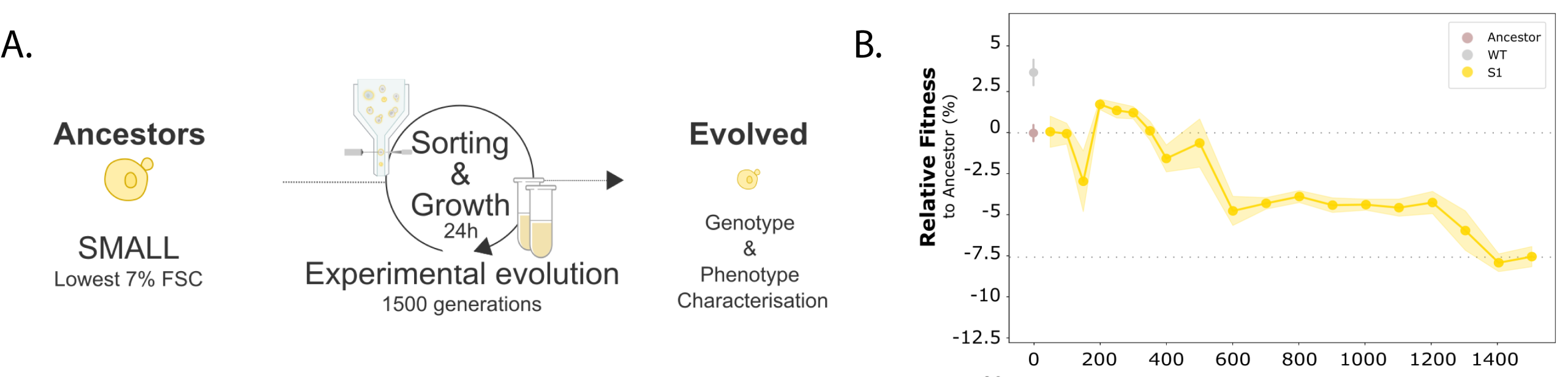
Figure 1: Experimental evolution of cellular miniaturisation and the effect of size decrease on fitness.
A. Selection regimen to obtain small cells with a four-fold volume increase via FAC-sorting of the smallest cell fraction followed by culture in a rich medium, iterated for 1500 generations. B. Relative fitness decreased by a modest 7% in small cells (compared to ~24% in TOR mutants). Fitness initially dropped sharply before recovering and eventually stabilising, reflected also in sustained biosynthetic activity.
Going through changes
The authors then turned to exploring the mechanisms behind smaller cell size. In the absence of selection, S cells did not revert back to their ancestral size. Even more, S cells returned to their newly characteristic size after transient perturbations, indicating a newly evolved homeostatic state that was actively controlled.
Having excluded a diffusible or secreted factor and/or changes in ploidy as causative factors, the next step was to explore a genetic basis for the observed change in size and associated adaptations. Whole genome sequencing across distinct time points in the evolutionary process revealed that, as expected, it’s complicated.
The next challenge was to disentangle the causative mutations from the ones representing compensatory adaptations to the smaller size. The authors focused on two attractive candidates, CLN3, encoding a G1 cyclin, and SCH9, encoding a TOR pathway effector.
In the case of CLN3, the observed mutations conferred a gain of function, stabilising the protein via C-terminal truncations. This stable, overactive Cln3, has previously been associated with smaller cell size, through shortening of the G1 phase. The case of SCH9, which accumulated loss-of-function mutations, was a bit more puzzling as its well-known role in controlling ribosome biosynthesis was not supported by the sustained biosynthetic activity of S cells. This suggested an alternative function of the identified Sch9 allele in the control of cell size and to explore this, the authors turned to the Sch9 effect on the pathway that controls cell cycle progression in yeast, the Greatwall kinase pathway. Sch9 is known to inhibit the Greatwall kinase Rim15, an inhibition that is proposed to be relieved in the SCH9 mutant S cells. This, along with further gain-of-function mutations identified along the Greatwall pathway, suggests that Rim15 derepression leads to size decrease. Indeed, using an inducible system to tune RIM15 expression, the authors revealed a dosage-dependent effect on cell size decrease, where an overexpressed RIM15 leads to smaller size. This effect was even more pronounced when RIM15 overexpression occurred in an SCH9/CLN3 mutant background, hinting at the synergistic effect of these genetic changes.
The authors thus propose a mechanism where cell size reduction is mediated by a hyperactive G1 cyclin and increased Greatwall pathway activity. How exactly this is facilitated merits further exploration, but Garoña and colleagues speculate that the combination of these two events leads to a fast phosphorylation of Whi5, thus quickly driving it outside the nucleus (preprint Figure 2). Interestingly, they also show a further size decrease when SWE1 was deleted in evolved clones, revealing that the limits of cell size may have not yet been reached in the duration of this regimen. Onwards and downwards!
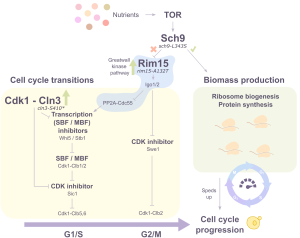
Figure 2: Proposed model of the cell cycle adaptations facilitating decreased cell size while maintaining fitness. An increase of Cln3 activity, combined with increased Rim15 activity (via Sch9 derepression) allows for faster progression through G1/S and G2/M, allowing for smaller cell size without an effect on biomass production.
Small cell, big world
Overall, Garoña and colleagues show striking adaptations in cell cycle dynamics and its control by nutrients that can lead to an impressive decrease in cell size without compromising on growth and fitness. While it remains to be uncovered whether these adaptations may serve as more generalisable principles for cell size change across evolution, the powerful system set up here pushes the limits of minimal cell size and of cell cycle rewiring. Furthermore, given the complex genetic changes observed, there is potentially more to learn from how these little cells navigate the great big world, both in terms of the facilitating mechanisms and the accompanying remodelling.
doi: https://doi.org/10.1242/prelights.43394
Read preprintSign up to customise the site to your preferences and to receive alerts
Register hereAlso in the cell biology category:
Microglia extract neuronal proteolytic organelles via skoupocytosis
Chandrika Rao

MechanoMaST – a multimodal pipeline for spatially registering mechanical and transcriptomic tissue data
AND
Paired-surface spatial mechanomics links tissue stiffness maps to spatial transcriptomics
Felipe Del Valle Batalla
E-cadherin clustering as a regulator of morphogenesis
Girish Kale, preLights peer support
preLists in the cell biology category:
‘In preprints’ from Development 2026
A list of the preprints featured in Development's 'In preprints' articles, as part of the new Preprint Editors initiative
| List by | Clarisse Brunet Avalos et al. |
Sainsbury Laboratory Symposium 2026
The Sainsbury Laboratory Symposium 2026, Shaping Life: Mechanisms of Morphogenesis, brought together researchers exploring the cellular, genetic and mechanical processes that shape plant form. This preList highlights preprints that were discussed or mentioned at the meeting. If you notice any missing preprints, please contact us at preLights@biologists.com
| List by | Ingrid Tsang |
Santa Cruz Developmental Biology Meeting 2026
This preList brings together a selection of preprints discussed at the Santa Cruz Developmental Biology Meeting 2026, held at UC Santa Cruz with the theme “Biomedicine, Biomechanics, and the Biosphere.” Reflecting the meeting’s broad scientific scope, from development and regeneration to evolution, tissue mechanics, and emerging technologies, this curated collection showcases work that contributed to conversations throughout the meeting.
| List by | Ingrid Tsang |
Developmental regulation: molecular and ecological niches
This conference was held at the Station Biologique de Roscoff (France) and brought together researchers exploring how diverse niche environments shape developmental processes across scales. Spanning topics from ecological and metabolic influences to signalling networks, mechanics and gene regulation, the meeting highlighted the interplay between intrinsic and extrinsic factors in controlling cell fate and tissue organisation. This preList gathers preprints discussed by speakers and poster presenters during the meeting. Please do get in touch at preLights@biologists.com if you notice any relevant preprints that we may have missed.
| List by | Ingrid Tsang |
preLighters’ choice – Handpicked DevBio preprints
preLighters with expertise across developmental and stem cell biology have nominated a few developmental biology (and related) preprints they’re excited about and explain in a few paragraph why. Concise preprint highlights, prepared by the preLighter community – a quick way to spot upcoming trends, new methods and fresh ideas.
| List by | Theodora Stougiannou et al. |
BSDB Spring Meeting: Molecules to Morphogenesis
The British Society for Developmental Biology (BSDB) Spring Meeting Molecules to Morphogenesis was held from 23–26 March 2026 at the University of Warwick (UK). This meeting brought together a vibrant community of researchers to discuss how molecular mechanisms are integrated across scales to drive morphogenesis, spanning diverse model systems and approaches. This preList contains preprints by presenters from the talk and poster sessions at the meeting. Please do get in touch at preLights@biologists.com if you notice any relevant preprints that we may have missed.
| List by | Ingrid Tsang |
Keystone Symposium on Stem Cell Models in Embryology 2026
The Keystone Symposium on Stem Cell Models in Embryology, 2026, was organised by Jun Wu (UT Southwestern), Jianping Fu (University of Michigan) and Miki Ebisuya (TU Dresden) and held at Asilomar Conference Grounds in California (US). The meeting discussed recent advances made in establishing stem-cell-based embryo models, what fundamental insights into developmental processes have been gleaned from them, as well as how they are beginning to be applied more widely. This prelist contains preprints by presenters at the talk and poster sessions at the conference, which our Reviews Editor in attendance spotted. Please do reach out to preLights@biologists.com if you notice any that we’ve missed.
| List by | Ingrid Tsang |
SciELO preprints – From 2025 onwards
SciELO has become a cornerstone of open, multilingual scholarly communication across Latin America. Its preprint server, SciELO preprints, is expanding the global reach of preprinted research from the region (for more information, see our interview with Carolina Tanigushi). This preList brings together biological, English language SciELO preprints to help readers discover emerging work from the Global South. By highlighting these preprints in one place, we aim to support visibility, encourage early feedback, and showcase the vibrant research communities contributing to SciELO’s open science ecosystem.
| List by | Carolina Tanigushi |
November in preprints – DevBio & Stem cell biology
preLighters with expertise across developmental and stem cell biology have nominated a few developmental and stem cell biology (and related) preprints posted in November they’re excited about and explain in a single paragraph why. Concise preprint highlights, prepared by the preLighter community – a quick way to spot upcoming trends, new methods and fresh ideas.
| List by | Aline Grata et al. |
October in preprints – DevBio & Stem cell biology
Each month, preLighters with expertise across developmental and stem cell biology nominate a few recent developmental and stem cell biology (and related) preprints they’re excited about and explain in a single paragraph why. Short, snappy picks from working scientists — a quick way to spot fresh ideas, bold methods and papers worth reading in full. These preprints can all be found in the October preprint list published on the Node.
| List by | Deevitha Balasubramanian et al. |
October in preprints – Cell biology edition
Different preLighters, with expertise across cell biology, have worked together to create this preprint reading list for researchers with an interest in cell biology. This month, most picks fall under (1) Cell organelles and organisation, followed by (2) Mechanosignaling and mechanotransduction, (3) Cell cycle and division and (4) Cell migration
| List by | Matthew Davies et al. |
September in preprints – Cell biology edition
A group of preLighters, with expertise in different areas of cell biology, have worked together to create this preprint reading list. This month, categories include: (1) Cell organelles and organisation, (2) Cell signalling and mechanosensing, (3) Cell metabolism, (4) Cell cycle and division, (5) Cell migration
| List by | Sristilekha Nath et al. |
July in preprints – the CellBio edition
A group of preLighters, with expertise in different areas of cell biology, have worked together to create this preprint reading lists for researchers with an interest in cell biology. This month, categories include: (1) Cell Signalling and Mechanosensing (2) Cell Cycle and Division (3) Cell Migration and Cytoskeleton (4) Cancer Biology (5) Cell Organelles and Organisation
| List by | Girish Kale et al. |
June in preprints – the CellBio edition
A group of preLighters, with expertise in different areas of cell biology, have worked together to create this preprint reading lists for researchers with an interest in cell biology. This month, categories include: (1) Cell organelles and organisation (2) Cell signaling and mechanosensation (3) Genetics/gene expression (4) Biochemistry (5) Cytoskeleton
| List by | Barbora Knotkova et al. |
May in preprints – the CellBio edition
A group of preLighters, with expertise in different areas of cell biology, have worked together to create this preprint reading lists for researchers with an interest in cell biology. This month, categories include: 1) Biochemistry/metabolism 2) Cancer cell Biology 3) Cell adhesion, migration and cytoskeleton 4) Cell organelles and organisation 5) Cell signalling and 6) Genetics
| List by | Barbora Knotkova et al. |
Keystone Symposium – Metabolic and Nutritional Control of Development and Cell Fate
This preList contains preprints discussed during the Metabolic and Nutritional Control of Development and Cell Fate Keystone Symposia. This conference was organized by Lydia Finley and Ralph J. DeBerardinis and held in the Wylie Center and Tupper Manor at Endicott College, Beverly, MA, United States from May 7th to 9th 2025. This meeting marked the first in-person gathering of leading researchers exploring how metabolism influences development, including processes like cell fate, tissue patterning, and organ function, through nutrient availability and metabolic regulation. By integrating modern metabolic tools with genetic and epidemiological insights across model organisms, this event highlighted key mechanisms and identified open questions to advance the emerging field of developmental metabolism.
| List by | Virginia Savy, Martin Estermann |
April in preprints – the CellBio edition
A group of preLighters, with expertise in different areas of cell biology, have worked together to create this preprint reading lists for researchers with an interest in cell biology. This month, categories include: 1) biochemistry/metabolism 2) cell cycle and division 3) cell organelles and organisation 4) cell signalling and mechanosensing 5) (epi)genetics
| List by | Vibha SINGH et al. |
March in preprints – the CellBio edition
A group of preLighters, with expertise in different areas of cell biology, have worked together to create this preprint reading lists for researchers with an interest in cell biology. This month, categories include: 1) cancer biology 2) cell migration 3) cell organelles and organisation 4) cell signalling and mechanosensing 5) genetics and genomics 6) other
| List by | Girish Kale et al. |
Biologists @ 100 conference preList
This preList aims to capture all preprints being discussed at the Biologists @100 conference in Liverpool, UK, either as part of the poster sessions or the (flash/short/full-length) talks.
| List by | Reinier Prosee, Jonathan Townson |
February in preprints – the CellBio edition
A group of preLighters, with expertise in different areas of cell biology, have worked together to create this preprint reading lists for researchers with an interest in cell biology. This month, categories include: 1) biochemistry and cell metabolism 2) cell organelles and organisation 3) cell signalling, migration and mechanosensing
| List by | Barbora Knotkova et al. |
Community-driven preList – Immunology
In this community-driven preList, a group of preLighters, with expertise in different areas of immunology have worked together to create this preprint reading list.
| List by | Felipe Del Valle Batalla et al. |
January in preprints – the CellBio edition
A group of preLighters, with expertise in different areas of cell biology, have worked together to create this preprint reading lists for researchers with an interest in cell biology. This month, categories include: 1) biochemistry/metabolism 2) cell migration 3) cell organelles and organisation 4) cell signalling and mechanosensing 5) genetics/gene expression
| List by | Barbora Knotkova et al. |
December in preprints – the CellBio edition
A group of preLighters, with expertise in different areas of cell biology, have worked together to create this preprint reading lists for researchers with an interest in cell biology. This month, categories include: 1) cell cycle and division 2) cell migration and cytoskeleton 3) cell organelles and organisation 4) cell signalling and mechanosensing 5) genetics/gene expression
| List by | Matthew Davies et al. |
November in preprints – the CellBio edition
This is the first community-driven preList! A group of preLighters, with expertise in different areas of cell biology, have worked together to create this preprint reading lists for researchers with an interest in cell biology. Categories include: 1) cancer cell biology 2) cell cycle and division 3) cell migration and cytoskeleton 4) cell organelles and organisation 5) cell signalling and mechanosensing 6) genetics/gene expression
| List by | Felipe Del Valle Batalla et al. |
BSCB-Biochemical Society 2024 Cell Migration meeting
This preList features preprints that were discussed and presented during the BSCB-Biochemical Society 2024 Cell Migration meeting in Birmingham, UK in April 2024. Kindly put together by Sara Morais da Silva, Reviews Editor at Journal of Cell Science.
| List by | Reinier Prosee |
‘In preprints’ from Development 2022-2023
A list of the preprints featured in Development's 'In preprints' articles between 2022-2023
| List by | Alex Eve, Katherine Brown |
preLights peer support – preprints of interest
This is a preprint repository to organise the preprints and preLights covered through the 'preLights peer support' initiative.
| List by | preLights peer support |
The Society for Developmental Biology 82nd Annual Meeting
This preList is made up of the preprints discussed during the Society for Developmental Biology 82nd Annual Meeting that took place in Chicago in July 2023.
| List by | Joyce Yu, Katherine Brown |
CSHL 87th Symposium: Stem Cells
Preprints mentioned by speakers at the #CSHLsymp23
| List by | Alex Eve |
Journal of Cell Science meeting ‘Imaging Cell Dynamics’
This preList highlights the preprints discussed at the JCS meeting 'Imaging Cell Dynamics'. The meeting was held from 14 - 17 May 2023 in Lisbon, Portugal and was organised by Erika Holzbaur, Jennifer Lippincott-Schwartz, Rob Parton and Michael Way.
| List by | Helen Zenner |
9th International Symposium on the Biology of Vertebrate Sex Determination
This preList contains preprints discussed during the 9th International Symposium on the Biology of Vertebrate Sex Determination. This conference was held in Kona, Hawaii from April 17th to 21st 2023.
| List by | Martin Estermann |
Alumni picks – preLights 5th Birthday
This preList contains preprints that were picked and highlighted by preLights Alumni - an initiative that was set up to mark preLights 5th birthday. More entries will follow throughout February and March 2023.
| List by | Sergio Menchero et al. |
CellBio 2022 – An ASCB/EMBO Meeting
This preLists features preprints that were discussed and presented during the CellBio 2022 meeting in Washington, DC in December 2022.
| List by | Nadja Hümpfer et al. |
Fibroblasts
The advances in fibroblast biology preList explores the recent discoveries and preprints of the fibroblast world. Get ready to immerse yourself with this list created for fibroblasts aficionados and lovers, and beyond. Here, my goal is to include preprints of fibroblast biology, heterogeneity, fate, extracellular matrix, behavior, topography, single-cell atlases, spatial transcriptomics, and their matrix!
| List by | Osvaldo Contreras |
EMBL Synthetic Morphogenesis: From Gene Circuits to Tissue Architecture (2021)
A list of preprints mentioned at the #EESmorphoG virtual meeting in 2021.
| List by | Alex Eve |
FENS 2020
A collection of preprints presented during the virtual meeting of the Federation of European Neuroscience Societies (FENS) in 2020
| List by | Ana Dorrego-Rivas |
Planar Cell Polarity – PCP
This preList contains preprints about the latest findings on Planar Cell Polarity (PCP) in various model organisms at the molecular, cellular and tissue levels.
| List by | Ana Dorrego-Rivas |
BioMalPar XVI: Biology and Pathology of the Malaria Parasite
[under construction] Preprints presented at the (fully virtual) EMBL BioMalPar XVI, 17-18 May 2020 #emblmalaria
| List by | Dey Lab, Samantha Seah |
1
Cell Polarity
Recent research from the field of cell polarity is summarized in this list of preprints. It comprises of studies focusing on various forms of cell polarity ranging from epithelial polarity, planar cell polarity to front-to-rear polarity.
| List by | Yamini Ravichandran |
TAGC 2020
Preprints recently presented at the virtual Allied Genetics Conference, April 22-26, 2020. #TAGC20
| List by | Maiko Kitaoka et al. |
3D Gastruloids
A curated list of preprints related to Gastruloids (in vitro models of early development obtained by 3D aggregation of embryonic cells). Updated until July 2021.
| List by | Paul Gerald L. Sanchez and Stefano Vianello |
ECFG15 – Fungal biology
Preprints presented at 15th European Conference on Fungal Genetics 17-20 February 2020 Rome
| List by | Hiral Shah |
ASCB EMBO Annual Meeting 2019
A collection of preprints presented at the 2019 ASCB EMBO Meeting in Washington, DC (December 7-11)
| List by | Madhuja Samaddar et al. |
EMBL Seeing is Believing – Imaging the Molecular Processes of Life
Preprints discussed at the 2019 edition of Seeing is Believing, at EMBL Heidelberg from the 9th-12th October 2019
| List by | Dey Lab |
Autophagy
Preprints on autophagy and lysosomal degradation and its role in neurodegeneration and disease. Includes molecular mechanisms, upstream signalling and regulation as well as studies on pharmaceutical interventions to upregulate the process.
| List by | Sandra Malmgren Hill |
Lung Disease and Regeneration
This preprint list compiles highlights from the field of lung biology.
| List by | Rob Hynds |
Cellular metabolism
A curated list of preprints related to cellular metabolism at Biorxiv by Pablo Ranea Robles from the Prelights community. Special interest on lipid metabolism, peroxisomes and mitochondria.
| List by | Pablo Ranea Robles |
BSCB/BSDB Annual Meeting 2019
Preprints presented at the BSCB/BSDB Annual Meeting 2019
| List by | Dey Lab |
MitoList
This list of preprints is focused on work expanding our knowledge on mitochondria in any organism, tissue or cell type, from the normal biology to the pathology.
| List by | Sandra Franco Iborra |
Biophysical Society Annual Meeting 2019
Few of the preprints that were discussed in the recent BPS annual meeting at Baltimore, USA
| List by | Joseph Jose Thottacherry |
ASCB/EMBO Annual Meeting 2018
This list relates to preprints that were discussed at the recent ASCB conference.
| List by | Dey Lab, Amanda Haage |