







MechanoMaST – a multimodal pipeline for spatially registering mechanical and transcriptomic tissue data
Posted on: 28 September 2026
Preprint posted on 31 August 2026
Paired-surface spatial mechanomics links tissue stiffness maps to spatial transcriptomics
Posted on:
Preprint posted on 20 September 2026
Separated by only a few hours! these two novel preprints detail new and complementary ways to match mechanical readouts from tissues to OMICs
Selected by Felipe Del Valle Batalla
Categories: biophysics, cell biology
Background to the preprints
Single-cell and spatial transcriptomics have revolutionised the understanding of tissue heterogeneity. However, transcript abundance alone doesn’t directly reflect physical properties like tissue stiffness. Tissue stiffness is a critical physical property that is pathologically altered in conditions like fibrosis or cancer and changes progressively with age. Understanding these mechanical changes is essential, yet structural extracellular matrix (ECM) gene expression, particularly fibrillar collagens, has frequently been used as an indirect proxy for mechanical rigidity. However, physical stiffness is influenced by far more than transcript abundance. Protein abundance, post-translational modifications, collagen crosslinking, matrix fibre alignment and architecture, enzymatic degradation, and interstitial fluid pressures all contribute to a tissue’s mechanical state. Consequently, transcript levels offer an incomplete and potentially misleading picture of tissue mechanics, motivating the development of workflows that directly integrate absolute mechanical measurements with spatial transcriptomics.
Combining mechanical measurements with spatial transcriptomics has been technically challenging due to incompatible sample preparation requirements, making performing both measurements on a single tissue section a major hurdle. Nanoindentation requires fresh, unfixed, and hydrated tissue maintained under physiological conditions to measure mechanical properties, while spatial transcriptomics generally requires rapid fixation and permeabilisation to preserve RNA integrity. To overcome this barrier, both approaches utilize adjacent tissue surfaces for each respective measurement and correlate the resulting physical and molecular datasets.
Decker et al.’s MechanoMaST pipeline and Ong et al.’s Paired-Surface Spatial Mechanomics, tackle this bottleneck using distinct but complementary strategies. By mapping absolute mechanical measurements onto spatial transcriptomic coordinates, these studies establish a framework for directly linking tissue biomechanics with molecular states.
Shared Key Findings
Despite using different biological systems and registration procedures, the two studies converge on important conclusions.
- Structural collagen transcripts are not reliable proxies for stiffness
The most notable shared finding is the breakdown of the assumption that fibrillar collagen transcription should directly reflect tissue stiffness. In both human colorectal cancer liver metastases and aging mouse ovaries, classical structural ECM transcripts failed to consistently track localized Young’s modulus. In the CRC liver metastasis dataset, COL1A1, COL3A1, and COL5A1 did not show positive correlations with stiffness, while COL1A2 and FN1 exhibited negative correlations. Similarly, in aged ovaries, collagen transcript abundance did not explain the increased physical stiffness detected by nanoindentation. The physical state of the ECM reflects accumulated protein deposition, crosslinking, degradation, and fibre organization, whereas mRNA abundance represents a much more transient molecular state.
- Physical and molecular maps can be registered across tissue surfaces
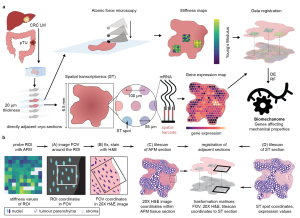
Both studies demonstrate that mechanical measurements can be spatially associated with transcriptomic measurements despite their incompatible experimental requirements. MechanoMaST from Decker et al. achieves this using a custom pipeline of affine transformations and template matching in adjacent serial cryosections. They rigorously quantified the level of spatial alignment and performed error propagation to obtain a refined, high-confidence dataset. Ong et al. generate two opposing surfaces from a single vibratome cut and register them by matching αSMA-positive vascular features visible on both faces, placing the two datasets within a common coordinate system in SpatialX. The mapping in both cases is based on landmarks, with mapping errors carefully estimated and discussed in the manuscripts. These approaches demonstrate that mechanical information measured on one tissue surface can be mapped onto spatial transcriptomic information acquired from another with sufficient spatial correspondence for biological interpretation at the resolved tissue scales.
- Tissue mechanics involve non-structural and context-dependent molecular programmes
The studies also shift attention away from structural ECM transcription alone toward secreted factors, inflammatory programmes, and tissue-specific regulatory mechanisms. In tumour tissue, the strongest stiffness-associated molecular signature consisted of secreted factors rather than classical structural collagens. In the aging ovary, matrix-associated genes were enriched among negative stiffness correlations, classical collagen genes did not correlate with stiffness, and immune-associated relationships became more prominent with age. Thus, the molecular determinants of tissue mechanics appear to be considerably more complex than simply ‘how much collagen is being transcribed.
Individual Key Findings
Decker et al. – MechanoMaST
Decker et al. developed MechanoMaST, applying the approach to human colorectal cancer liver metastasis (CRC LM) samples.
- Mechanical stability across serial cryosections and the gene stiffness signature
A critical methodological question is whether mechanical measurements from one cryosection can meaningfully represent the adjacent section used for spatial transcriptomics. Across consecutive 20-µm cryosections, the authors found that Young’s modulus measurements remained statistically stable, supporting the premise that adjacent sections can be paired for mechanical and molecular analysis. Rather than focusing exclusively on structural ECM genes, the authors combined differential expression across stiffness tiers with Random Forest machine learning. This analysis identified a stiffness signature with TGFBI as the strongest candidate. The broader analysis therefore points toward a mechanoresponsive transcriptional programme associated with tissue remodelling rather than simply increased collagen production.
- Functional connection to tumour biology
The association of TGFBI with stiff tumour stroma is particularly interesting. Previous studies have already established that a stiff microenvironment correlates with altered collagen microarchitecture and reduced CD8⁺ T-cell infiltration. Describing TGFBI as the top candidate in MechanoMaST underscores how mechanoadaptive programmes contribute to matrix organization and the immune landscape of the tumour. Furthermore, the reported association of stiffness-linked candidates TGFBI, TFF3, and PRAP1 with metabolic dysfunction-associated steatohepatitis (MASLD) suggests that stiffness-associated transcriptional programmes intersect with broader pathological states involving tissue remodelling and metabolic dysfunction.
Ong et al. – Paired-surface spatial mechanomics
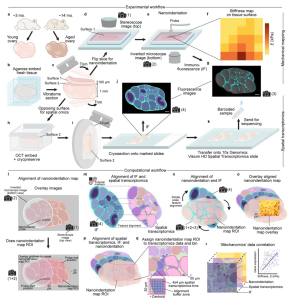
Ong et al. developed a complementary strategy to investigate the relationship between tissue mechanics and transcription during reproductive aging in mouse ovaries. The authors combine large area map nanoindentation on fresh tissues with 10x Genomics Visium HD, providing substantially greater transcriptomic spatial resolution than conventional Visium.
- Age-dependent reconfiguration of mechanical-transcriptional relationships
The most striking finding is that gene expression tracked local stiffness at both ages, but the associated genes differed. Similar numbers of genes were associated with stiffness in young and aged ovaries, arguing against a general loss of stiffness-associated transcription with age. This suggests that the relationship between the physical and transcriptional states of the tissue is reconfigured rather than progressively disrupted with age. This interpretation is consistent with the broader observation that the relationship between stiffness and transcription is highly compartment-specific and changes with reproductive age. High-stiffness regions were associated with cell cycle programs, while softer regions were associated with cholesterol biosynthesis and matrix-related expression. This demonstrates that physical stiffening does not necessarily coincide with increased transcription of classical structural matrix components. Instead, stiff regions may represent a state characterized by inflammatory signalling, altered matrix maintenance and metabolism, and a loss of normal tissue homeostasis.
- Paired-surface registration methodology shows distinct compartment responses
Rather than relying on adjacent serial cryosections, the method uses a single vibratome cut to generate two physically complementary tissue surfaces. One surface is subjected to nanoindentation, while the opposing surface is processed for spatial transcriptomics after cryopreservation. Each 50 µm nanoindentation grid point was associated with a median of 89 4-µm transcriptomic bins, enabling mechanical properties to be examined within discrete anatomical microenvironments. Registration uses immunofluorescence landmarks, specifically αSMA-positive vascular features at the cut plane visible on both sides. Matching these features in SpatialX sets the orientation and scale independently for each tissue, allowing nanoindentation regions to be placed into transcriptomic coordinates. Compartment-resolved analyses showed that stiffness-expression relationships differed across ovarian microenvironments. The corpus luteum, the temporary endocrine structure that forms after ovulation, had the clearest signal. Within this compartment, cholesterol biosynthetic enzymes and the lipoprotein receptor Scarb1 decreased with stiffness, while the steroidogenic regulator Nr5a1 and collagen receptor Ddr2 increased with stiffness, illustrating how local mechanical-molecular relationships can be revealed.
What I Like About These Preprints
- A new way of understanding mechanosensing in spatial biology
Spatial mechanomics shifts the focus from simply identifying gene expression locations to exploring how expression correlates with a directly measured physical property at the same anatomical site. A significant finding is the failure of structural collagen mRNA to reliably predict physical stiffness, highlighting a fundamental distinction between gene expression and material properties. Interpreting collagen expression as a direct indicator of tissue stiffness could lead to crucial biological misinterpretations.
- Complementary engineering solutions
The two papers provide elegant solutions to the same experimental problem. MechanoMaST prioritizes quantitative uncertainty estimation, spatial alignment quantification, error propagation, and robust registration between continuous cryosections. Ong et al. instead exploit fresh tissues and geometry, using paired surfaces to minimize the separation between mechanical and transcriptomic measurements while taking advantage of the high spatial resolution of Visium HD.
- Possible mechanistic and therapeutic applications derived from new methods
The identification of specific molecular signatures associated with mechanical states raises the possibility of testing how these relationships contribute to tissue function in different contexts. For example, the association between TGFBI, tumour stiffness, matrix architecture, and reduced CD8⁺ T-cell infiltration implies that mechanobiological pathways could eventually become therapeutic targets. In the ovary, where interventions targeting fibrosis are already being explored to extend reproductive lifespan, identifying which compartments and programs track local stiffness could help determine where such treatments act and monitor their local mechanical and molecular effects.
Future Directions and Questions for the Authors
1) Both pipelines demonstrate that multiple spatial modalities can be registered across tissue surfaces. Q: Given these registration frameworks, how readily could a third or fourth modality be incorporated—for example, spatial proteomics or other spatial OMICS?
2) The discrepancy between transcript abundance and stiffness raises a fundamental temporal question. Collagen and other ECM components can persist and undergo extensive post-translational modification long after the transcriptional programme that produced them has changed. Q: How much of the transcript–stiffness mismatch reflects temporal lag between transient mRNA expression and the much longer lifetime of deposited matrix?
3) Both studies are fundamentally spatial and correlational. A gene associated with a stiff region may either contribute to tissue stiffening or simply represent a cellular response to an already stiff environment. Q: Could perturbation experiments determine whether these factors actively drive matrix remodelling and tissue stiffening, rather than simply responding to mechanical stress?
Sign up to customise the site to your preferences and to receive alerts
Register hereAlso in the biophysics category:
Reciprocal mechanochemical feedback couples neural crest migration and neurulation
Béryl Laplace-Builhé

Organoids reveal niche-specific mechanotransduction-guided human cortical patterning and cell fate acquisition.
Kanishka Parashar

Matrix Rigidity Governs Switch-Like Oscillatory State Transitions of the Segmentation Clock in Isolated Presomitic Mesoderm Cells
Felipe Del Valle Batalla

Also in the cell biology category:
MechanoMaST – a multimodal pipeline for spatially registering mechanical and transcriptomic tissue data
AND
Paired-surface spatial mechanomics links tissue stiffness maps to spatial transcriptomics
Felipe Del Valle Batalla
E-cadherin clustering as a regulator of morphogenesis
Girish Kale, preLights peer support
Temporal decoding of blood flow derived mechanical cues driving liver regeneration
Tran To
preLists in the biophysics category:
Santa Cruz Developmental Biology Meeting 2026
This preList brings together a selection of preprints discussed at the Santa Cruz Developmental Biology Meeting 2026, held at UC Santa Cruz with the theme “Biomedicine, Biomechanics, and the Biosphere.” Reflecting the meeting’s broad scientific scope, from development and regeneration to evolution, tissue mechanics, and emerging technologies, this curated collection showcases work that contributed to conversations throughout the meeting.
| List by | Ingrid Tsang |
October in preprints – DevBio & Stem cell biology
Each month, preLighters with expertise across developmental and stem cell biology nominate a few recent developmental and stem cell biology (and related) preprints they’re excited about and explain in a single paragraph why. Short, snappy picks from working scientists — a quick way to spot fresh ideas, bold methods and papers worth reading in full. These preprints can all be found in the October preprint list published on the Node.
| List by | Deevitha Balasubramanian et al. |
October in preprints – Cell biology edition
Different preLighters, with expertise across cell biology, have worked together to create this preprint reading list for researchers with an interest in cell biology. This month, most picks fall under (1) Cell organelles and organisation, followed by (2) Mechanosignaling and mechanotransduction, (3) Cell cycle and division and (4) Cell migration
| List by | Matthew Davies et al. |
March in preprints – the CellBio edition
A group of preLighters, with expertise in different areas of cell biology, have worked together to create this preprint reading lists for researchers with an interest in cell biology. This month, categories include: 1) cancer biology 2) cell migration 3) cell organelles and organisation 4) cell signalling and mechanosensing 5) genetics and genomics 6) other
| List by | Girish Kale et al. |
Biologists @ 100 conference preList
This preList aims to capture all preprints being discussed at the Biologists @100 conference in Liverpool, UK, either as part of the poster sessions or the (flash/short/full-length) talks.
| List by | Reinier Prosee, Jonathan Townson |
February in preprints – the CellBio edition
A group of preLighters, with expertise in different areas of cell biology, have worked together to create this preprint reading lists for researchers with an interest in cell biology. This month, categories include: 1) biochemistry and cell metabolism 2) cell organelles and organisation 3) cell signalling, migration and mechanosensing
| List by | Barbora Knotkova et al. |
preLights peer support – preprints of interest
This is a preprint repository to organise the preprints and preLights covered through the 'preLights peer support' initiative.
| List by | preLights peer support |
66th Biophysical Society Annual Meeting, 2022
Preprints presented at the 66th BPS Annual Meeting, Feb 19 - 23, 2022 (The below list is not exhaustive and the preprints are listed in no particular order.)
| List by | Soni Mohapatra |
EMBL Synthetic Morphogenesis: From Gene Circuits to Tissue Architecture (2021)
A list of preprints mentioned at the #EESmorphoG virtual meeting in 2021.
| List by | Alex Eve |
Biophysical Society Meeting 2020
Some preprints presented at the Biophysical Society Meeting 2020 in San Diego, USA.
| List by | Tessa Sinnige |
ASCB EMBO Annual Meeting 2019
A collection of preprints presented at the 2019 ASCB EMBO Meeting in Washington, DC (December 7-11)
| List by | Madhuja Samaddar et al. |
EMBL Seeing is Believing – Imaging the Molecular Processes of Life
Preprints discussed at the 2019 edition of Seeing is Believing, at EMBL Heidelberg from the 9th-12th October 2019
| List by | Dey Lab |
Biomolecular NMR
Preprints related to the application and development of biomolecular NMR spectroscopy
| List by | Reid Alderson |
Biophysical Society Annual Meeting 2019
Few of the preprints that were discussed in the recent BPS annual meeting at Baltimore, USA
| List by | Joseph Jose Thottacherry |
Also in the cell biology category:
Santa Cruz Developmental Biology Meeting 2026
This preList brings together a selection of preprints discussed at the Santa Cruz Developmental Biology Meeting 2026, held at UC Santa Cruz with the theme “Biomedicine, Biomechanics, and the Biosphere.” Reflecting the meeting’s broad scientific scope, from development and regeneration to evolution, tissue mechanics, and emerging technologies, this curated collection showcases work that contributed to conversations throughout the meeting.
| List by | Ingrid Tsang |
Developmental regulation: molecular and ecological niches
This conference was held at the Station Biologique de Roscoff (France) and brought together researchers exploring how diverse niche environments shape developmental processes across scales. Spanning topics from ecological and metabolic influences to signalling networks, mechanics and gene regulation, the meeting highlighted the interplay between intrinsic and extrinsic factors in controlling cell fate and tissue organisation. This preList gathers preprints discussed by speakers and poster presenters during the meeting. Please do get in touch at preLights@biologists.com if you notice any relevant preprints that we may have missed.
| List by | Ingrid Tsang |
preLighters’ choice – Handpicked DevBio preprints
preLighters with expertise across developmental and stem cell biology have nominated a few developmental biology (and related) preprints they’re excited about and explain in a few paragraph why. Concise preprint highlights, prepared by the preLighter community – a quick way to spot upcoming trends, new methods and fresh ideas.
| List by | Theodora Stougiannou et al. |
BSDB Spring Meeting: Molecules to Morphogenesis
The British Society for Developmental Biology (BSDB) Spring Meeting Molecules to Morphogenesis was held from 23–26 March 2026 at the University of Warwick (UK). This meeting brought together a vibrant community of researchers to discuss how molecular mechanisms are integrated across scales to drive morphogenesis, spanning diverse model systems and approaches. This preList contains preprints by presenters from the talk and poster sessions at the meeting. Please do get in touch at preLights@biologists.com if you notice any relevant preprints that we may have missed.
| List by | Ingrid Tsang |
Keystone Symposium on Stem Cell Models in Embryology 2026
The Keystone Symposium on Stem Cell Models in Embryology, 2026, was organised by Jun Wu (UT Southwestern), Jianping Fu (University of Michigan) and Miki Ebisuya (TU Dresden) and held at Asilomar Conference Grounds in California (US). The meeting discussed recent advances made in establishing stem-cell-based embryo models, what fundamental insights into developmental processes have been gleaned from them, as well as how they are beginning to be applied more widely. This prelist contains preprints by presenters at the talk and poster sessions at the conference, which our Reviews Editor in attendance spotted. Please do reach out to preLights@biologists.com if you notice any that we’ve missed.
| List by | Ingrid Tsang |
SciELO preprints – From 2025 onwards
SciELO has become a cornerstone of open, multilingual scholarly communication across Latin America. Its preprint server, SciELO preprints, is expanding the global reach of preprinted research from the region (for more information, see our interview with Carolina Tanigushi). This preList brings together biological, English language SciELO preprints to help readers discover emerging work from the Global South. By highlighting these preprints in one place, we aim to support visibility, encourage early feedback, and showcase the vibrant research communities contributing to SciELO’s open science ecosystem.
| List by | Carolina Tanigushi |
November in preprints – DevBio & Stem cell biology
preLighters with expertise across developmental and stem cell biology have nominated a few developmental and stem cell biology (and related) preprints posted in November they’re excited about and explain in a single paragraph why. Concise preprint highlights, prepared by the preLighter community – a quick way to spot upcoming trends, new methods and fresh ideas.
| List by | Aline Grata et al. |
October in preprints – DevBio & Stem cell biology
Each month, preLighters with expertise across developmental and stem cell biology nominate a few recent developmental and stem cell biology (and related) preprints they’re excited about and explain in a single paragraph why. Short, snappy picks from working scientists — a quick way to spot fresh ideas, bold methods and papers worth reading in full. These preprints can all be found in the October preprint list published on the Node.
| List by | Deevitha Balasubramanian et al. |
October in preprints – Cell biology edition
Different preLighters, with expertise across cell biology, have worked together to create this preprint reading list for researchers with an interest in cell biology. This month, most picks fall under (1) Cell organelles and organisation, followed by (2) Mechanosignaling and mechanotransduction, (3) Cell cycle and division and (4) Cell migration
| List by | Matthew Davies et al. |
September in preprints – Cell biology edition
A group of preLighters, with expertise in different areas of cell biology, have worked together to create this preprint reading list. This month, categories include: (1) Cell organelles and organisation, (2) Cell signalling and mechanosensing, (3) Cell metabolism, (4) Cell cycle and division, (5) Cell migration
| List by | Sristilekha Nath et al. |
July in preprints – the CellBio edition
A group of preLighters, with expertise in different areas of cell biology, have worked together to create this preprint reading lists for researchers with an interest in cell biology. This month, categories include: (1) Cell Signalling and Mechanosensing (2) Cell Cycle and Division (3) Cell Migration and Cytoskeleton (4) Cancer Biology (5) Cell Organelles and Organisation
| List by | Girish Kale et al. |
June in preprints – the CellBio edition
A group of preLighters, with expertise in different areas of cell biology, have worked together to create this preprint reading lists for researchers with an interest in cell biology. This month, categories include: (1) Cell organelles and organisation (2) Cell signaling and mechanosensation (3) Genetics/gene expression (4) Biochemistry (5) Cytoskeleton
| List by | Barbora Knotkova et al. |
May in preprints – the CellBio edition
A group of preLighters, with expertise in different areas of cell biology, have worked together to create this preprint reading lists for researchers with an interest in cell biology. This month, categories include: 1) Biochemistry/metabolism 2) Cancer cell Biology 3) Cell adhesion, migration and cytoskeleton 4) Cell organelles and organisation 5) Cell signalling and 6) Genetics
| List by | Barbora Knotkova et al. |
Keystone Symposium – Metabolic and Nutritional Control of Development and Cell Fate
This preList contains preprints discussed during the Metabolic and Nutritional Control of Development and Cell Fate Keystone Symposia. This conference was organized by Lydia Finley and Ralph J. DeBerardinis and held in the Wylie Center and Tupper Manor at Endicott College, Beverly, MA, United States from May 7th to 9th 2025. This meeting marked the first in-person gathering of leading researchers exploring how metabolism influences development, including processes like cell fate, tissue patterning, and organ function, through nutrient availability and metabolic regulation. By integrating modern metabolic tools with genetic and epidemiological insights across model organisms, this event highlighted key mechanisms and identified open questions to advance the emerging field of developmental metabolism.
| List by | Virginia Savy, Martin Estermann |
April in preprints – the CellBio edition
A group of preLighters, with expertise in different areas of cell biology, have worked together to create this preprint reading lists for researchers with an interest in cell biology. This month, categories include: 1) biochemistry/metabolism 2) cell cycle and division 3) cell organelles and organisation 4) cell signalling and mechanosensing 5) (epi)genetics
| List by | Vibha SINGH et al. |
March in preprints – the CellBio edition
A group of preLighters, with expertise in different areas of cell biology, have worked together to create this preprint reading lists for researchers with an interest in cell biology. This month, categories include: 1) cancer biology 2) cell migration 3) cell organelles and organisation 4) cell signalling and mechanosensing 5) genetics and genomics 6) other
| List by | Girish Kale et al. |
Biologists @ 100 conference preList
This preList aims to capture all preprints being discussed at the Biologists @100 conference in Liverpool, UK, either as part of the poster sessions or the (flash/short/full-length) talks.
| List by | Reinier Prosee, Jonathan Townson |
February in preprints – the CellBio edition
A group of preLighters, with expertise in different areas of cell biology, have worked together to create this preprint reading lists for researchers with an interest in cell biology. This month, categories include: 1) biochemistry and cell metabolism 2) cell organelles and organisation 3) cell signalling, migration and mechanosensing
| List by | Barbora Knotkova et al. |
Community-driven preList – Immunology
In this community-driven preList, a group of preLighters, with expertise in different areas of immunology have worked together to create this preprint reading list.
| List by | Felipe Del Valle Batalla et al. |
January in preprints – the CellBio edition
A group of preLighters, with expertise in different areas of cell biology, have worked together to create this preprint reading lists for researchers with an interest in cell biology. This month, categories include: 1) biochemistry/metabolism 2) cell migration 3) cell organelles and organisation 4) cell signalling and mechanosensing 5) genetics/gene expression
| List by | Barbora Knotkova et al. |
December in preprints – the CellBio edition
A group of preLighters, with expertise in different areas of cell biology, have worked together to create this preprint reading lists for researchers with an interest in cell biology. This month, categories include: 1) cell cycle and division 2) cell migration and cytoskeleton 3) cell organelles and organisation 4) cell signalling and mechanosensing 5) genetics/gene expression
| List by | Matthew Davies et al. |
November in preprints – the CellBio edition
This is the first community-driven preList! A group of preLighters, with expertise in different areas of cell biology, have worked together to create this preprint reading lists for researchers with an interest in cell biology. Categories include: 1) cancer cell biology 2) cell cycle and division 3) cell migration and cytoskeleton 4) cell organelles and organisation 5) cell signalling and mechanosensing 6) genetics/gene expression
| List by | Felipe Del Valle Batalla et al. |
BSCB-Biochemical Society 2024 Cell Migration meeting
This preList features preprints that were discussed and presented during the BSCB-Biochemical Society 2024 Cell Migration meeting in Birmingham, UK in April 2024. Kindly put together by Sara Morais da Silva, Reviews Editor at Journal of Cell Science.
| List by | Reinier Prosee |
‘In preprints’ from Development 2022-2023
A list of the preprints featured in Development's 'In preprints' articles between 2022-2023
| List by | Alex Eve, Katherine Brown |
preLights peer support – preprints of interest
This is a preprint repository to organise the preprints and preLights covered through the 'preLights peer support' initiative.
| List by | preLights peer support |
The Society for Developmental Biology 82nd Annual Meeting
This preList is made up of the preprints discussed during the Society for Developmental Biology 82nd Annual Meeting that took place in Chicago in July 2023.
| List by | Joyce Yu, Katherine Brown |
CSHL 87th Symposium: Stem Cells
Preprints mentioned by speakers at the #CSHLsymp23
| List by | Alex Eve |
Journal of Cell Science meeting ‘Imaging Cell Dynamics’
This preList highlights the preprints discussed at the JCS meeting 'Imaging Cell Dynamics'. The meeting was held from 14 - 17 May 2023 in Lisbon, Portugal and was organised by Erika Holzbaur, Jennifer Lippincott-Schwartz, Rob Parton and Michael Way.
| List by | Helen Zenner |
9th International Symposium on the Biology of Vertebrate Sex Determination
This preList contains preprints discussed during the 9th International Symposium on the Biology of Vertebrate Sex Determination. This conference was held in Kona, Hawaii from April 17th to 21st 2023.
| List by | Martin Estermann |
Alumni picks – preLights 5th Birthday
This preList contains preprints that were picked and highlighted by preLights Alumni - an initiative that was set up to mark preLights 5th birthday. More entries will follow throughout February and March 2023.
| List by | Sergio Menchero et al. |
CellBio 2022 – An ASCB/EMBO Meeting
This preLists features preprints that were discussed and presented during the CellBio 2022 meeting in Washington, DC in December 2022.
| List by | Nadja Hümpfer et al. |
Fibroblasts
The advances in fibroblast biology preList explores the recent discoveries and preprints of the fibroblast world. Get ready to immerse yourself with this list created for fibroblasts aficionados and lovers, and beyond. Here, my goal is to include preprints of fibroblast biology, heterogeneity, fate, extracellular matrix, behavior, topography, single-cell atlases, spatial transcriptomics, and their matrix!
| List by | Osvaldo Contreras |
EMBL Synthetic Morphogenesis: From Gene Circuits to Tissue Architecture (2021)
A list of preprints mentioned at the #EESmorphoG virtual meeting in 2021.
| List by | Alex Eve |
FENS 2020
A collection of preprints presented during the virtual meeting of the Federation of European Neuroscience Societies (FENS) in 2020
| List by | Ana Dorrego-Rivas |
Planar Cell Polarity – PCP
This preList contains preprints about the latest findings on Planar Cell Polarity (PCP) in various model organisms at the molecular, cellular and tissue levels.
| List by | Ana Dorrego-Rivas |
BioMalPar XVI: Biology and Pathology of the Malaria Parasite
[under construction] Preprints presented at the (fully virtual) EMBL BioMalPar XVI, 17-18 May 2020 #emblmalaria
| List by | Dey Lab, Samantha Seah |
1
Cell Polarity
Recent research from the field of cell polarity is summarized in this list of preprints. It comprises of studies focusing on various forms of cell polarity ranging from epithelial polarity, planar cell polarity to front-to-rear polarity.
| List by | Yamini Ravichandran |
TAGC 2020
Preprints recently presented at the virtual Allied Genetics Conference, April 22-26, 2020. #TAGC20
| List by | Maiko Kitaoka et al. |
3D Gastruloids
A curated list of preprints related to Gastruloids (in vitro models of early development obtained by 3D aggregation of embryonic cells). Updated until July 2021.
| List by | Paul Gerald L. Sanchez and Stefano Vianello |
ECFG15 – Fungal biology
Preprints presented at 15th European Conference on Fungal Genetics 17-20 February 2020 Rome
| List by | Hiral Shah |
ASCB EMBO Annual Meeting 2019
A collection of preprints presented at the 2019 ASCB EMBO Meeting in Washington, DC (December 7-11)
| List by | Madhuja Samaddar et al. |
EMBL Seeing is Believing – Imaging the Molecular Processes of Life
Preprints discussed at the 2019 edition of Seeing is Believing, at EMBL Heidelberg from the 9th-12th October 2019
| List by | Dey Lab |
Autophagy
Preprints on autophagy and lysosomal degradation and its role in neurodegeneration and disease. Includes molecular mechanisms, upstream signalling and regulation as well as studies on pharmaceutical interventions to upregulate the process.
| List by | Sandra Malmgren Hill |
Lung Disease and Regeneration
This preprint list compiles highlights from the field of lung biology.
| List by | Rob Hynds |
Cellular metabolism
A curated list of preprints related to cellular metabolism at Biorxiv by Pablo Ranea Robles from the Prelights community. Special interest on lipid metabolism, peroxisomes and mitochondria.
| List by | Pablo Ranea Robles |
BSCB/BSDB Annual Meeting 2019
Preprints presented at the BSCB/BSDB Annual Meeting 2019
| List by | Dey Lab |
MitoList
This list of preprints is focused on work expanding our knowledge on mitochondria in any organism, tissue or cell type, from the normal biology to the pathology.
| List by | Sandra Franco Iborra |
ASCB/EMBO Annual Meeting 2018
This list relates to preprints that were discussed at the recent ASCB conference.
| List by | Dey Lab, Amanda Haage |