







Eyewire II – A connectomic resource for resolving cell types and circuits of the mouse retina
Posted on: 31 August 2026 , updated on: 7 September 2026
Preprint posted on 1 June 2026
How does the eye wire together? Eyewire II is a connectomics resource mapping the circuits behind vision
Selected by Phoebe Reynolds
Categories: cell biology, neuroscience
Background:
The sensory organs are crucial for understanding and interacting with the surrounding world, and the mammalian retina serves as a highly structured, well-understood model of sensory processing. Despite the apparent structural simplicity, the network is immensely complex. The mammalian retina has been estimated to contain around 130 distinct cell types. These diverse neurons with morphological, functional, and transcriptomic variety work congruently to encode salient visual features like motion, direction, and contrast (3). Therefore, to truly decode vision, we need to move beyond single-cell identities and map their functional circuits. Large-scale connectomics datasets derived from volumetric electron microscopy (EM) can provide this structural wiring diagram, revealing insights into the retinal network.
However, previous retinal EM datasets have had several limitations (4). Therefore, to bridge these limitations, the authors of this preprint developed Eyewire II. This spans nearly 1 mm² of the mouse retina while combining AI-assisted EM reconstruction with two-photon calcium imaging of the same tissue. It is complemented by comprehensive cell-type identification via extensive morphological classification, resulting in a mammalian retinal connectome that integrates cellular structure, function, and synaptic wiring.
Key findings:
The Eyewire II Resource
The preprint authors were successful in creating the Eyewire II resource. This EM volume covers approximately 1 mm² of the temporo-ventral mouse retina and is roughly 10 – 100 times larger than previous mouse EM retina datasets (Figure 1). This unprecedented scale enables large neurons, such as wide-field amacrine cells that span hundreds of micrometers and were significantly truncated in previous datasets, to be almost fully reconstructed. In addition, the tissue was processed to retain intracellular ultrastructure, with ribbon synapses clearly visible, and allows for the direct identification of synaptic connectivity, bypassing the need to rely on physical proximity or contact area as a synapse indicator.
To handle this large volume, the authors developed a high-throughput pipeline combining deep learning segementation with human proofreading. While complex cells still required manual correction, overall human proofreading effort was drastically reduced. Remarkably, bipolar cells (BCs) required a median of zero edits, dropping their proofreading time to just 2 minutes per cell, while more complex cells such as retinal ganglion cells (RGCs) required only around 39 minutes per cell. Therefore, the authors alongside community tracers successfully proofread over 25,000 out of an estimated 100,000 cells in the volume. However, because proofreaders initially focused on the most complex cells, this is estimated to represent around 35% of the total proofreading effort required.
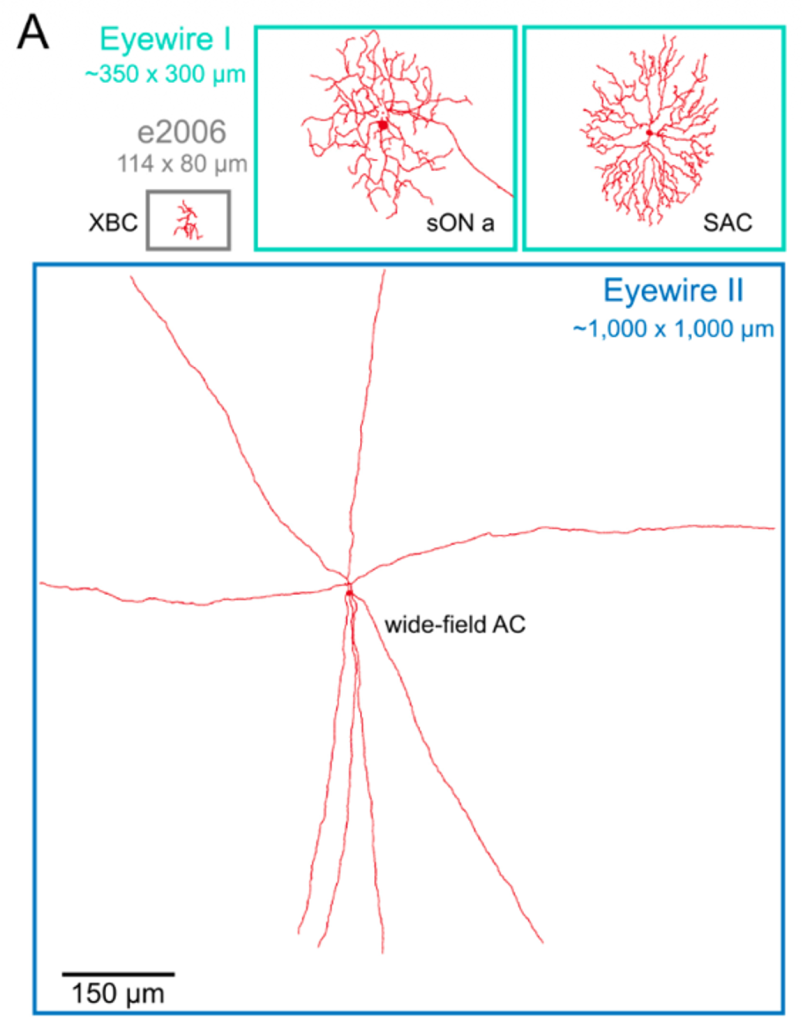
Figure 1. Dataset overview. Scale comparison showing the 1 mm² area of Eyewire II relative to previous mouse retinal EM volumes, enabling full reconstruction of wide-field amacrine cell arbors. Taken from (Eyewire II, 2026), Fig. 1A. made available under a CC BY 4.0. International license
Morphological classification of retinal cell subtypes
Due to the large quantity of proofreading, the authors were able to demonstrate that morphology alone contained significant, extractable information regarding neuronal identity. Here, the retina as a resource comes into force, as it is known to have distinct morphology subtypes. After reconstruction, neurons were converted into flattened skeletons and analysed using quantitative morphology features, such as dendritic arbor density and branching topology. By exploring different features, the researchers showed that many well-known distinct cell types could be separated into distinct stratification layers and split within a two-dimension t-SNE embedding, resolving biologically relevant morphological variation. Using bipolar cells as a test case, as these are some of the ‘simplest’ cells within the retinal classes, the authors found all known bipolar cell classes (Figure 2). In addition, they used the idea of retinal mosaics (cell types spread evenly across the retina) for independent validation. Using morphological features of the BC types and mosaics, they found that the nearest-neighbour distance strongly correlated with axon terminal size and the expected spatial organisation. Similarly, because Eyewire II overcomes previous truncation issues, the team successfully obtained large, well-structured mosaics for many RGC types, including large alpha types.
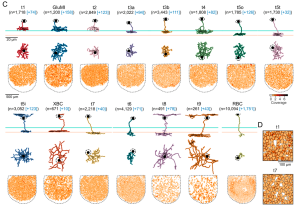
Figure 2. Complete Bipolar Cell Retinal Mosaics. Complete spatial mosaics for all 15 bipolar cell types reconstructed across the volume, displaying characteristic, non-overlapping spatial distributions and accurate automated cell-typing. Taken from (Eyewire II, 2026), Fig. 4C-D. made available under a CC BY 4.0 International license.
Anatomy linked to function
One of the most powerful aspects of Eyewire II is the ability to directly link anatomy to function, due to the precise alignment of the recorded ganglion cell layer from prior two-photon imaging with the EM volume. This allows for morphology, connectivity, and function to be analysed congruently for almost 400 cells. Here, they found that while similar morphology generally predicts consistent physiological responses (such as in sustained ON alpha cells), the match is not always consistent. Interestingly, the authors observed that light responses for some cell types, notably ON starburst Acs, differed systematically across the five recording fields. Rather than attributing this to biological variability, they calculated the light exposure for the fields and modelled cumulative activation. They discovered that differences in light adaptation contributed to these variations, showing that neuronal identity does not alone determine function, but the state of the circuit can also alter the neuronal response.
Direct circuit reconstruction
As synapses are clearly visible, Eyewire II excitingly allows for structural circuit reconstruction. Therefore, the authors reconstructed the rod pathway, one of the most clearly understood individual circuits of the retina, as proof of principle (5). They mapped the connections of nine rod BCs, confirming that they mainly provided output to A17 and A2 Acs while receiving reciprocal inhibitory inputs predominantly from A17s (Figure 3). This successfully validated the dataset by accurately reproducing known retinal anatomy. Scaling this approach, they then used a deep learning model that automatically detected approximately 6.5 million ribbon synapses across the volume. This allowed for large-scale analysis of ribbon distribution, confirming that ribbon BCs possess fewer but larger ribbons than cone bipolar cells.
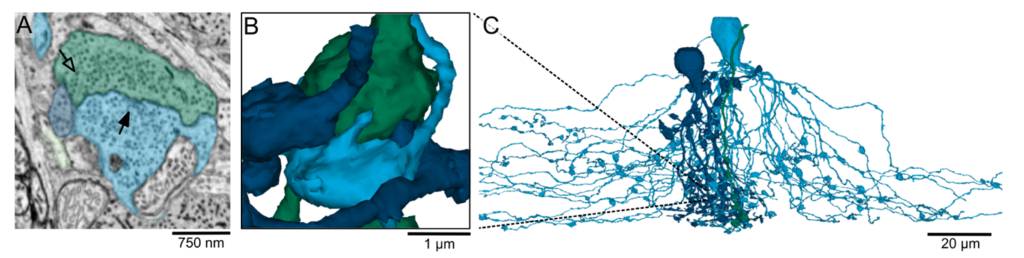
Figure 3. Circuit reconstruction of the rod pathway. 3D reconstructions showing representative ribbon synapses from bipolar cells (A) and conventional inhibitory feedback synapses (B). (C) Reconstructed connectivity graph of the canonical rod pathway, mapping inputs from nine rod bipolar cells onto AII and A17 amacrine cells. Taken from (Eyewire II, 2026), Fig. 8A-C. made available under a CC BY 4.0 International license .
Conclusions and Future directions:
Eyewire II is a detailed, integrative resource that combines structural connectivity with morphology and physiology. The larger dataset ensures that previously truncated neurons can now be fully reconstructed and expands the possible biological questions that can now be addressed, such as systematic identification of cell-type specific connectivity patterns and circuit motifs underlying retinal computations. The resource has a wide range of future applications, including identifying non-canonical cell types, comparing synaptic organisation, and investigating subcellular features such as ribbon synapses or mitochondrial distribution.
However, there are several limitations that must be considered. Firstly, the data is derived from a single temporo-ventral region of one mouse, and functional data is only available for a limited subset of cells, meaning caution must be taken when generalising morphology-function relationships. Secondly, the EM imaging does not yet fully extend into the outer plexiform layer, limiting the study of outer retinal computations. Finally, conventional inhibitory synapses currently are trickier to detect and can require future focus for the development of an automated, network-wide detection.
Why this preprint is interesting:
I find this preprint interesting because it shifts connectomics from a single study into a community resource that can enable future discoveries across the field of retinal neuroscience. Rather than answering one biological question, it provides a dataset to investigate retinal cell types, circuits, and function combined. In addition, the paper highlights how AI and deep learning are changing the scale of connectomics. Reconstructing neurons from EM has traditionally required extensive manual tracing, making large volumes difficult to analyse. Eyewire II demonstrates that effective tools along with human proofreading can make these previously insurmountable, large-scaled projects tracable, showing how AI can expand what is experimentally possible.
The integration of functional calcium imaging data with structural EM is another major strength. Historically, researchers have often had to infer how a neuron’s morphology relates to its functional response. By matching functional recordings to individually reconstructed neurons, Eyewire II provides direct evidence linking neuronal structure and activity, allowing researchers to ask how anatomy and connectivity relate to function.
Overall, I find this paper exciting because it brings together scale, anatomy, and function within a single resource. It provides understanding on not only properties of retinal neurons, but how their circuits are constructed for function.
Questions for the authors:
- Eyewire II directly links morphology with physiological responses, but understandably functional data is available for only a small subset of the reconstructed cells, and within a single mouse. How representative do you think these cells and their morphology–function relationships are of broader retinal populations and individuals?
- Excitingly, your initial automated segmentation is accurate enough that many cells require little or no proofreading, but the paper does not report a single overall measure of segmentation accuracy. How do you quantify the remaining segmentation errors, in particular split and merge errors, and how confident are you that a proofread neuron is complete?
- I really like your cell-type classification pipeline using morphology. However, where do you think morphology reaches its limits as a definition of neuronal cell type, and how do you see transcriptomic information complementing morphology in future versions of Eyewire II?
- The rod bipolar circuit is a great proof of principle because the connectivity is already well established. Looking forward, which retinal circuit are you most excited that Eyewire II is now uniquely positioned to identify that previous approaches could not?
References:
- H Wässle and B B Boycott. Functional architecture of the mammalian retina. Physiol. Rev.,71(2):447–480, April 1991.
- Joshua Hahn, Aboozar Monavarfeshani, Mu Qiao, Allison H Kao, Yvonne Kölsch, Ayush Kumar, Vincent P Kunze, Ashley M Rasys, Rose Richardson, Joseph B Wekselblatt, Herwig Baier, Robert J Lucas, Wei Li, Markus Meister, Joshua T Trachtenberg, Wenjun Yan, Yi-Rong Peng, Joshua R Sanes, and Karthik Shekhar. Evolution of neuronal cell classes and types in the vertebrate retina. Nature, 624(7991):415–424, 14 December 2023. doi:10.1038/s41586-023-06638-9.
- Antinucci P, Suleyman O, Monfries C, Hindges R. Neural Mechanisms Generating Orientation Selectivity in the Retina. Curr Biol. 2016 Jul 25;26(14):1802-15. doi: 10.1016/j.cub.2016.05.035.
- Crystal L Sigulinsky, Rebecca L Pfeiffer, and Bryan William Jones. Retinal connectomics: A review. Annu. Rev. Vis. Sci., 10(1):263–291, September 2024. doi: 10.1146/annurev-vision-102122-110414.
- H Wässle, U Grünert, M H Chun, and B B Boycott. The rod pathway of the macaque monkey retina: identification of AII-amacrine cells with antibodies against calretinin. J. Comp. Neurol., 361(3):537–551, 23 October 1995. doi: 10.1002/cne.903610315.
doi: https://doi.org/10.1242/prelights.44609
Read preprintSign up to customise the site to your preferences and to receive alerts
Register hereAlso in the cell biology category:
Microglia extract neuronal proteolytic organelles via skoupocytosis
Chandrika Rao

MechanoMaST – a multimodal pipeline for spatially registering mechanical and transcriptomic tissue data
AND
Paired-surface spatial mechanomics links tissue stiffness maps to spatial transcriptomics
Felipe Del Valle Batalla
E-cadherin clustering as a regulator of morphogenesis
Girish Kale, preLights peer support
Also in the neuroscience category:
Microglia extract neuronal proteolytic organelles via skoupocytosis
Chandrika Rao
Vectorial efference copy and visuomotor transformation through gap junctions
Lochlan Walsh

SPOTTER: Automated Tissue-Barcoding Platform for Spatial Proteomics and Phosphoproteomics
TheLangeLab, Felix Kraus

preLists in the cell biology category:
‘In preprints’ from Development 2026
A list of the preprints featured in Development's 'In preprints' articles, as part of the new Preprint Editors initiative
| List by | Clarisse Brunet Avalos et al. |
Sainsbury Laboratory Symposium 2026
The Sainsbury Laboratory Symposium 2026, Shaping Life: Mechanisms of Morphogenesis, brought together researchers exploring the cellular, genetic and mechanical processes that shape plant form. This preList highlights preprints that were discussed or mentioned at the meeting. If you notice any missing preprints, please contact us at preLights@biologists.com
| List by | Ingrid Tsang |
Santa Cruz Developmental Biology Meeting 2026
This preList brings together a selection of preprints discussed at the Santa Cruz Developmental Biology Meeting 2026, held at UC Santa Cruz with the theme “Biomedicine, Biomechanics, and the Biosphere.” Reflecting the meeting’s broad scientific scope, from development and regeneration to evolution, tissue mechanics, and emerging technologies, this curated collection showcases work that contributed to conversations throughout the meeting.
| List by | Ingrid Tsang |
Developmental regulation: molecular and ecological niches
This conference was held at the Station Biologique de Roscoff (France) and brought together researchers exploring how diverse niche environments shape developmental processes across scales. Spanning topics from ecological and metabolic influences to signalling networks, mechanics and gene regulation, the meeting highlighted the interplay between intrinsic and extrinsic factors in controlling cell fate and tissue organisation. This preList gathers preprints discussed by speakers and poster presenters during the meeting. Please do get in touch at preLights@biologists.com if you notice any relevant preprints that we may have missed.
| List by | Ingrid Tsang |
preLighters’ choice – Handpicked DevBio preprints
preLighters with expertise across developmental and stem cell biology have nominated a few developmental biology (and related) preprints they’re excited about and explain in a few paragraph why. Concise preprint highlights, prepared by the preLighter community – a quick way to spot upcoming trends, new methods and fresh ideas.
| List by | Theodora Stougiannou et al. |
BSDB Spring Meeting: Molecules to Morphogenesis
The British Society for Developmental Biology (BSDB) Spring Meeting Molecules to Morphogenesis was held from 23–26 March 2026 at the University of Warwick (UK). This meeting brought together a vibrant community of researchers to discuss how molecular mechanisms are integrated across scales to drive morphogenesis, spanning diverse model systems and approaches. This preList contains preprints by presenters from the talk and poster sessions at the meeting. Please do get in touch at preLights@biologists.com if you notice any relevant preprints that we may have missed.
| List by | Ingrid Tsang |
Keystone Symposium on Stem Cell Models in Embryology 2026
The Keystone Symposium on Stem Cell Models in Embryology, 2026, was organised by Jun Wu (UT Southwestern), Jianping Fu (University of Michigan) and Miki Ebisuya (TU Dresden) and held at Asilomar Conference Grounds in California (US). The meeting discussed recent advances made in establishing stem-cell-based embryo models, what fundamental insights into developmental processes have been gleaned from them, as well as how they are beginning to be applied more widely. This prelist contains preprints by presenters at the talk and poster sessions at the conference, which our Reviews Editor in attendance spotted. Please do reach out to preLights@biologists.com if you notice any that we’ve missed.
| List by | Ingrid Tsang |
SciELO preprints – From 2025 onwards
SciELO has become a cornerstone of open, multilingual scholarly communication across Latin America. Its preprint server, SciELO preprints, is expanding the global reach of preprinted research from the region (for more information, see our interview with Carolina Tanigushi). This preList brings together biological, English language SciELO preprints to help readers discover emerging work from the Global South. By highlighting these preprints in one place, we aim to support visibility, encourage early feedback, and showcase the vibrant research communities contributing to SciELO’s open science ecosystem.
| List by | Carolina Tanigushi |
November in preprints – DevBio & Stem cell biology
preLighters with expertise across developmental and stem cell biology have nominated a few developmental and stem cell biology (and related) preprints posted in November they’re excited about and explain in a single paragraph why. Concise preprint highlights, prepared by the preLighter community – a quick way to spot upcoming trends, new methods and fresh ideas.
| List by | Aline Grata et al. |
October in preprints – DevBio & Stem cell biology
Each month, preLighters with expertise across developmental and stem cell biology nominate a few recent developmental and stem cell biology (and related) preprints they’re excited about and explain in a single paragraph why. Short, snappy picks from working scientists — a quick way to spot fresh ideas, bold methods and papers worth reading in full. These preprints can all be found in the October preprint list published on the Node.
| List by | Deevitha Balasubramanian et al. |
October in preprints – Cell biology edition
Different preLighters, with expertise across cell biology, have worked together to create this preprint reading list for researchers with an interest in cell biology. This month, most picks fall under (1) Cell organelles and organisation, followed by (2) Mechanosignaling and mechanotransduction, (3) Cell cycle and division and (4) Cell migration
| List by | Matthew Davies et al. |
September in preprints – Cell biology edition
A group of preLighters, with expertise in different areas of cell biology, have worked together to create this preprint reading list. This month, categories include: (1) Cell organelles and organisation, (2) Cell signalling and mechanosensing, (3) Cell metabolism, (4) Cell cycle and division, (5) Cell migration
| List by | Sristilekha Nath et al. |
July in preprints – the CellBio edition
A group of preLighters, with expertise in different areas of cell biology, have worked together to create this preprint reading lists for researchers with an interest in cell biology. This month, categories include: (1) Cell Signalling and Mechanosensing (2) Cell Cycle and Division (3) Cell Migration and Cytoskeleton (4) Cancer Biology (5) Cell Organelles and Organisation
| List by | Girish Kale et al. |
June in preprints – the CellBio edition
A group of preLighters, with expertise in different areas of cell biology, have worked together to create this preprint reading lists for researchers with an interest in cell biology. This month, categories include: (1) Cell organelles and organisation (2) Cell signaling and mechanosensation (3) Genetics/gene expression (4) Biochemistry (5) Cytoskeleton
| List by | Barbora Knotkova et al. |
May in preprints – the CellBio edition
A group of preLighters, with expertise in different areas of cell biology, have worked together to create this preprint reading lists for researchers with an interest in cell biology. This month, categories include: 1) Biochemistry/metabolism 2) Cancer cell Biology 3) Cell adhesion, migration and cytoskeleton 4) Cell organelles and organisation 5) Cell signalling and 6) Genetics
| List by | Barbora Knotkova et al. |
Keystone Symposium – Metabolic and Nutritional Control of Development and Cell Fate
This preList contains preprints discussed during the Metabolic and Nutritional Control of Development and Cell Fate Keystone Symposia. This conference was organized by Lydia Finley and Ralph J. DeBerardinis and held in the Wylie Center and Tupper Manor at Endicott College, Beverly, MA, United States from May 7th to 9th 2025. This meeting marked the first in-person gathering of leading researchers exploring how metabolism influences development, including processes like cell fate, tissue patterning, and organ function, through nutrient availability and metabolic regulation. By integrating modern metabolic tools with genetic and epidemiological insights across model organisms, this event highlighted key mechanisms and identified open questions to advance the emerging field of developmental metabolism.
| List by | Virginia Savy, Martin Estermann |
April in preprints – the CellBio edition
A group of preLighters, with expertise in different areas of cell biology, have worked together to create this preprint reading lists for researchers with an interest in cell biology. This month, categories include: 1) biochemistry/metabolism 2) cell cycle and division 3) cell organelles and organisation 4) cell signalling and mechanosensing 5) (epi)genetics
| List by | Vibha SINGH et al. |
March in preprints – the CellBio edition
A group of preLighters, with expertise in different areas of cell biology, have worked together to create this preprint reading lists for researchers with an interest in cell biology. This month, categories include: 1) cancer biology 2) cell migration 3) cell organelles and organisation 4) cell signalling and mechanosensing 5) genetics and genomics 6) other
| List by | Girish Kale et al. |
Biologists @ 100 conference preList
This preList aims to capture all preprints being discussed at the Biologists @100 conference in Liverpool, UK, either as part of the poster sessions or the (flash/short/full-length) talks.
| List by | Reinier Prosee, Jonathan Townson |
February in preprints – the CellBio edition
A group of preLighters, with expertise in different areas of cell biology, have worked together to create this preprint reading lists for researchers with an interest in cell biology. This month, categories include: 1) biochemistry and cell metabolism 2) cell organelles and organisation 3) cell signalling, migration and mechanosensing
| List by | Barbora Knotkova et al. |
Community-driven preList – Immunology
In this community-driven preList, a group of preLighters, with expertise in different areas of immunology have worked together to create this preprint reading list.
| List by | Felipe Del Valle Batalla et al. |
January in preprints – the CellBio edition
A group of preLighters, with expertise in different areas of cell biology, have worked together to create this preprint reading lists for researchers with an interest in cell biology. This month, categories include: 1) biochemistry/metabolism 2) cell migration 3) cell organelles and organisation 4) cell signalling and mechanosensing 5) genetics/gene expression
| List by | Barbora Knotkova et al. |
December in preprints – the CellBio edition
A group of preLighters, with expertise in different areas of cell biology, have worked together to create this preprint reading lists for researchers with an interest in cell biology. This month, categories include: 1) cell cycle and division 2) cell migration and cytoskeleton 3) cell organelles and organisation 4) cell signalling and mechanosensing 5) genetics/gene expression
| List by | Matthew Davies et al. |
November in preprints – the CellBio edition
This is the first community-driven preList! A group of preLighters, with expertise in different areas of cell biology, have worked together to create this preprint reading lists for researchers with an interest in cell biology. Categories include: 1) cancer cell biology 2) cell cycle and division 3) cell migration and cytoskeleton 4) cell organelles and organisation 5) cell signalling and mechanosensing 6) genetics/gene expression
| List by | Felipe Del Valle Batalla et al. |
BSCB-Biochemical Society 2024 Cell Migration meeting
This preList features preprints that were discussed and presented during the BSCB-Biochemical Society 2024 Cell Migration meeting in Birmingham, UK in April 2024. Kindly put together by Sara Morais da Silva, Reviews Editor at Journal of Cell Science.
| List by | Reinier Prosee |
‘In preprints’ from Development 2022-2023
A list of the preprints featured in Development's 'In preprints' articles between 2022-2023
| List by | Alex Eve, Katherine Brown |
preLights peer support – preprints of interest
This is a preprint repository to organise the preprints and preLights covered through the 'preLights peer support' initiative.
| List by | preLights peer support |
The Society for Developmental Biology 82nd Annual Meeting
This preList is made up of the preprints discussed during the Society for Developmental Biology 82nd Annual Meeting that took place in Chicago in July 2023.
| List by | Joyce Yu, Katherine Brown |
CSHL 87th Symposium: Stem Cells
Preprints mentioned by speakers at the #CSHLsymp23
| List by | Alex Eve |
Journal of Cell Science meeting ‘Imaging Cell Dynamics’
This preList highlights the preprints discussed at the JCS meeting 'Imaging Cell Dynamics'. The meeting was held from 14 - 17 May 2023 in Lisbon, Portugal and was organised by Erika Holzbaur, Jennifer Lippincott-Schwartz, Rob Parton and Michael Way.
| List by | Helen Zenner |
9th International Symposium on the Biology of Vertebrate Sex Determination
This preList contains preprints discussed during the 9th International Symposium on the Biology of Vertebrate Sex Determination. This conference was held in Kona, Hawaii from April 17th to 21st 2023.
| List by | Martin Estermann |
Alumni picks – preLights 5th Birthday
This preList contains preprints that were picked and highlighted by preLights Alumni - an initiative that was set up to mark preLights 5th birthday. More entries will follow throughout February and March 2023.
| List by | Sergio Menchero et al. |
CellBio 2022 – An ASCB/EMBO Meeting
This preLists features preprints that were discussed and presented during the CellBio 2022 meeting in Washington, DC in December 2022.
| List by | Nadja Hümpfer et al. |
Fibroblasts
The advances in fibroblast biology preList explores the recent discoveries and preprints of the fibroblast world. Get ready to immerse yourself with this list created for fibroblasts aficionados and lovers, and beyond. Here, my goal is to include preprints of fibroblast biology, heterogeneity, fate, extracellular matrix, behavior, topography, single-cell atlases, spatial transcriptomics, and their matrix!
| List by | Osvaldo Contreras |
EMBL Synthetic Morphogenesis: From Gene Circuits to Tissue Architecture (2021)
A list of preprints mentioned at the #EESmorphoG virtual meeting in 2021.
| List by | Alex Eve |
FENS 2020
A collection of preprints presented during the virtual meeting of the Federation of European Neuroscience Societies (FENS) in 2020
| List by | Ana Dorrego-Rivas |
Planar Cell Polarity – PCP
This preList contains preprints about the latest findings on Planar Cell Polarity (PCP) in various model organisms at the molecular, cellular and tissue levels.
| List by | Ana Dorrego-Rivas |
BioMalPar XVI: Biology and Pathology of the Malaria Parasite
[under construction] Preprints presented at the (fully virtual) EMBL BioMalPar XVI, 17-18 May 2020 #emblmalaria
| List by | Dey Lab, Samantha Seah |
1
Cell Polarity
Recent research from the field of cell polarity is summarized in this list of preprints. It comprises of studies focusing on various forms of cell polarity ranging from epithelial polarity, planar cell polarity to front-to-rear polarity.
| List by | Yamini Ravichandran |
TAGC 2020
Preprints recently presented at the virtual Allied Genetics Conference, April 22-26, 2020. #TAGC20
| List by | Maiko Kitaoka et al. |
3D Gastruloids
A curated list of preprints related to Gastruloids (in vitro models of early development obtained by 3D aggregation of embryonic cells). Updated until July 2021.
| List by | Paul Gerald L. Sanchez and Stefano Vianello |
ECFG15 – Fungal biology
Preprints presented at 15th European Conference on Fungal Genetics 17-20 February 2020 Rome
| List by | Hiral Shah |
ASCB EMBO Annual Meeting 2019
A collection of preprints presented at the 2019 ASCB EMBO Meeting in Washington, DC (December 7-11)
| List by | Madhuja Samaddar et al. |
EMBL Seeing is Believing – Imaging the Molecular Processes of Life
Preprints discussed at the 2019 edition of Seeing is Believing, at EMBL Heidelberg from the 9th-12th October 2019
| List by | Dey Lab |
Autophagy
Preprints on autophagy and lysosomal degradation and its role in neurodegeneration and disease. Includes molecular mechanisms, upstream signalling and regulation as well as studies on pharmaceutical interventions to upregulate the process.
| List by | Sandra Malmgren Hill |
Lung Disease and Regeneration
This preprint list compiles highlights from the field of lung biology.
| List by | Rob Hynds |
Cellular metabolism
A curated list of preprints related to cellular metabolism at Biorxiv by Pablo Ranea Robles from the Prelights community. Special interest on lipid metabolism, peroxisomes and mitochondria.
| List by | Pablo Ranea Robles |
BSCB/BSDB Annual Meeting 2019
Preprints presented at the BSCB/BSDB Annual Meeting 2019
| List by | Dey Lab |
MitoList
This list of preprints is focused on work expanding our knowledge on mitochondria in any organism, tissue or cell type, from the normal biology to the pathology.
| List by | Sandra Franco Iborra |
Biophysical Society Annual Meeting 2019
Few of the preprints that were discussed in the recent BPS annual meeting at Baltimore, USA
| List by | Joseph Jose Thottacherry |
ASCB/EMBO Annual Meeting 2018
This list relates to preprints that were discussed at the recent ASCB conference.
| List by | Dey Lab, Amanda Haage |
Also in the neuroscience category:
‘In preprints’ from Development 2026
A list of the preprints featured in Development's 'In preprints' articles, as part of the new Preprint Editors initiative
| List by | Clarisse Brunet Avalos et al. |
preLighters’ choice – Handpicked DevBio preprints
preLighters with expertise across developmental and stem cell biology have nominated a few developmental biology (and related) preprints they’re excited about and explain in a few paragraph why. Concise preprint highlights, prepared by the preLighter community – a quick way to spot upcoming trends, new methods and fresh ideas.
| List by | Theodora Stougiannou et al. |
BSDB Spring Meeting: Molecules to Morphogenesis
The British Society for Developmental Biology (BSDB) Spring Meeting Molecules to Morphogenesis was held from 23–26 March 2026 at the University of Warwick (UK). This meeting brought together a vibrant community of researchers to discuss how molecular mechanisms are integrated across scales to drive morphogenesis, spanning diverse model systems and approaches. This preList contains preprints by presenters from the talk and poster sessions at the meeting. Please do get in touch at preLights@biologists.com if you notice any relevant preprints that we may have missed.
| List by | Ingrid Tsang |
Keystone Symposium on Stem Cell Models in Embryology 2026
The Keystone Symposium on Stem Cell Models in Embryology, 2026, was organised by Jun Wu (UT Southwestern), Jianping Fu (University of Michigan) and Miki Ebisuya (TU Dresden) and held at Asilomar Conference Grounds in California (US). The meeting discussed recent advances made in establishing stem-cell-based embryo models, what fundamental insights into developmental processes have been gleaned from them, as well as how they are beginning to be applied more widely. This prelist contains preprints by presenters at the talk and poster sessions at the conference, which our Reviews Editor in attendance spotted. Please do reach out to preLights@biologists.com if you notice any that we’ve missed.
| List by | Ingrid Tsang |
November in preprints – DevBio & Stem cell biology
preLighters with expertise across developmental and stem cell biology have nominated a few developmental and stem cell biology (and related) preprints posted in November they’re excited about and explain in a single paragraph why. Concise preprint highlights, prepared by the preLighter community – a quick way to spot upcoming trends, new methods and fresh ideas.
| List by | Aline Grata et al. |
October in preprints – DevBio & Stem cell biology
Each month, preLighters with expertise across developmental and stem cell biology nominate a few recent developmental and stem cell biology (and related) preprints they’re excited about and explain in a single paragraph why. Short, snappy picks from working scientists — a quick way to spot fresh ideas, bold methods and papers worth reading in full. These preprints can all be found in the October preprint list published on the Node.
| List by | Deevitha Balasubramanian et al. |
October in preprints – Cell biology edition
Different preLighters, with expertise across cell biology, have worked together to create this preprint reading list for researchers with an interest in cell biology. This month, most picks fall under (1) Cell organelles and organisation, followed by (2) Mechanosignaling and mechanotransduction, (3) Cell cycle and division and (4) Cell migration
| List by | Matthew Davies et al. |
July in preprints – the CellBio edition
A group of preLighters, with expertise in different areas of cell biology, have worked together to create this preprint reading lists for researchers with an interest in cell biology. This month, categories include: (1) Cell Signalling and Mechanosensing (2) Cell Cycle and Division (3) Cell Migration and Cytoskeleton (4) Cancer Biology (5) Cell Organelles and Organisation
| List by | Girish Kale et al. |
May in preprints – the CellBio edition
A group of preLighters, with expertise in different areas of cell biology, have worked together to create this preprint reading lists for researchers with an interest in cell biology. This month, categories include: 1) Biochemistry/metabolism 2) Cancer cell Biology 3) Cell adhesion, migration and cytoskeleton 4) Cell organelles and organisation 5) Cell signalling and 6) Genetics
| List by | Barbora Knotkova et al. |
April in preprints – the CellBio edition
A group of preLighters, with expertise in different areas of cell biology, have worked together to create this preprint reading lists for researchers with an interest in cell biology. This month, categories include: 1) biochemistry/metabolism 2) cell cycle and division 3) cell organelles and organisation 4) cell signalling and mechanosensing 5) (epi)genetics
| List by | Vibha SINGH et al. |
Biologists @ 100 conference preList
This preList aims to capture all preprints being discussed at the Biologists @100 conference in Liverpool, UK, either as part of the poster sessions or the (flash/short/full-length) talks.
| List by | Reinier Prosee, Jonathan Townson |
2024 Hypothalamus GRC
This 2024 Hypothalamus GRC (Gordon Research Conference) preList offers an overview of cutting-edge research focused on the hypothalamus, a critical brain region involved in regulating homeostasis, behavior, and neuroendocrine functions. The studies included cover a range of topics, including neural circuits, molecular mechanisms, and the role of the hypothalamus in health and disease. This collection highlights some of the latest advances in understanding hypothalamic function, with potential implications for treating disorders such as obesity, stress, and metabolic diseases.
| List by | Nathalie Krauth |
‘In preprints’ from Development 2022-2023
A list of the preprints featured in Development's 'In preprints' articles between 2022-2023
| List by | Alex Eve, Katherine Brown |
CSHL 87th Symposium: Stem Cells
Preprints mentioned by speakers at the #CSHLsymp23
| List by | Alex Eve |
Journal of Cell Science meeting ‘Imaging Cell Dynamics’
This preList highlights the preprints discussed at the JCS meeting 'Imaging Cell Dynamics'. The meeting was held from 14 - 17 May 2023 in Lisbon, Portugal and was organised by Erika Holzbaur, Jennifer Lippincott-Schwartz, Rob Parton and Michael Way.
| List by | Helen Zenner |
FENS 2020
A collection of preprints presented during the virtual meeting of the Federation of European Neuroscience Societies (FENS) in 2020
| List by | Ana Dorrego-Rivas |
ASCB EMBO Annual Meeting 2019
A collection of preprints presented at the 2019 ASCB EMBO Meeting in Washington, DC (December 7-11)
| List by | Madhuja Samaddar et al. |
SDB 78th Annual Meeting 2019
A curation of the preprints presented at the SDB meeting in Boston, July 26-30 2019. The preList will be updated throughout the duration of the meeting.
| List by | Alex Eve |
Autophagy
Preprints on autophagy and lysosomal degradation and its role in neurodegeneration and disease. Includes molecular mechanisms, upstream signalling and regulation as well as studies on pharmaceutical interventions to upregulate the process.
| List by | Sandra Malmgren Hill |
Young Embryologist Network Conference 2019
Preprints presented at the Young Embryologist Network 2019 conference, 13 May, The Francis Crick Institute, London
| List by | Alex Eve |